What is mental arithmetic, and when should a child start?
If you have ever watched a child add up long columns of numbers without a pen, a calculator, or even a pause, mental arithmetic can look a little like a magic trick. It isn't. It's a skill built step by step on a very old, very concrete tool — the abacus — and then gradually moved into the child's imagination.
Here is what it actually is, and how to think about the right time to start.
What mental arithmetic actually is
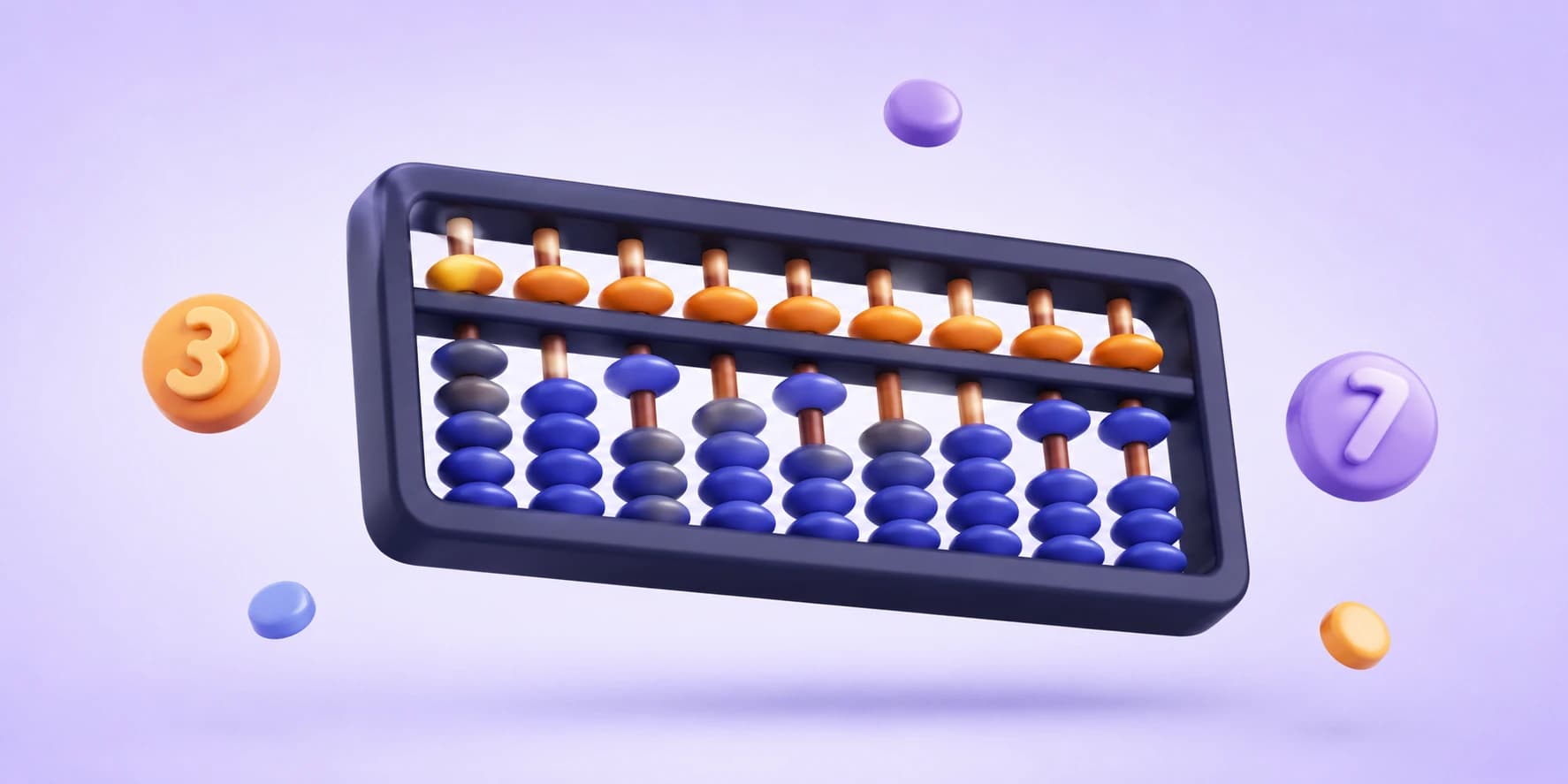
Mental arithmetic is the ability to calculate in your head quickly and accurately, without writing anything down. In a structured programme, children don't get there by memorising tricks. They learn on a physical abacus (often the Japanese soroban), moving real beads to represent numbers.
Over time, something interesting happens: the child stops needing the physical beads. They picture the abacus instead, and "move" the beads in their imagination. The hands may still twitch slightly — a sign the mental image is doing the work — but the calculation is happening entirely in the mind.
The abacus isn't the goal. It's the bridge — a concrete object the child eventually replaces with a mental picture.
How it differs from school maths
School maths is broad: it covers geometry, word problems, fractions, reasoning, and much more. Mental arithmetic is narrower and deeper. It trains one specific thing — fast, confident calculation — to a level most adults never reach.
The two don't compete. A child who can add and subtract without effort spends less mental energy on the "mechanics" and has more attention left for the actual problem in front of them. That's the practical connection: mental arithmetic doesn't replace school maths, it removes friction from it.
The right age to start
There's no single magic number, but there is a sensible window. Most programmes work best with children roughly 5 to 12 years old.
- Around 5–7, children are just building a feel for numbers. Working with a physical abacus gives them something to touch and see, which suits how they learn at this age.
- Around 8–12, children can move faster and take the mental-imagery step more readily, because they already handle numbers comfortably.
Starting younger than five is usually not helpful — the fine motor control and attention span aren't quite there yet. Starting later isn't "too late" at all; older children simply progress differently, leaning more on understanding than on repetition.
What the first lessons look like
Early lessons are short and hands-on. A child learns how beads represent numbers, practises simple movements, and repeats them until they become automatic. Progress is deliberately gradual — the point is to make each small step effortless before adding the next.
Two things matter far more than talent at this stage:
- Regularity. A few minutes of practice on most days beats a long, tiring session once a week.
- Calm. Speed comes later, on its own. Early on, accuracy and comfort are what build the foundation.
Is it for every child?
Broadly, yes — it isn't a programme for "gifted" children only. Because it's built on repetition and small wins, it tends to suit a wide range of temperaments, including children who don't yet think of themselves as "good at maths."
What it asks for isn't a special aptitude. It's a little consistency, a bit of patience, and an adult nearby who notices the progress. Get those, and the rest is just practice.
If you're weighing it up, the honest summary is this: mental arithmetic won't turn a child into a prodigy overnight, and no reputable programme should promise that. What it can do — steadily, over months — is make numbers feel easy. For a lot of children, that shift in confidence is the real result, and it reaches well beyond the abacus.