How to Assign Abacus Homework and Spot Learning Gaps Before They Grow
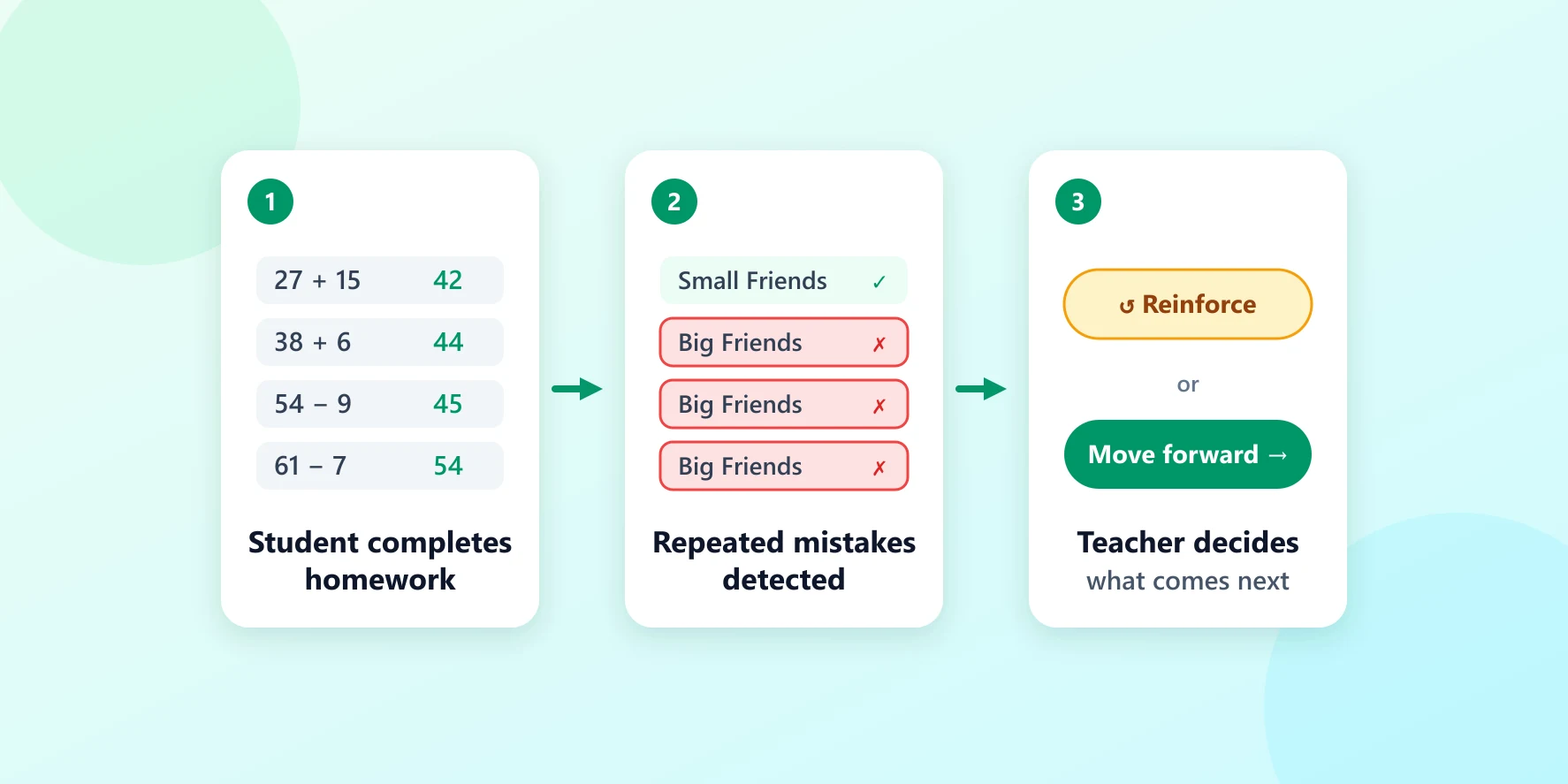
Homework in mental arithmetic is not only about giving children more exercises to solve.
It has another, equally important purpose: helping the teacher understand whether a student has truly mastered a topic and is ready to move forward.
At the beginning of an abacus program, this is relatively easy. If a child is working on one specific rule, the reason behind a mistake is usually clear. But the program gradually becomes more complex.
New topics start building on everything the student has already learned. With Small Friends, Big Friends, and later Anzan, a child may be using several previously learned rules within a single exercise.
At that point, seeing a wrong answer is no longer enough. The real question becomes:
Why did the student make the mistake?
Checking an Answer Is Not the Same as Finding the Problem
Imagine a teacher with 30 students. If each student receives 30 homework exercises, that is already 900 answers to review.
Checking 900 answers manually takes time. But even after all of them have been checked, the teacher still has a more important problem to solve.
The result may show:
Correct / Incorrect.
What the teacher actually needs to understand is:
Which skill or topic caused the mistake?
When the program is simple, identifying the reason is relatively straightforward. As students progress, however, new exercises increasingly depend on skills learned earlier.
A mistake in today's homework may not be caused by today's lesson at all. The real problem may come from a rule the child studied weeks or even months earlier but never fully mastered.
A single incorrect answer rarely explains that.
In Abacus Learning, Topics Build on One Another
Mental arithmetic is learned step by step.
- Students first develop basic abacus skills.
- Then they move to Small Friends.
- Later come Big Friends.
Exercises gradually become more complex, while previously learned rules continue to appear together with new ones. When students progress toward mental calculation and Anzan, this connection between topics becomes even more important.
That is why moving forward before a previous topic has been properly consolidated can create serious difficulties. A small gap can gradually become a much larger problem.
- A child does not fully master one rule.
- The next topic introduces additional mistakes.
- Then another new topic is added.
- The number of errors grows.
After some time, it becomes difficult to identify where the problem originally started.
It becomes a snowball effect.
Why a Student Can Suddenly Start Struggling
From the outside, the situation may look confusing.
A child may have studied successfully for several months and then suddenly start making more mistakes.
- Their speed decreases.
- Homework takes longer.
- They become frustrated.
They may even start saying:
“I can't do this.”
Adults may interpret this as a loss of motivation or a lack of ability. But sometimes the explanation is much simpler.
- The student never fully mastered one earlier topic.
- The gap was not identified at the right moment.
- There was no additional explanation or short reinforcement lesson.
- The program continued.
Because later topics depended on that earlier skill, one small weakness gradually began affecting more and more exercises. Eventually, the child may genuinely feel that mental arithmetic has suddenly become too difficult.
This can be one of the reasons students lose confidence or stop learning before completing the program. Yet the original problem may have been relatively easy to correct if it had been noticed earlier.
Homework Should Be a Diagnostic Tool
Good homework should answer more than:
“How many exercises did the student complete?”
It should also answer more than:
“What percentage of answers were correct?”
The more important question is:
Which skills has the student mastered, and where is a learning gap beginning to appear?
This is where a digital platform or app can make the teacher's work much easier. A digital system can record large amounts of information automatically:
- which exercises the student completed;
- which answers were correct or incorrect;
- where mistakes occurred;
- whether the same type of error keeps repeating;
- how quickly the student completed the exercises;
- how the student's results change over time.
Instead of trying to reconstruct the whole learning picture from workbook pages, screenshots, or WhatsApp messages, the teacher can review the student's learning history in one place.
What Should a Teacher See After Homework?
The most valuable part begins after the child has finished the assignment. The teacher needs to make a decision:
Is the student ready to move forward, or does this topic need more practice?
If the student completes most exercises confidently, maintains appropriate speed, and makes only occasional mistakes, moving to the next topic may be reasonable.
But if the results show repeated errors in a particular type of exercise, that is a signal to stop and investigate.
- Sometimes another homework assignment is enough.
- Sometimes the child needs an additional explanation.
- Sometimes a short individual lesson focused on one specific topic is the best solution.
That lesson may take very little time. But it can prevent a much larger learning problem several weeks later.
Completing the Curriculum Is Not the Same as Mastering It
Teachers often work according to a structured program. One topic is covered this week. The next topic comes the following week.
But in mental arithmetic, simply completing a topic does not mean the student has mastered it.
Building a stable skill is more important than moving quickly through the curriculum.
If a topic has not been consolidated, adding the next one can make the situation worse. Homework data should therefore help teachers make pedagogical decisions:
- continue to the next topic;
- assign additional practice;
- return to a previous skill;
- provide an individual explanation;
- or temporarily reduce the difficulty.
Technology should not make this decision instead of the teacher. Its job is to help the teacher see the problem earlier.
Workbooks Are Still Fundamental
A digital platform should not replace workbooks. In mental arithmetic, the workbook remains one of the basic tools for developing skills.
Children need repetition. They need to solve large numbers of similar exercises until the required operations become automatic. Without this repetition, it is difficult to build the level of automaticity needed for more advanced mental calculation.
That is why workbooks and worksheets remain an essential part of abacus education.
Digital tools have a different role. They can help teachers:
- provide additional practice;
- check results automatically;
- monitor progress;
- identify recurring mistakes;
- understand which topic may need reinforcement.
The purpose of an app is therefore not to replace traditional practice. It is to give the teacher information that may otherwise be difficult to obtain.
Workbooks Build the Skill. Digital Tools Help Measure It.
These two tools are not competitors. They perform different functions.
The workbook builds automaticity.
The child repeats exercises and strengthens the required mental and abacus processes.
The digital platform helps measure the result.
It shows how confidently the child performs, where mistakes occur, and whether performance improves over time.
Used together, these tools can give the teacher a much more complete picture of the student's learning.
How Amavit Approaches Abacus Homework
Amavit is a platform and app designed for mental arithmetic teachers and students.
Teachers can assign digital homework to an individual student or an entire group, while the system automatically records the results. This allows teachers to go beyond simply seeing whether homework was completed. They can review the student's performance and use the results to decide what should happen next.
The main idea is not automatic checking for the sake of automatic checking. The real value appears when the data helps answer an educational question:
Is this student ready for the next topic?
If the results reveal a problem, the teacher can provide additional practice or return to the relevant skill before moving forward.
At the same time, Amavit does not require teachers to abandon their existing curriculum, workbooks, or worksheets. Teachers can continue using their own teaching program and combine traditional workbook practice with digital exercises and progress analysis.
Why the History of Results Matters
One mistake tells a teacher very little. Every child makes occasional mistakes. What matters more is repetition.
If a student gives one incorrect answer, it may simply be an accidental error.
If the same type of mistake appears again and again, it deserves the teacher's attention.
This is why a history of results can be more useful than a single completed assignment. It can help distinguish between:
- an occasional mistake;
- a persistent learning gap;
- declining performance;
- improvement after additional practice.
Without this history, teachers have to remember large amounts of information themselves or maintain separate records. A digital system can preserve this information automatically.
Good Automation Does Not Replace the Teacher
Software can check an answer. It can calculate accuracy. It can record speed. It can show changes over time.
But software should not decide what is happening with the child.
- The teacher understands the context.
- The teacher knows the student.
- The teacher observes the child's behaviour during lessons.
- And the teacher can understand why a particular mistake may be happening.
The right role for technology is therefore not to replace the teacher. It is to provide better information for the teacher to make a decision.
Instead of spending hours manually checking hundreds of repetitive exercises, the teacher can spend that time doing the work that actually requires professional expertise:
identifying the cause of the problem and helping the child correct it.
Sometimes One Extra Lesson Can Prevent a Much Bigger Problem
One of the most important principles in mental arithmetic is reinforcing a topic at the right time.
If a teacher sees a problem early, it can often be corrected relatively easily.
- A few additional exercises.
- One more explanation.
- A short individual lesson.
And the student can move forward confidently again.
But if that moment is missed, every new topic may begin building on top of the previous mistake. Several months later, correcting the problem may require significantly more effort.
That is why a good homework system should do more than save teachers time. Its more important purpose is:
to help the teacher notice a small learning gap before it becomes a large one.
Want to see how digital homework works in practice?
Amavit helps mental arithmetic teachers assign practice, review student results and track progress while continuing to use their own curriculum and workbooks.
Try Amavit Free for Teachers →