Best Free Abacus Platform for Teachers: What Should It Actually Do?
There is a paradox in teaching mental arithmetic.
For a child to become genuinely fast and confident at calculation, regular practice is essential. The same skills must be repeated again and again — dozens or even hundreds of similar exercises — until the process becomes automatic.
For learning, this repetition is necessary.
For a child, it can quickly become boring.
And this is one of the biggest challenges for a mental arithmetic teacher: not only teaching a child how to calculate, but keeping that child engaged long enough to practise consistently and eventually move from a physical abacus to mental calculation.
This is why a good digital platform for abacus teachers should solve much more than simply “assigning homework online.”
This is one of the principles behind Amavit.
The real challenge is not giving a child another hundred problems. It is getting them to actually do them.
The traditional homework process is familiar to almost every mental arithmetic teacher.
After the lesson, the teacher sends a message to the parent on WhatsApp:
“Workbook, page 26, exercises 3–7.”
Or the child receives another worksheet containing a new set of calculations.
There is nothing wrong with this approach. Repetition is an essential part of mental arithmetic training. Students need regular practice if they are going to develop fluency.
The problem is different.
To a child, one hundred similar calculations on a sheet still look like one hundred similar calculations.
After a while, the novelty disappears. Homework starts to feel like an obligation. The child becomes less willing to practise, parents have to remind them more often, and the teacher increasingly finds themselves fighting not for better results, but simply for the child's willingness to continue.
This becomes particularly important in mental arithmetic because a complete learning programme can last for a considerable period of time.
That is why one of the main ideas behind Amavit is simple:
let children practise the same core skills repeatedly, but present that practice in different formats.
One skill — several completely different ways to practise it
If a child needs to complete one hundred calculations at a certain level, there is no reason all one hundred have to appear as identical rows of numbers on a sheet of paper.
The same educational objective can be presented in several ways.
A child can, of course, calculate using a physical abacus and exercises from a workbook.
This is the traditional approach, and Amavit is not designed to replace it.
But the next practice session can happen on a screen.
Numbers appear one after another, and the child has to keep the calculation sequence in mind and give the final answer.
Even this type of activity can be varied.
In one mode, the numbers appear in a fixed position — for example, in the centre of the screen.
In another, they appear dynamically in different areas of the screen: perhaps in the upper-right corner, then in the lower-left, then somewhere else.
The child has to notice the number quickly and then include it in the ongoing calculation.
The mathematical skill being trained is essentially the same.
But from the child's perspective, the activity feels different.
Another format is flash cards.
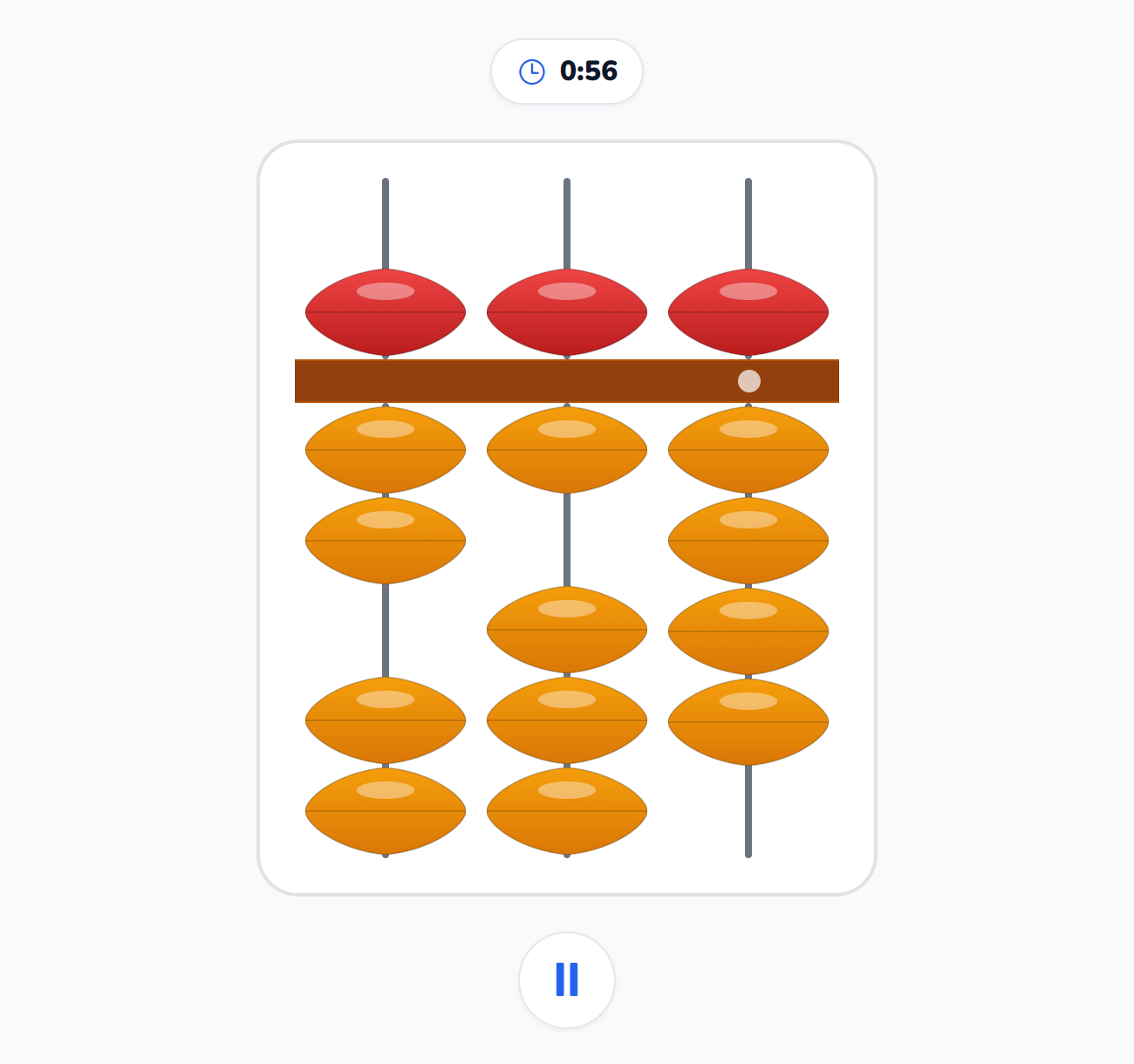
Instead of ordinary numbers, the child sees images of an abacus with beads in different positions. The student has to recognise the represented number and continue the calculation.
Again, the core skill remains similar, but the way information is perceived changes.
This is one of the principles behind Amavit:
do not try to eliminate the repetition that learning requires — make that repetition more varied.
The child still completes the necessary amount of practice.
It simply feels less like filling in the same worksheet over and over again.
Moving from a physical abacus to mental calculation is a separate learning challenge
At the beginning, a child works with a real abacus.
They physically move the beads and gradually learn to associate numbers and operations with bead positions.
But the longer-term goal is more interesting.
Eventually, the child should learn to visualise the abacus mentally and perform calculations without having the physical tool in front of them.
This is one of the key transitions in mental arithmetic training.
The student is no longer simply recalling an arithmetic rule. They are maintaining a visual-spatial representation of the abacus in their mind and mentally manipulating the beads while calculating.
This transition is not always easy.
If a child works only with a physical abacus and paper exercises for a long time, the teacher may need to spend additional effort helping them move from physical actions to mental visualisation.
A digital environment can make this transition more gradual.
- Physical abacus.
- Images of an abacus.
- Flash cards.
- Visual exercises.
- And eventually, calculation without a physical image in front of the child.
In this way, technology does not replace the abacus.
It can become a bridge between the physical abacus and the mental abacus.
For Amavit, this is an important part of the product philosophy.
A digital platform should not replace the teacher's methodology
There is another extreme.
Some educational platforms effectively tell the teacher:
“Here is our curriculum. Here are our levels. Here are our lessons. Here is the order of topics. Now teach according to our system.”
For Amavit, this approach was unacceptable from the beginning.
Mental arithmetic teachers use different methodologies.
They use different workbooks, different sequences of topics, different exercises and different programme lengths.
That is why Amavit is not another mental arithmetic school, and it is not designed to replace the teacher's methodology.
The teacher decides:
- what to teach;
- in what order to teach it;
- which exercises to use;
- how many calculations to assign;
- which mathematical operations to practise;
- how many digits to use;
- what speed is appropriate;
- and what level of difficulty is suitable for each child.
The platform provides the tools around that methodology.
The methodology remains with the teacher.
Workbooks and worksheets should not disappear
We do not believe that moving to a digital platform should force a teacher to abandon materials they have successfully used for years.
If a teacher has a good workbook, printed materials or their own worksheets, they should continue using them.
That is why physical and digital homework can exist together in Amavit.
A teacher can include a workbook assignment such as:
Page 17, exercises 4–8
and combine it with interactive Amavit activities.
For example:
- virtual abacus practice;
- number sequences displayed on screen;
- flash cards;
- other types of digital exercises.
This means Amavit does not force the teacher to choose between:
a workbook or an app.
Both can be used wherever each one works best.
Creating homework should not take longer than sending a WhatsApp message
There is also a very practical problem.
If it is faster for a teacher to type:
“Page 27, exercise 5”
in WhatsApp than to create homework in an educational platform, sooner or later the teacher will return to WhatsApp.
This is why speed and simplicity are essential.
Imagine that a teacher's programme contains 53 lessons.
Homework for different groups often follows the same structure. A group completing Lesson 17 today will probably receive a very similar assignment to another group that completed Lesson 17 a month earlier.
Why should the teacher create the same homework again?
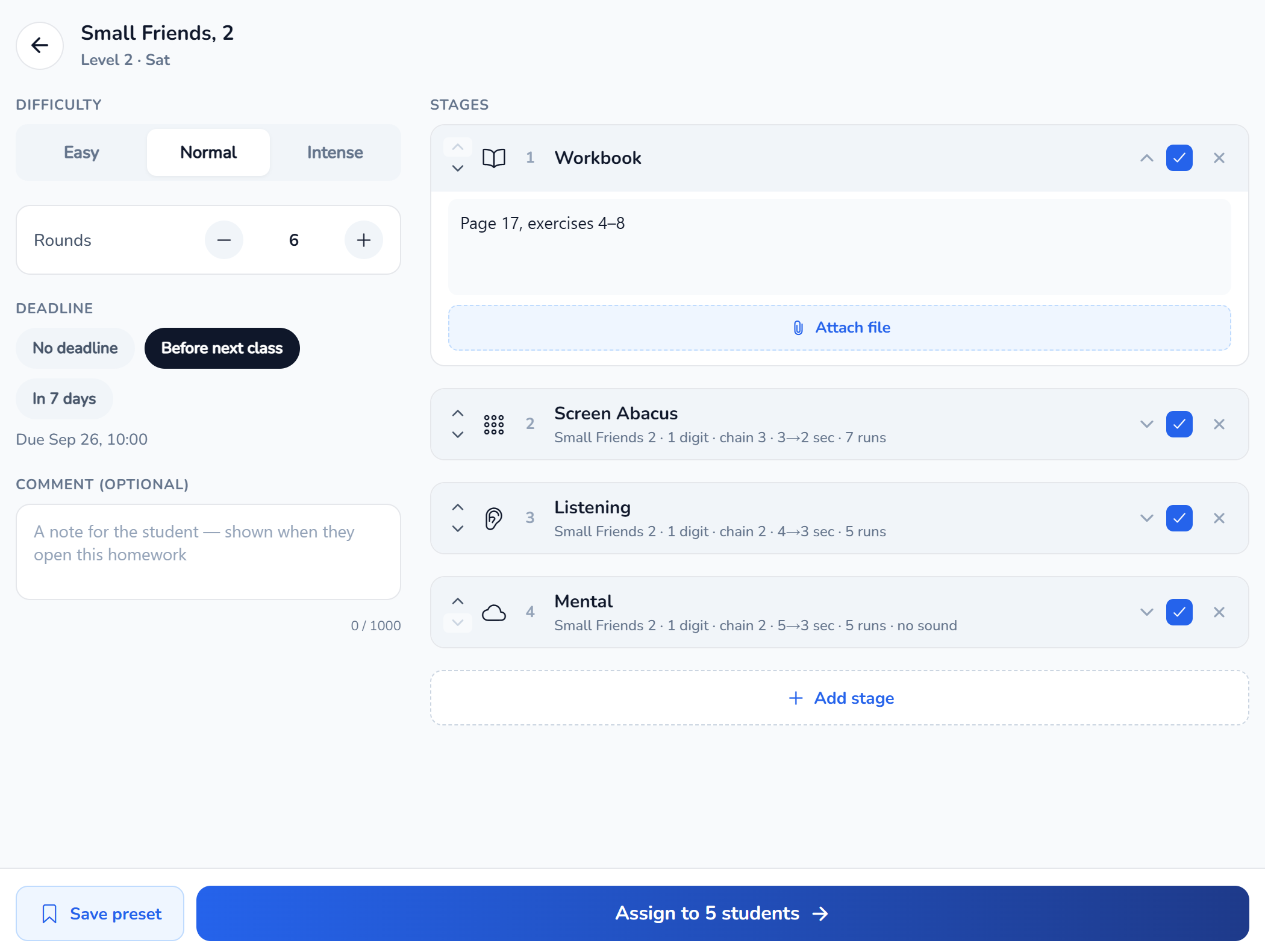
In Amavit, a teacher can create an assignment once, configure it according to their methodology, give it a clear name and save it.
For example:
Lesson 17 — Small Friends
The next time another group reaches that lesson, the teacher can simply open the saved assignment and use it again.
Different levels of difficulty can also be prepared:
Easy — Normal — Hard.
- A student who needs additional support can receive the easier version.
- Most of the group can receive the standard version.
- A stronger student can receive the more difficult version.
The assignment can be sent to the whole group or adjusted for an individual student.
The ideal workflow is simple:
the lesson ends → the teacher selects the saved homework → adjusts the level for individual students if necessary → clicks Assign.
Homework is ready.
Not several minutes.
Potentially just a few seconds.
Automatic checking should remove routine work from the teacher
Once homework has been assigned, another problem appears: checking it.
With a paper worksheet, the process is straightforward but time-consuming. The child completes the work, and someone still has to check the answers.
The more students a teacher has, the more time is spent on repetitive technical work.
Interactive Amavit exercises can be checked automatically.
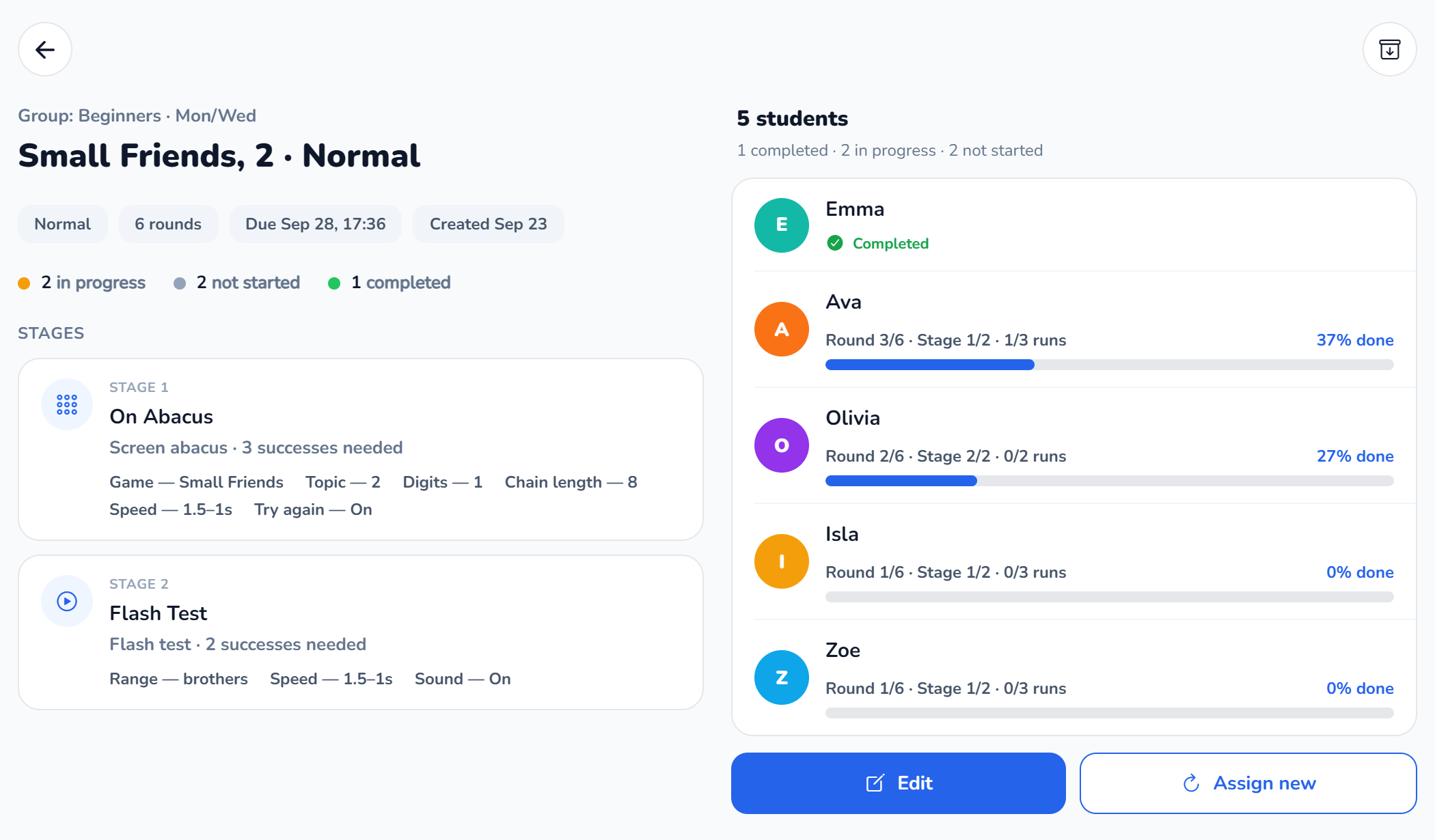
The teacher can see:
- whether the assignment was completed;
- how accurately the child calculated;
- how quickly they worked;
- where difficulties appeared;
- whether the child is practising regularly.
Workbook exercises can still be checked in the way the teacher already prefers.
Again, the goal of Amavit is not to eliminate traditional teaching.
The goal is to automate the parts that genuinely can be automated.
But saving time is not the biggest value
At first glance, the main advantage of a teaching platform may appear to be the time it saves.
We believe that is only part of the value.
There is another, potentially more important issue:
student retention.
A mental arithmetic programme can last for a long time.
And the longer a child studies, the harder it can become to maintain motivation.
Students may leave for many different reasons.
- The child becomes tired of repetitive homework.
- The parent no longer sees clear progress.
- Homework turns into an argument at home.
- The results may be improving, but the parent cannot easily see that improvement.
- The child stops practising regularly, and the teacher discovers the problem too late.
All of this affects retention.
That is why Amavit is designed not simply as a homework assignment tool, but as a system that can help teachers keep children engaged in learning for longer.
Parents should be able to see progress themselves — not only hear about it from the teacher
There is an important difference between two situations.
In the first, the teacher tells the parent:
“Your child is doing well and making progress.”
In the second, the parent opens an app and can see for themselves:
- the child practised four times this week;
- homework was completed;
- accuracy improved;
- speed changed;
- new achievements were earned.
In the second situation, the value of the learning process becomes much more visible.
The teacher no longer has to explain that value only through words.
This is why parents have their own experience within Amavit.
They can see information about their own child, including:
- homework;
- activity;
- results;
- progress;
- achievements.
This improves communication with families while also reducing administrative work for the teacher.
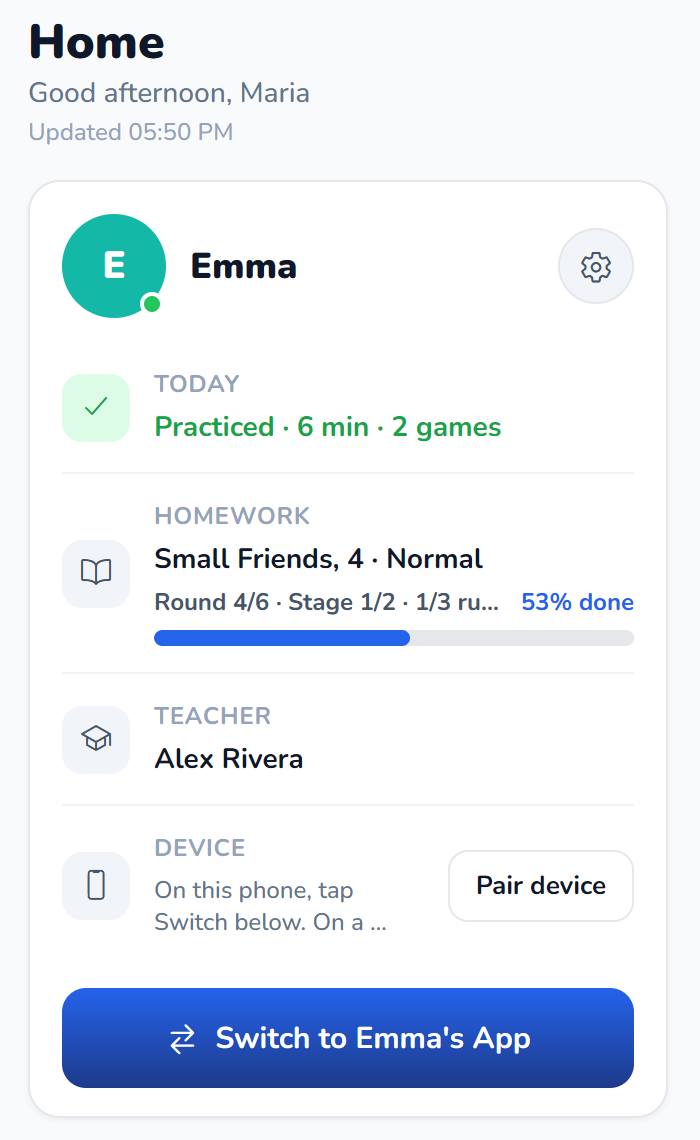
Parents can stay informed without having to ask the teacher for every update.
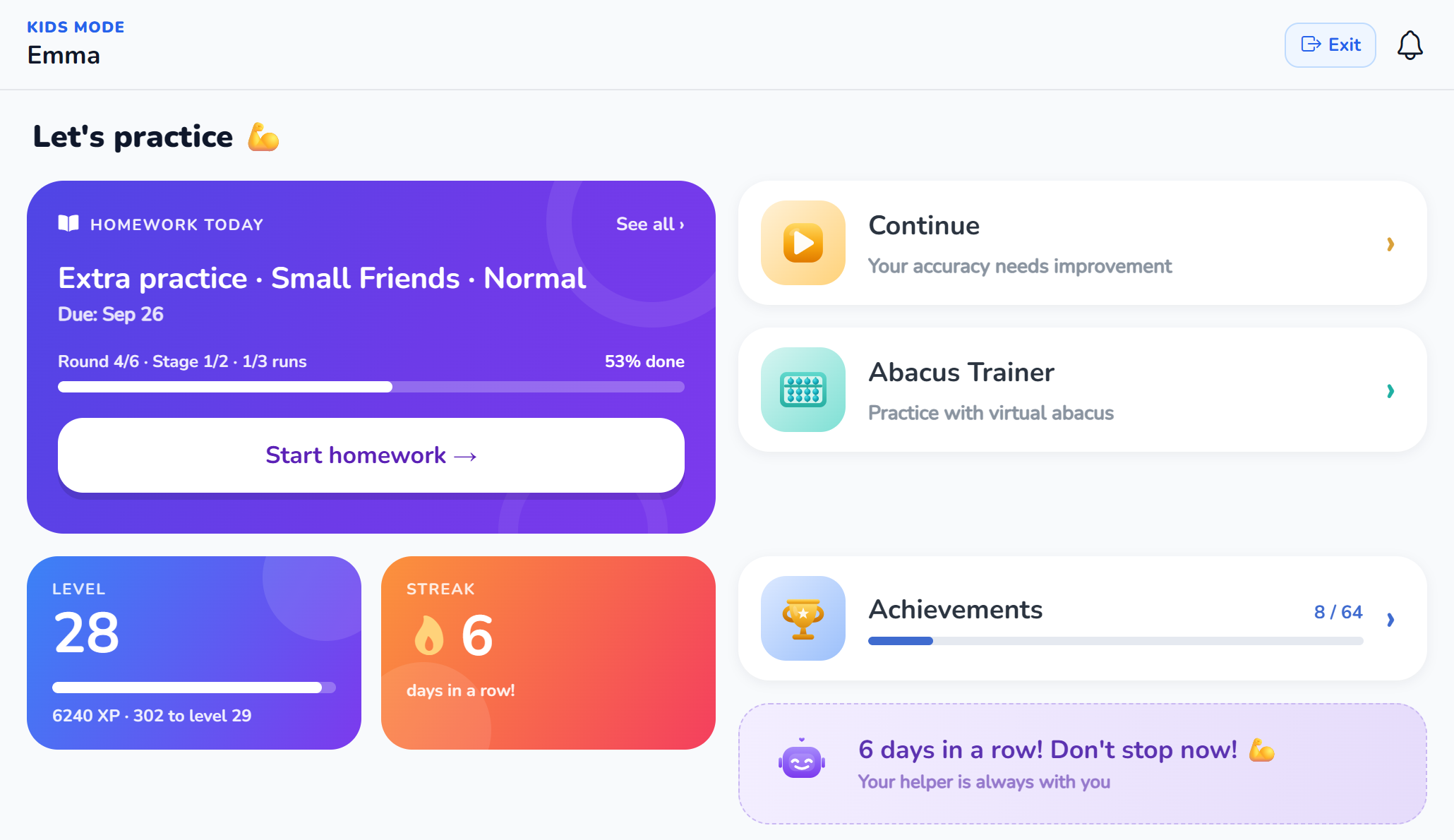
Gamification should support learning — not turn education into a game for the sake of gaming
Children like to feel progress.
- Earning an achievement.
- Maintaining a daily practice streak.
- Collecting points.
- Improving their previous result.
- Competing with other students.
- Competing with themselves.
This is why Amavit includes motivational mechanics such as achievements, streaks, progress indicators, points and other activities.
But there is an important principle.
We do not want children to come to Amavit only to play.
The game is the packaging.
Inside it is still real mental arithmetic practice.
The purpose of gamification is to help a child complete one more useful practice session today — and to want to come back tomorrow.
Over time, the ecosystem may also include additional competitions, certificates and other activities that give children more reasons to remain engaged.
But the educational objective must always come first.
Amavit is not an educational centre and is not a competitor to the teacher
This is another principle that is particularly important to us.
When teachers add their students to a third-party educational platform, there is a natural concern:
“What happens to my student base?”
For an independent teacher, this is not an abstract issue.
These students are part of their business.
That is why Amavit is deliberately not being built as an educational centre or marketplace that receives a teacher's students and then begins developing its own commercial relationship with them.
The teacher determines their own methodology, schedule, learning materials, assessment methods and communication with parents.
The teacher's students remain the teacher's students.
Amavit provides the infrastructure for working with them.
Minimum data — especially when children are involved
A child does not need another full online profile simply to complete a homework assignment.
This is why Amavit follows a data-minimisation approach.
A child does not need to use their real name; a nickname can be used.
Access is separated by role.
- Teachers see the students and groups they manage.
- Parents see their own children.
- Children see their own learning activities and progress.
Amavit does not sell users' personal data. You can read more in our Security overview and Children's Privacy Policy.
Teachers should also be able to take their data with them rather than becoming permanently locked into the platform.
The principle is simple:
the teacher uses Amavit — Amavit does not acquire ownership of the teacher or their students.
Why is Amavit free for teachers?
This naturally leads to another question.
If the platform provides all of these tools, why can teachers use it for free?
Because the business model was not designed around charging teachers simply for access to the basic tools they need to teach their own students.
The core functionality for everyday teaching should allow a teacher to:
- manage students and groups;
- organise their teaching workflow;
- assign homework;
- reuse saved assignments;
- see results;
- monitor progress;
- work with parents.
Amavit is currently free for teachers.
The wider ecosystem can be monetised through optional additional services, primarily through enhanced Parent Premium features, extended statistics, additional activities, competitions, certificates and other optional services.
Additional professional features for teachers may also appear in the future if they provide genuine additional value.
But the fundamental idea remains the same:
a teacher should not have to pay simply for the ability to teach their own students effectively.
So what should a good platform actually give an abacus teacher?
- Not another methodology.
- Not another textbook.
- Not another administrative system.
- And certainly not another competitor for their students.
A good platform should connect things that previously existed separately:
Teacher → Child → Parent → Homework → Practice → Results → Motivation.
- It should allow a child to practise the necessary skills repeatedly while experiencing that practice in different formats.
- It should help students gradually move from a physical abacus to a mental abacus.
- It should make learning progress visible to parents.
- It should reduce routine work for teachers.
- It should help a teacher work with five, twenty or fifty students without administrative work increasing at exactly the same rate.
And most importantly, it should help children remain engaged in learning long enough for regular practice to become a real skill.
That is what we are building Amavit to do.
A platform for mental arithmetic teachers that does not try to replace the teacher.
It is designed to give teachers better tools to do their work well.
Frequently Asked Questions
Is Amavit really free for teachers?
Yes. Amavit is currently free for teachers. Managing students and groups, assigning and reusing homework, seeing results, monitoring progress and working with parents do not require a paid plan. The ecosystem is monetised through optional services, primarily Parent Premium features.
Can I use my own abacus curriculum?
Yes. Amavit does not impose a methodology. The teacher decides what to teach, in what order, which exercises to use, how many digits, what speed and what level of difficulty suits each child.
Can I use my existing workbook?
Yes. A homework assignment can combine a workbook task — for example, “Page 17, exercises 4–8” — with interactive Amavit activities such as virtual abacus practice, number sequences and flash cards.
Does Amavit require children's personal data?
No. Amavit follows a data-minimisation approach: a child can use a nickname instead of a real name, and access is separated by role. Amavit does not sell users' personal data.
Can parents track their child's progress?
Yes. Parents have their own experience within Amavit and can see their own child's homework, activity, results, progress and achievements.
Try Amavit Free as a Teacher
Assign abacus homework in seconds, keep your own methodology and let parents see progress for themselves.
Create Teacher Account