How to Track Student Progress in Abacus Classes: Accuracy, Speed and Practice Consistency
In mental arithmetic, knowing whether a student answered correctly or incorrectly is not enough.
Imagine two students.
The first solves 90 out of 100 calculations correctly but takes a long time to complete them.
The second also gets 90 out of 100 correct, but completes the same task much faster.
On paper, both students have the same accuracy: 90%. From a teacher's perspective, however, these are two very different results.
Now consider another situation. A student completes today's homework almost perfectly, but has not practised at all for the previous five days.
Can we say that the student is progressing well? Not necessarily.
To understand real progress in mental arithmetic, a teacher needs to look at several indicators together:
accuracy, speed, practice consistency, practice volume, difficulty level and progress over time.
Only together do these indicators show what is actually happening.
Why correct answers alone are not enough
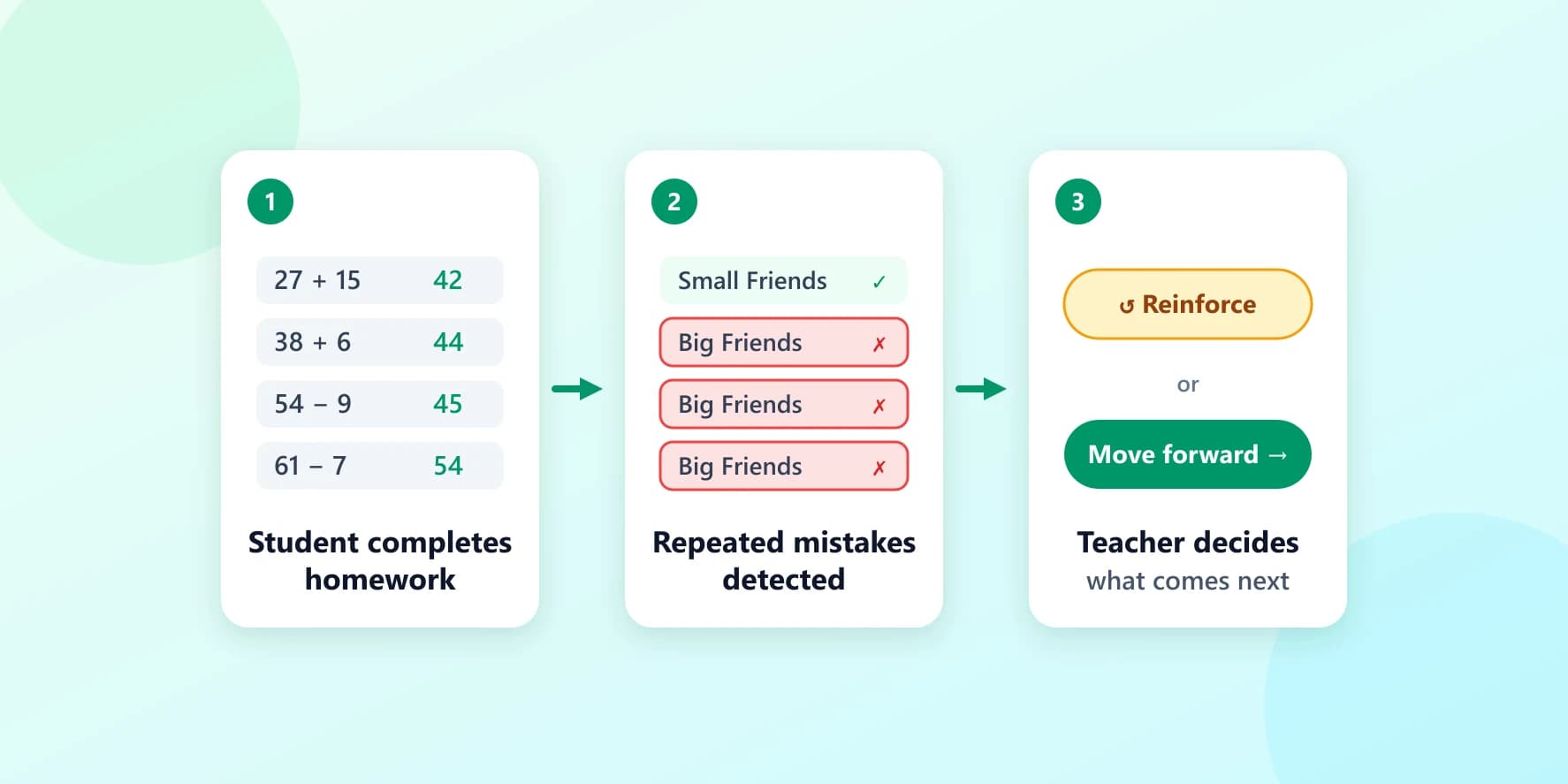
At the beginning of an abacus programme, it is often relatively easy to understand why a child is making mistakes. If the student is currently learning one specific technique and begins making errors, the cause is usually fairly obvious.
As the programme becomes more advanced, the situation changes. A single exercise may require the student to combine a new topic with several previously learned techniques.
At that point, a result such as:
87 correct answers out of 100
does not tell the teacher very much about the remaining 13 mistakes. What exactly went wrong?
- Did the student misunderstand the new topic?
- Was an earlier technique never fully mastered?
- Is the student calculating too quickly?
- Can the student calculate correctly, but only at a slow speed?
- Do mistakes appear only in longer number chains?
- Or do they begin only after the presentation speed is increased?
The further a student progresses, the harder it becomes for a teacher to answer these questions manually.
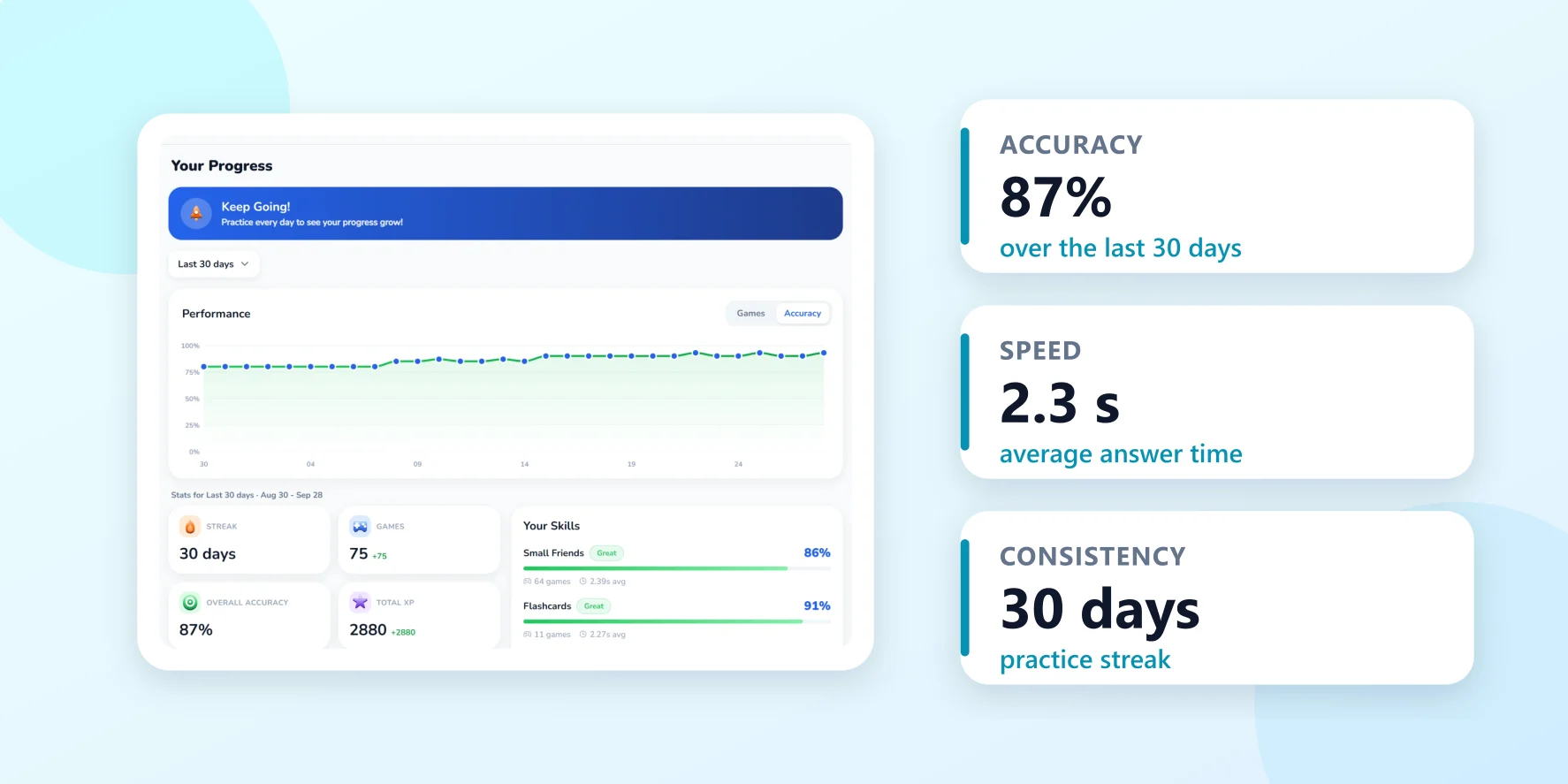
Real progress includes at least three core indicators
The first is accuracy. A student needs to produce correct answers consistently. If accuracy is low, increasing speed alone is not meaningful progress.
The second is speed. Once a technique has been learned correctly, the calculation process should gradually become faster and more automatic. Something that initially requires several seconds of conscious effort should eventually happen much more quickly.
The third is practice consistency. Mental arithmetic skills are built through repetition. One excellent practice session does not compensate for long periods without practice.
A teacher therefore needs to know not only:
“How did the student perform today?”
but also:
“How regularly is this student practising?”
Accuracy, speed and consistency need to be considered together.
High speed with low accuracy is not a good result
Children often want to calculate faster, especially when there is an element of competition.
The student increases the pace. Speed improves. But the number of mistakes also begins to rise.
Technically, we could say:
“The student became faster.”
Educationally, the situation may actually be:
“The student started rushing before the skill became stable.”
This is why speed and accuracy should always be analysed together. For example:
Student A
Accuracy: 96%
Average time: 3.1 seconds
Student B
Accuracy: 72%
Average time: 1.8 seconds
Student B is faster. That does not necessarily mean Student B is performing better.
The teacher may need to reduce the speed temporarily, restore accuracy and only then begin increasing the pace again.
High accuracy at low speed tells us something different
The opposite situation is also common.
A student makes almost no mistakes. Accuracy is 98%. But every operation takes too long.
This may indicate that the child understands the technique correctly but has not yet automated it. The student may not need another explanation of the rule. The student needs more practice.
These are two completely different teaching decisions.
Low accuracy → investigate the source of the errors.
High accuracy but low speed → practise until the skill becomes more automatic.
If a teacher sees only one final score, these students may appear similar. When several parameters are visible, the difference becomes much clearer.
A workbook alone cannot develop high calculation speed
Workbooks and worksheets remain extremely important in mental arithmetic. They allow children to repeat the required operations many times and help build fundamental calculation techniques.
But paper has a natural limitation. It cannot control the speed at which information appears.
When working from a workbook, the child controls the pace:
- look at the number;
- think;
- calculate;
- move to the next one.
That makes it difficult to systematically train higher mental calculation speeds using paper alone.
This is where a digital platform becomes particularly useful.
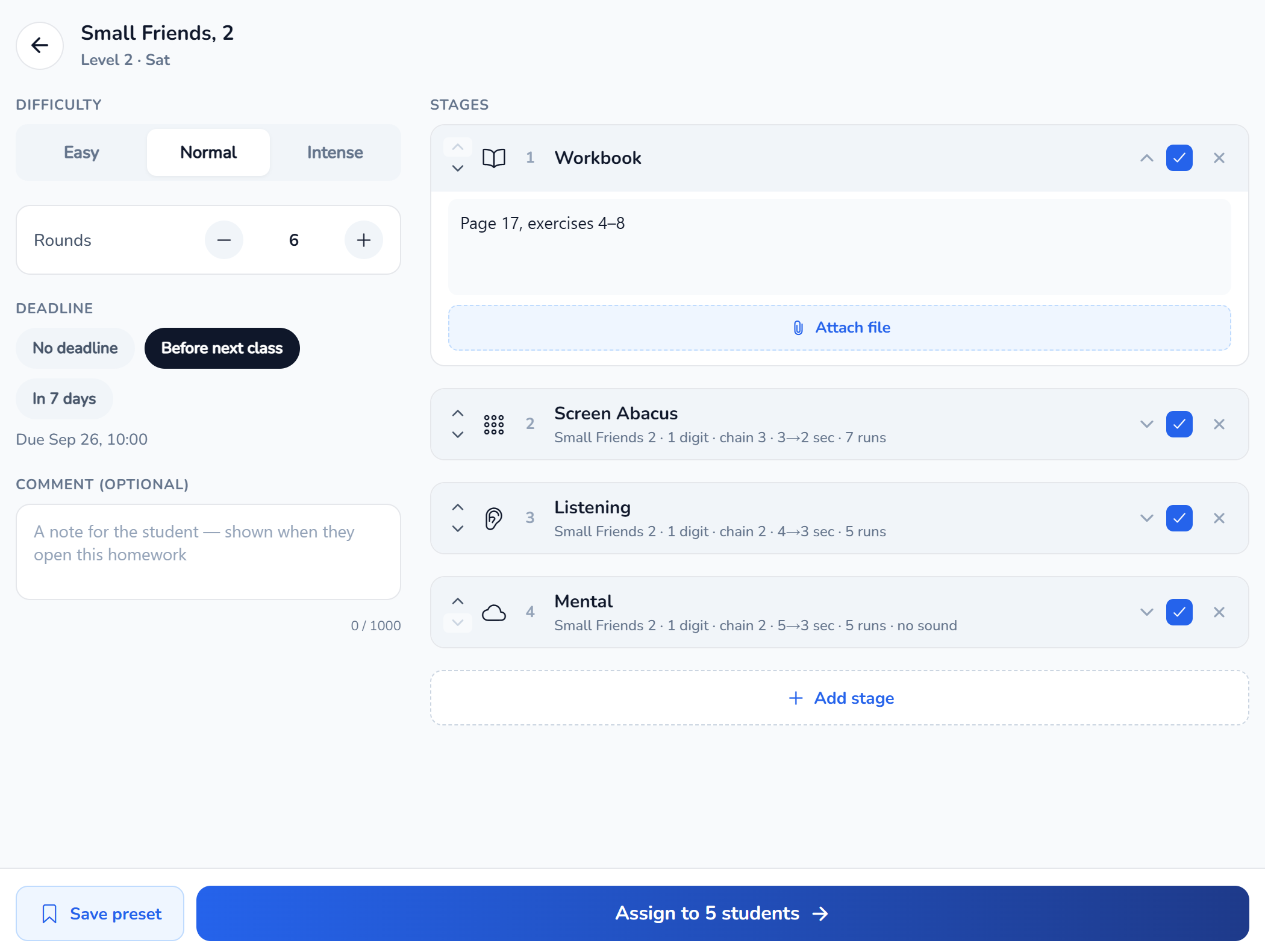
Speed should increase gradually
Imagine a student who is beginning speed-based mental arithmetic practice.
The teacher may initially use a comfortable pace:
5 seconds per number.
Once the student can maintain good accuracy at that speed, the interval can gradually be reduced:
3.5 seconds → 2 seconds → 1.5 seconds → 1 second.
With advanced students, the presentation speed can become much faster. In high-speed practice, intervals may eventually be reduced to fractions of a second — for example, 0.1 seconds per number, which means up to ten numbers can appear within one second.
At that pace, the student cannot work in the same way as with a normal written example. There is simply not enough time to consciously analyse every individual operation.
The skill needs to become increasingly automatic. This is also where the mental image of the abacus becomes especially important.
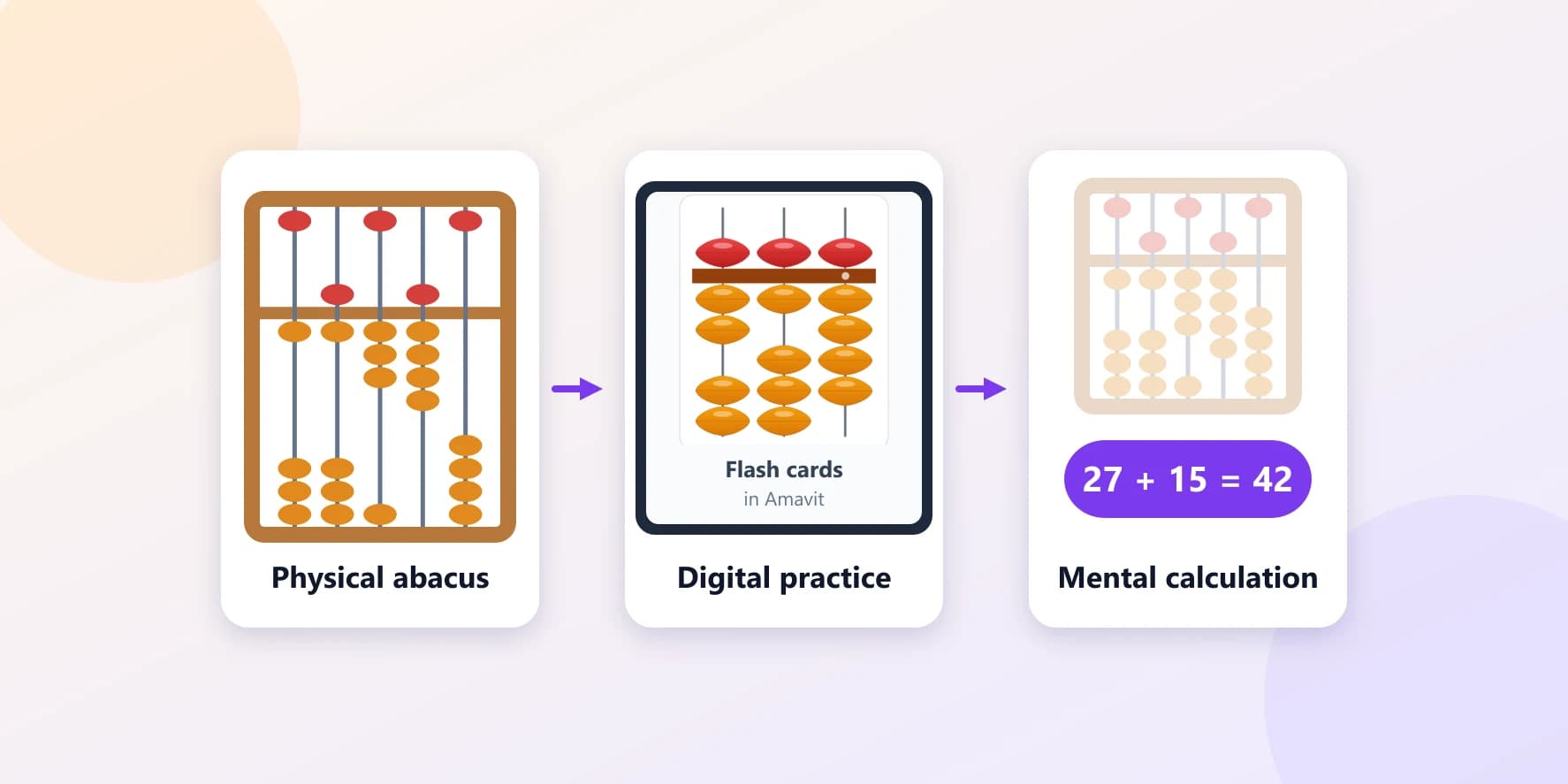
A digital platform can help students move from a physical abacus to a mental abacus
At the beginning, the child works with a physical abacus. The student moves the beads and gradually develops an association between numbers, operations and bead positions.
- The next step can involve visual representations of the abacus.
- Then flash cards.
- Then numbers appearing on the screen at a controlled speed.
Gradually, the student begins performing the calculation without a physical abacus in front of them. Instead, the child visualises it mentally.
This transition from a physical abacus to a mental abacus is one of the key stages of mental arithmetic training. A digital environment can help make this transition more structured:
physical abacus → abacus images → visual exercises → controlled speed → mental abacus.
The platform does not replace the physical abacus. It helps build a bridge from physical calculation to mental calculation. We look at this transition step by step in Abacus Worksheets vs Digital Practice.
Speed should increase only while accuracy remains stable
There is an important principle here.
The goal is not to make the child calculate as fast as possible at any cost. Speed should increase while accuracy remains at an acceptable level.
Imagine that a student performs well at two seconds per number. The teacher reduces the interval to 1.5 seconds. Accuracy suddenly drops.
That is useful information. The student may simply not be ready for the new speed yet. The teacher can return to the previous level, reinforce the skill and try again later.
The opposite is also true. If the student maintains strong accuracy across several sessions, the teacher can gradually increase the speed again.
This is why speed and accuracy must be viewed together. Neither metric is very useful in isolation.
Digital practice can measure things paper cannot
A workbook can show the final answer. A digital system can show much more about the learning process. For example:
- how fast the exercise was presented;
- what accuracy the student achieved;
- how the result changed as the speed increased;
- whether errors appeared when chains became longer;
- how often the child practised;
- how many exercises were completed;
- and how the student's performance changed over time.
This is what turns an educational platform from a simple exercise generator into a teaching tool.
One result matters less than the trend
A single good day does not necessarily mean that a student is progressing. A single bad day does not necessarily mean that there is a problem either.
Children get tired. They lose concentration. Some days are simply better than others.
What matters much more is the trend. For example:
Week 1 — 78% accuracy, 3-second speed
Week 2 — 86% accuracy, 3-second speed
Week 3 — 91% accuracy, 2-second speed
Week 4 — 93% accuracy, 1.5-second speed
That shows clear progress.
Now consider another pattern:
Week 1 — 94% accuracy, 2-second speed
Week 2 — 91% accuracy, 1.5-second speed
Week 3 — 76% accuracy, 1-second speed
This may indicate that the student was accelerated too quickly.
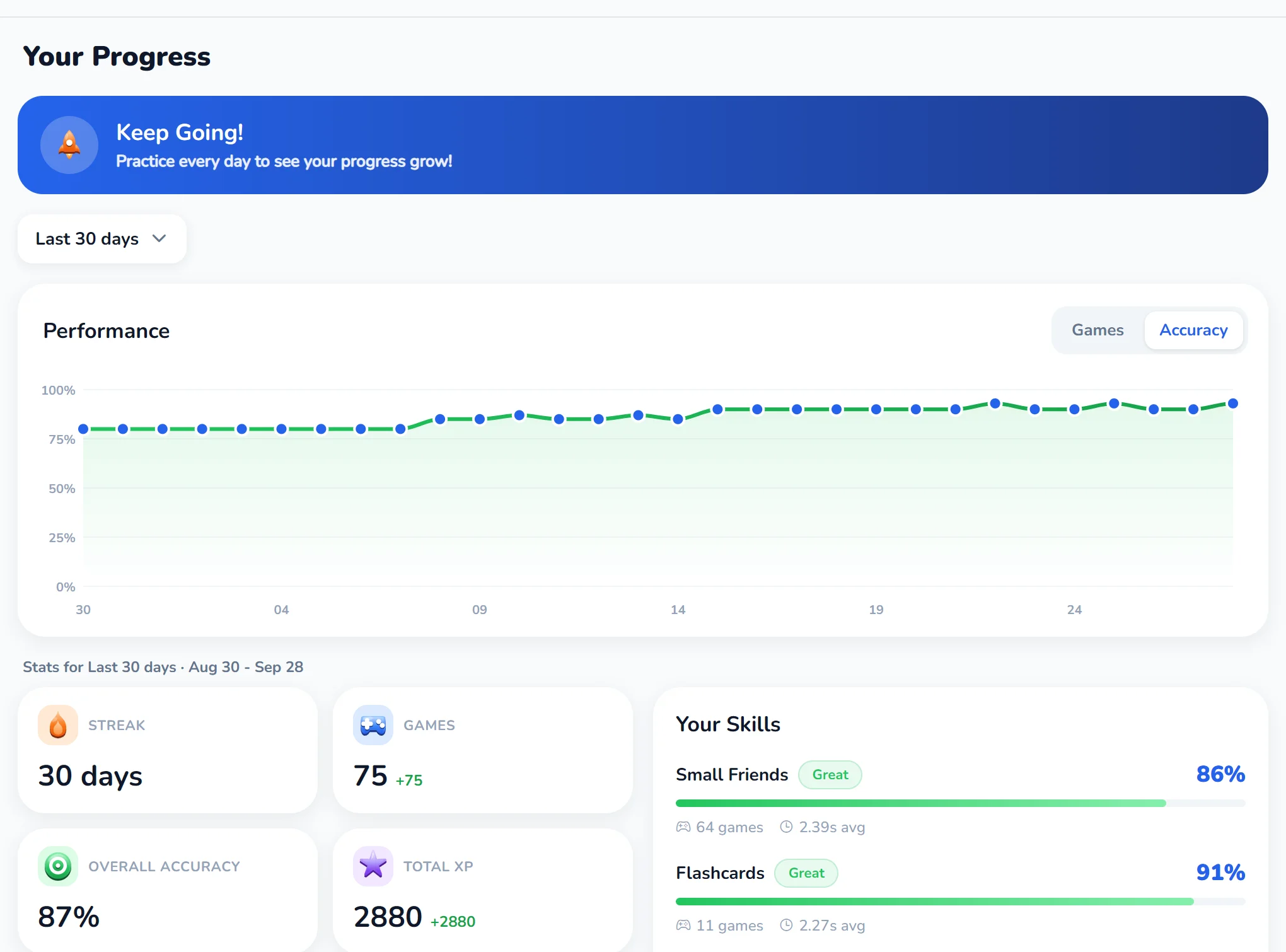
A single score might not reveal the problem. The history does.
Practice consistency is as important as speed
Mental arithmetic depends on repetition.
A student who practises for 5–10 minutes on most days may develop a much more stable learning routine than a student who completes a very large amount of work only once a week.
Teachers therefore need to understand:
- when the child practised;
- how often they returned to practice;
- how many activities they completed;
- and whether there are long gaps between sessions.
This is also why a practice streak is more than simply a gamification feature.
For a student, it creates an additional reason to return tomorrow.
For a teacher, it provides a very simple indicator of learning consistency.
Good analytics should tell the teacher who needs attention
Teachers do not need twenty beautiful charts simply because the software is capable of generating them. They need an answer to a much more practical question:
“Which student needs my attention today?”
For example:
- one student has not practised for five days;
- another student's accuracy has suddenly dropped;
- another has stopped completing homework;
- another calculates correctly but has not improved in speed for several weeks;
- another began making significantly more mistakes after the pace was increased.

A useful platform should help identify these situations quickly.
Analytics should lead to action. If a chart does not help the teacher make a decision, the chart may not be necessary.
Parents need a simpler view of progress
Teachers and parents are looking at the same child, but they need different levels of information.
A teacher may need to see:
- accuracy;
- speed;
- topics;
- difficulty;
- practice history;
- consistency;
- number of completed exercises;
- and changes over time.
Most parents need answers to much simpler questions:
- Is my child practising?
- Is the homework being completed?
- Is there progress?
- Are the results improving?
- Is there something that needs attention?
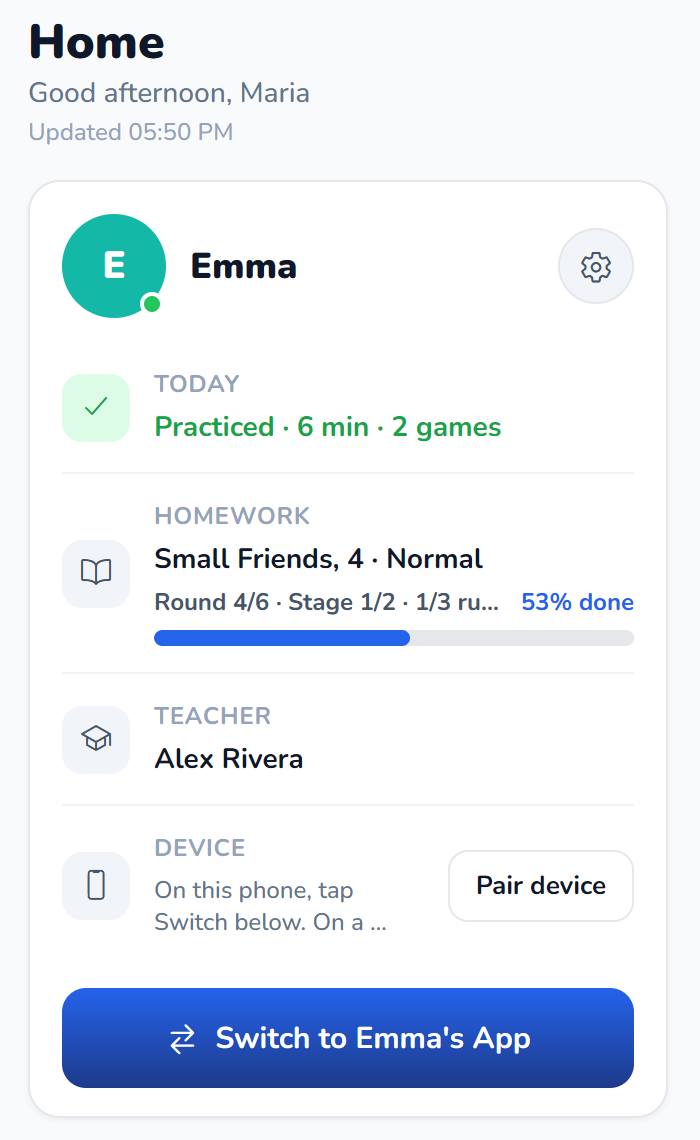
A good educational platform should therefore not simply show the same analytics dashboard to everyone. Teachers need professional information. Parents need a clear and understandable view of their child's progress.
Workbooks and digital platforms should work together
There is no reason to make teachers choose between these two tools.
Workbooks are important. The physical abacus is important. Repetition is important. But each tool is good at solving a different problem.
- A workbook is effective for repeated written practice.
- A physical abacus is essential when initially building calculation technique.
- A digital environment is especially useful for controlling speed, varying practice formats, automatically collecting results and supporting the transition towards mental abacus calculation.
So the right question is not:
“Which is better: a workbook or an app?”
The better question is:
“Which tool works best for this particular stage of learning?”
The platform should not replace the teacher
It is possible to collect enormous amounts of data. But data does not teach the child.
An accuracy score of 74% does not explain the mistake. A speed graph cannot independently decide whether the student is ready for the next topic. That remains the teacher's job.
The platform should do something else:
- collect the information;
- identify trends;
- highlight potential problems;
- and help the teacher make a decision.
Without digital history, a teacher may eventually notice:
“I think this student has not been practising as well recently.”
With structured data, the teacher can see something much more concrete:
“The student practised only once during the past week, accuracy declined, and the error rate increased after the exercise speed was raised.”
That is information the teacher can act on.
In Amavit, data should lead to the next teaching decision
This is one of the principles behind Amavit.
The objective is not simply to show teachers more numbers. The objective is to help them understand:
what is happening with the student and what to do next.
- If the student is making many mistakes, investigate the reason.
- If the student is accurate but slow, increase appropriate practice and gradually work on speed.
- If accuracy falls sharply after increasing the pace, reduce the speed.
- If the child has stopped practising, address consistency.
- If the results remain strong, gradually increase the difficulty.
- If the student is confident on a physical abacus, begin introducing more visual exercises and mental abacus practice.
In other words:
data should become a teaching decision.
Why a workbook alone is no longer enough
A workbook remains an important part of mental arithmetic training. But it has limits.
- It cannot display numbers every five seconds and then gradually reduce the interval to two seconds.
- It cannot automatically compare a student's accuracy at different speeds.
- It cannot show a teacher three months of practice history.
- It cannot automatically identify that a child has stopped practising.
- And it cannot provide multiple interactive formats for moving gradually from physical manipulation to mental visualisation.
That is why a digital platform should not be viewed as a replacement for the workbook. It is a complementary teaching tool — as we explain in what a free abacus platform for teachers should actually do.
Especially when the objective is not simply to teach a student to calculate correctly, but to develop fast, accurate and confident mental calculation.
What does progress in mental arithmetic really mean?
Progress is not one percentage. It is not one speed. And it is not simply the number of problems completed.
It is a combination of:
accuracy + speed + practice consistency + practice volume + difficulty + progress over time.
When teachers can see these indicators together, it becomes much easier to understand:
- what result the student achieved;
- why the student achieved that result;
- where the problem may be;
- and what should happen in the next practice session.
That is what a modern platform for mental arithmetic teachers should do.
Not simply check answers. It should help the teacher see the learning process as a whole.
Try Amavit Free for Teachers
See accuracy, speed and practice consistency for every student — and decide what should happen in the next lesson.
Create Teacher Account