Abacus Worksheets vs Digital Practice: How a Child’s Training Should Change Over Time
When a child starts learning mental arithmetic, you cannot simply put them in front of a screen and expect them to calculate quickly in their head.
The learning process develops in stages.
At the beginning, the child first needs to learn how to use a physical abacus. They move the beads with their hands, learn the rules, repeat the same movements again and again, and gradually turn those movements into an automatic skill. At this stage, workbooks, worksheets and paper-based exercises are extremely important.
But the ultimate goal of mental arithmetic is not to make a child move beads quickly forever.
The goal is to help the child gradually move away from the physical abacus, visualise it mentally and perform calculations in their head.
That is why the type of practice should change as the student develops.
- At first, paper and the physical abacus play a major role.
- Then digital exercises are gradually added.
- At more advanced stages, most of the practice shifts towards mental calculation.
At the beginning, children really do need a workbook
The first stages of mental arithmetic are largely about developing a mechanical skill. A child has to become comfortable with the abacus itself.
- They see a number.
- They understand which beads need to move.
- They perform the movement with their hands.
- They get the result.
Then they repeat the process. Again. And again. And many more times.
This repetition is essential. A child needs to complete a large number of similar examples until they no longer have to consciously think about every individual movement.
That is why a workbook is so valuable at the beginning. The child opens a page and works through examples one after another using a physical abacus. This is how the foundation is gradually built.
Trying to remove paper-based exercises completely at the beginning would therefore be a mistake.
A digital platform should not replace this stage.
The challenge appears later
Once the basic skill becomes more stable, a different problem appears.
If a child receives only one type of practice for months:
open the next page → solve another 50 examples → close the workbook,
the work can become repetitive.
But the amount of practice cannot simply be reduced. Mental arithmetic requires repetition. If a child needs to complete one hundred calculations to reinforce a skill, five attractive exercises will not produce the same result.
So the challenge is not to eliminate repetition. The challenge is to allow a child to practise the same skill in different ways.
This is where digital practice becomes particularly useful.
The same calculations do not always have to look the same
Imagine that a student needs to reinforce one specific topic.
One option is to give them a worksheet with one hundred examples.
That works. But visually, all one hundred tasks are very similar.
Another option is to divide the same amount of practice between several different activities.
Part of the work can be done in a workbook with a physical abacus. Then the child moves to an exercise on a screen. For example, numbers may appear one after another in the centre of the screen, while the student keeps the running calculation in mind.
The next exercise can be more dynamic. Instead of appearing in the same place, the numbers can appear in different parts of the screen.
- One number may appear in the upper-right corner.
- The next one in the lower-left.
- Another somewhere else.
The child has to notice the number quickly, process it and continue the calculation.
The mathematical skill being practised may be almost identical. But for the child, the activity feels different.
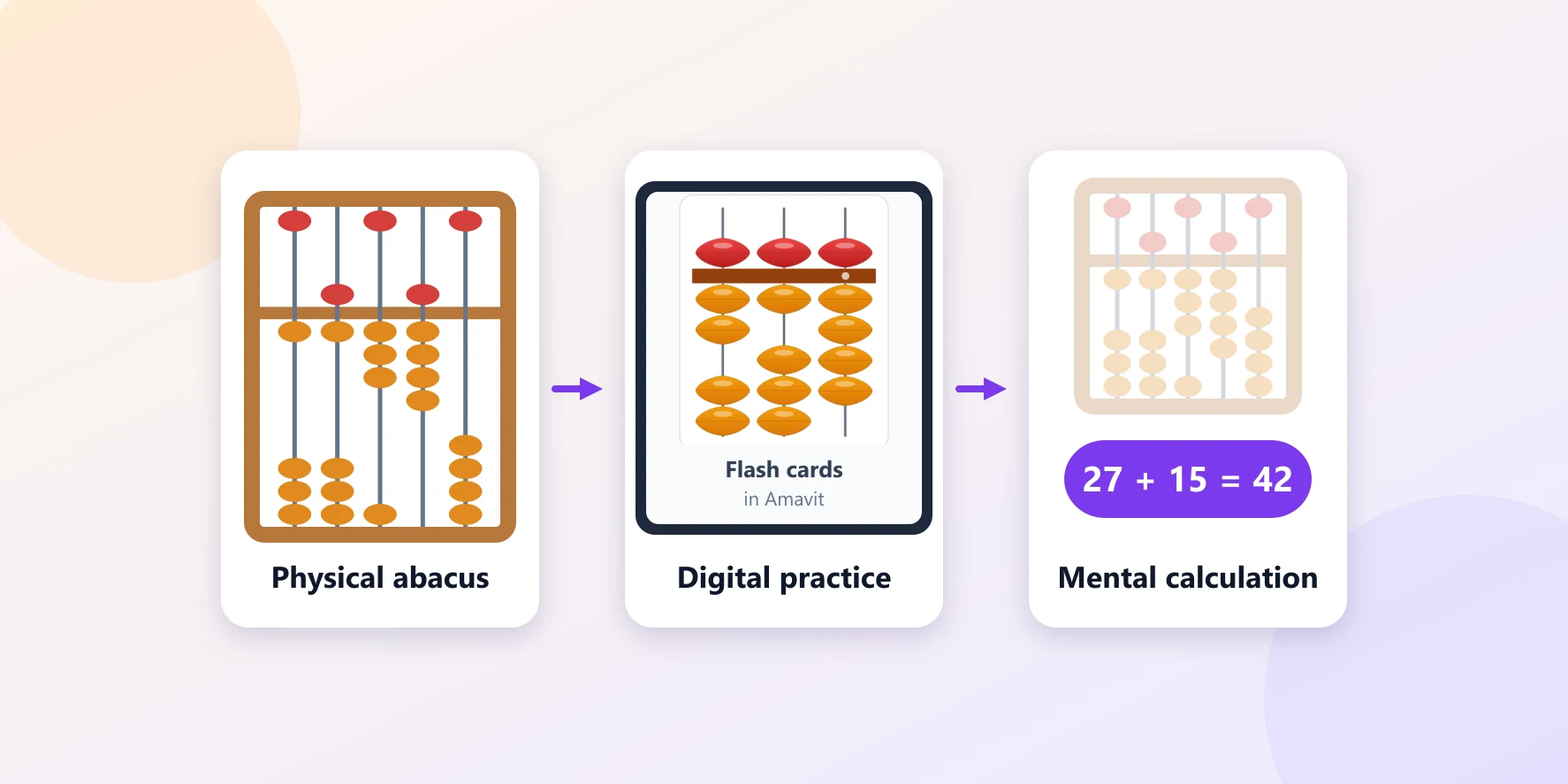
Another format is flash cards. Instead of seeing an ordinary number, the child sees an image of an abacus with beads in a particular position. The student has to recognise the value quickly and continue calculating.
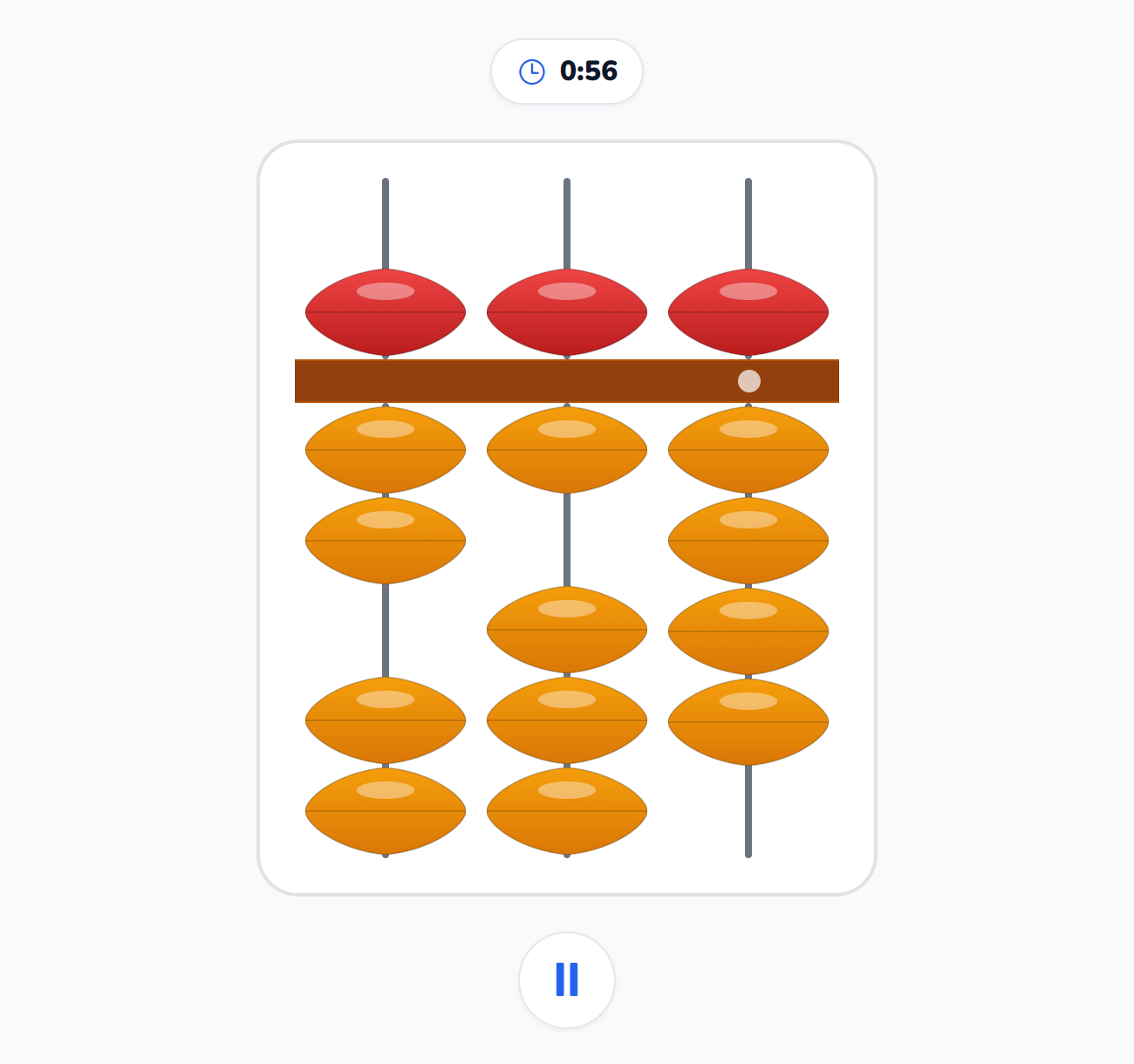
Again, the amount of practice has not been reduced. Only the way the practice is presented has changed.
This is one of the main principles behind Amavit:
children still need to calculate a lot, but they do not need to practise in exactly the same format every time.
Gradually, the physical abacus should disappear
The most important transition begins once the basic mechanical skill has already been developed.
- The child understands how the abacus works.
- They can move the beads confidently.
- They know the combinations they have already studied.
Now the teacher has to move them towards the next stage. The child needs to start seeing the abacus not only in front of them, but in their imagination.
- At first, they may still use the physical abacus.
- Then they work more frequently with images of the abacus.
- After that, with flash cards.
- Then with ordinary number sequences while trying to perform the operations using an imagined abacus.
In other words, the learning process gradually moves through the following stages:
physical abacus → visual image of the abacus → mental abacus → mental calculation.
This transition cannot happen in one day. A teacher cannot simply remove the physical abacus and say:
“Now calculate in your head.”
The skill has to develop gradually. And this is one of the areas where a digital environment gives the teacher more options than a traditional worksheet alone.
The further a child progresses, the smaller the role of paper becomes
At the beginning of the programme, the workbook may represent a significant part of home practice. That is completely normal.
But as the student moves towards mental calculation, the structure of practice begins to change. Workbook exercises gradually become a smaller part of the overall training.
More practice can be completed through:
- abacus images;
- flash cards;
- number sequences;
- speed-based exercises;
- different chain lengths;
- mental calculation without a physical abacus.
When the student reaches anzan and more advanced levels, the main objective is no longer the mechanical movement of physical beads. The main objective is fast and accurate mental calculation.
This matters particularly for competitions, where performance depends on the ability to process calculations quickly without relying on a physical abacus.
A strong mental arithmetic programme therefore should not only teach children how to use an abacus. It should gradually teach them how to calculate without needing the physical tool at all.
That is why workbooks and digital practice should not be treated as competitors
Discussions about digital education are often reduced to a simple question:
Which is better — a workbook or an app?
For mental arithmetic, that is not really the right question. Different tools are more useful at different stages.
- For a beginner, the workbook and physical abacus may be the foundation of learning.
- After some time, interactive exercises can be added.
- Then the balance starts to change.
- At an advanced level, digital practice and mental calculation can become a much larger part of the lesson and homework.
A good system therefore should not force teachers to choose one tool forever. It should allow the proportion to change as the child develops.
The teacher should control that transition
Children do not all progress at the same speed.
One child may become comfortable with the physical abacus quickly and be ready to move towards visualisation.
Another may need more time.
That is why software should not decide automatically:
“After ten lessons, stop using the workbook.”
Or:
“From this level onwards, use only the app.”
That is a teaching decision. And it should remain with the teacher.
In Amavit, the teacher decides what type of homework each student receives. For example:
- Workbook: Page 18, exercises 1–5.
Then add:
- Virtual Abacus: 5 minutes.
- Flash Cards: 3 minutes.
- Screen Practice: several calculation chains.
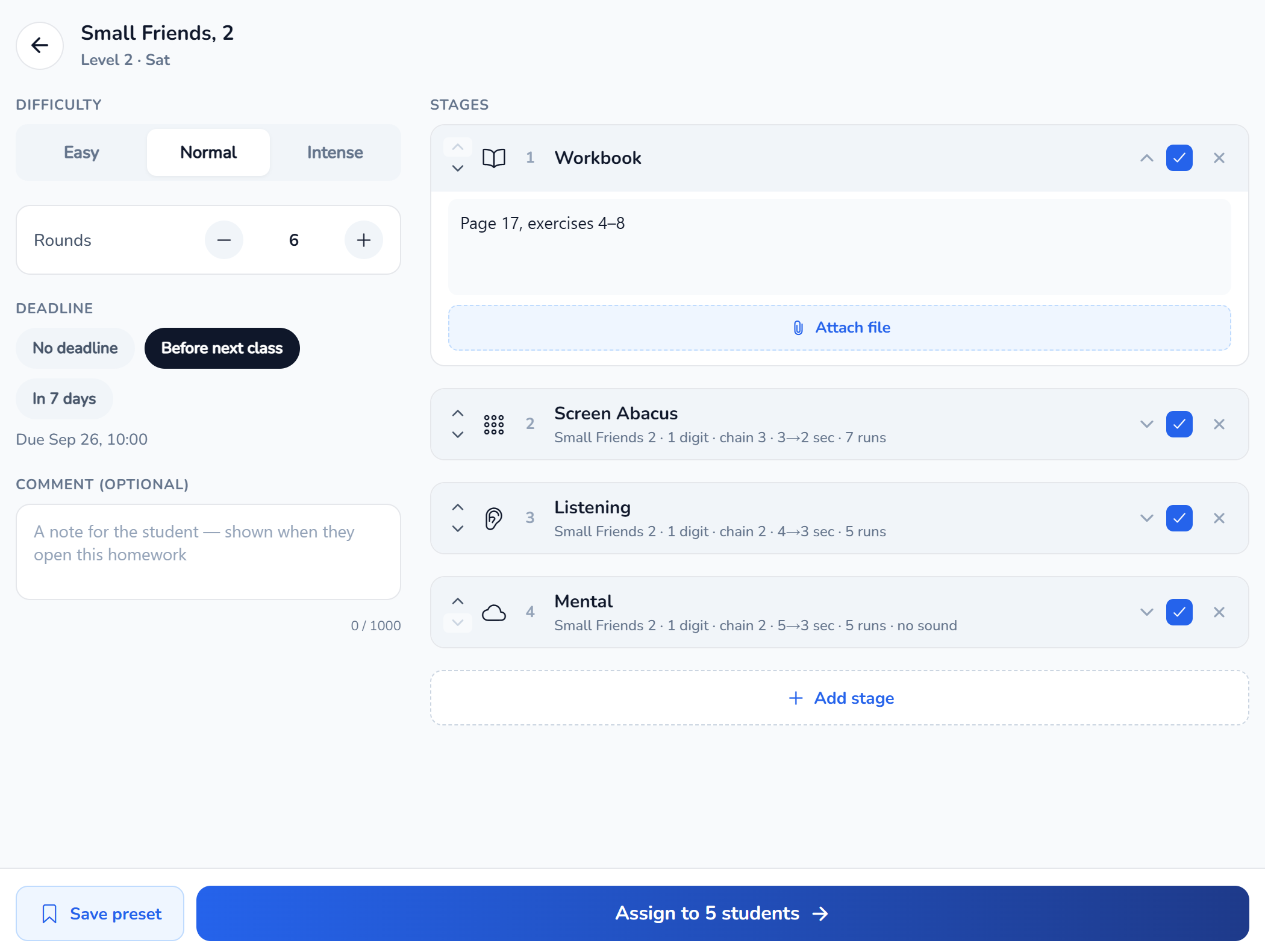
Another student in the same group may continue doing more work with a physical abacus because they are not yet ready to move forward.
The digital platform does not dictate the teaching method. It gives the teacher more options.
Digital practice makes it easier to adjust the level of difficulty
Children in the same group almost never develop at exactly the same pace.
- One student may already find an exercise easy.
- For another, it may be exactly the right level.
- A third may still be struggling.
With paper homework, the teacher often has to either give everyone the same worksheet or prepare separate material for different students.
A digital platform makes this easier. The same type of exercise can be adjusted by changing parameters such as:
- number of digits;
- chain length;
- speed;
- number of examples;
- difficulty;
- type of presentation.
This allows the teacher to keep the same topic for the entire group while giving different students different levels of practice. This becomes especially useful during the transition from physical abacus to mental calculation.
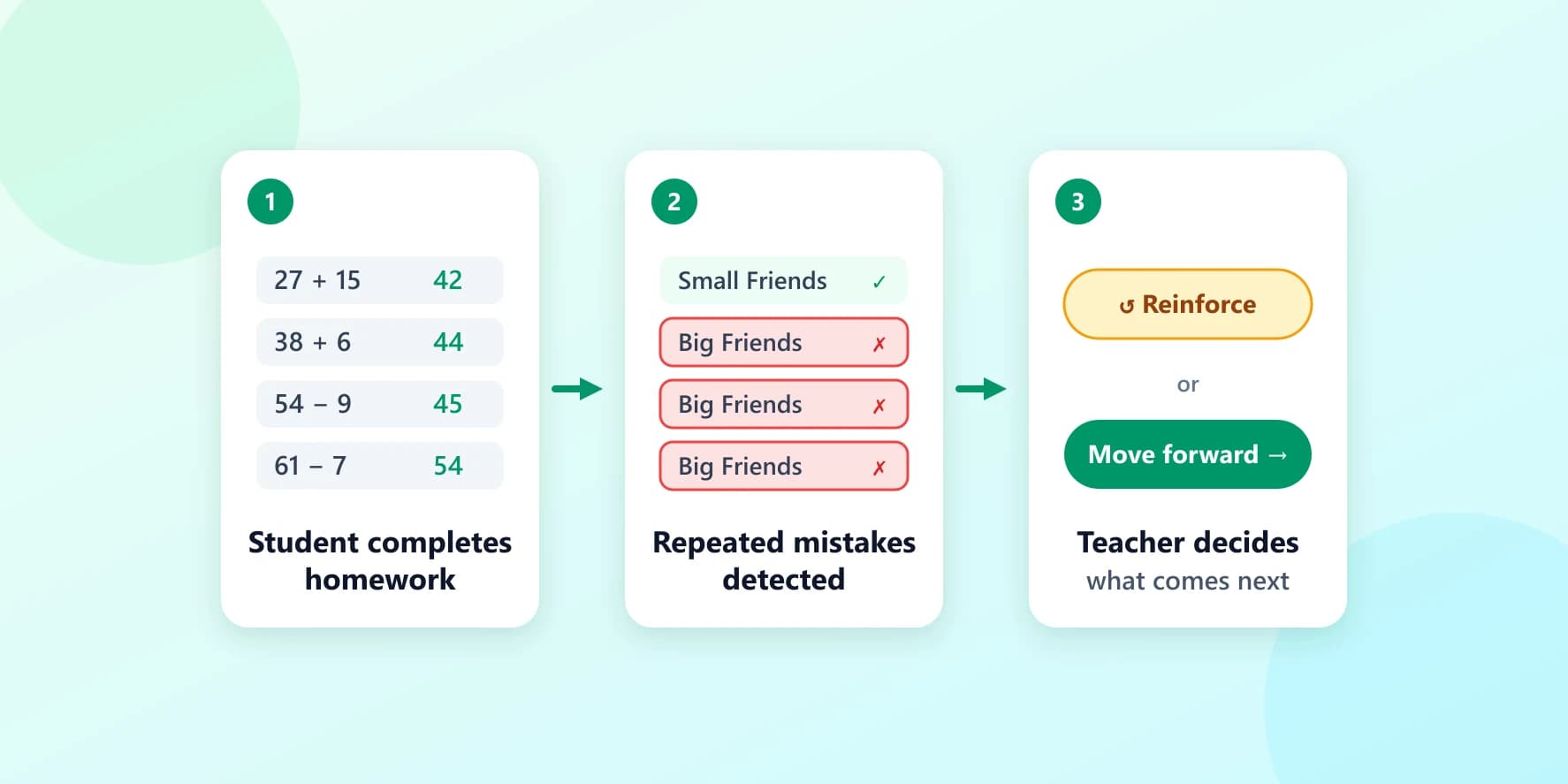
Digital homework allows the teacher to see more than just the final answer
Paper exercises have another limitation. Once the teacher says:
“Page 25, exercises 1–10,”
they have very little information about what happens until the next lesson. They do not know:
- when the child completed the homework;
- how long they practised;
- whether they finished everything;
- how many mistakes they made;
- how quickly they calculated.
The teacher normally sees only the final work when it is checked.
Digital practice can provide much more information automatically. The teacher can see whether homework was completed, the student's level of accuracy and how their speed changes over time.
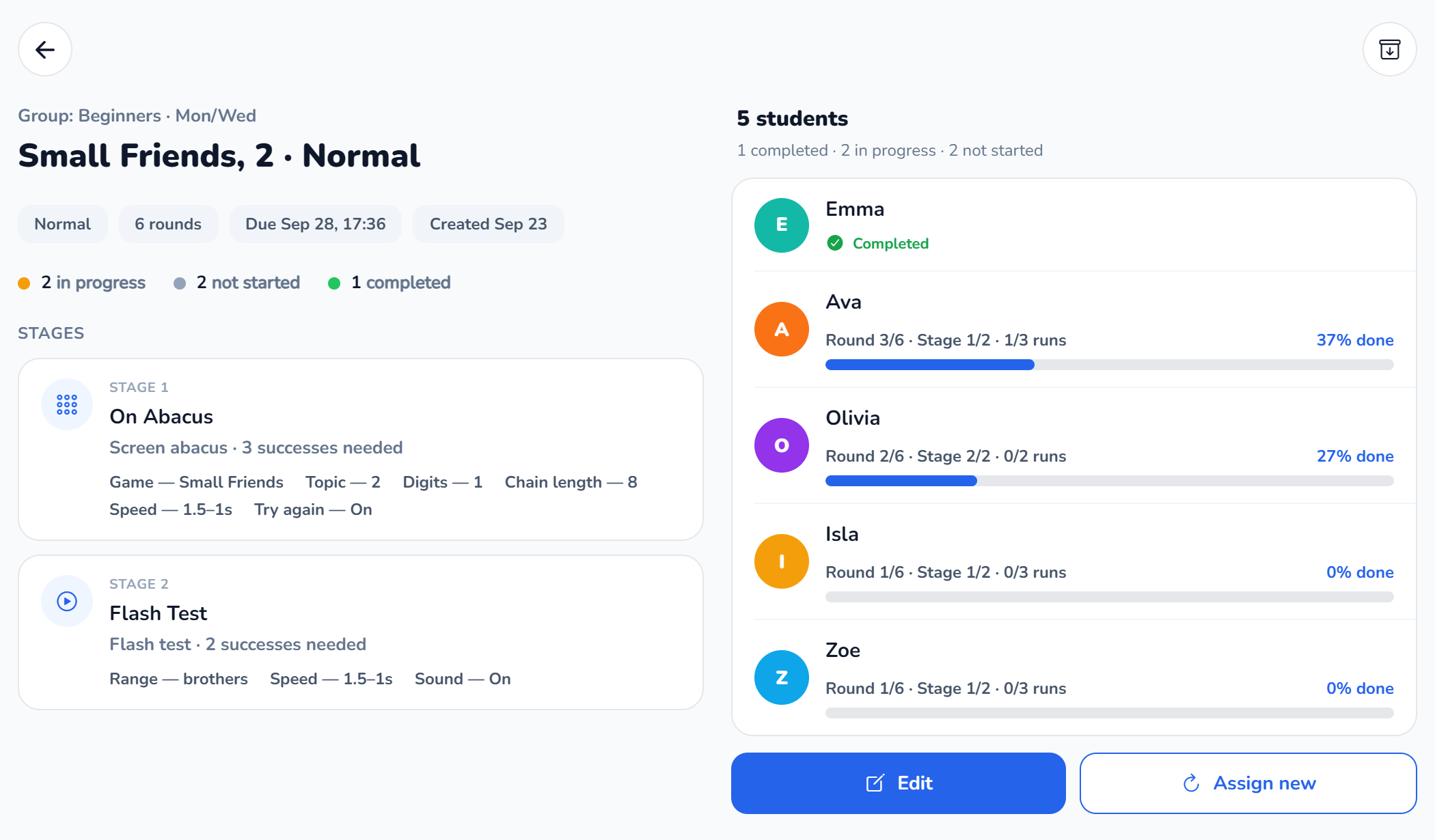
This becomes increasingly important as the child develops mental calculation. A correct answer alone is no longer enough to understand progress.
One student may calculate correctly but very slowly.
Another may calculate extremely quickly but make too many mistakes.
These are two completely different teaching situations. We look at this in more detail in how to spot learning gaps in abacus homework.
Automatic checking becomes more valuable as the number of students grows
There is also a very practical issue.
Imagine a teacher with 30 students. Each student receives 30 digital calculations. That is already 900 answers.
If every answer has to be checked manually, the teacher spends a significant amount of time on technical work rather than teaching.
With digital exercises, those answers can be checked automatically. The teacher can then focus on the important part: reviewing the results and understanding where the student is having difficulty.
Technology should not make teaching decisions for the teacher. It should remove the work that does not require a teacher in the first place.
Variety can help children stay in the programme for longer
Mental arithmetic has another important characteristic. It is not a programme that is normally completed in a few weeks. Building a strong skill takes time.
This means the teacher is not only solving an educational problem. They are also solving a motivation problem.
The child needs to remain engaged after several months. And then for several more months.
If homework looks exactly the same week after week, even a motivated student can become tired of it. Different types of practice can make the learning process feel less repetitive.
- One day the child works in a workbook.
- Another day they complete screen practice.
- Then flash cards.
- Then they try to improve their previous result.
- They earn an achievement.
- They complete a speed challenge.
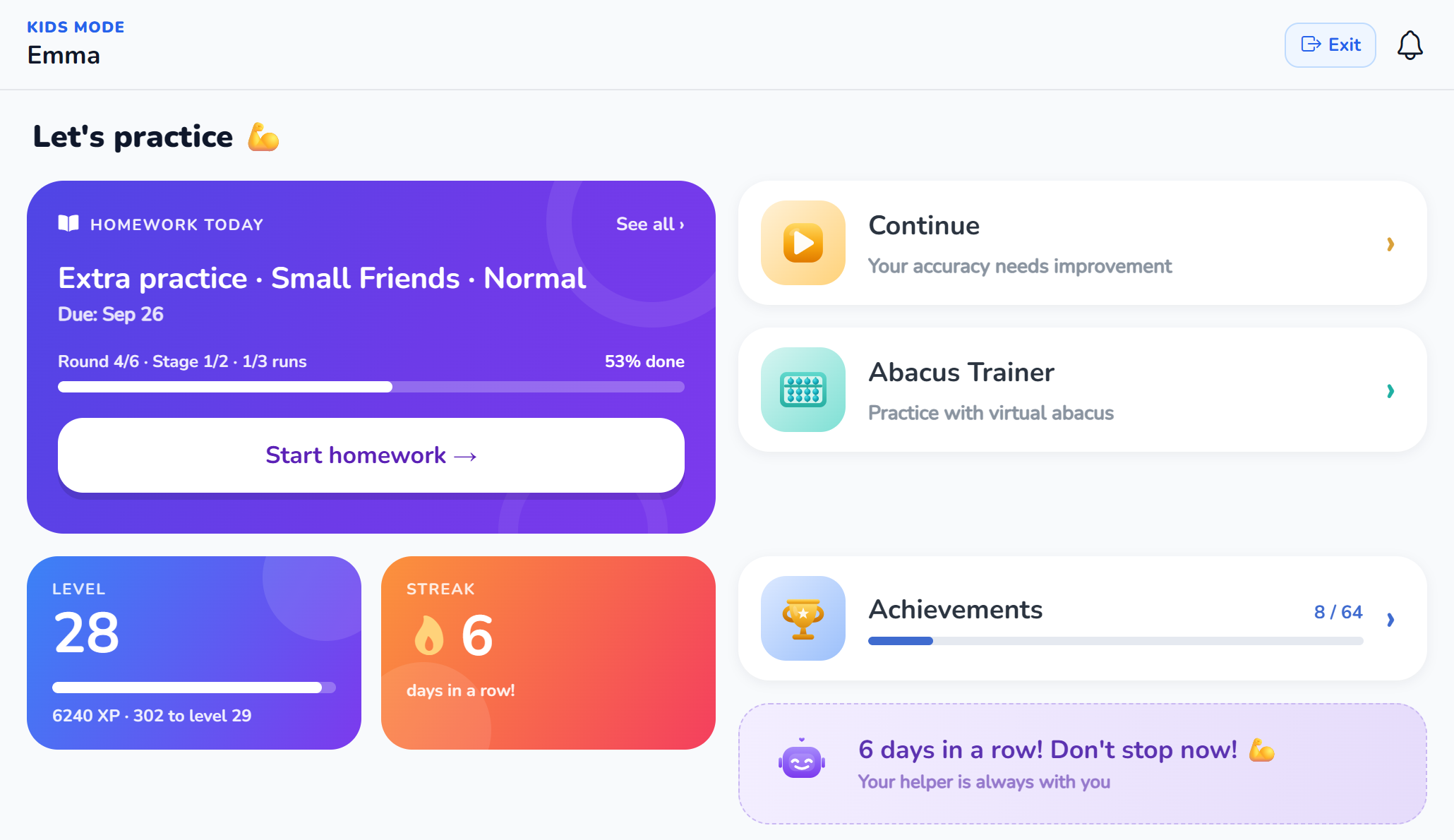
The learning remains systematic, but it no longer looks and feels exactly the same every day.
So what is the role of the workbook?
A very important one.
The workbook is still needed. Especially at the beginning.
- It helps children develop the basic mechanics of working with an abacus.
- It allows them to complete large series of similar exercises.
- It does not require a device.
- And it remains a simple and effective tool for teachers.
The purpose of a digital platform is therefore not to eliminate workbooks. The purpose is to:
use the workbook when it is the most effective tool, and use digital practice when digital tools provide something additional.
As the child progresses, the balance between the two naturally changes.
Quick summary for teachers
- Beginner: Physical abacus + workbook
- Developing student: Workbook + digital exercises
- Mental abacus stage: More visual and screen-based practice
- Advanced / Anzan: Mostly mental calculation and speed practice
The real question is different
The real question is not:
“Which is better: workbook or digital homework?”
It is:
“What stage of learning is this child currently at, and what type of practice do they need now?”
- A beginner needs a physical abacus and a large amount of mechanical practice.
- Then visual and digital exercises should gradually be introduced.
- After that, more attention moves towards the mental abacus.
- At an advanced level, fast and accurate mental calculation becomes the central skill.
This is why Amavit was not designed as an electronic replacement for a workbook. It is designed to support the stage where learning gradually moves from physical calculation to mental calculation.
At first, the child learns to calculate on an abacus.
Then they learn to see the abacus without having it in front of them.
Eventually, they learn to calculate quickly in their head.
The tools used by the teacher should change together with that skill.
Try Amavit Free as a Teacher
Combine workbook assignments with digital practice and change the balance as each student moves towards mental calculation.
Create Teacher Account