How Can a Child Calculate and Recite a Poem at the Same Time?
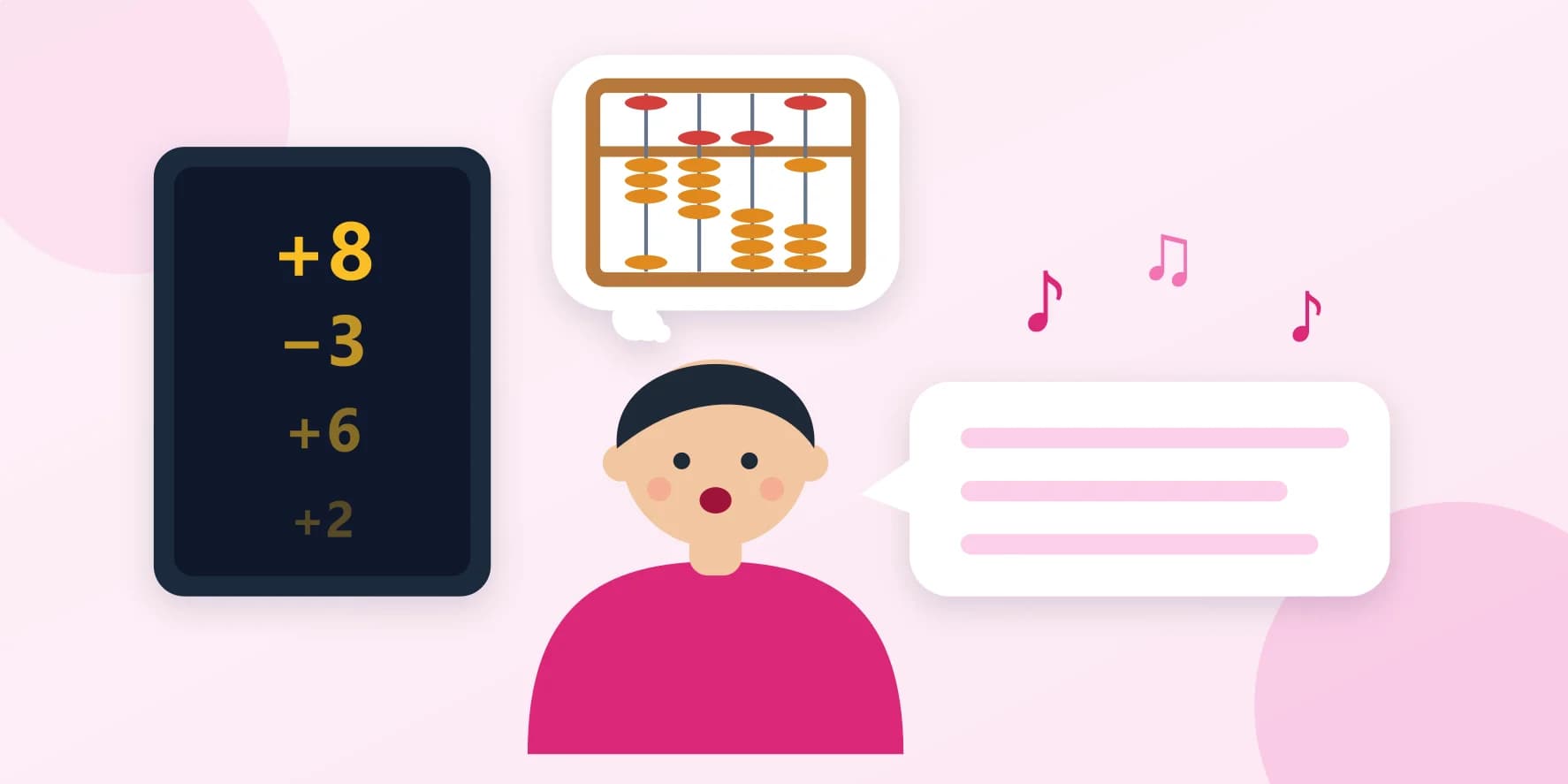
One of the most surprising results of advanced mental arithmetic can be seen when a child calculates while doing something completely different at the same time.
For example, a trained child may:
- follow a fast sequence of numbers;
- recite a poem;
- sing a song;
- perform movements;
- or, in some cases, even play a musical instrument.
For someone who has never trained with a mental abacus, this can look almost impossible.
It seems logical that if a child is performing a difficult calculation, all of their attention should be focused on that task.
But mental-abacus calculation does not work in exactly the same way as the mental calculation most adults use — and that is a large part of what mental arithmetic actually trains.
And this difference helps explain why performing two tasks at the same time can eventually become possible.
Adults calculate numbers. Mental-abacus students work with an image
When an adult calculates mentally, they usually work directly with numbers. For example:
27 + 15
A person might think:
- 27 + 10 = 37.
- Then: 37 + 5 = 42.
During this calculation, there is a clear intermediate result. The person has to remember it.
If someone interrupts and asks:
“What number were you at?”
the person tries to remember: 37.
Then the calculation continues.
Mental abacus works differently.
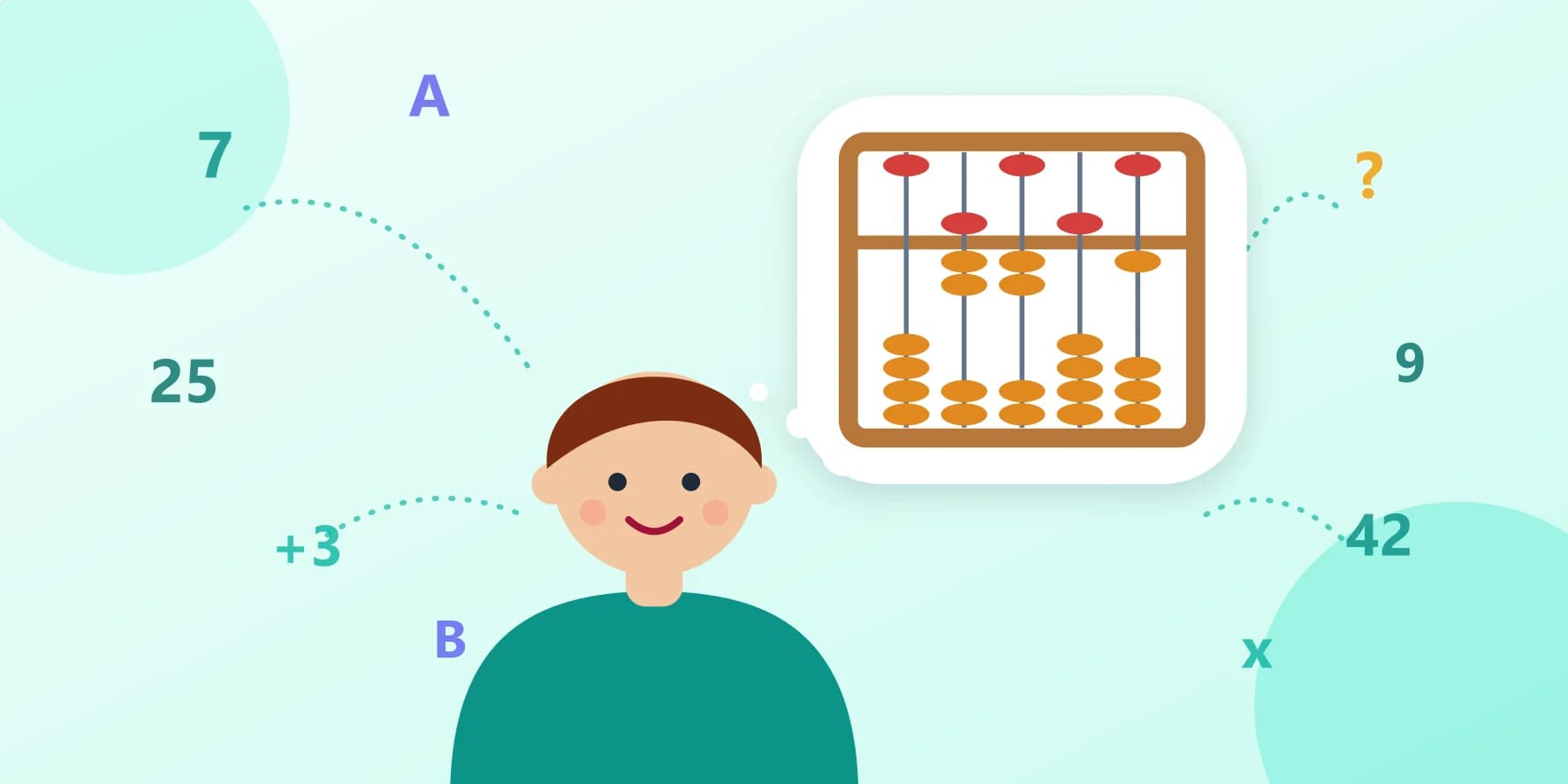
A well-trained child does not necessarily need to keep translating every intermediate state into a number. Instead, the child visualises an abacus.
- They see the position of the beads in their mind.
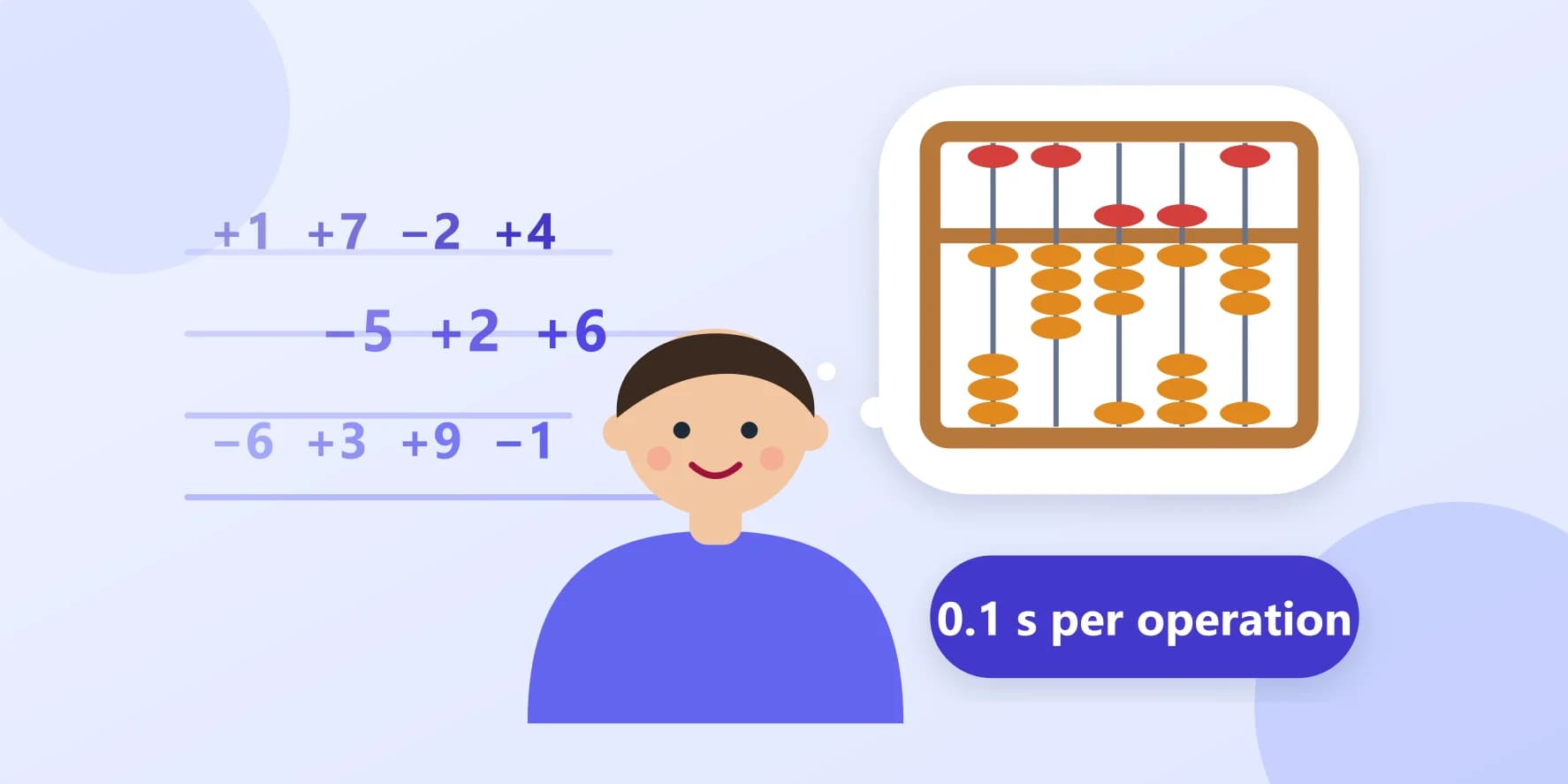
- The next number appears — and they mentally move the beads.
- Another number appears — and the image changes again.
- Then again. And again.
The mental image continues changing until the sequence ends.
There may be no conscious numerical intermediate result
This is one of the most fascinating features of advanced mental-abacus calculation.
A child may follow a long sequence without thinking:
“Now the answer is 8.” “Now it is 11.” “Now it is 7.” “Now it is 12.”
They do not need to continuously convert every state of the mental abacus into a spoken or consciously recognised number.
Instead, what remains in the mind is the configuration of the beads. Each new operation changes that configuration.
Only when the calculation ends does the child look at the final mental image and read the number represented by the beads.
In a simplified form, the process looks more like this:
number → bead movement → new bead position → next movement → new bead position
and only at the end:
final abacus image → numerical answer.
That is very different from traditional step-by-step mental arithmetic.
Traditional mental calculation:
number → intermediate answer → next number → new intermediate answer
Mental abacus:
number → bead movement → new bead image → next movement → final image → answer
This helps explain how mental calculation can become so fast
If a child had to consciously pronounce every intermediate answer, extremely high speeds would be very difficult to achieve. Inner speech itself is relatively slow.
But advanced mental-abacus students do not necessarily need to verbally label every intermediate state. They can work directly with a changing visual-spatial image.
- A number appears.
- The mental abacus changes.
- Another number appears.
- The image changes again.
With sufficient practice, this process becomes extremely fast.
The student is no longer performing a long chain of consciously verbalised arithmetic steps. They are manipulating a continuously changing visual representation.
This is one reason mental-abacus calculation can reach speeds that seem impossible to someone using conventional mental calculation — see how mental calculation speed develops.
What about the idea of “two sides of the brain”?
Mental arithmetic is often explained using a simple model of the two hemispheres of the brain.
One side is described as more associated with visual images, spatial processing, and rapid pattern recognition.
The other is often associated with language, sequential processing, and analytical tasks.
This is a useful way to illustrate the concept, although the real brain is much more complex. Cognitive tasks are not literally divided into two independent halves, and both hemispheres interact continuously.
Still, as a teaching analogy, the idea helps explain something important.
During advanced mental-abacus calculation, one task can rely heavily on a fast visual-spatial representation, while another task may involve speech, sequence, or a well-learned motor action.
When both skills are sufficiently developed, they can sometimes be performed in parallel.
How can a child calculate while reciting a poem?
Imagine that numbers are appearing on a screen.
The child is not trying to pronounce every number internally or calculate each intermediate answer in the usual way.
- They see a number.
- The beads move in their imagination.
- They see the next number.
- The bead configuration changes again.
This process can become largely visual.
At the same time, the child recites a poem. That task involves something different:
- remembering the text;
- keeping the words in the correct sequence;
- speaking them aloud;
- and maintaining the rhythm.
So there are two very different streams of information:
visual-spatial mental-abacus processing
and a verbal sequence.
With sufficient training, a child may be able to maintain both at the same time.
The absence of a verbal intermediate result matters
This point is particularly important.
Imagine that after every operation the child had to mentally say:
“Seven… nine… four… eleven…”
Reciting a poem at the same time would become much more difficult. Both tasks would compete heavily for verbal processing.
Mental abacus allows the child to operate differently.
The intermediate state does not always need to become a word or a number spoken internally. It can remain a visual bead configuration.
It is simply an image. The image changes repeatedly. Only at the end does the child convert the final configuration into a numerical answer.
This is one of the reasons why simultaneous mental calculation and speech can become possible.
Singing can work in a similar way
A child may sing a familiar song while watching numbers appear.
The mental abacus continues changing in their imagination. At the same time, the song continues through the verbal and musical sequence.
This becomes particularly impressive at high calculation speeds. Numbers may be appearing faster than once per second.
From the outside, it may look as though the child is constantly switching:
calculate; sing; calculate; sing.
But for a highly trained student, it may feel very different. Both processes can continue with relatively little conscious step-by-step control.
Can a child calculate while playing a musical instrument?
In some cases, yes. But this is considerably more difficult.
Playing a musical instrument is already a complex activity involving:
- memory;
- movement;
- rhythm;
- hearing;
- and coordination.
For a child to combine it with mental-abacus calculation, both skills have to be extremely well practised.
A child who is still learning a piano piece will probably find it very difficult to calculate at the same time.
But if the music has become highly automated and the mental-abacus skill is also advanced, combining them can become possible.
That is why such demonstrations can look so extraordinary.
It is not simply “multitasking”
People sometimes describe this ability by saying:
“This child can do several things at once.”
But that explanation is too simple. What matters is how the tasks are being performed.
The child is not necessarily jumping chaotically from one task to another.
Instead, one highly complex activity has been trained so extensively that much of it can be performed through a fast and stable visual representation.
The student no longer needs to consciously control every small step. That leaves more capacity for a second information stream.
This is impossible at the beginning
If you ask a beginner to calculate while reciting a poem, the result will probably be poor. That is completely normal.
At the beginning, the child still thinks about almost every movement.
- They remember the rules.
- They monitor the beads.
- They are afraid of losing the result.
Most of their attention is occupied by the mental-abacus task.
Only after hundreds and thousands of repetitions does the process gradually change.
- First, individual movements become familiar.
- Then the student relies less on conscious verbal processing.
- The mental image becomes more stable.
- Speed increases.
- And eventually, an additional task may become possible.
This is a sign of advanced training
Being able to calculate while reciting a poem is therefore not a beginner's exercise. It reflects a high level of training.
It shows that the mental-abacus image has become stable enough to survive additional cognitive load. The child can maintain the mental representation even when part of their attention is being used elsewhere.
And the more difficult the second task becomes, the greater the level of automaticity required.
What is the child actually training?
This type of exercise places demands on several processes at the same time. The child needs to:
- process visual information quickly;
- maintain a mental image;
- continuously modify that image;
- remember the sequence of operations;
- continue another task;
- and prevent one stream of information from destroying the other.
At this point, advanced mental-abacus training looks very different from ordinary mathematics.
It becomes much easier to understand why fast calculation is only the visible result of a much broader skill.
The “two hemispheres” idea is useful — but it should not be taken too literally
For children and parents, it is tempting to explain the process like this:
the fast, visual side works with the mental abacus, while the slower, precise side handles speech, a song, or another sequential task.
As an analogy, this makes the concept easy to understand.
But scientifically, the brain is not divided into two independent processors where one hemisphere calculates and the other recites a poem. Both hemispheres communicate constantly, and complex cognitive tasks usually involve networks distributed across the brain.
So a more accurate way to describe the process is:
mental-abacus training can help a child become very efficient at combining visual-spatial processing with a separate verbal or sequential task.
This preserves the important idea without oversimplifying the neuroscience.
Why can trained children react so quickly?
There is another interesting practical effect.
A child who is accustomed to working with a fast stream of information can become much more comfortable when something unexpected happens during a task.
They are used to:
- receiving information quickly;
- maintaining the main process;
- switching attention;
- and continuing under additional cognitive load.
This does not mean that such a child can never be surprised or confused.
But repeated practice under high information load can develop a habit of quickly re-engaging with a problem rather than freezing because something unexpected occurred.
That can be useful far beyond mental arithmetic.
Not a superpower — a trained skill
When parents see a child calculating rapidly while reciting a poem, they may think:
“This child must be exceptionally gifted.”
But the path to that result is usually much less mysterious.
- Thousands of exercises.
- Repetition.
- Increasing speed.
- Increasing the number of digits.
- Developing the mental abacus.
- Moving away from slow, conscious calculation.
- Learning not to convert every intermediate state into a verbal number.
- And gradually building automaticity.
What looks like an extraordinary ability from the outside is often the result of long, structured training.
This also explains the real purpose of mental arithmetic
A child is unlikely to need to calculate faster than a calculator in adult life.
But the ability to process information quickly, maintain a complex visual representation, and continue another familiar task at the same time is a much more interesting result.
This is why fast mental calculation should not be viewed as the final purpose of the training. It is a tool. A training mechanism.
And the ability to calculate while simultaneously performing another task is one of the clearest demonstrations of how far the mental-abacus skill can develop.
At the beginning, a child may need their full concentration to solve one simple example.
After years of training, the same child may be able to process several numbers per second, move beads on an imaginary abacus without consciously naming every intermediate result, and recite a poem at the same time.
Only when the calculation ends do they look at the final mental abacus and read the answer.
And that is one of the clearest examples of how dramatically information processing can change through long-term mental-abacus practice.
Free for teachers