From 3 Seconds to 0.1 Seconds per Operation: How Speed Develops in Mental Arithmetic
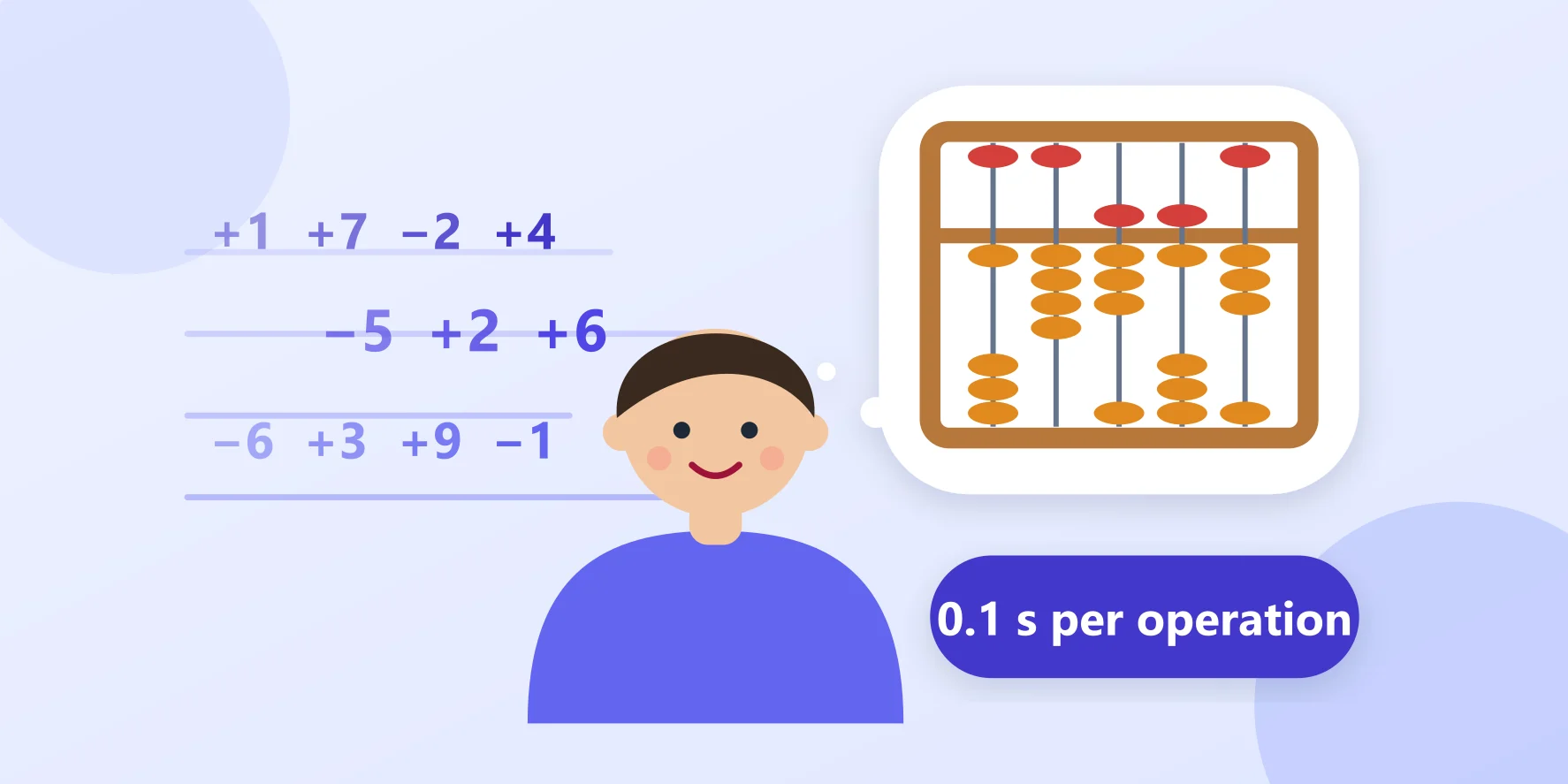
When parents first see a child solving mental arithmetic problems at a speed of several numbers per second, it can look almost unbelievable.
Numbers flash across the screen so quickly that an adult may barely have time to read them, yet the child gives the correct answer only a few seconds later.
For a well-trained mental arithmetic student, however, this is not a trick — and it is not necessarily the result of exceptional natural talent. It is the result of systematic learning, gradual progression, and a great deal of practice.
Over more than 12 years of working with mental arithmetic students, we have seen thousands of children with very different starting abilities. Our experience shows that almost any child who practises regularly and follows the methodology correctly can significantly improve the speed of mental calculation.
For most students, a level of around 1 second per operation is achievable. Many can eventually work at around 0.8 seconds.
Some students progress much further — to 0.3 seconds per operation. And highly trained students may even reach speeds close to 0.1 seconds per operation.
That means processing up to ten numbers in a single second.
How does a child get there?
Mental arithmetic starts with the simplest possible operations
Children do not begin with complicated formulas or high-speed calculations.
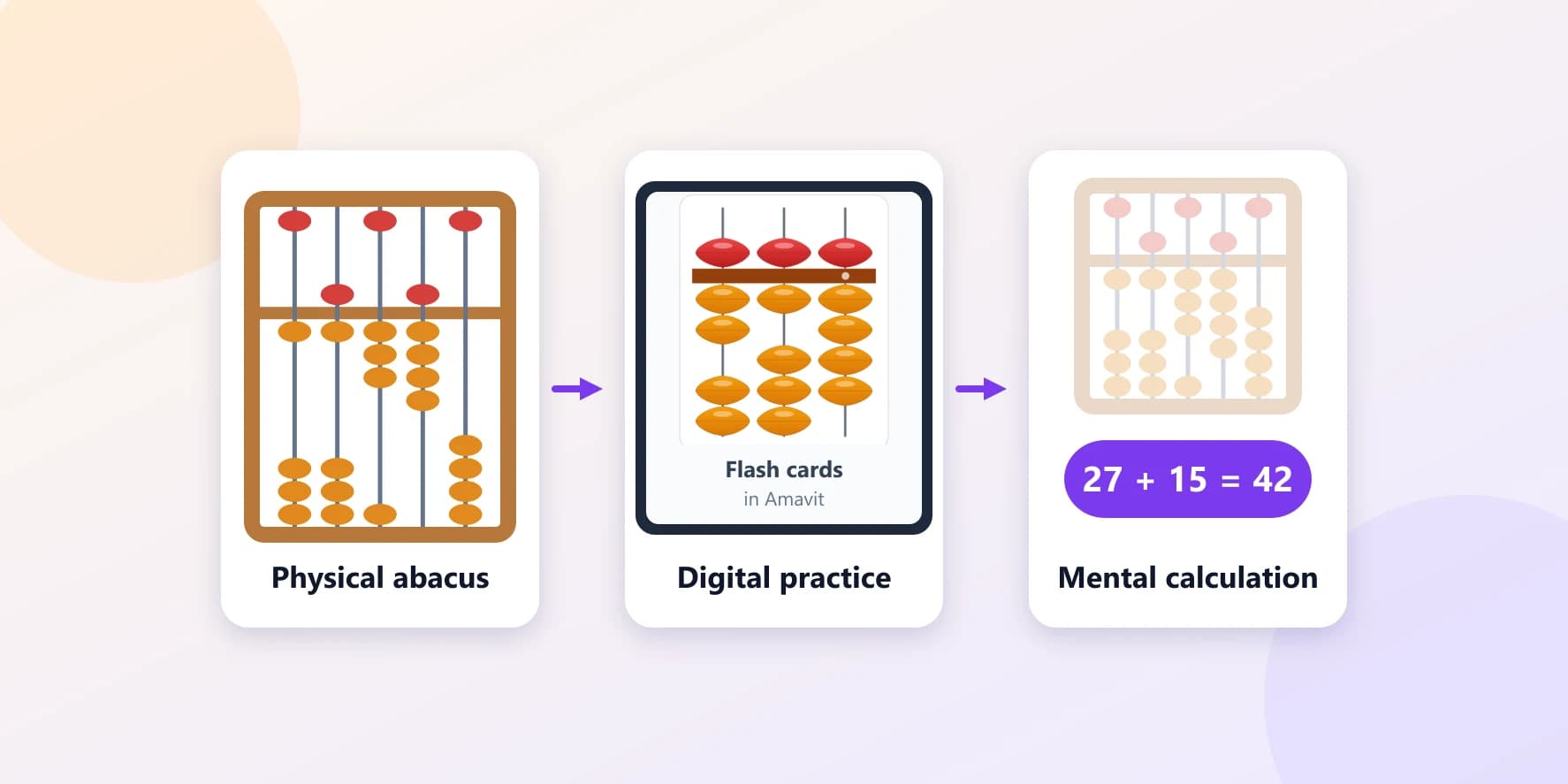
They first learn to use a physical abacus. They learn how numbers are represented, how the beads move, and how each action changes the value shown on the abacus.
The first exercises are extremely short. For example:
1 + 2
or: 4 − 2
At the beginning, a problem may contain only two numbers and one operation.
The goal is not to build long calculation chains or increase speed. The goal is for the child to understand exactly what happens to the beads after each operation.
Later, short sequences can gradually be introduced, for example:
+1, +2, −3, +4, −2
But this comes only after the simplest operations have become comfortable.
The next major step is learning to imagine the abacus mentally. Instead of relying entirely on the physical tool, the child begins to visualise the position of the beads and move them in their mind.
This is where the mental abacus skill begins to develop.
First, the child needs to see the abacus in their mind
This is one of the most important characteristics of mental arithmetic.
Gradually, a number stops being only a written digit. The child begins to associate it with a specific bead configuration on an abacus.
When the next number appears, that mental image changes. If the child needs to add two, for example, they mentally move the corresponding beads and visualise the new position.
Before this process can become fast, it must first become stable.
That is why the first mental-abacus exercises are performed relatively slowly.
What is a good starting speed?
There is no single starting speed that is right for every child.
In many cases, mental training begins at around:
3 to 3.5 seconds per operation.
Some children are comfortable starting at approximately 2.5 seconds. Others need a little more time. Starting at 5 seconds is also possible, although in our experience it is less common.
The purpose of the first stage is not to set a speed record. The child needs enough time to:
- see the number;
- represent it on the mental abacus;
- mentally change the position of the beads;
- hold the new image in memory;
- and be ready for the next operation.
Once this process becomes stable, the speed can gradually increase.
Speed should increase step by step
Suppose a child can confidently complete an exercise at 3 seconds per operation.
The next stages might be approximately:
2.5 seconds → 2 seconds → 1.5 seconds → 1 second → 0.8 seconds
and then, if the student is ready, even faster.
This is not a fixed progression that every student must follow exactly. Speed development is individual.
The principle is much more important than the exact numbers:
move to the next speed only when the current speed has become sufficiently comfortable and accurate.
If the child suddenly starts making many mistakes, loses the mental image of the abacus, or can no longer follow the numbers, the speed has probably increased too quickly.
In that case, it is better to slow down slightly and consolidate the skill.
At first, children can both see and hear the numbers
There is another important stage in speed development that is often overlooked.
At slower training speeds, a digital exercise can provide two sources of information at the same time:
the child sees the number and hears it spoken aloud.
For example, on Amavit, audio can be used at appropriate training speeds.
For a beginner, this provides additional support. The child simultaneously:
- sees the number;
- hears the number;
- visualises it on the mental abacus.
For many students, this is easier than relying only on rapid visual presentation.
But as the speed increases, a physical limitation appears: human speech simply cannot pronounce numbers fast enough.
At higher speeds, audio has to disappear
This becomes particularly noticeable with multi-digit numbers.
A single-digit number can be pronounced relatively quickly. But at extreme speeds — for example, close to 0.1 seconds per operation — spoken audio is no longer possible. The numbers appear much faster than any person can pronounce them.
With two-digit numbers, this limit is reached much earlier. At speeds faster than approximately 1.4–1.5 seconds per operation, continuous spoken presentation of two-digit numbers becomes increasingly impractical.
Training therefore gradually changes from:
see + hear
to: see only.
Moving from audio-supported calculation to visual-only calculation is a real challenge
This transition matters.
A child may calculate very well while both seeing and hearing the numbers. But when the audio support disappears, errors can suddenly increase — even at a similar speed.
That is normal. One of the information channels the child had relied on is no longer available.
Now the student has to depend almost entirely on:
- visual perception;
- the mental image of the abacus;
- automatic bead movements;
- and the ability to retain the intermediate result.
This transition also needs to be trained gradually. It is another important stage in the development of mental calculation.
One second per operation is realistic for most students
Based on our long-term experience, approximately 1 second per operation is an achievable level for nearly any child who practises mental arithmetic consistently.
Many students eventually become even faster and reach around 0.8 seconds per operation.
These do not have to be children with extraordinary mathematical abilities. Very often, the biggest difference is not natural talent but the amount and consistency of practice.
One student may complete only the minimum required homework and achieve a good, stable result.
Another may want to go further and practise significantly more. That is when much higher speeds become possible.
What happens after one second?
Once a child can confidently calculate at around one second per operation, the next stage becomes particularly interesting.
Possible levels include:
0.8 seconds → 0.5 seconds → 0.3 seconds
and, for highly trained students, 0.1 seconds per operation.
From our practical experience, approximately one in three or one in four students who train seriously can approach speeds around 0.3 seconds per operation.
A speed close to 0.1 seconds is much less common — approximately one in ten to fifteen highly trained students.
The important point is that these are not necessarily children who showed exceptional abilities from the beginning. Very often, the difference is the amount of systematic practice they have completed.
0.1 seconds per operation means ten numbers per second
Try to imagine that speed.
Ten numbers appear on the screen one after another within a single second. Most adults would struggle even to consciously read every number. A highly trained child can continue following the sequence and calculate the result.
At this speed, it is impossible to pronounce every number — either aloud or through an audio recording. The calculation becomes almost entirely visual.
This is why advanced mental abacus training is not simply about learning to add or subtract quickly. The student learns to process visual information extremely fast, maintain a mental image of the abacus, and modify that image every time a new number appears.
Of course, not every child needs to reach this level. For regular mental arithmetic training, a speed of around one second per operation is already a very strong result.
But competitive and advanced mental arithmetic can take the skill much further.
Speed is only one part of difficulty
There is another extremely important factor:
the number of digits.
These are completely different tasks:
- calculating single-digit numbers at one second per operation;
- calculating two-digit numbers;
- three-digit numbers;
- four-digit numbers;
- or five-digit numbers.
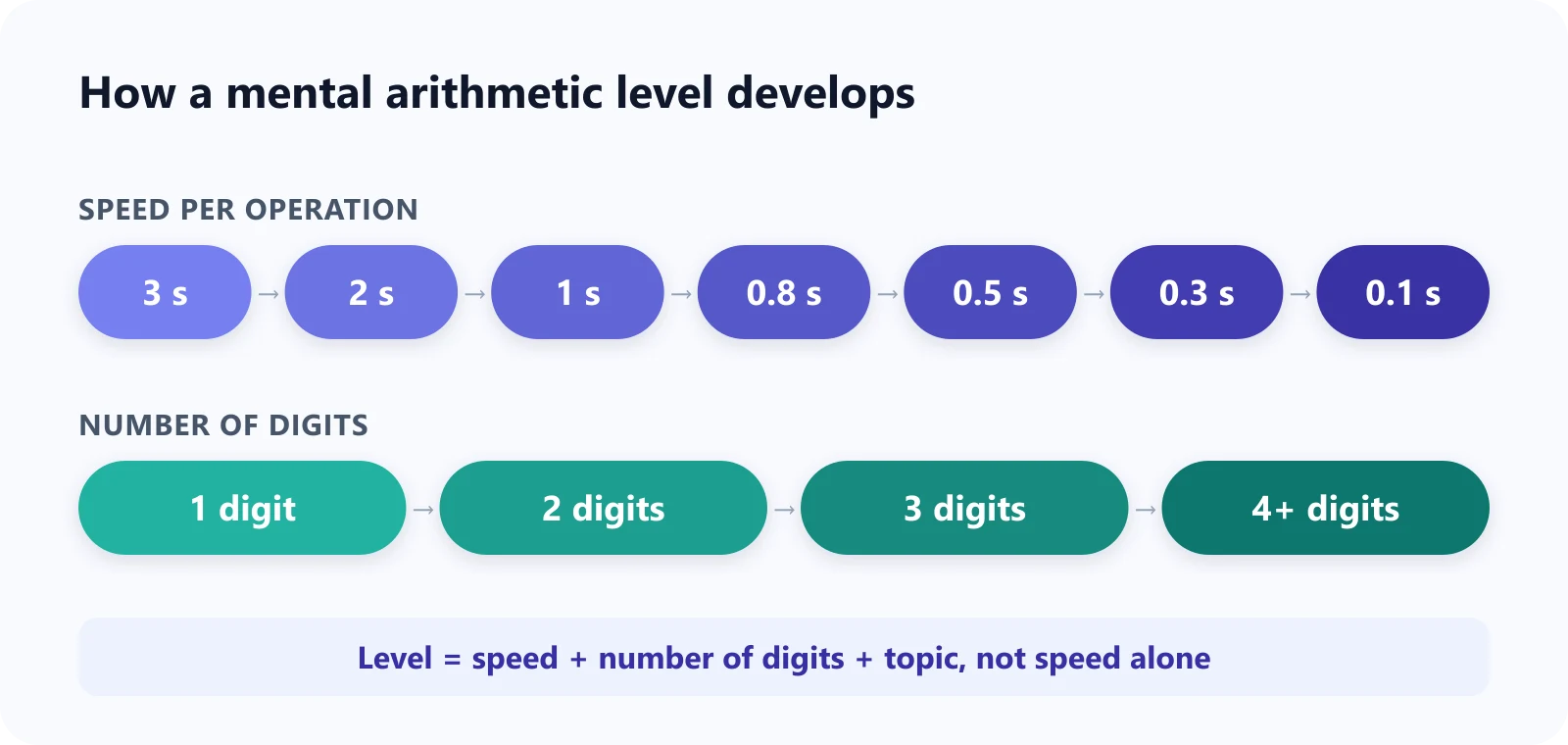
That is why a student's level should never be evaluated by speed alone. At least two parameters must be considered:
speed and number of digits.
From single-digit to multi-digit calculation
At the beginning, children work with single-digit numbers. After sufficient practice, these exercises become relatively easy for most students.
The next step is two-digit calculation. This level can also be mastered by almost any child who practises consistently.
Then the challenge increases:
three-digit numbers → four-digit numbers → five-digit numbers
Some exceptionally strong students can work with even larger numbers.
This means that two children who both calculate at one second per operation can actually be working at completely different levels.
One may be calculating single-digit numbers.
Another may be calculating three-digit numbers.
The same speed therefore does not necessarily mean the same level of difficulty.
The methodology becomes more complex as the child progresses
Development is not only about increasing speed and the number of digits. The calculation rules themselves also become more complex.
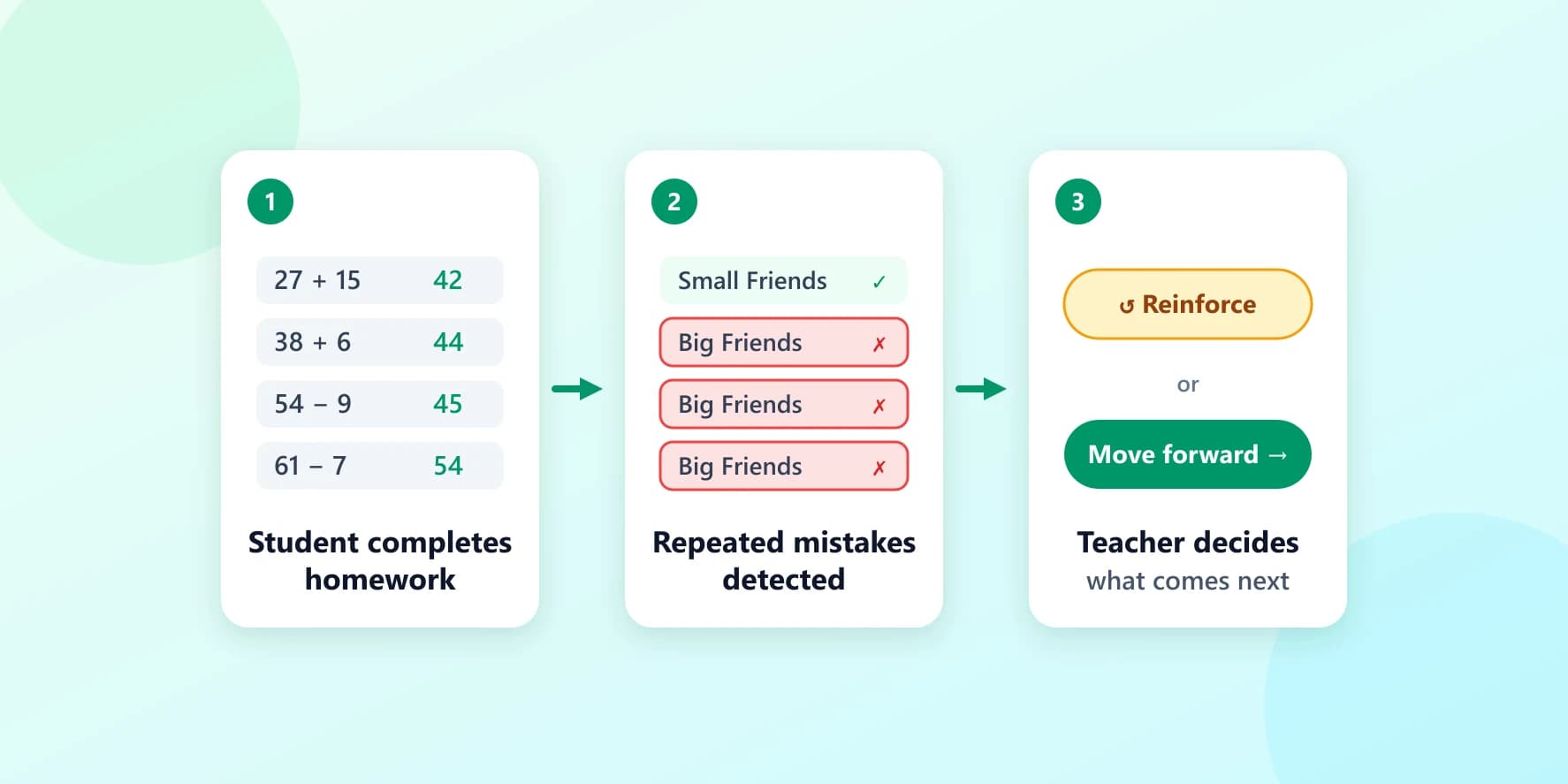
Children usually begin with Simple operations — calculations that do not require crossing five or ten. This creates the basic technique and the first stable mental image of the abacus.
Then more advanced combinations are introduced. Children learn Small Friends. Later they learn Big Friends. New combinations and transitions are gradually added.
At the same time, the number of digits increases:
- single-digit;
- two-digit;
- three-digit;
- four-digit numbers;
- and beyond.
And throughout all these stages, the student continues developing speed.
This means several parameters are progressing simultaneously:
- the complexity of the topic;
- the length of the calculation chain;
- the number of digits;
- the speed of each operation.
Anzan comes at a more advanced stage
Anzan should not be confused with the very beginning of mental calculation.
Children begin developing the mental image of the abacus much earlier, while working with simple topics. Anzan comes later, when the basic operations have already become highly automated.
This is where the quality of earlier training becomes especially important.
A student who has already trained simple operations down to approximately one second per operation enters more advanced speed training with a completely different level of automaticity.
The child does not need to learn from the beginning how to see a number quickly and change the mental abacus. That mechanism already exists.
Now it can be applied to more complex topics while speed continues to increase.
Automaticity matters more than rushing through the curriculum
It is possible to move through a curriculum very quickly.
- A student can learn Simple.
- Then Small Friends.
- Then Big Friends.
- Then move on to larger numbers.
But if the child still has to consciously remember the appropriate rule before every operation, very high speed will be impossible.
A strong student reaches a point where the basic actions become almost automatic. The child does not spend several seconds thinking:
“What formula should I use here?”
The number appears — and the mental image of the abacus changes almost immediately.
It is similar to reading.
A beginner reads a word letter by letter.
An experienced reader recognises the whole word almost instantly.
A similar process of automaticity develops in mental abacus training.
This is why regular practice matters so much
High speed does not come simply from knowing the formulas. It comes from a large number of correct repetitions.
A teacher can explain a new topic in one lesson. But it is impossible to turn a new action into an automatic skill in one lesson. That requires regular practice.
- Each training session strengthens the mental image of the abacus.
- The actions become more familiar.
- The child recognises numbers faster.
- Audio support can gradually be removed.
- Then speed can increase.
- Then the number of digits can increase.
Step by step, a very high level of automaticity develops.
Why digital training becomes especially important for speed
At the beginning, many traditional tools work perfectly well:
- a physical abacus;
- workbooks;
- flashcards;
- exercises prepared by the teacher.
But try manually training a child at 0.3 seconds per operation. Or presenting ten numbers in a single second with exactly the same interval between them.
In practice, this is almost impossible to do accurately by hand.
This is where a digital platform stops being merely a convenient addition and becomes an important training tool.
A teacher can precisely configure:
- speed per operation;
- number of operations;
- number of digits;
- difficulty;
- topic;
- and, at appropriate stages, whether audio support is used.
For example:
- one student may practise single-digit numbers at 0.8 seconds per operation;
- another may work with two-digit numbers at 1.5 seconds;
- a third may already be training very fast visual sequences without audio support.
This allows every child to practise at the level that is appropriate for them.
Speed without accuracy is not progress
There is one important rule:
fast and wrong is not a result.
If a child starts making too many mistakes after the speed increases, the student is probably not ready yet.
Stability comes first. Acceleration comes second.
Of course, mistakes are a normal part of learning. But the student must still demonstrate that they are controlling the calculation rather than simply trying to keep up with numbers flashing across the screen.
The right question is not only “How fast?”
When discussing a child's level in mental arithmetic, asking:
“How fast can they calculate?”
is not enough. We also need to know:
- which topic they are working on;
- how many digits the numbers contain;
- how many operations are in the chain;
- whether the numbers are supported by audio or presented visually only;
- and how accurately the child calculates.
For example:
- single-digit numbers — 0.5 seconds per operation;
- two-digit numbers — 1 second;
- three-digit numbers — 2 seconds.
This gives a much clearer picture of the student's actual level.
The most interesting stage begins when calculation becomes automatic
At a very high level, mental-abacus calculation can become so automated that some trained children are able to calculate while simultaneously doing something else.
- They may recite a poem.
- Sing a song.
- Perform another intellectual or motor task.
In some demonstrations, highly trained children can even calculate while playing a musical instrument.
This deserves a separate discussion.
It shows just how far mental-abacus automaticity can develop and why the method is interesting not only from the perspective of arithmetic, but also from the perspective of cognitive training.
There is no magic — there is practice
When someone first sees a child calculating at 0.3 or even 0.1 seconds per operation, it is easy to think:
“That child must simply be exceptionally gifted.”
Children certainly have different natural abilities. But many years of experience show that consistency of practice plays an enormous role.
- One child completes only the minimum homework.
- Another practises every day.
- A third becomes so engaged that they constantly try to beat their own speed record.
After several years, the difference between them can become enormous. The third child's results may eventually look extraordinary.
Yet all three children may have started from a very similar level.
What does the path to high-speed mental calculation look like?
If we simplify the process, it looks approximately like this:
- Physical abacus. The child understands numbers and how the beads move.
- Very short, simple examples. Two numbers and one operation.
- Mental image of the abacus. The child begins moving the beads mentally.
- Simple operations. Basic automaticity begins to form.
- Gradual acceleration. Approximately 3–3.5 → 2.5 → 2 → 1.5 → 1 second per operation.
- Moving from “see + hear” to visual-only calculation. Audio is gradually removed as an additional support.
- Small Friends and Big Friends. More complex calculation rules are added.
- Increasing the number of digits. Single-digit → two-digit → three-digit → four-digit numbers and beyond.
- Further acceleration. 0.8 → 0.5 → 0.3 seconds per operation.
- Advanced training and Anzan. Highly trained students may progress even further — in some cases approaching 0.1 seconds per operation.
Not every child needs to complete every stage. And reaching the maximum possible speed is not the objective for every student.
But the fact that such levels are possible demonstrates how far the mental-abacus skill can develop.
The goal is not 0.1 seconds
Extreme speed looks impressive. It is useful in competitions and is a clear demonstration of advanced mastery.
But the purpose of mental arithmetic is not to make every child process ten numbers per second.
The real goal is gradual development.
- At first, a child solves one short example.
- Then they learn to see the abacus in their imagination.
- They begin working with longer chains.
- They become faster.
- Gradually, they stop depending on audio support.
- They work with larger numbers.
- They master more complex rules.
And something that once required intense conscious concentration eventually becomes a stable, highly automated skill.
That journey — from a slow, conscious operation to fast mental calculation — is one of the most fascinating aspects of mental-abacus training.