What Is Mental Arithmetic and Why Is It Important for Children?
Mental arithmetic is often understood too literally.
Parents see a child adding and subtracting large numbers very quickly in their head and make a simple conclusion:
mental arithmetic is a method that teaches children to calculate very fast.
But fast calculation is only the most visible result. The real purpose of mental arithmetic is much broader.
It is not simply a mathematics program. It is a form of cognitive training that develops attention, memory, visualisation, concentration, and the speed at which a child can perceive and process information.
Fast mental calculation is therefore better understood as one of the outcomes of the training — not its main purpose.
Fast calculation is not the main goal
Imagine a child who can add numbers faster than most adults. It looks impressive.
But if the only purpose of mental arithmetic were to make children calculate faster, the method would have much less value today.
- Everyone has a smartphone.
- We have calculators.
- We have computers.
- We now have artificial intelligence.
Technology can perform arithmetic operations faster than any human being.
So the real question is not:
“Why should a child calculate faster than a calculator?”
The more important question is:
“What happens to the child's cognitive skills while they are learning to calculate this way?”
That is where mental arithmetic becomes much more interesting.
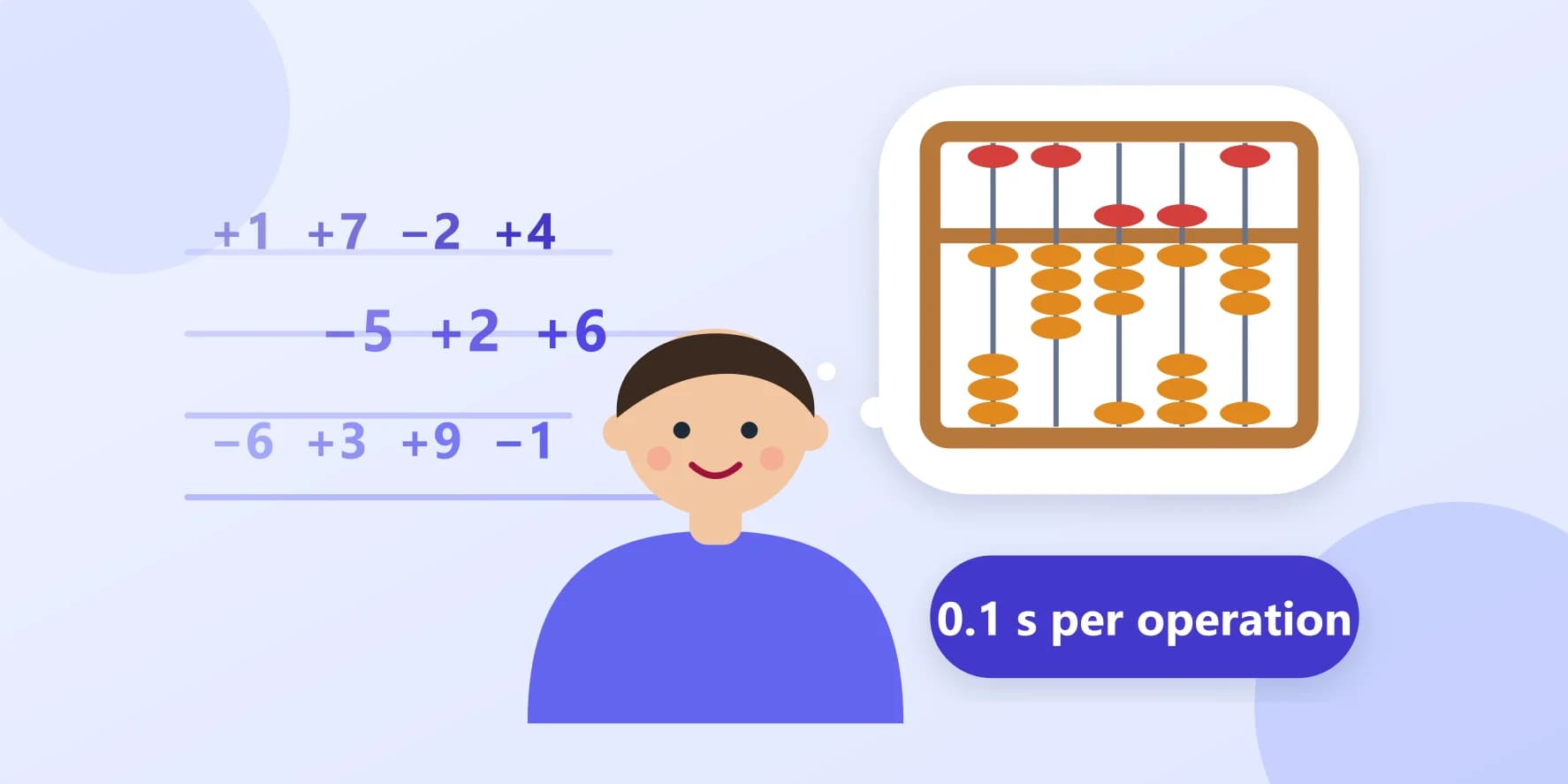
A child is learning not only to calculate, but to process information quickly
During mental arithmetic training, information is constantly arriving. The child has to:
- see or hear it;
- recognise it;
- hold it in working memory;
- process it;
- make a decision;
- perform an operation;
- retain the intermediate result;
- and immediately prepare for the next piece of information.
At the beginning, this process can take several seconds. But with training, the speed gradually increases.
Three seconds. Two seconds. One second.
Eventually, in advanced training, considerably less than one second.
So the child is not only practising arithmetic. The child is repeatedly practising the cycle:
perception → processing → decision → action.
And that skill is useful far beyond mathematics.
Why mental arithmetic uses the abacus
The foundation of traditional mental arithmetic is the abacus.
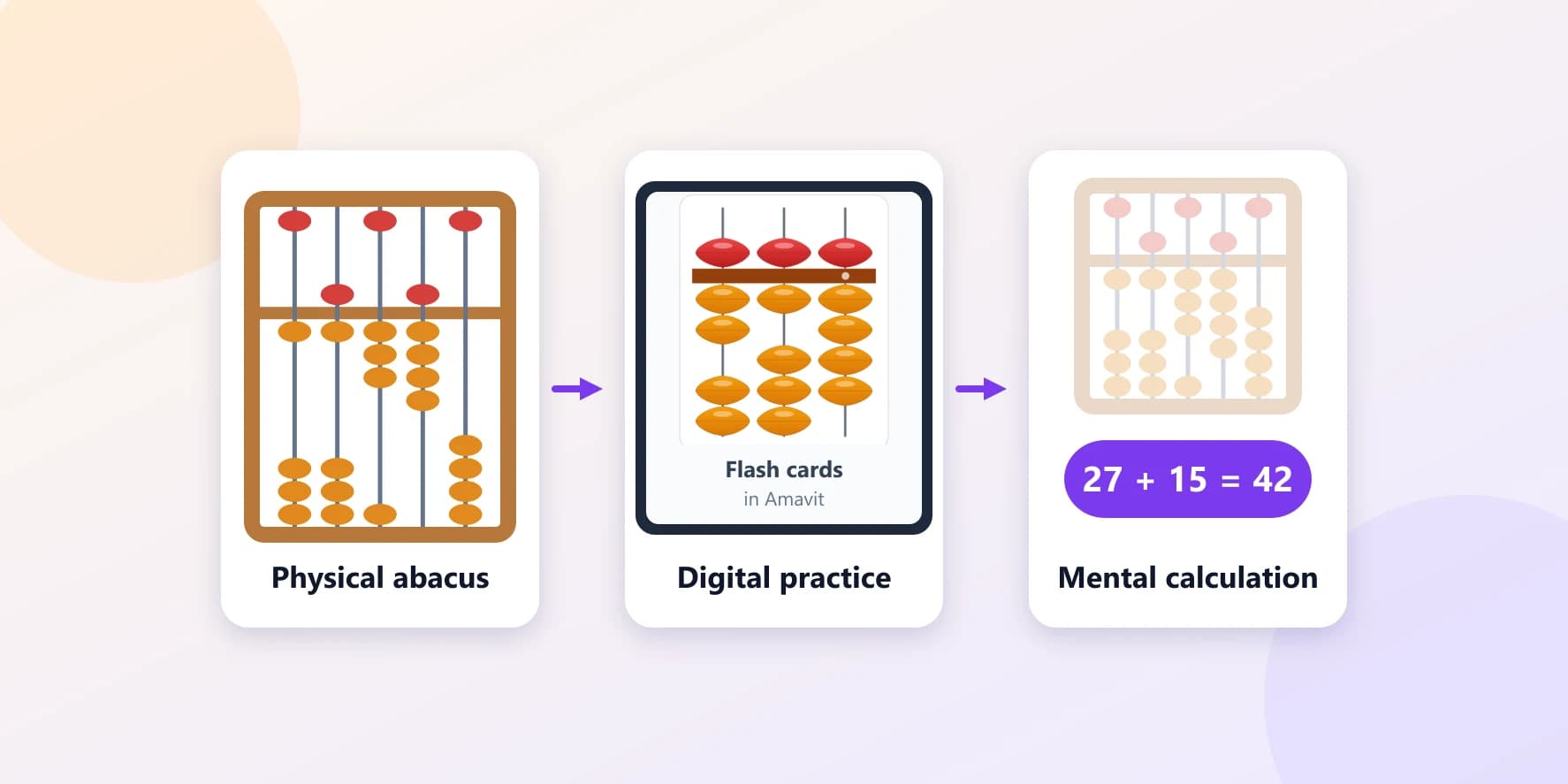
At first, children work with a physical abacus. They move the beads with their fingers and see the result in front of them.
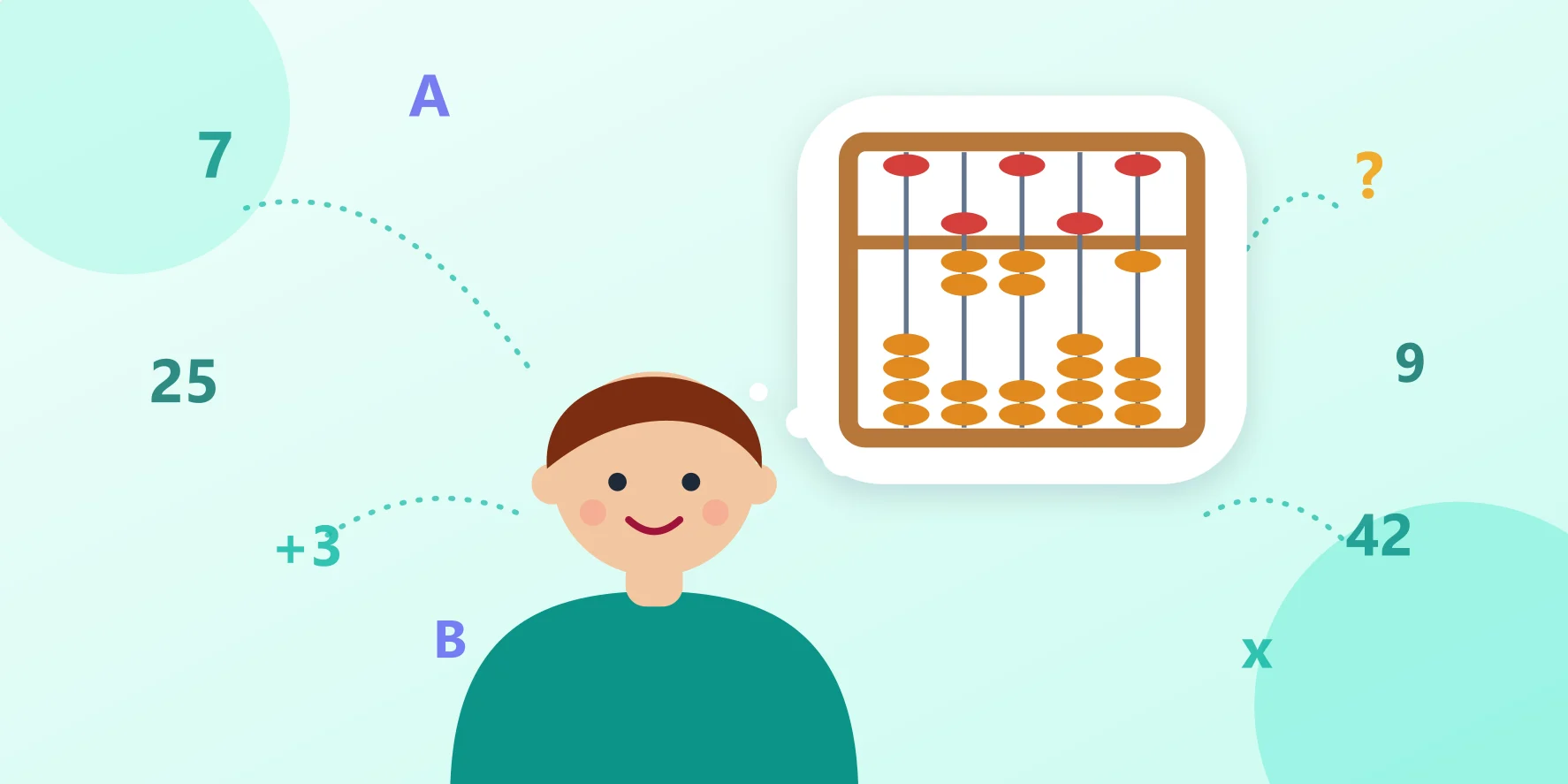
But gradually, the physical abacus is replaced by a mental image.
- The child begins to imagine the abacus.
- They visualise the position of the beads.
- They move those beads mentally.
- They retain the image.
- Then the next number appears, and they modify the image again.
This is one of the most important characteristics of mental-abacus training. The child is working with several processes at the same time:
- visual perception;
- spatial representation;
- working memory;
- attention;
- calculation;
- decision-making;
- and speed of response.
People often describe this in simple language as “training both sides of the brain.”
That is an understandable way to explain the idea, but the real process is more complex. Mental-abacus calculation involves several interacting cognitive systems rather than one isolated area of the brain.
The important point is that the child is not simply memorising arithmetic rules. They are learning to coordinate different ways of perceiving and manipulating information.
Image plus number
One of the distinctive features of mental arithmetic is that a child gradually stops working with numbers only as abstract symbols.
For example, the number:
7
is no longer just the written digit 7. The child also develops a visual representation of how seven appears on an abacus.
A mathematical symbol becomes connected to an image. Then the child learns to change that image very quickly.
This is one reason why experienced mental-abacus students can process sequences of numbers much faster than someone who tries to pronounce every number internally.
They are not working only with digits. They are also working with visual representations.
Mental arithmetic is like preparing the soil
There is a simple analogy that helps explain the purpose of mental arithmetic.
Imagine a piece of land. You can throw seeds onto it and hope that something grows.
Or you can first prepare the soil.
- You loosen it.
- Water it.
- Fertilise it.
- Remove weeds.
- Create the right conditions for strong growth.
Then you can plant different seeds, and they have a much better environment in which to develop.
Mental arithmetic can be understood in a similar way.
It is not the “seed.” It helps prepare the “soil” — the child's cognitive abilities.
And later, many different types of learning can build on that foundation:
- mathematics;
- languages;
- science;
- music;
- programming;
- and other subjects.
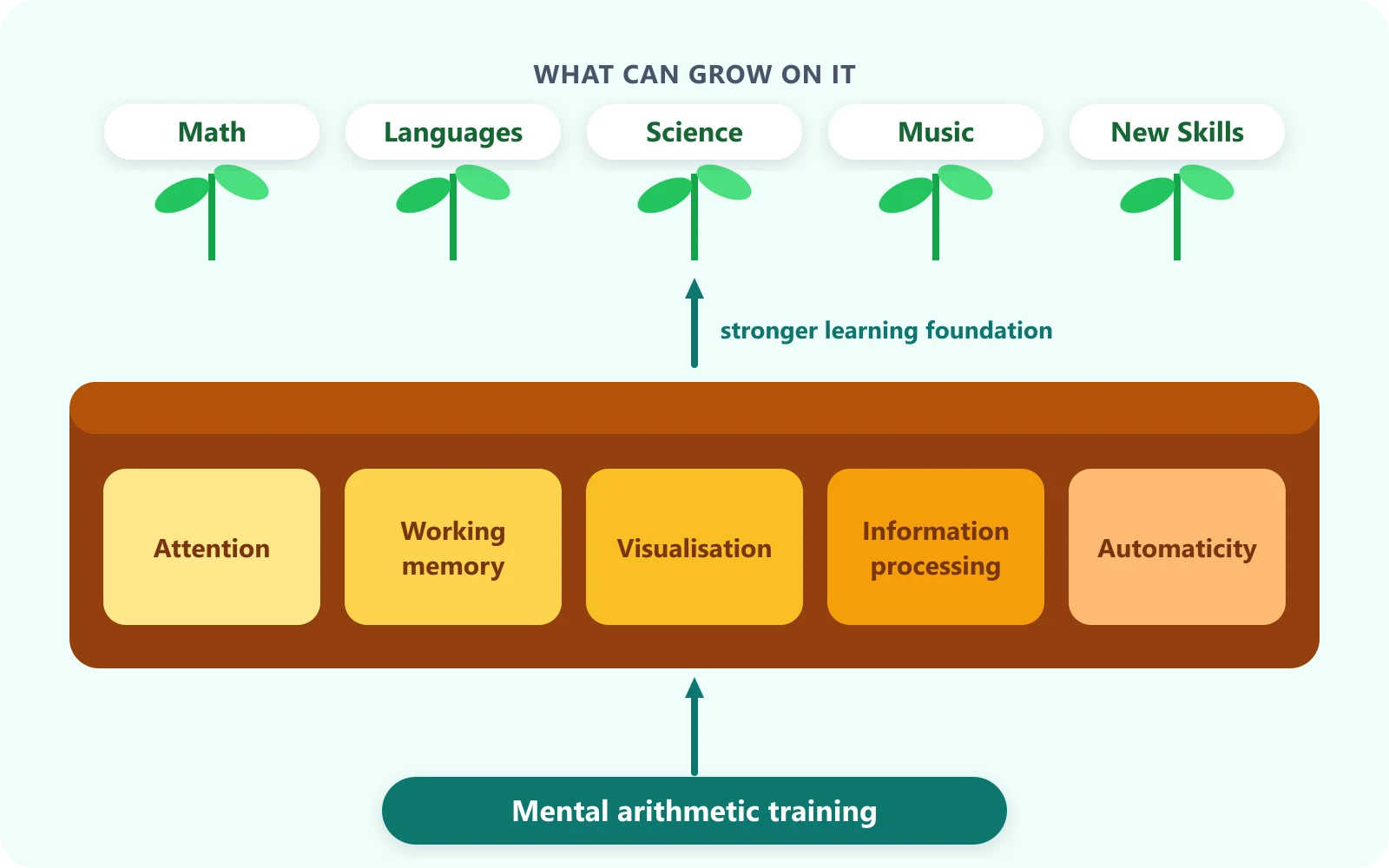
The goal is not simply to make the child better at adding numbers. The broader goal is to strengthen the skills involved in learning itself.
Working memory is constantly trained
During fast exercises, the child has to keep information active.
- They need to remember the intermediate result.
- They need to maintain the mental image of the abacus.
- They receive the next number.
- They change the result.
- Then they hold the new result again.
This happens repeatedly. That places continuous demands on working memory.
Different training formats can also use different channels of perception. A child may:
- see the numbers;
- hear the numbers;
- see the position of physical beads;
- or imagine the abacus mentally.
This creates a rich form of practice involving visual, auditory, and mental representation.
The speed of information processing matters
Children today live in a completely different information environment from children twenty or even ten years ago.
Every day they are surrounded by enormous amounts of information:
- messages;
- videos;
- educational materials;
- apps;
- news;
- social media;
- new technologies;
- artificial intelligence.
The amount of available information is increasing much faster than the number of hours in a day.
That means the challenge is no longer simply getting access to information. The challenge is being able to:
- understand it quickly;
- separate what matters from what does not;
- retain the important parts;
- process them;
- and make decisions.
The speed of this cycle is becoming increasingly important.
From slow thinking to faster automatic processing
At the beginning of training, a child may need significant time for a single operation.
- They see the number.
- Remember the rule.
- Think about the movement.
- Check themselves.
- Only then do they continue.
But with practice, familiar actions become automated. The child no longer needs to consciously reconstruct every step. Information can be processed much faster.
This is an important part of skill development.
In many areas of life, there is a large difference between someone who needs a long time to process new information and someone who can quickly understand a situation and respond appropriately.
And this goes far beyond mathematics.
Mental arithmetic also trains concentration
Try to calculate a long sequence of numbers appearing every second. If your attention disappears for only a moment, you may lose the intermediate result.
As speed increases, there is less room for distraction. The child gradually learns to stay focused on the task.
Not because an adult repeatedly says:
“Pay attention.”
But because the exercise itself demands concentration.
At higher speeds this becomes even more obvious. The child understands that if they lose focus for a moment, the entire sequence may be lost.
That is a very different kind of attention training from simply being told to concentrate.
Why regular practice is so important
Mental arithmetic has something in common with sport.
- You cannot go to the gym once and become strong.
- You cannot play the piano once a month and become a skilled musician.
In the same way, a child cannot complete a few abacus exercises and suddenly develop advanced mental calculation.
The training needs consistency. Short, regular practice gradually changes the level of the skill.
The child begins to:
- recognise numbers faster;
- create the mental image more quickly;
- hold information more reliably;
- and perform tasks with more confidence.
Hundreds and thousands of repetitions gradually transform a conscious action into an automatic one.
Why fast calculation is only the visible result
If a child spends several years practising how to:
- see information quickly;
- hear it;
- hold it in memory;
- create a visual representation;
- manipulate that representation;
- and make a decision,
it is not surprising that eventually the child can calculate very quickly.
But the fast calculation is the visible part of the process. Underneath it is a much larger amount of training.
So it is more useful to see high-speed mental calculation not as the ultimate objective, but as a visible indicator of how automated the underlying processes have become.
It is similar to watching an athlete during a competition.
We see the performance.
We do not see the thousands of training sessions that produced it.
The ability to learn may become more important than specific knowledge
There is another reason why this type of training is particularly relevant today.
Specific knowledge can become outdated. Professions change. Technologies change. The tools today's children will use in fifteen or twenty years may not even exist yet.
It is impossible to predict everything a child will need to know in adulthood.
But we can help develop the ability to learn.
- To perceive new information quickly.
- To remember it.
- To process it.
- To adapt.
- To learn new tools.
That ability is becoming increasingly valuable.
Mental arithmetic does not replace school — it supports the ability to learn
Mental arithmetic is not a replacement for mathematics.
- It does not replace school.
- It does not replace reading.
- It does not replace languages.
And it should not try to do so.
Its purpose is different. It can function as a training system for cognitive skills that a child may later use in many different areas.
This brings us back to the soil analogy.
Well-prepared soil is not the harvest. But it creates better conditions for many different plants to grow.
In the same way, stronger attention, working memory, visualisation, and faster information processing are not school subjects by themselves. But they can support a child's ability to learn many different subjects.
Modern life requires faster adaptation
Today, the problem is no longer a lack of information. The problem is information overload.
People constantly need to decide:
- what matters;
- what can be ignored;
- what should be remembered;
- what requires a response;
- and what decision should be made.
This pressure will likely continue to increase. Artificial intelligence is accelerating the process even further.
In a few minutes, a person can now obtain an amount of information that previously might have required hours or days to find.
But receiving information is not the same as understanding it. The ability to process information remains essential.
This is one reason why the cognitive skills involved in mental arithmetic are so relevant to modern life.
Good mental arithmetic is not a race for impressive numbers
It is possible to tell a child:
“You need to be the fastest.”
But that is a very narrow view of the method.
A much more useful question is how the child is changing over time.
- Can they concentrate for longer?
- Can they understand instructions more quickly?
- Can they work confidently with larger amounts of information?
- Can they retain what they have learned more reliably?
These changes are less visible than a fast answer on a screen. But they matter much more.
In a good mental arithmetic program, speed is a by-product of steady progress — not a target to chase at any cost. That is also why it matters which kind of practice a child gets at each stage, and not only how much.
Fast calculation is the part everyone can see. The real value of mental arithmetic lies in what develops underneath it: attention, working memory, visualisation and the ability to process information quickly — a foundation on which many other kinds of learning can grow.
Mental arithmetic works best with regular practice.
Amavit helps teachers combine abacus learning, mental calculation, homework and progress tracking in one system.
Explore Amavit for TeachersFree for teachers