Why Small Education Academies Should Not Build Their Own Learning Platform
As an education academy grows, sooner or later the same idea appears:
“We need our own platform.”
The academy wants one place for students, teachers, schedules, homework, results, payments, analytics, mobile access and its own branding. At first, building a proprietary platform can seem like the obvious next step.
But for a small or medium-sized education business, developing software from scratch is often far more expensive and complicated than expected. And the biggest cost is not necessarily building the first version. The real challenge starts after launch.
For many small education academies, building a proprietary learning platform is unnecessary. Development is only the first cost: hosting, security, mobile updates, bug fixing, integrations and ongoing support continue for years. A configurable hosted platform can provide branding, student and teacher management, payments and digital learning tools without requiring an internal software team.
A learning platform is not just a website
One of the most common mistakes is to think of an education platform as a more advanced website. A website can be built, published and updated occasionally.
A learning platform works differently. People use it every day. Students complete exercises. Teachers manage groups. Managers work with schedules. Parents may make payments. Results are stored. User data changes. New features are added.
This is no longer simply a website. It is a software product.
At first, the requirements usually look simple
The first list may include only registration, student accounts, groups, scheduling, homework and progress tracking. Then additional requirements begin to appear. For example:
A relatively small project can quickly become a large system.
Development is only the first cost
Even if an academy can afford the initial development, the expenses do not stop when the platform goes live. The system still requires developers, testing, bug fixing, hosting, backups, updates, security, user support, compatibility with new devices and changes to external integrations.
The platform becomes an ongoing operational expense.
- Initial development
- Hosting
- Maintenance
- Mobile updates
- Security
- Integrations
- New features
- Years of support
The real cost of “our own platform” is a chain of ongoing expenses, not one invoice.
Developers are needed even when you do not want new features
An academy may say:
“We do not need anything new. We just need the platform to keep working.”
But software does not remain unchanged around you. Browsers change. Android changes. iOS changes. Payment providers update their systems. Libraries and frameworks change. Servers need maintenance. Security vulnerabilities appear. Bugs happen.
Keeping software stable still requires technical work.
A good platform is never completely finished
Once real teachers and students begin using a system, new requests appear. For example: “Can we have a different report?” “Can we create another manager role?” “Can we change how the timetable works?” “Can we see student payments?” “Can we add another type of exercise?” “Can we send notifications?” “Can we add the academy logo?”
This is normal. Real users reveal what the product needs next.
For a small academy, an internal IT team can be disproportionately expensive
A large education group may be able to employ a product manager, backend developers, frontend developers, mobile developers, designers, QA engineers, DevOps specialists and support staff.
For a small academy, that is usually not the core business. The core business is education. Which leads to a simple question:
Why should an education company also become a software company?
The cost is not only developer salaries
There are many less visible costs: managing development; writing specifications; testing; managing contractors; finding replacement developers; maintaining documentation; server infrastructure; monitoring; handling critical incidents.
The owner or director may also start spending significant time managing technology instead of the academy.
The most expensive part can be maintaining the platform for years
Building version one is one challenge. Supporting it one year later, three years later, five years later is another. During that time, the academy may need to update technologies, replace outdated components, add new functionality, maintain compatibility and improve security.
That is why the true cost of software should be considered over several years, not only at launch.
A mobile app makes the project even more complex
If the academy wants both a web platform and a mobile application, another layer of complexity appears: iOS; Android; different screen sizes; multiple operating-system versions; app stores; push notifications; ongoing app updates.
A mobile app is not something you publish once and forget.
Parents already expect a good digital experience
Parents expect digital services to be fast, clear, mobile-friendly and reliable. And they do not compare an academy platform only with other education companies. They compare it with every digital service they use every day.
So a poorly maintained “own platform” can actually make a strong academy look less professional.
Does an academy ever need to build its own platform?
Sometimes, yes. For example, when the organisation is very large, the technology is genuinely unique, existing solutions cannot support the business model, there is already an internal IT team, or software itself is part of the company's core product.
But for many smaller academies, a better question is:
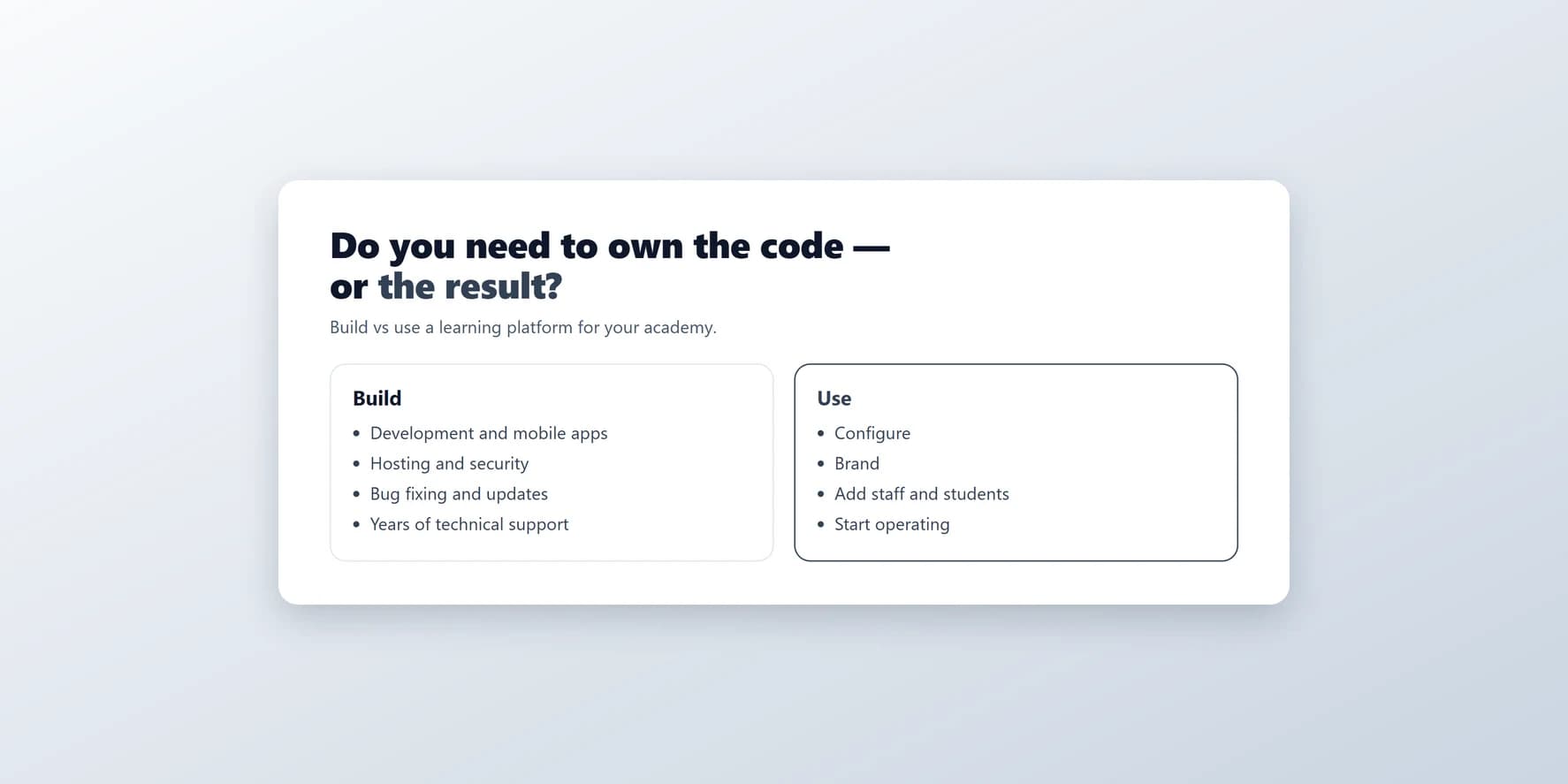
Do we really need to own the code, or do we need the result?
Most academies do not need code
They need a branded digital environment, student management, teacher management, scheduling, homework, results, control, payments and mobile access. In other words, they need capabilities. They do not necessarily need to develop every capability themselves.
Build
Development · mobile apps · hosting · security · bug fixing · updates · technical support · payment integrations · IT management
Use
Configure · brand · add staff · add students · connect workflows · start operating
Do you need to own the code — or do you need the result?
Businesses already use this model everywhere
Most companies do not build their own online banking system. They do not develop their own accounting software. They do not create their own video-conferencing technology. They use existing infrastructure.
Because it is usually more efficient to use mature technology than to recreate it from zero. Education platforms can follow the same logic.
An existing platform can be launched much faster
Building your own platform may require requirements, technical specifications, hiring, design, development, testing, bug fixing and staff training. Only then can the academy begin using it.
With an existing system, much of that work has already been done. The academy can move directly to configuring branding, staff, groups, schedules, students and workflows.
Explore Amavit for academies. See how your academy can use a branded learning and management platform without building one from scratch — Amavit for academies.
The biggest advantage: focus on education
Instead of asking: Which server should we use? Who will fix this bug? Why are push notifications not working? Why did the mobile update fail? — the academy owner can focus on teaching quality, student acquisition, retention, teacher training, opening new groups and growing the business.
But a ready-made platform should not feel like someone else's school
This is an important concern. Academy owners often worry that a third-party platform will show another company's brand, another school's identity, an unfamiliar system. That is why customisation matters.
A platform should be able to support the academy's own identity. For example: the academy's logo; customised visual elements; academy staff roles; academy-specific workflows. The technology may come from an external provider, while the customer experience still belongs to the academy.
The platform entry point can be added directly to the academy website
This is especially useful for parents and students. They visit the academy's normal website. They click Student Login or Open Learning Platform and enter the learning environment.
The platform becomes part of the academy's digital infrastructure rather than a disconnected external tool.
The academy can maintain its own brand
With Amavit, an academy can use its own logo and customise the environment around its organisation. This matters for more than appearance. A branded environment helps parents and students perceive digital practice as part of the academy's educational service.
At the same time, the underlying technology and ongoing development remain with Amavit.
Your academy. Your students. Your brand. Our technology.
Mobile access can be included too
Students and parents can use the Amavit mobile application. The app itself remains under the Amavit name. Inside the application, however, the academy environment can be customised around the academy's identity.
This creates a practical middle ground between developing a completely separate mobile app for every school and using a generic external tool with no connection to the academy brand.
The academy does not need to pay separately for every technical component
With a proprietary platform, every improvement may become a separate development project. A new report. A new role. A new management function. A new interface. A new integration.
In a shared platform model, much of the core product development is maintained centrally rather than by each individual academy. This changes the economics significantly.
The academy does not need to manage hosting
A proprietary system requires infrastructure. Someone has to monitor servers, capacity, backups, performance and technical incidents. With a hosted platform, this technical layer does not become the academy director's responsibility.
The same applies to updates
Teachers do not care which framework version is running. Parents do not care which database technology is used. They care that the platform opens, the exercises work, the results are saved and the service is reliable. The technical layer should remain the responsibility of the technology provider.
Payments add another layer of complexity
As an academy grows, payment administration becomes another operational challenge. Managers may need to understand who paid, who has not paid, which student the payment belongs to, which group, which service.
Building that system independently means integrating payment providers and maintaining those integrations. A ready-made platform can simplify this part of the workflow too.
The academy can connect its own payment infrastructure
Depending on the market and agreement, an academy can use an appropriate payment gateway or banking integration. Payment information can then become part of the wider academy workflow rather than being managed completely separately.
This can reduce the need to constantly switch between the learning system, spreadsheets, banking tools, messaging apps, schedules and reports.
One system can connect the main roles
The academy owner can monitor the business. Managers can work with administrative processes. Teachers can manage their groups — see managing several abacus groups. Students can practise and complete assignments. Parents can interact with the relevant parts of the system.
The goal is not to combine five disconnected tools if one integrated environment can handle the workflow.
| Your academy | Amavit technology |
|---|---|
| Your brand and logo | Platform |
| Your teachers | Practice |
| Your managers | Management |
| Your students | Hosting and updates |
| Your website | Mobile access |
There is also an important question about Premium access
An academy can choose between different models. The first option is simple. The academy uses branding, customisation, management functions and its own academy environment. Students and parents use the standard Amavit model, and families who want Premium can purchase it individually.
But there is another option.
The academy can provide Premium to all its students
Under an academy agreement, the school can choose to provide Premium access centrally to its students. Then every participating child receives the same full access. Parents do not need to make a separate decision about whether to buy Premium. Teachers also know that their students have access to the same set of tools.
Family-paid Premium
The academy uses branding and management tools. Families decide individually whether they want Premium.
Academy-sponsored Premium
The academy provides Premium access to all participating students under an academy agreement.
This can make the platform feel even more like the academy's own product
The academy can include digital access as part of its overall educational offer. For example, a family purchases the academy's programme and receives lessons, home practice, digital training, Premium functionality, game-based activities and mobile access.
From the parent's perspective, this is no longer simply an additional subscription to an external service. It becomes part of the academy's own educational package.
Centralised Premium can also be more economical
When an academy provides Premium access to a larger number of students, special volume terms can be agreed. This can make full digital access more economical than buying individual subscriptions separately. At the same time, the academy strengthens its own product offer.
A small academy can offer a professional digital product without building one
This is perhaps the most important result. A smaller school can provide a digital experience that previously required significant software investment. It can have its own brand, entry from its website, its own staff, its own roles, its own students, its own groups, its own payment workflows and its own teaching model.
But it does not need to maintain its own software development team.
The real choice is build or use
An academy usually has two broad options.
Build. Develop the platform internally or through contractors. Hire developers. Maintain infrastructure. Develop the product. Fix bugs. Update applications. Fund every next development phase.
Use. Adopt an existing platform. Configure it for the academy. Add branding. Connect staff. Connect students. Focus on running and growing the education business.
How can you decide which option is right?
Ask a few practical questions:
- Is software development one of our core competencies?
- Do we have a strong internal IT team?
- Are we ready to fund development and maintenance for several years?
- Do we need something so unique that existing solutions cannot support us?
If the answer to most of these questions is no, building a proprietary platform may not be the most efficient use of the academy's resources.
Own the customer experience — not necessarily the code
For an academy, what matters most is how its brand is presented, how students learn, how parents experience the service, how teachers work and how managers control operations.
Parents usually do not care who wrote the backend. They care whether the academy provides a professional experience.
Own the customer experience — not necessarily the code.
The main conclusion
A small education academy does not need to become a software company. Building a proprietary platform means much more than paying for initial development. It also means maintenance, updates, hosting, mobile applications, security, integrations, bug fixing and ongoing technical costs.
Using an existing platform can provide many of the same business benefits without requiring the academy to build everything from scratch. And when the platform can be customised, branded, connected to the academy website, used by managers, teachers and students, connected to payment workflows and configured with Premium access for all students, it can effectively become the academy's own digital infrastructure.
The academy can then focus on the reason it exists in the first place: teaching students and growing the education business.
Build your academy — not your software. Learn about academy solutions — or start smaller by recommending Amavit as a practice trainer to your students.
Frequently asked questions
Should a small academy build its own learning platform?
Not necessarily. For many smaller organisations, a hosted platform can provide the required functionality without the cost and complexity of maintaining an internal software product.
What are the hidden costs of building an education platform?
Beyond initial development, costs can include hosting, security, maintenance, mobile updates, integrations, bug fixing and ongoing technical support.
Can an academy use its own branding on Amavit?
Yes. Academy configurations can include the academy's logo and customised environment.
Can students enter the platform from the academy's own website?
Yes. A platform entry point can be integrated into the academy website.
Can academy managers and teachers have different roles?
Yes. The academy model is designed to support different organisational roles and levels of access.
Can an academy integrate payments?
Payment integrations can be configured depending on the academy's market, payment provider and agreement.
Can parents pay for Premium individually?
Yes. One model allows families to decide individually whether they want Premium access.
Can the academy provide Premium to every student instead?
Yes. Under an academy agreement, Premium access can be provided centrally to participating students, including volume-based commercial terms.