How to Find the Exact Cause of Repeated Abacus Subtraction Errors
A common situation in mental arithmetic looks like this: a child keeps making mistakes in subtraction. The teacher assigns more examples. The child practises more. The same mistakes continue. The natural conclusion is:
“They need more practice.”
Sometimes that is true. But not always. A repeated error is not a diagnosis. It is a signal.
Before assigning another 100 examples, the teacher needs to answer a more useful question:
Where exactly does the skill stop being stable?
The problem may come from:
- incorrect finger technique;
- one specific Small or Big Friend;
- poor rule recognition;
- excessive speed;
- digit length;
- chain length;
- an older topic that has become unstable;
- a weak mental image;
- or simply insufficient practice.
Each cause requires a different solution.
When subtraction errors repeat, first identify the last topic the child can perform reliably and the first topic where errors begin. Then test technique, isolated vs mixed practice, speed, digit length, chain length and physical vs mental calculation one variable at a time.
More practice is useful only when you know what to practise
If a child repeatedly performs the wrong movement, another 100 repetitions may not solve the problem. They may simply reinforce the wrong pattern.
That is why the first goal is not: increase the number of examples. The first goal is: locate the exact point where stable performance turns into repeated errors.
Once that boundary is clear, practice becomes much more targeted.
The most useful question: What is the last stable topic?
Instead of testing everything at once, move through the program systematically. Suppose the child is currently struggling with a particular subtraction level. Test that level. If errors continue, move one step back. Test the previous topic. If that is also unstable, move back again.
Continue until you reach a topic where the child can work correctly, confidently and with stable technique. Now you have found an important reference point:
the last reliably consolidated level.
The next level is where the diagnostic work should begin.
This is much faster with a digital platform
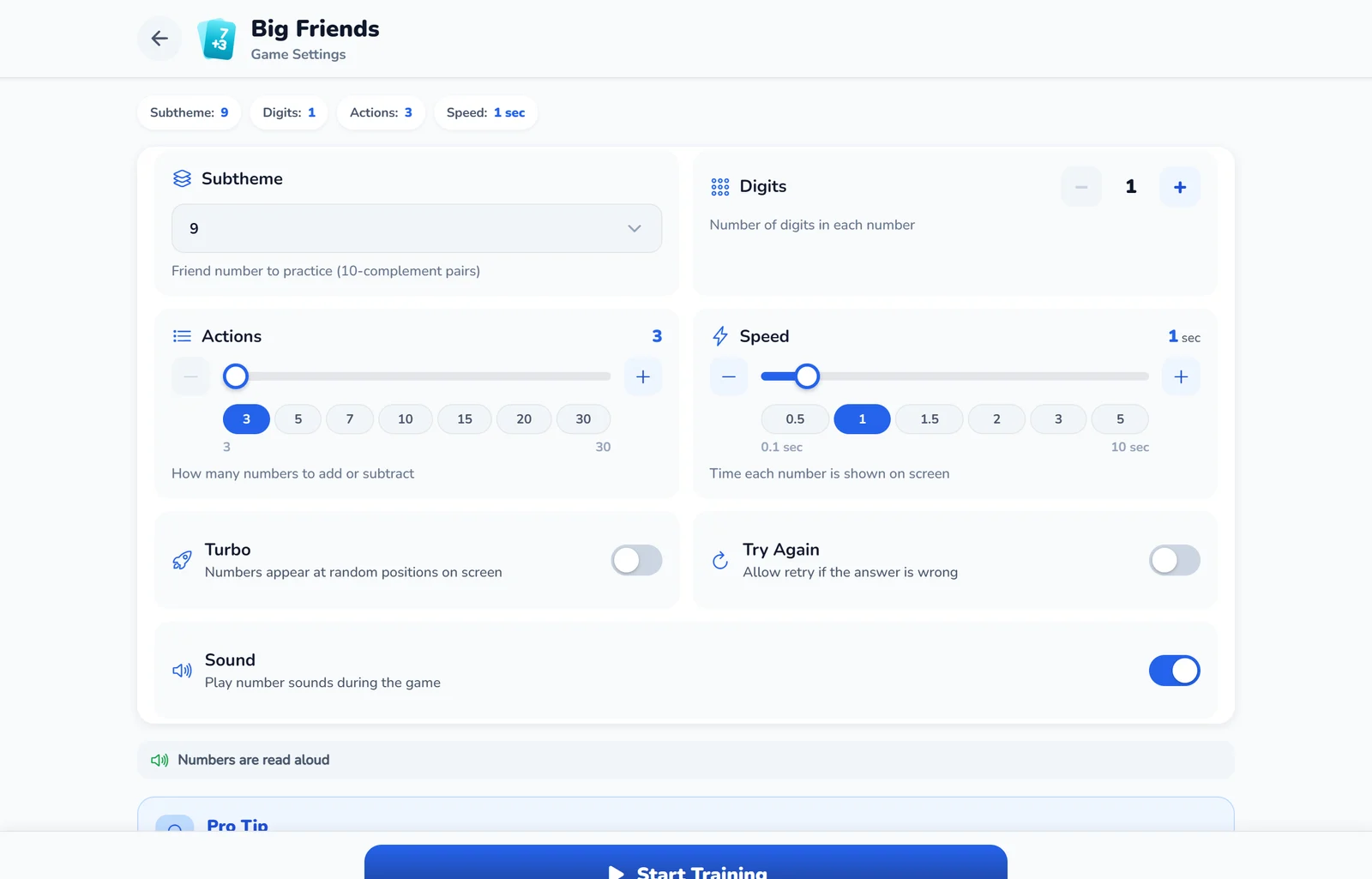
This is one of the places where a platform can make teacher diagnosis significantly easier. In Amavit, a teacher can quickly:
- select a topic;
- run a short practice block;
- review the result;
- switch to the previous topic;
- test again;
- continue moving backward until performance becomes stable.
The teacher does not need to manually search through a workbook for the right page, the right combination, the right difficulty or enough comparable examples. The platform allows the teacher to change the diagnostic condition almost immediately.
On the teacher’s Games tab, this means choosing a game (Simple, Small Friends, Big Friends…), the subtheme, the operations, digits, number of actions and the time each number is shown, then letting the child complete a short run. The result screen shows the accuracy, how many answers were correct and the average time per answer.
A simple diagnostic ladder
Imagine that the student is making repeated errors in an advanced subtraction topic. The teacher can test:
- Current topic ❌
- Previous topic ❌
- Previous topic ❌
- Earlier topic ✅
Last stable level → start diagnosis here, then move back up: technique → isolated → mixed → speed → complexity.
At each stage, ask: Is the skill stable here? If no: move back one more step. If yes: stop. You have found the last stable level.
Now move forward one step and analyse why the next level breaks down.
This is different from simply giving an easier exercise
The goal is not to make the child feel successful by reducing difficulty. The goal is diagnostic. We are looking for the transition:
stable → unstable
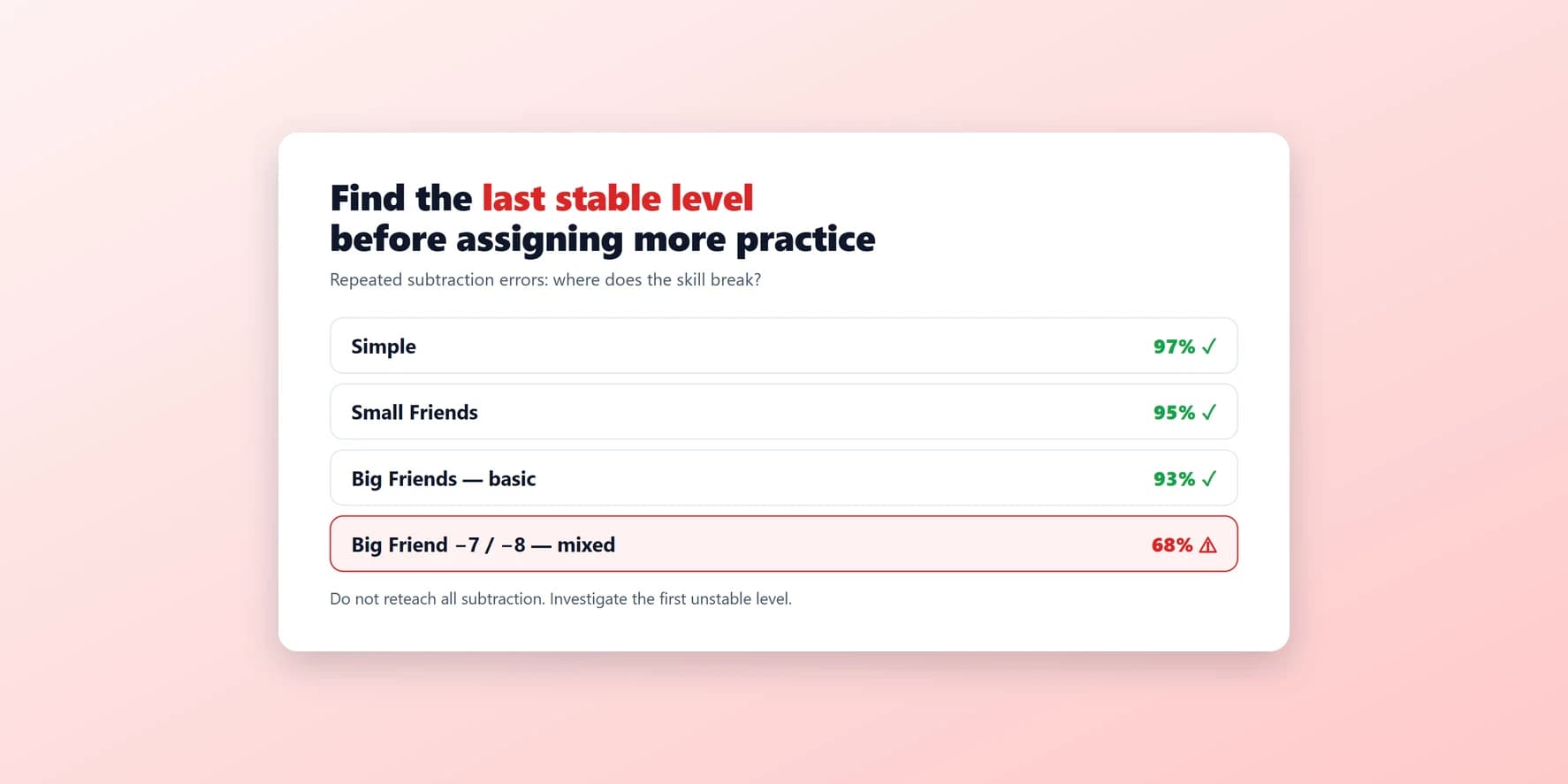
because that transition tells the teacher much more than one final percentage. For example:
| Simple subtraction | 97% — stable ✓ |
|---|---|
| Small Friends subtraction | 95% — stable ✓ |
| Early Big Friends | 93% — stable ✓ |
| Big Friend −7 / −8 (mixed) | 68% — unstable ⚠ |
Do not reteach all subtraction. Investigate the first unstable level.
Now the teacher has a much more precise problem to solve. Not:
“The child is weak at subtraction.”
But:
“The skill becomes unstable when these specific Big Friends combinations are introduced.”
That is actionable.
Why this is harder to do with a workbook
A skilled teacher can diagnose the same problem using textbooks and worksheets. Of course. But it takes more manual work. The teacher needs to find the correct page, select comparable examples, control the sequence, possibly write additional examples, change the level manually and track the answers.
If the next test needs another topic, the teacher repeats the process. With a digital platform, the topic can be changed in seconds. This matters especially when a teacher has many students, several groups and limited lesson time.
Workbook
Find page · select examples · prepare next level · track manually · repeat
Amavit
Select topic · test · switch topic · test · find the stable boundary
Same teaching principle. Faster diagnostic workflow.
The platform helps find where the problem starts
This is an important distinction. The platform does not automatically explain the cause. But it can help the teacher identify where performance begins to deteriorate. For example:
- Topic A — 96%
- Topic B — 94%
- Topic C — 91%
- Topic D — 68%
That immediately tells the teacher: Topic D requires investigation. Now teacher observation begins.
Data finds the boundary. The teacher finds the cause.
Once the weak boundary is identified, the teacher should ask:
- Does the child understand the rule?
- Is finger technique correct?
- Does isolated practice work?
- Does mixed practice fail?
- Is the speed too high?
- Does performance change with digit length?
- Does a longer chain create the problem?
- Is physical work stable but mental work weak?
The platform helps narrow the search. The teacher makes the methodological diagnosis.
The platform helps you find where the problem starts. The teacher decides why it starts.
Step 1: Check the rule slowly
Take the first unstable topic. Reduce the complexity. Use a physical abacus. Ask the child to perform the rule slowly. If necessary, ask:
“What are you going to do here?”
If the child cannot select the correct rule even at a slow speed, the problem is probably understanding or recognition. Do not increase speed yet.
Step 2: Check finger technique
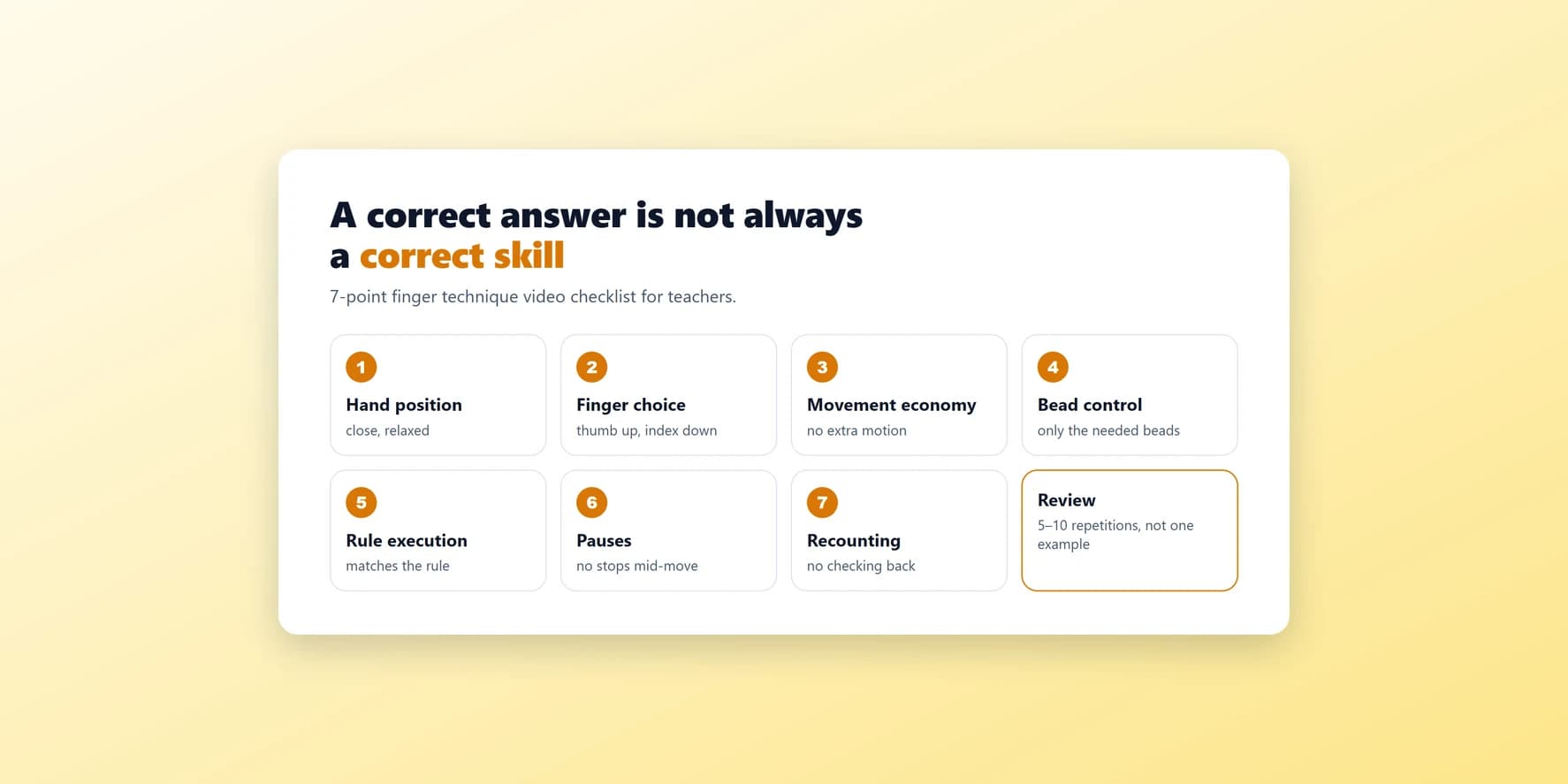
The child may understand the rule but perform it inefficiently. Look for wrong finger choice, extra movements, unnecessary corrections, pauses between parts of the combination and recounting after the movement.
Ask the child to repeat the specific problematic movement several times. If the same technical problem appears repeatedly, you have found another part of the cause.
Our finger technique video checklist lists exactly what to look for.
Step 3: Test isolated practice
Now test only the problematic combination. For example: only −7. If performance becomes stable, the child probably knows the movement. The next question is whether they can recognise it when other rules are mixed in.
Step 4: Move to mixed practice
Now combine the weak topic with familiar material. If isolated practice is strong but mixed practice falls sharply, the problem is likely not the physical movement itself. It may be rule recognition, selection or automaticity.
This requires a different type of practice — see why mixed practice matters.
Step 5: Change speed
Keep everything else the same. Only change speed. For example:
- 2 seconds — 95%
- 1.5 seconds — 92%
- 1 second — 74%
Now the diagnosis becomes clearer. The child knows the topic. The current difficulty is speed. The answer is not: more difficult examples. The answer may be: reduce speed and rebuild stability.
Step 6: Change digit length
Again, change only one variable. For example: one-digit subtraction — stable; two-digit subtraction — unstable. That suggests the rule itself may be understood, while place-value management creates the difficulty.
Do not automatically reteach the entire subtraction topic. Target the actual problem.
Step 7: Change chain length
The child may work well for 5 operations but begin making mistakes at 10 or 15. In that case, the weak point may be sequence stability, concentration or mental-image maintenance. Not the subtraction rule itself.
Step 8: Compare physical and mental performance
This is another powerful diagnostic comparison. If physical subtraction is stable and mental subtraction is unstable, the mechanical rule may already be consolidated. The problem may instead be mental-image stability, speed, chain length or insufficient mental practice.
But if the same errors appear physically, return to the physical foundation first — see physical vs mental abacus.
Change one parameter at a time
This is essential. If you simultaneously change topic, speed, digit length, chain length and mixed practice — and accuracy falls, you will not know why.
For diagnosis, change: one variable at a time. This is one of the biggest advantages of structured digital practice. The teacher can keep most conditions unchanged and alter only the parameter being tested.
- Topic ✓
- Speed
- Digit length
- Chain length
- Physical / mental
If you change four parameters at once, you do not know which one caused the error.
Weak topics should be tested precisely
Do not diagnose “subtraction is weak.” Try to reach:
“Big Friend −7 becomes unstable in mixed practice above this speed.”
That is a teaching decision. The more precise the diagnosis, the less unnecessary practice the child receives.
A practical example
Suppose a child is making many subtraction mistakes. The teacher checks: Big Friends mixed — unstable. Then: Big Friends isolated — mostly stable. Then: Small Friends mixed — stable.
Now the likely boundary is clear. The child has not lost subtraction completely. The difficulty begins when Big Friends must be recognised and selected inside mixed practice. The next assignment can be targeted accordingly.
Another example
Suppose: one-digit Big Friends — stable; two-digit Big Friends — unstable. The teacher now knows that simply repeating one-digit subtraction is unlikely to solve the problem. The child needs work on place value, two-digit transitions and appropriate speed.
Different diagnosis. Different homework.
Do not automatically make the task harder
When a child struggles, teachers sometimes try to “train through” the difficulty by increasing practice intensity. But the best next step may actually be slower speed, shorter chains, lower digit length, a return to physical practice or isolated rule work.
Reducing one parameter temporarily is not regression. It is a diagnostic and teaching tool.
After finding the weak point, rebuild forward
Once the last stable level and the first unstable level are known, progress becomes much clearer. A useful sequence is:
- Stable level
- Weak topic in isolation
- Correct technique
- Repetition
- Mix with one familiar topic
- Broader mixed practice
- Increase speed
- Increase complexity
This is much more efficient than random additional practice.
Do not keep the weak topic isolated forever
Isolation is useful for repair. But the child eventually needs to recognise the rule independently. So after the movement becomes stable: mix it with one familiar topic; then with several; then return to normal mixed practice.
The real goal is not: “The child can solve −7 when told that every example will contain −7.” The goal is: “The child recognises when −7 is required and performs it automatically.”
Regularity still matters
Sometimes the diagnostic search reveals no major technical problem. Then the teacher checks practice history and sees one session this week, two sessions last week.
In that case, the problem may simply be insufficient consolidation. Do not confuse lack of regular practice with lack of ability. The solution may simply be restoring consistency.
This is where platform history helps again
A teacher can look at practice frequency, homework completion, topic results, accuracy and speed. This gives additional context. The same 70% result means something different if the child practised five times versus once.
In Amavit, the teacher sees each student’s activity and homework completion; the parent’s progress screen shows accuracy and average time by type of practice.
A diagnostic checklist for repeated subtraction errors
When errors keep appearing, check:
- What is the last stable topic?
- At which next topic do errors begin?
- Does the child understand the rule?
- Is physical finger technique correct?
- Is isolated practice stable?
- What happens in mixed practice?
- What happens when speed changes?
- What happens when digit length changes?
- What happens when chain length changes?
- Is physical stronger than mental?
- Is practice regular enough?
This creates a much clearer diagnosis than simply saying “The child needs more subtraction practice.”
Amavit can make this process much faster
A teacher can move through topics and difficulty levels quickly. For example: test one topic; see errors; move to the previous topic; test again; continue until the last stable level is found. Then move forward and change one parameter at a time.
This makes it possible to locate a weak point with much less manual preparation. With a workbook, the same process is possible. But the teacher has to manually find or create the appropriate examples at each stage.
The educational principle is the same. The digital workflow is faster.
This matters more as the number of students grows
With five students, a teacher may have time to manually prepare diagnostic examples. With 30, 50 or 100 students, that becomes increasingly difficult.
A platform can reduce the administrative part of diagnosis. The teacher's time is then spent where it creates the most value: observing; interpreting; correcting; choosing the next step.
The platform should not replace the teacher
Amavit can help answer “Where does performance begin to break down?” But the teacher still answers “Why?” That distinction is important.
A repeated error can come from technique, rule recognition, speed, place value, chain length, mental-image stability or practice regularity. Only the teacher can combine the data with observation and make the correct methodological decision.
Different causes need different homework
| Cause | Homework |
|---|---|
| Technique problem | Slow physical practice |
| Rule-understanding problem | Return to explanation and isolated examples |
| Recognition problem | Isolated → limited mixed → broader mixed practice |
| Speed problem | Reduce speed and rebuild accuracy |
| Digit-length problem | Reduce digit length and increase gradually |
| Chain-length problem | Shorten the sequence |
| Mental problem | Return temporarily to physical or an easier mental level |
| Regularity problem | Restore consistent practice first |
This is real personalisation. Not a completely different curriculum for every child. Just the correct adjustment for the actual cause.
For a broader explanation of how repeated mistakes reveal weak topics, see why children keep making the same mistakes.
The main conclusion
When a child repeatedly makes subtraction errors, do not begin with “Give them more examples.” Begin with:
“Where is the last level that is still fully stable?”
Then find the first level where errors begin. That boundary gives the teacher a starting point. From there, test rule understanding, finger technique, isolated vs mixed practice, speed, digit length, chain length, physical vs mental and practice regularity. And change only one variable at a time.
A digital platform makes this process significantly faster because the teacher can switch between topics and settings without manually rebuilding each diagnostic exercise.
The platform helps identify where the weak point begins. The teacher determines why it begins. Only then should new practice be assigned.
Because the goal is not to make the child solve more examples. The goal is to find the weakest link, rebuild it and reconnect the child with the stable learning path.
Frequently asked questions
Why does a child keep making subtraction mistakes on the abacus?
The cause may be technique, one specific rule, poor rule recognition, excessive speed, digit length, chain length, mental-image instability or insufficient practice.
How can a teacher find the child's weak subtraction topic?
Start with the current difficult topic and move backward one level at a time until performance becomes stable. The first unstable level above that point is the best place to begin diagnosis.
Should a child simply practise more subtraction when errors repeat?
Not necessarily. Extra repetition is useful only when the teacher knows which skill or parameter needs reinforcement.
Why should teachers change only one parameter at a time?
Because changing speed, digit length, chain length and topic simultaneously makes it difficult to identify the actual cause of the error.
Can an abacus platform help diagnose weak topics?
Yes. A digital platform can make it faster to test different topics and settings under consistent conditions. Teacher observation is still required to determine the cause.
Can the same diagnosis be done with a workbook?
Yes, but the teacher usually has to select or create the appropriate examples manually, which can take more time.
What should happen after the weak level is found?
Repair the specific skill in isolation, confirm correct technique, gradually mix it with familiar topics and then increase speed and complexity.
What if physical subtraction is good but mental subtraction is weak?
The problem may relate more to mental-image stability, speed or chain length than to the subtraction rule itself.
Free for teachers