Planning Holiday Abacus Practice Without Overloading Families
School holidays create a difficult question for abacus teachers. What is better? Stop practice completely? Or continue almost at the normal learning pace?
Both extremes can create problems. If a child does not return to the skill for several weeks, some automaticity may weaken. But if the holiday becomes normal lessons, large homework assignments, daily parent supervision and constant reminders, the family may start feeling that mental arithmetic is one more obligation they can never take a break from.
Holiday practice therefore needs a different goal: not maximum progress, but maintaining the skill without overloading the child or the family.
Holiday abacus practice should usually focus on maintaining the skill rather than maximising progress. A few short sessions each week, familiar topics and simple reminders can help children stay connected to the skill without turning the holiday into a normal school routine.
Holidays are not a normal school week
During the school term, children usually have a relatively stable routine. School. After-school activities. Homework. Sports.
During holidays, that structure changes. Families may travel, visit relatives, wake up later, spend more time outside, have no normal study desk or leave workbooks at home.
Simply copying the normal homework schedule into the holiday period often does not work. And it does not need to.
The main holiday goal is to maintain contact with the skill
In most cases, a child does not need to spend a two-week holiday learning several new topics, dramatically increasing speed or moving to another level. It is usually more useful to:
- keep some regular contact with practice;
- review familiar topics;
- maintain the mental image;
- preserve confidence.
Holiday work is therefore often better treated as maintenance practice rather than intensive development.
Holiday practice should maintain the habit — not take over the holiday.
Less practice, more consistency
Instead of 30–40 minutes once a week, a child may benefit more from 5–10 minutes several times per week. This is easier to fit around family plans. The session does not feel like a large academic task. But the skill is still activated regularly — the same logic as in how often children should practise.
There is no single holiday schedule for every student
One child may need only 5–7 minutes. Another may already be advanced and accustomed to longer sessions. The teacher should consider age, current level, normal practice volume, length of the holiday, the child's motivation and whether a competition is approaching.
But the basic principle remains: holiday practice should usually feel lighter than normal training.
Daily practice is not always necessary
A daily obligation can become irritating when a family is on holiday. For many children, 3–4 short sessions per week may be enough to maintain the skill.
The important thing is to avoid a complete break for several weeks when the skill is still developing.
Familiar topics usually work best
Holidays are not always the best time to introduce a difficult new topic. Especially if there is no regular lesson, the teacher cannot closely observe technique and the child is practising independently.
Most holiday practice can focus on familiar topics, mixed review, comfortable speed and maintaining accuracy. Complex new algorithms are usually better introduced when the teacher can observe and correct the child properly.
Strong students can still have a challenge
If a student has trained for a long time, is highly motivated, asks for more or is preparing for a competition, the teacher can add a speed challenge, longer chains, mental practice or competition-style exercises.
But this should be an individual decision. Holiday practice does not need to be identical for everyone.
Do not use the holiday to “fix everything”
A common temptation is:
“There are two free weeks. Now we can finally close every gap.”
The teacher assigns weak topics, new topics, large workbook sections, speed work, mental work and extra exercises. The result can be more homework than during the normal school term. That is rarely a good holiday strategy.
Choose one or two priorities. For example: maintain Small Friends; preserve mental speed; keep two-digit accuracy stable. That may be enough.
Holiday homework should be extremely clear
During a holiday, families should not have to ask:
“What exactly were we supposed to do?”
Use a simple structure. For example: 3 short sessions per week, each 5–10 minutes, with one familiar topic, a short mixed block and mental practice if appropriate.
The simpler the plan, the more likely it is to happen.
Give families a minimum and an optional level
For example: Minimum — three short sessions per week. Optional — one additional challenge for students who want to do more.
This changes the psychology of the homework. The required part feels manageable. The extra work becomes a choice rather than another obligation.
Holiday practice can have different levels
- Light — for travelling families or children who need more rest.
- Standard — for normal maintenance.
- Intensive — for motivated students or those preparing for a competition.
This is usually better than sending exactly the same holiday homework to every student — the same idea as in teaching a mixed-ability group.
| Light | Standard | Competition |
|---|---|---|
| 2–3 short sessions | 3–4 sessions | Individual plan |
| 5–7 min | 5–10 min | Accuracy + speed |
| Familiar topics | Mixed review + mental | Competition format |
Different goals require different holiday plans.
The biggest holiday problem is often not difficulty — it is forgetting
This is where holiday practice becomes different from normal homework. During the school term, the family has routines. During a holiday, days are less structured, parents are distracted, children are excited and travel changes plans.
Even if everyone genuinely intends to practise, they may simply forget. Then the teacher has three options. The teacher can send repeated WhatsApp reminders, depend on the parent to remember, or use a system that keeps the task in front of the child.
The third option can reduce a great deal of unnecessary administration.
Teachers should not need to send daily WhatsApp reminders
Imagine a teacher has 30, 50 or 100 students. If holiday practice depends on messages such as “Do not forget to practise today,” the teacher has not really gone on holiday either. And parents may begin to experience the messages as pressure.
A better system is one where the homework is prepared in advance and the platform itself keeps it visible.
Parents should not have to remember everything either
Parents are on holiday too. They may be travelling, organising family activities, working remotely or looking after several children. A holiday plan that works only if the parent remembers every session is fragile.
Ideally, the child should gradually take some responsibility for their own practice. A digital routine can help.
Notifications can bring practice back to attention
A short reminder can be enough. Its role is simply to bring the learning task back into attention — not to demand a long session. The family may have completely forgotten about practice. A small signal can remind them:
“There is still a short activity to complete today.”
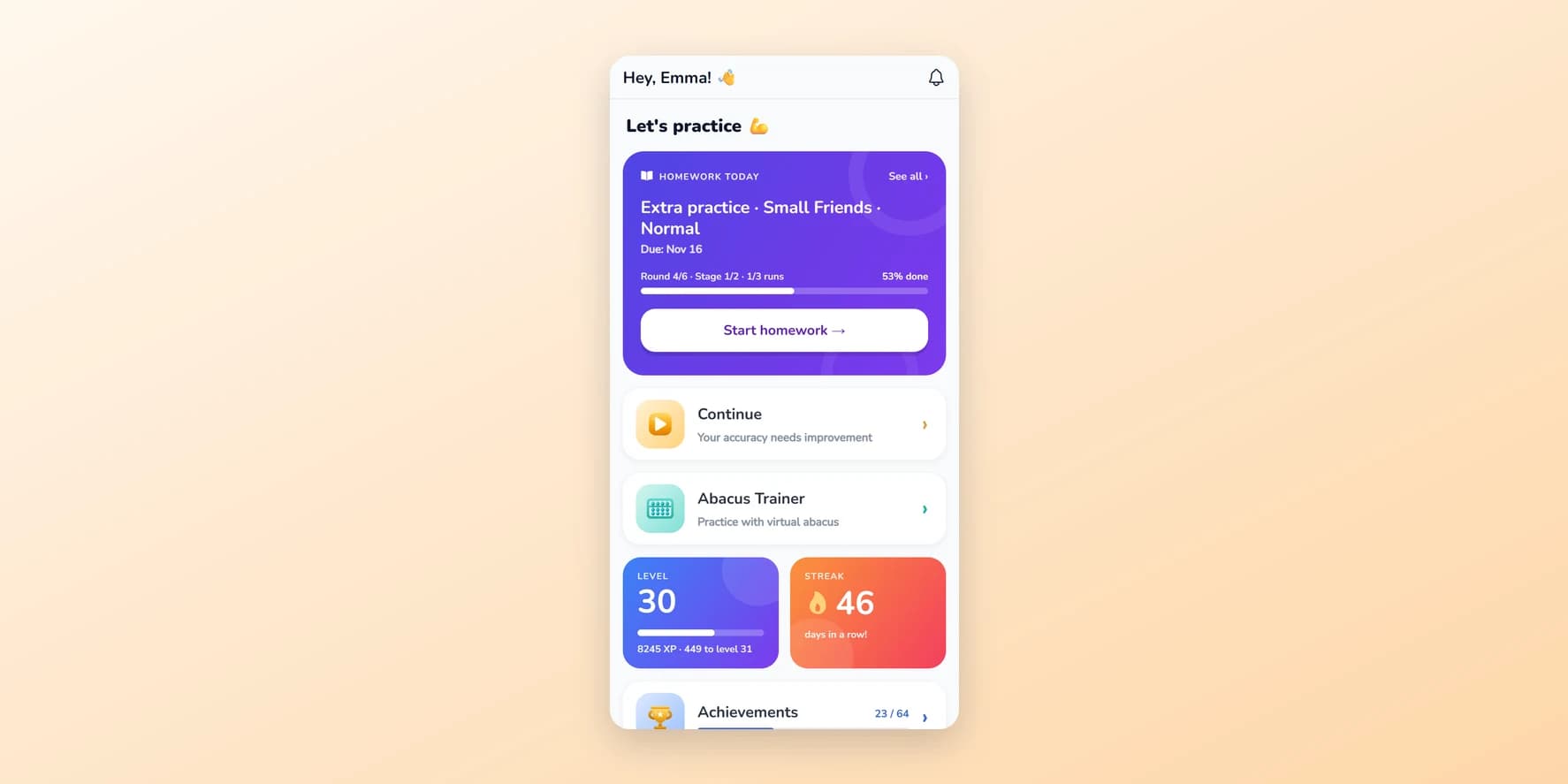
In Amavit, the child and the parent get a notification when the teacher assigns or changes homework. After that, the assignment stays at the top of the child’s home screen as Homework Today until it is done, and the parent’s home screen shows whether the child has practised today. Amavit does not currently send daily “you missed practice” pushes — the reminder is the task itself, waiting where the child opens the app.
Streaks can be particularly effective during holidays
A streak gives the child a simple reason to return. Not:
“I have to study for 30 minutes.”
But:
“I only need to do a little practice to keep my streak going.”
That is psychologically much easier. A short session may be enough to maintain continuity, habit and contact with the skill. This is particularly useful during periods when normal routines disappear — see also how to keep children motivated.
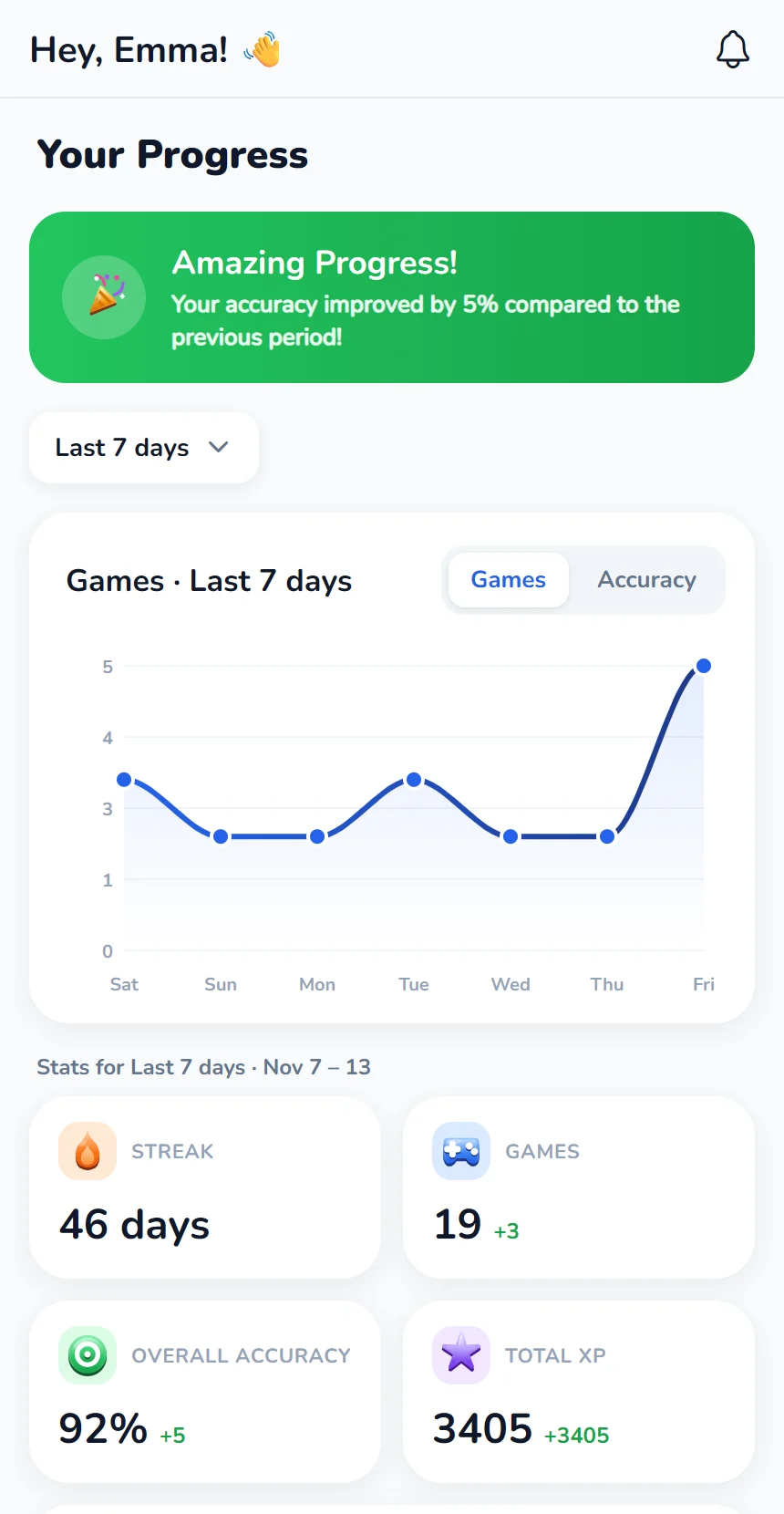
In Amavit, the streak counts the days in a row with practice and sits on the child’s home screen with a simple prompt: “Play today to keep it!”
The application can carry part of the reminder work
This is an important practical advantage.
Without a platform
Teacher reminds the parent → parent reminds the child → the child may still forget. Every time, by hand.
With a platform
Teacher sets the holiday plan once → the homework is already there → the family is notified → the streak gives a reason to return → the child completes a short session
Less chasing. More consistent practice.
The teacher is still responsible for creating an appropriate holiday plan. But the routine reminder process does not need to depend entirely on human memory.
Technology should reduce the amount teachers and parents need to remember.
Reminders should motivate, not create anxiety
There is an important boundary. A streak should encourage the child to return to practice. It should not create real stress. The message can communicate:
“Your streak is at risk — complete a short practice session today.”
But the child should not feel that missing one holiday day is a disaster. Gamification should support a habit. Not create guilt.
The best holiday reminder leads to a small, achievable task
If the reminder opens an assignment that requires 40 minutes, several workbook pages or a new difficult topic, the child may simply close it. If it opens 5–10 minutes of familiar practice, the barrier is much lower.
So reminders and workload should work together. The application can keep the task visible. But the teacher still needs to design an appropriate holiday task.
- Short assignment
- Visible reminder
- Child practises 5–10 minutes
- Streak continues
- Next short session
5–10 minutes can be enough.
The best reminder leads to a small, achievable task.
This is where Amavit is particularly useful
The teacher can prepare holiday homework in advance: selected topics, short practice volume, appropriate speed, different difficulty levels and a deadline that covers the break. Then Amavit helps keep the practice visible through the assignment on the child’s home screen, the notification when it is assigned, the streak and other motivational elements.
The family does not have to search old WhatsApp messages. The teacher does not need to send daily reminders. And the parent does not need to carry the entire responsibility for remembering.
Parents should support the habit — not carry the whole reminder system.
Holiday practice can also be done independently with an online abacus trainer.
Workbooks can still be part of the plan
Digital practice does not mean abandoning paper. If the child enjoys workbook practice or the teacher believes it is useful, the holiday plan can include a few pages, a short worksheet or physical abacus work.
But the amount should stay reasonable. The family should not need to pack a suitcase of educational materials.
Travel changes what is practical
Sometimes the child has no printer, no normal desk, no workbook and limited luggage. In those situations, digital or mental practice may become more important temporarily.
The goal is flexibility. Not forcing every family into the same format.
Do not punish missed holiday practice
If the child misses a few sessions, there is no need to return with “Now you must catch up everything.” Instead: check the current level; see what remains stable; reduce speed temporarily if needed; restore the routine.
A holiday should not create educational debt.
Do a short check after the holiday
Not an exam. Just a few familiar tasks. Check accuracy, speed, older topics and mental stability. If everything is stable: continue. If something weakened: review briefly.
The first lesson back can be slightly easier
After two or three weeks away, the child may not immediately return to their previous speed. That is normal. Begin with familiar topics, slightly slower speed and shorter chains. Then increase the workload again.
Do not confuse temporary rust with skill loss
A child may perform below normal for the first few minutes after a holiday. That does not mean the skill disappeared. Sometimes it simply needs reactivation. A few sessions may restore the previous level quickly — progress is not always linear.
Give parents a very simple message
For example:
During the holidays, we are not expecting the normal study workload. The goal is simply to maintain the skill. A few short practice sessions each week are enough. The assignment will be waiting on your child's home screen in Amavit. If a session is skipped, there is no need to worry — we will gradually return to the normal routine after the holiday.
This reduces unnecessary pressure.
Parents should not need to supervise every session
If the child is sufficiently independent: give them a clear assignment; let them open the application; complete the practice; see their result; maintain their streak.
The parent can remind when necessary. But the holiday should not become a daily negotiation: “Have you done your mental arithmetic yet?” — see how parents can support a child without becoming a second teacher.
Holidays can be a good time for motivational practice
Not everything has to feel like normal homework. Teachers can use short challenges, games, personal records, streaks, small achievements and family mini-competitions.
The goal is to keep practice light enough that the child wants to return.
Streaks are a tool, not the goal
A streak is useful if it supports consistency. But the real purpose is still maintaining the skill. The child should not practise only because a number on the screen must survive.
Gamification is the hook. Learning is the purpose.
The child's goal matters
There is a major difference between a student following a normal course and a student competing in two weeks. The second student may need a much more intensive holiday plan.
The teacher needs to decide: maintenance or preparation? These are different tasks.
Holiday maintenance
Goal: preserve the skill. Priorities: short sessions · regular contact · familiar topics · comfortable speed · low pressure
Competition preparation
Goal: maintain or improve performance. Priorities: accuracy · competition format · speed · stability under pressure · specific weak topics
The second is no longer a standard holiday plan.
Prepare holiday practice in advance
Do not wait until the final lesson before the break. Prepare the plan early. The teacher can identify who is travelling, how long the break lasts, who has a competition and who only needs maintenance. Then different holiday plans can be assigned in advance.
Use reusable holiday templates
For example: Holiday Light, Holiday Standard, Holiday Competition. Then adjust only a few parameters for each child. This reduces teacher workload significantly.
Amavit can support holiday templates
The teacher can prepare short assignments with selected topics, different speeds and different difficulty levels, and keep them as saved presets. A stronger child may receive a more intensive version. Another child: standard practice. A family taking a real break: light maintenance.
The teacher does not need to manually rebuild every holiday assignment.
Automation should also give the teacher a holiday
Teachers need rest too. If holiday practice requires daily WhatsApp reminders, manual screenshot collection, individual chasing and constant checking, the teacher continues working throughout the break.
If assignments are prepared in advance and the platform keeps them visible and collects the results, the teacher can step back. They can review the bigger picture later instead of acting as a daily dispatcher.
Academies should have a consistent holiday policy
If several teachers work in one academy, it can be confusing when one teacher assigns heavy holiday homework, another assigns nothing and a third sends daily reminders. A simple academy-wide principle can help. For example:
- short breaks — optional maintenance;
- longer breaks — light regular practice;
- competition students — individual plans.
The exact policy can vary. Consistency is what matters. If 300 students go on holiday, teachers should not have to remind 300 families by hand: the academy can prepare Holiday Light, Holiday Standard and Holiday Competition once, and teachers only assign each child to the right plan.
Holiday policy also helps parents
Families know what is expected, how much time is required, how important the assignment is and what happens if they miss a session. That reduces unnecessary questions.
Do not lose the child because of holiday homework
If mental arithmetic starts to mean “Even on holiday, I am not allowed to rest,” something has gone wrong. Especially for children who have already trained for a long time.
Sometimes less is better. Because the learning journey lasts months, often years.
Long-term consistency matters more than a perfect holiday
One missed day does not destroy the skill. Several missed sessions are not a catastrophe either. What matters more is returning, continuing and maintaining the habit over the long term.
Example holiday plans
| Standard student | 3 times per week · 5–10 minutes · familiar topics + a short mixed block · no difficult new topic |
|---|---|
| Strong student | 3–4 sessions · 10–15 minutes · mixed practice + speed challenge + mental calculation |
| Competition student | Individual plan · regular competition-format practice · weak-topic work · accuracy first |
That is usually enough.
How Amavit can help
In Amavit, teachers can prepare different holiday assignments with their own topics, speed, volume, difficulty level and deadline. The child receives a clear task. The application keeps that task visible on the child’s home screen and adds motivational mechanisms such as the streak.
The teacher can review homework progress without collecting daily screenshots or sending repeated WhatsApp messages. And different students can receive different holiday plans without the teacher rebuilding everything manually — see also moving abacus homework beyond WhatsApp.
The main conclusion
Holidays are not the time to completely forget mental arithmetic. But they are also not the time to recreate a normal school week. A good holiday plan is usually shorter, lighter, more flexible and focused on maintaining the skill.
The teacher needs to decide maintenance or competition preparation, choose a manageable workload, keep familiar topics active, avoid overloading the family and allow the child to genuinely rest.
The platform can then handle part of the routine: keep the homework visible; let the family know when it is assigned; support a streak; reduce the need for daily teacher messages; reduce the amount parents need to remember.
That is where technology becomes particularly useful during holidays. It does not make the child study more. It makes it easier to remember to study a little. And for long-term skill development, that small difference can be very valuable.
Frequently asked questions
Should children practise abacus every day during school holidays?
Not necessarily. For many children, a few short sessions per week may be enough to maintain the skill, depending on level and goals.
How long should holiday abacus practice be?
Holiday practice can often be shorter than normal homework. A brief 5–10 minute session may be enough for maintenance for many students.
Should children learn new abacus topics during holidays?
Usually familiar topics are easier to manage when the teacher is not closely supervising. New complex material may be better introduced during normal lessons.
Can children stop practising completely during holidays?
A short break is not catastrophic, but maintaining some contact with the skill can make the return to normal training easier.
How can teachers remind students without messaging parents every day?
Prepare the holiday homework in advance on a digital platform. The assignment then stays visible on the child's screen, the family is notified when it is assigned, and a streak gives the child a simple reason to come back.
Are streaks useful for holiday practice?
They can be useful when they encourage a short, manageable session. They should support consistency without creating unnecessary pressure.
Should competition students follow the same holiday plan?
Not always. Students preparing for competition may need a more structured individual plan with accuracy, speed and competition-format practice.
Free for teachers