Why Children Lose Interest in Mental Arithmetic — and How to Keep Them Motivated
Mental arithmetic requires consistency.
It is not enough for a child to attend one lesson a week. Real progress comes from repetition:
- today;
- tomorrow;
- the day after;
- week after week;
- month after month;
- year after year.
And this creates one of the biggest challenges in mental-arithmetic education.
It is not simply teaching a child how to calculate. It is helping the child continue long enough for the skill to become truly stable.
Even the best methodology cannot produce its full result if a child stops halfway through the process.
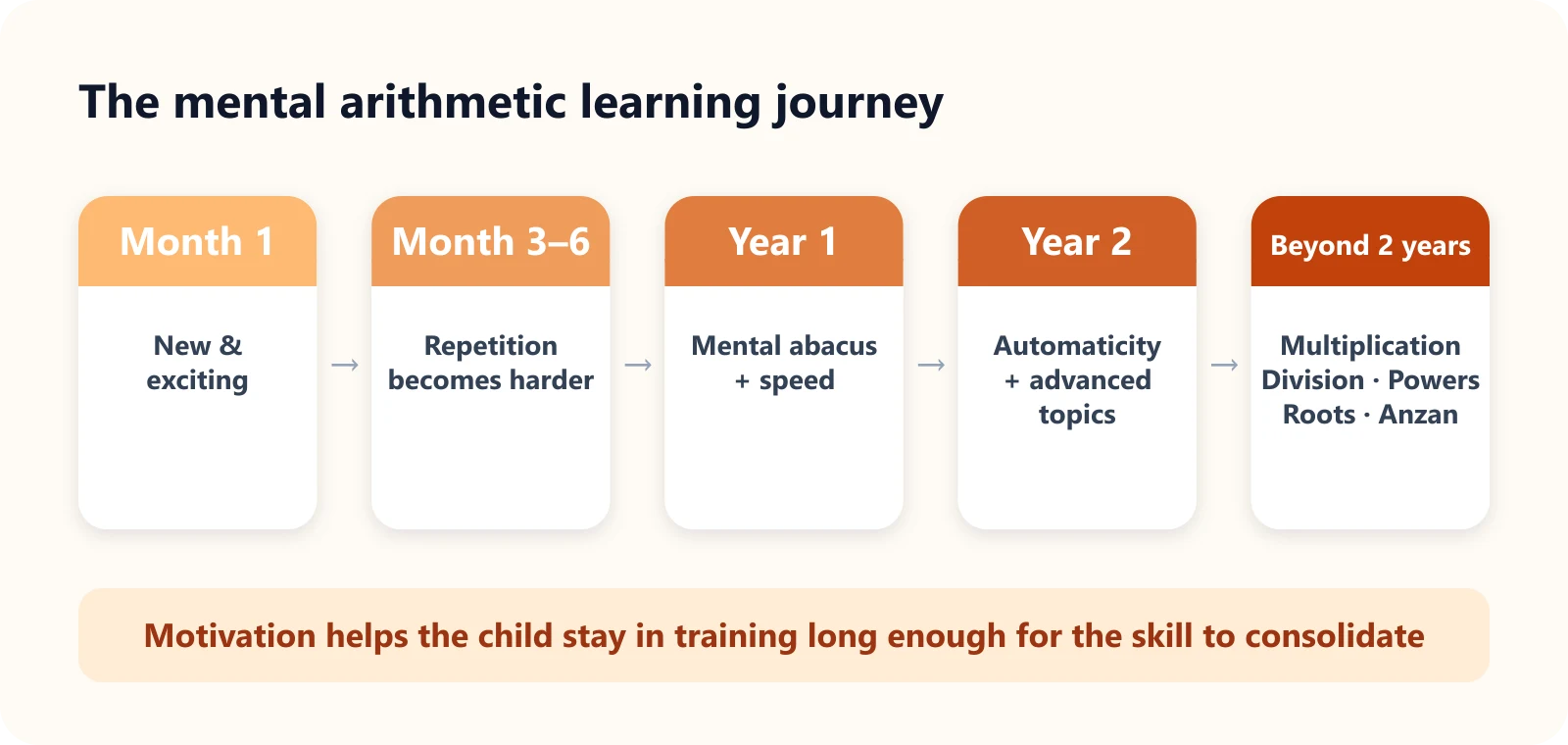
At the beginning, almost everything feels exciting
The first lessons are usually easy to enjoy.
- A new abacus.
- Beads.
- A completely different way of calculating.
- New exercises.
Children are curious to try it.
Each new topic gives a quick sense of progress:
yesterday they could not do it; today they can.
But after several months, things begin to change.
- The basic principles are familiar.
- The number of repetitions increases.
- More difficult topics appear.
- Home practice becomes regular.
- The feeling of novelty gradually disappears.
And this is exactly the point where motivation may begin to fall.
Why stopping too early is a serious problem
Mental arithmetic is not a short course where a child simply learns a few rules.
The deeper goal is to gradually transform difficult conscious actions into a stable, highly automated skill — and that skill is what mental arithmetic is really about.
That requires:
- repetition;
- consistency;
- gradual progression;
- and enough time.
From our long-term practical experience, around two years of regular training should be viewed as a minimum full learning cycle rather than an upper limit.
2 years = minimum full learning cycle
A practical guideline based on long-term teaching experience, not a fixed rule for every child.
A child who studies for much less time may already show visible results, but the skill may still be relatively fragile.
- Speed may have increased.
- The mental abacus may already be developing.
- Some operations may feel easier.
But if training stops completely at that stage, part of the progress can weaken surprisingly quickly.
- Speed declines.
- The mental image of the abacus becomes less stable.
- Actions that were beginning to feel automatic require conscious effort again.
It is similar to learning to drive
A driving instructor can explain everything perfectly.
- How to brake.
- How to turn.
- How to use mirrors.
- How to change lanes.
- How to park.
A learner may complete several successful sessions with an instructor. But that does not mean the skill is fully established.
The driver still needs experience. The same actions have to be repeated hundreds and thousands of times.
Turning. Braking. Changing lanes. Checking mirrors. Parking.
Eventually, the driver stops consciously thinking about every movement. Many actions become automatic.
That is when the skill becomes much more stable.
Something similar happens with mental abacus.
First the child thinks — later the child simply does
At the beginning, almost every action requires attention.
- The child remembers the rule.
- Visualises the beads.
- Thinks about how they should move.
- Checks the result.
After many repetitions, the process becomes faster.
Eventually, the child no longer needs to consciously analyse every small movement. A number appears — and the mental abacus changes almost automatically.
But this cannot happen after a few weeks. Or even after only a few months.
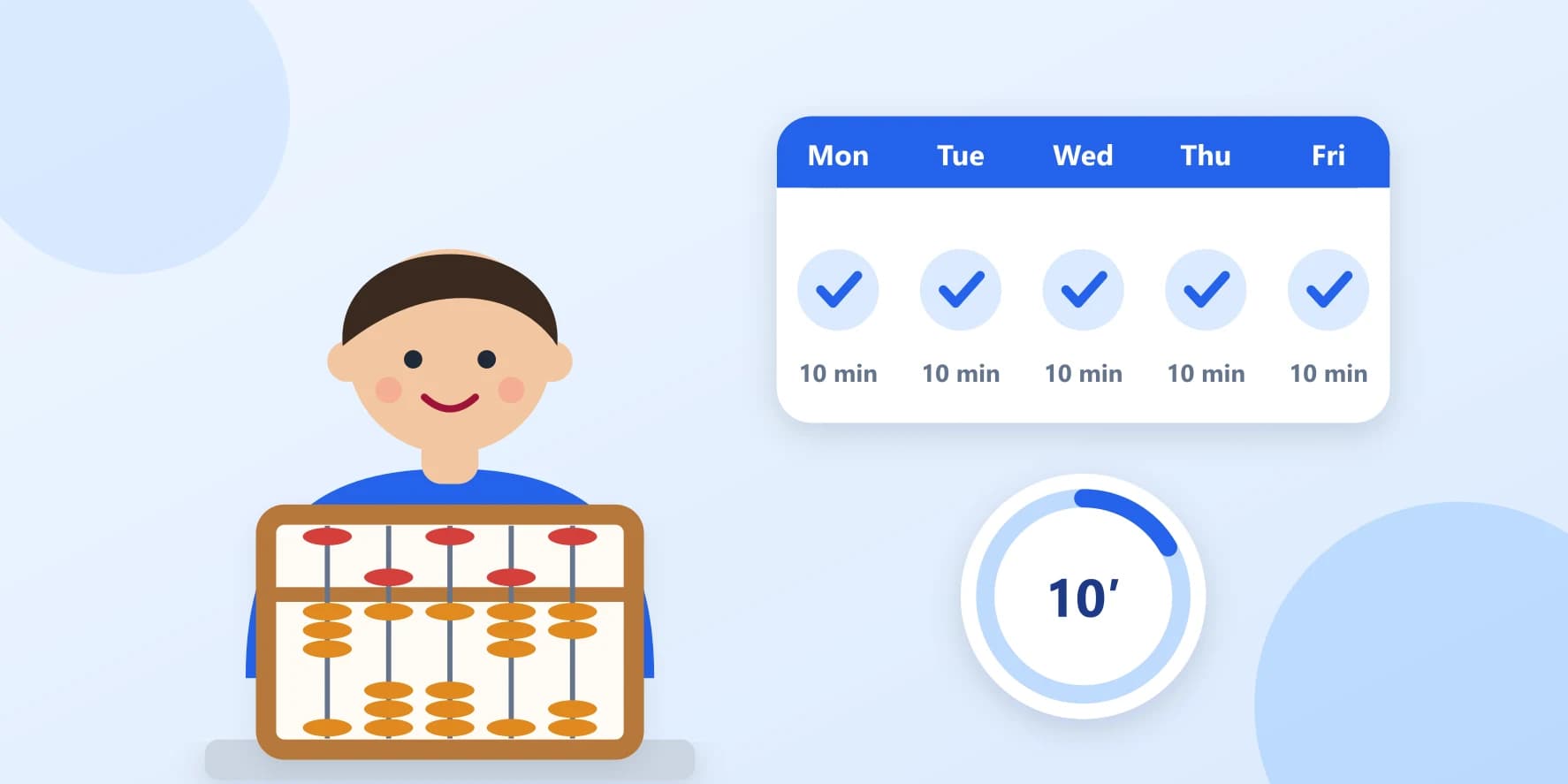
It takes a very large number of correct repetitions — see how much practice a child needs each day.
That is why the duration of training matters so much.
Two years is the minimum — not the finish line
Another common misunderstanding is that mental arithmetic ends once a child can add and subtract quickly.
It does not.
As the student develops, the program continues to become more challenging. After basic operations come more advanced areas:
- multiplication;
- division;
- powers;
- roots;
- larger numbers;
- longer calculation chains;
- higher speed;
- Anzan and advanced training formats.
So after two years, a child should not necessarily feel:
“I have finished everything.”
In many cases, this is the point at which a strong foundation has been created and more advanced development becomes possible.
The longer a child continues, the deeper the automaticity becomes and the more sophisticated the training can be.
More advanced content also helps preserve interest
This point is important.
If a child spent two years doing exactly the same addition and subtraction exercises, boredom would be understandable.
But a well-designed program should continue evolving.
- At first, the child works with single-digit numbers.
- Then two-digit numbers.
- Then three-digit numbers.
- Multiplication appears.
- Division.
- Powers.
- Roots.
- Higher speed.
- Competition formats.
- Anzan.
So the child is not simply repeating the same skill forever. The challenge keeps changing.
This helps solve two problems at the same time:
consolidating existing skills
and maintaining interest through increasing complexity.
If training stops halfway, part of the effort may be lost
Imagine a child who has trained for four or five months.
- They have already learned something new.
- They calculate faster.
- A mental abacus is beginning to develop.
The parents see the progress and think:
“Great. The goal has been achieved. We can stop now.”
But this may be exactly the wrong moment to stop.
The skill exists, but it is not yet stable enough. If practice stops completely, part of the progress may gradually disappear.
- The parents invested money.
- The child invested time.
- The teacher invested effort.
But the main objective — building a durable skill — was never fully completed.
That is why a strong program should not only make the first month interesting. It needs to help the child continue long enough for the skill to consolidate.
The biggest problem is repetition
Mental arithmetic naturally requires a huge amount of repetition.
To automate an action, the child needs to perform it dozens, hundreds, and eventually thousands of times — that is also how calculation speed grows from seconds to fractions of a second.
Methodologically, this is correct. For a child, it can become boring.
Imagine two years of home practice that always looks the same:
- open the workbook;
- complete one page;
- complete another page;
- close the workbook.
Again tomorrow. And again. And again.
Even a disciplined child may struggle to continue with that format for a long time.
The problem is not repetition itself. Repetition is necessary.
The real problem is:
how do we organise thousands of repetitions so that the child is willing to continue?
A child does not need motivation for one lesson. They need enough motivation to complete thousands of repetitions over several years.
This is where a digital platform changes the experience
A printed workbook is limited. The exercises are prepared in advance. The child solves them one after another.
A digital platform can turn the same necessary repetition into many different forms of practice. Today it may be:
- a virtual abacus;
- tomorrow — flashcards;
- mental calculation;
- listening exercises;
- a game-based task;
- speed training;
- practice on a specific topic;
- a competition-style format.
The methodological objective does not change:
the child still needs the necessary number of correct repetitions.
But from the child's point of view, the experience is no longer identical every day.
This is one of the reasons Amavit was created
Amavit does not replace workbooks. They remain an important part of the learning process.
But if a child is going to study for two years or longer, workbooks alone may not be enough to maintain motivation for many students.
The risk is that repetition becomes boring before the skill has had time to consolidate.
That is why Amavit uses different training formats and allows the difficulty to develop over time.
Teachers can change:
- exercise type;
- speed;
- number of digits;
- chain length;
- topic;
- number of operations;
- presentation format.
The repetitions remain. But the way the child experiences them changes.
This can make a long learning process much easier to sustain.
What we observed in our own centres
For us, this is not only a theoretical idea.
We observed the effect in our own education centres and across our franchise network.
According to our internal data and practical observations, when a digital training platform was actively used, children continued studying approximately three times longer than in a more traditional model based mainly on workbooks and standard homework.
That is a major difference. And the important question is why it happens.
The platform does not remove the need for practice. The child still completes a large number of exercises.
But variation in formats, visible progress, game mechanics, and regular feedback can help the child stay engaged for much longer.
And that additional time is what allows the skill to consolidate more deeply.
Children need to see progress
Adults can sometimes tolerate boring work for a result that will arrive years later. Children usually find that much harder.
Telling an eight-year-old:
“Keep practising for two years and then you will see the result”
is rarely very motivating.
The child needs a result today. This week. This month.
That means a large long-term goal needs to be broken into many smaller achievements. For example:
- yesterday the child calculated at 2 seconds per operation;
- today they are faster;
- yesterday one topic produced many errors;
- today it is almost correct;
- they reached a new level;
- earned an achievement;
- set a personal record.
The child needs to regularly feel:
“I am getting better.”
Motivation works better when there are many small goals
A distant goal feels abstract. Small goals are easier to understand. For example:
- finish today's practice;
- continue a streak;
- earn a medal;
- reach the next level;
- open a chest;
- improve a personal record;
- move into a new league;
- earn more points.
Each individual goal is small. But together they create a constant sense of movement.
The child repeatedly receives the message:
“I have taken another step.”
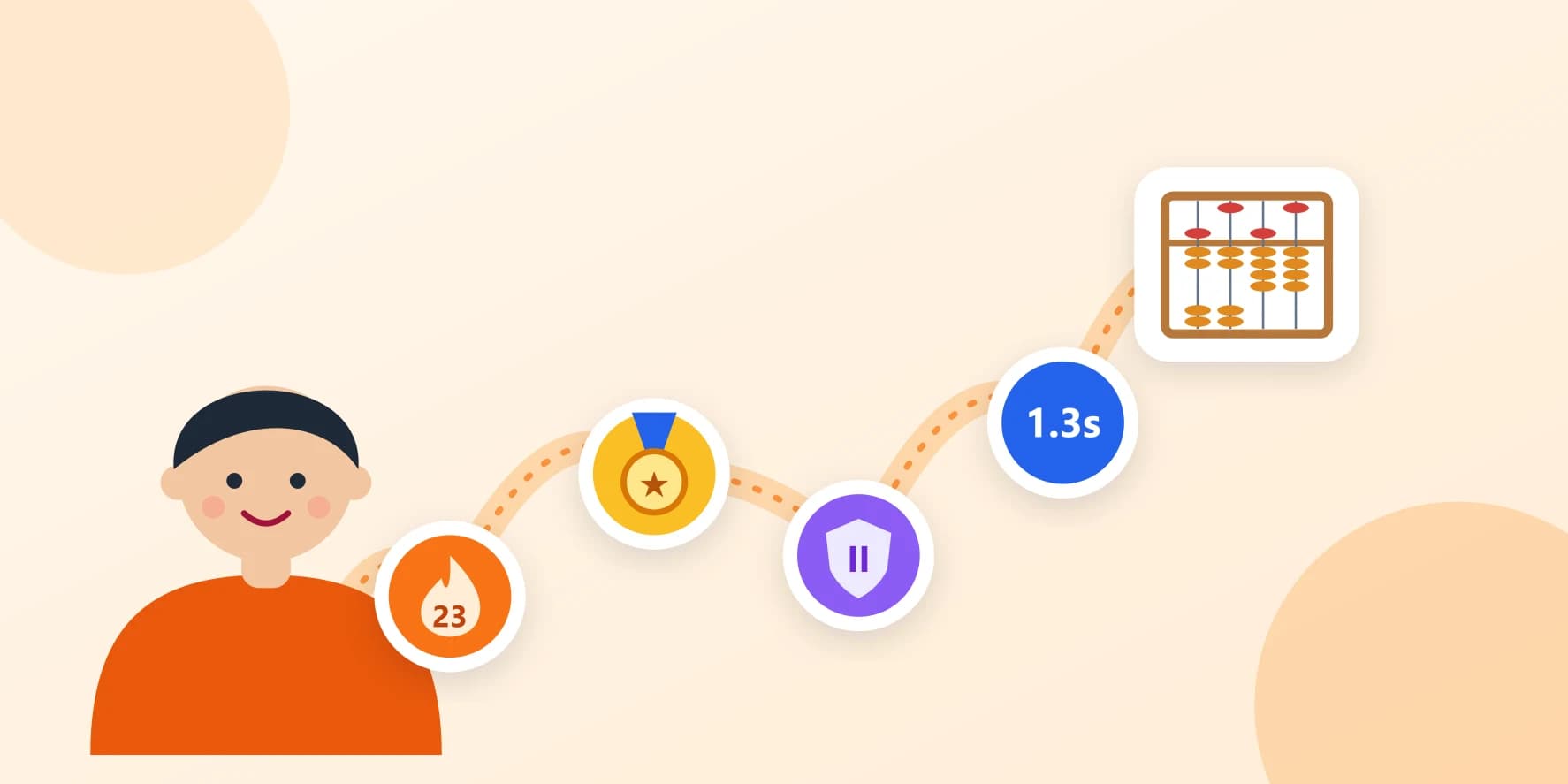
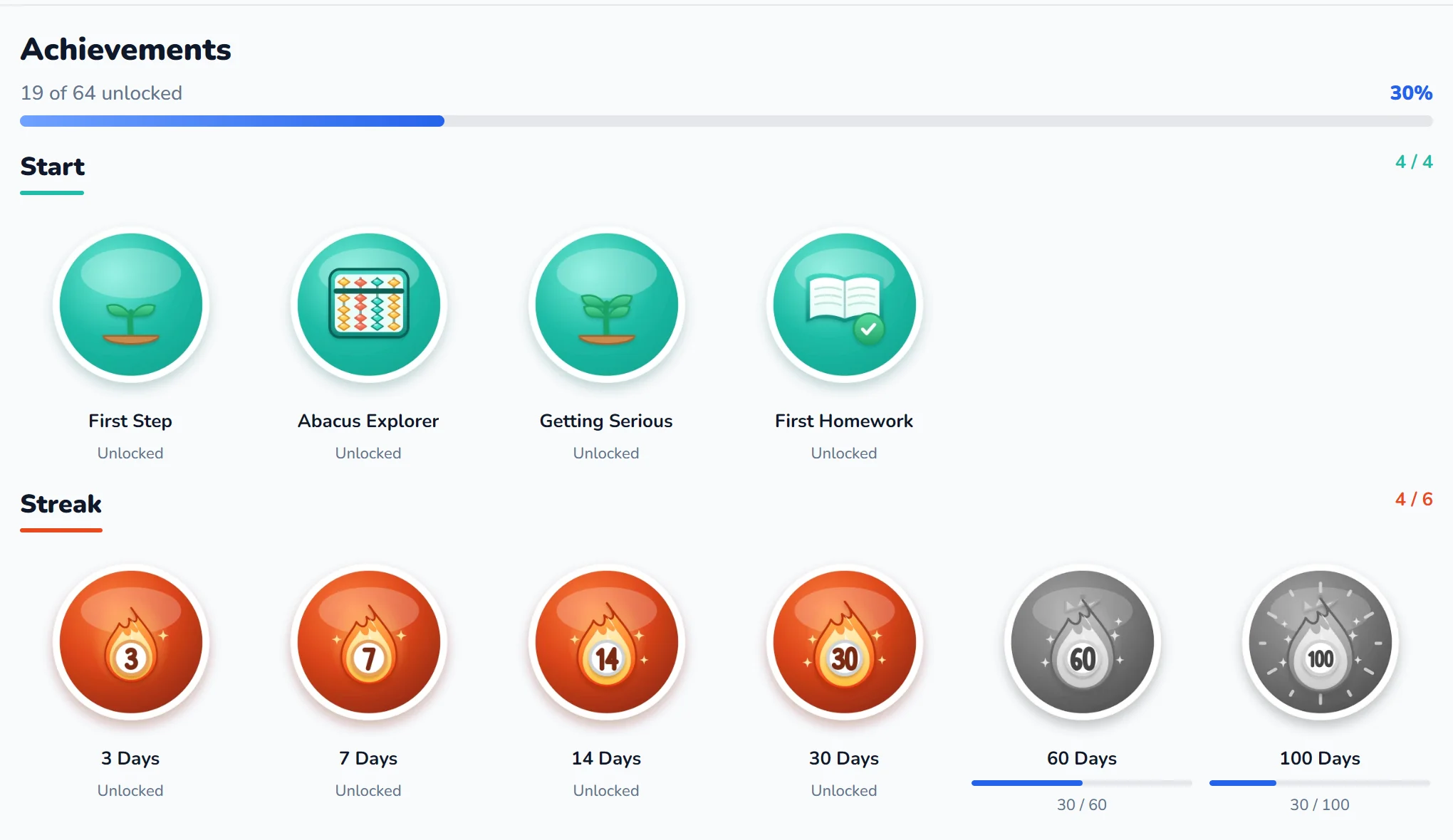
A streak is simple, but powerful
A streak shows how many days in a row the child has practised.
3 days. 7 days. 20 days. 50 days.
For an adult, this may look like just a number. For a child, it becomes an achievement.
If the streak has reached 23 days, losing it on day 24 suddenly feels disappointing.
Sometimes that small reason is enough for the child to open the training even on a day when motivation is low.
And this is particularly valuable in mental arithmetic. Because the skill is not built by occasional bursts of enthusiasm. It is built by consistency.
But a streak alone is not enough
If the only reason to practise becomes:
“I do not want to lose my streak,”
the effect will eventually weaken.
That is why motivation needs several different elements.
- Streaks.
- Personal records.
- Achievements.
- Medals.
- Leagues.
- New levels.
- Game mechanics.
- Competitions.
- Teacher feedback.
- Visible progress.
Each mechanism works in a slightly different way.
Medals should represent real achievements
A medal should not appear simply because the child opened the app. It should correspond to a real result. For example:
- 100 correct examples;
- one month of consistent training;
- mastering a new topic;
- a new speed level;
- a new number of digits;
- a certain number of completed training sessions.
Then the reward becomes evidence:
“You really have improved.”
Leagues and levels create a sense of journey
Children need to understand not only:
“Where am I now?”
but also:
“Where am I going next?”
The next level should be visible. And it should feel achievable.
This principle is familiar from video games. Players rarely think only about the final ending. They want:
- one more level;
- one more achievement;
- one more reward.
Education can use the same principle — as long as the rewards are connected to real learning.
Competition works for some children, but not all
Some children love competition.
They want to be first. They compare speed. Points. Streaks. League position.
For them, rankings can be extremely motivating.
Another child may react very differently. If they constantly see themselves near the bottom, motivation can fall.
That is why competition with other students should never be the only motivational system.
The most universal competitor is yesterday's self
For most children, a healthier model is:
today I am better than I was yesterday.
Yesterday: 70% correct.
Yesterday: 1.5 seconds.
Last week: this topic was difficult.
Today: 82%.
Today: 1.3.
Today: it works.
Almost every child can experience this kind of progress.
They do not need to become the best in the group. They simply need to keep improving compared with themselves.
Habit matters more than inspiration
A child will not be highly motivated every day.
Sometimes they want to practise. Sometimes they do not. That is normal.
That is why habit matters. For example:
- practice always happens after school;
- after a snack;
- before screen time;
- at a regular time in the evening.
When practice becomes part of the daily routine, the question:
“Do I want to practise today?”
appears less often.
Parents influence how long a child continues
It is very easy to destroy motivation through constant conflict.
“Sit down and practise.”
“You did nothing again.”
“You are not going anywhere until you finish.”
If this happens repeatedly, the child creates a very simple association:
mental arithmetic = conflict with parents.
At that point, even a good program begins to feel negative.
A better approach is usually:
- keep daily practice manageable;
- create a predictable routine;
- show the child their progress;
- support consistency;
- avoid turning every mistake into a problem.
The teacher remains essential
No digital platform can replace a good teacher.
The teacher understands the child.
- Sees fatigue.
- Knows when to increase the challenge.
- When to reduce it.
- Which child responds to competition.
- Which child needs encouragement.
- Who needs a more difficult goal.
A platform should help the teacher keep the child engaged in the process. It should not try to replace the teacher.
Good motivation is made of many small reasons to continue
There is no single magical feature that makes a child study for two years.
What works is a combination of small things.
- Today the child continues a streak.
- Tomorrow they earn a medal.
- Then they beat a personal record.
- Move into a new league.
- Discover a new exercise.
- Receive praise from the teacher.
- Finally master a topic that used to be difficult.
Each event is small. Together, they create a long path that the child continues to follow.
Because the real result does not appear in one week
- At first, the child simply understands the principle.
- Then the mental abacus begins to develop.
- Speed increases.
- Automaticity appears.
- The number of digits grows.
- Topics become more complex.
- Then come multiplication. Division. Powers. Roots. Anzan. Advanced speed exercises.
All of this takes time.
That is why motivation is not decoration around the educational program. It directly affects the result.
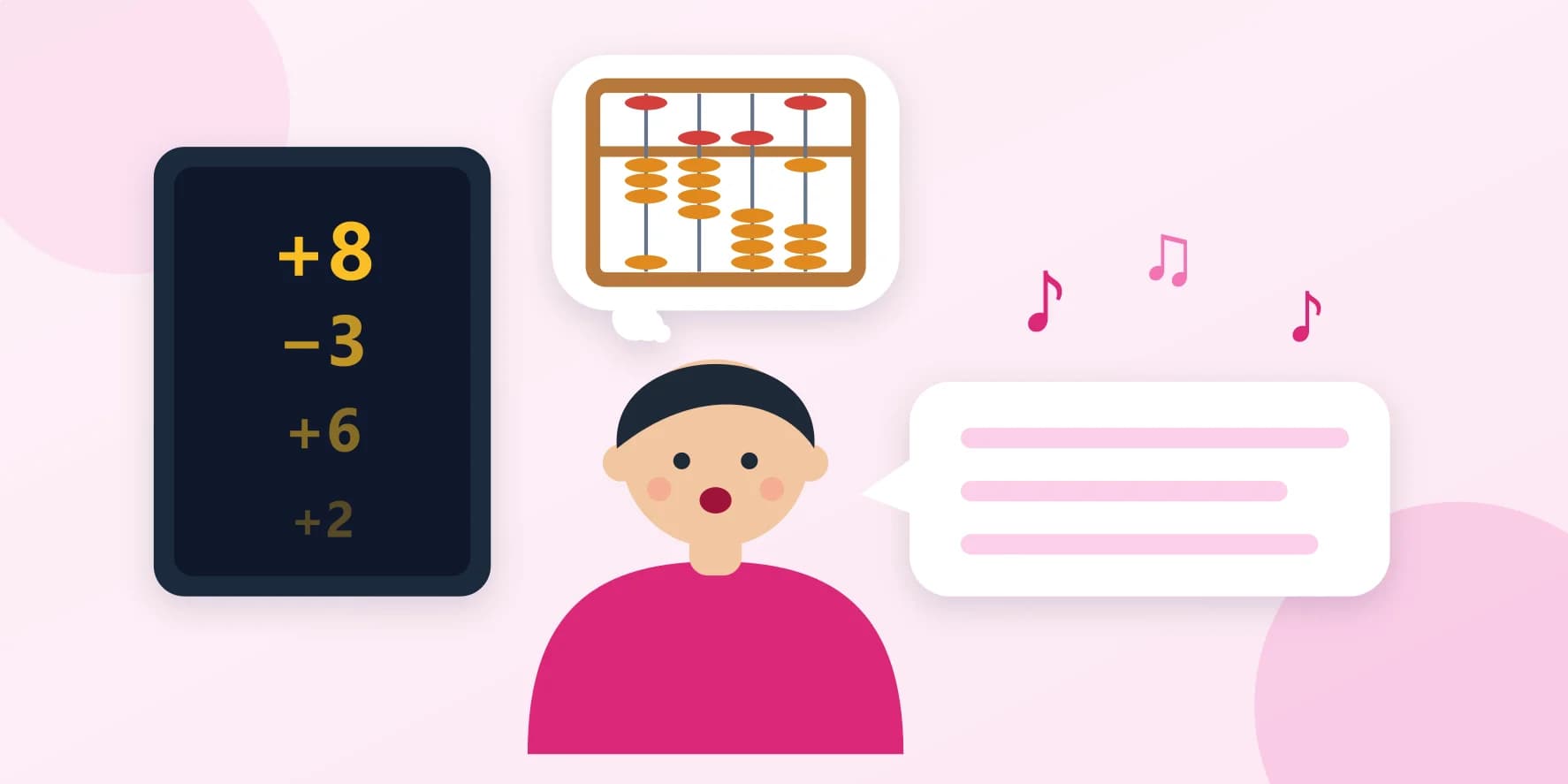
At the most advanced stages, the skill can become so automatic that a child calculates while doing something else entirely — see how a child can calculate and recite a poem at the same time.
If the child continues long enough, the skill has a chance to become stable.
If the child stops too early, a significant part of the work may be lost.
The goal is not to force a child to practise today
The right question is not:
“How do we make a child do another 100 examples?”
The better question is:
“How do we help the child keep returning to practice month after month and year after year?”
Mental arithmetic is not built in one long session. It is built through thousands of small repetitions.
And the purpose of a strong program is to help the child complete at least a full two-year learning cycle — and then continue increasing the challenge for as long as interest and progress remain.
Not simply to learn something for a few months. But to develop the skill deeply enough for it to become stable.
The goal is not to make a child practise today. The goal is to help them want to return tomorrow.
That is why keeping a child interested can be just as important as explaining the next formula correctly.
Free for teachers