How Much Mental Arithmetic Practice Does a Child Need Each Day?
One of the most common questions parents ask is:
“How much mental arithmetic practice should my child do at home?”
Ten minutes? Thirty minutes? An hour?
And is daily practice really necessary if the child already attends lessons with a teacher once or twice a week?
The short answer is:
in mental arithmetic, regular practice matters more than occasional long sessions.
It is usually better to practise for 10–15 minutes on most days than to spend an hour trying to complete a large amount of homework once a week.
Mental arithmetic is not something a child only needs to understand. It is a skill. And skills are built through repetition.
One lesson a week is not enough
A teacher may explain a new topic perfectly. For example:
- Simple;
- Small Friends;
- Big Friends;
- a new transition;
- or a new type of operation.
During the lesson, the child understands it. They may even solve several examples correctly.
But there is a huge difference between:
“I understand how to do this”
and “I can do this automatically.”
For an operation to become automatic, the child needs to repeat it many times — this is what mental arithmetic actually trains.
That is the role of home practice.
During the lesson, the child learns. At home, the child consolidates.
Without the second stage, progress can slow down significantly.
Why one long session is usually worse than short daily practice
Imagine two children.
The first practises:
15 minutes, five times a week.
The second practises:
75 minutes once a week.
The total time is exactly the same. But the result is unlikely to be the same.
The first child regularly returns to the skill.
- Today they practise.
- Tomorrow they use it again.
- Two days later they reinforce it once more.
The brain repeatedly receives the message:
“This is important. Keep this skill available.”
For the second child, almost a week may pass between training sessions. During that time, part of the newly formed skill can weaken.
The next practice session then becomes partly about recovering what was already learned rather than moving forward.
That is why frequency matters so much in mental arithmetic.
A short session is better than skipping practice completely
Parents sometimes think:
“We do not have thirty minutes today, so we will skip practice.”
That is usually the wrong approach.
If time is limited, it is still better to do:
- 5–7 minutes;
- a few short examples;
- one block of mental calculation;
- a short flashcard exercise;
than to skip the day completely.
Even a short session helps maintain the skill. This is especially important when a child has only recently learned a new topic.
How much should a beginner practise?
Beginners do not need huge amounts of homework. In fact, sessions that are too long can quickly create fatigue and resistance.
At an early stage, approximately 7–10 minutes per day can often be enough.
That might include:
- a few short examples on a physical abacus;
- simple flashcards;
- a small block of exercises on the current topic;
- a few introductory mental-abacus exercises.
The main objective at this stage is to build the habit of regular practice.
It is often better to finish slightly early while the child is still engaged than to continue until they are completely exhausted.
Intermediate level: 15–20 minutes
Once the basic principles are understood, the amount of practice can gradually increase.
For many students, a good regular routine is approximately 15–20 minutes.
During this time, several different types of activity can be combined. For example:
- 5 minutes — workbook;
- 5 minutes — flashcards;
- 5 minutes — mental calculation;
- and a few extra minutes for speed work or a difficult topic.
The child does not spend twenty minutes doing exactly the same exercise. The format changes, which helps maintain attention.
Advanced level: 30–40 minutes
If a child has been studying for a long time, is preparing for competitions, or wants to develop very high calculation speed, practice can become significantly longer.
For example: 30–40 minutes per day.
But it is especially important to structure these sessions correctly. A child should not spend all forty minutes doing one type of exercise.
It is usually more effective to divide the session into different blocks:
- physical or mental abacus;
- speed exercises;
- multi-digit calculation;
- weak-topic revision;
- flashcards;
- Anzan;
- competition-style tasks.
This keeps the training intensive without making it monotonous.
Practice time depends on the goal
There is no single number that is correct for every child.
The important question is:
what is the child training for?
If the goal is general development and steady progress through the curriculum, one level of practice may be enough.
If the child wants to participate in competitions, preparation needs to be more intensive.
If the goal is to calculate at 0.3 seconds per operation, even more training will usually be required — see how calculation speed develops step by step.
As a practical guideline, we can think of three levels:
- 7–10 minutes — minimum regular practice;
- 15–20 minutes — a strong everyday routine for most students;
- 30–40 minutes — advanced or competition-level preparation.
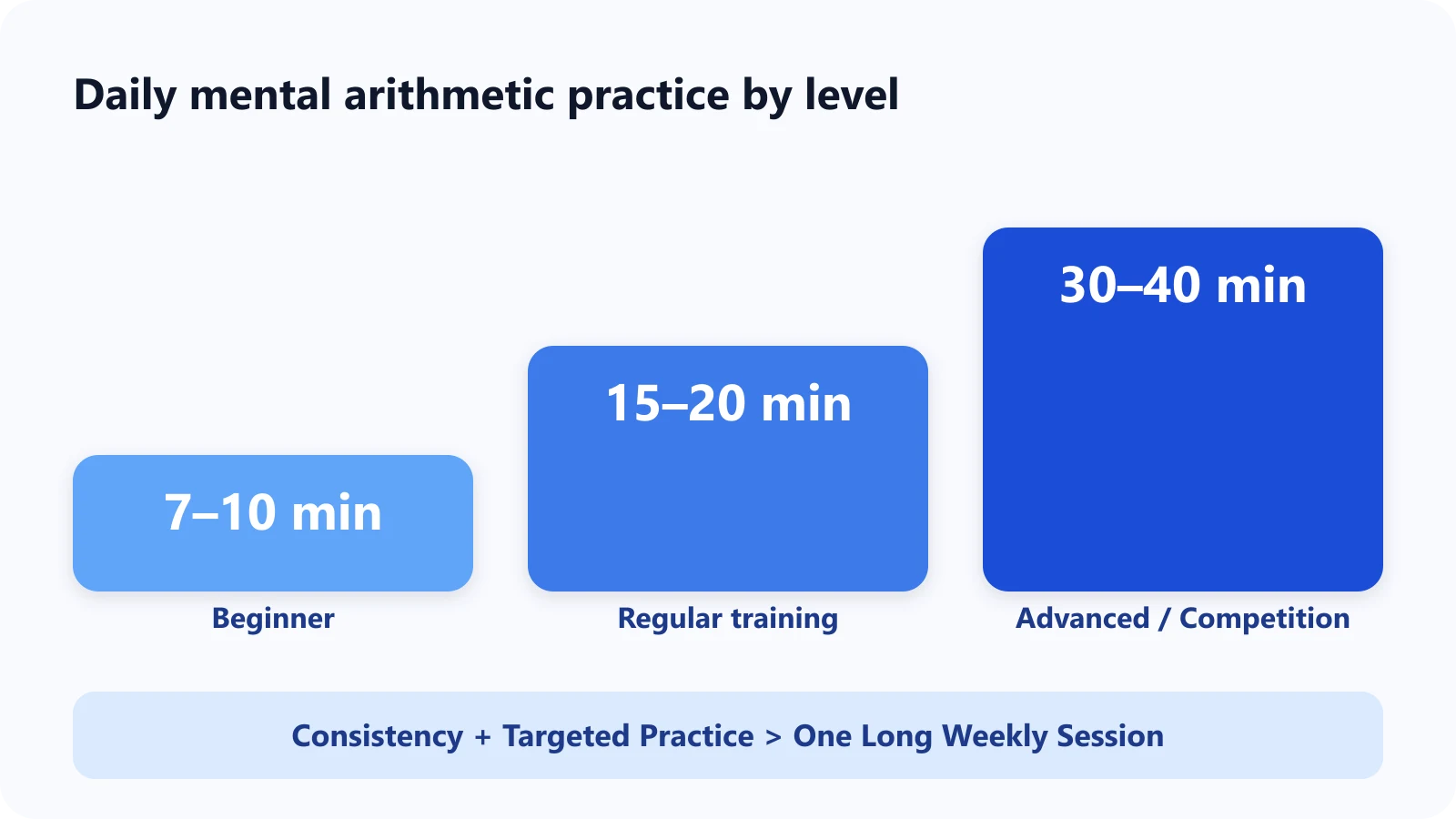
These ranges are practical guidelines, not strict rules.
But time alone is never enough. The quality of the exercises matters just as much.
Thirty minutes of the wrong practice can be worse than ten minutes of the right practice
It is important not only to ask how long a child practises, but also what exactly they are practising.
Suppose a student has not fully mastered one particular topic.
The teacher could give them 100 random examples. The child may complete a large amount of work.
But if the problematic operation appears only a few times, the practice may do very little to solve the actual problem.
It is much more effective to create an exercise where the weak topic appears more frequently.
And this is where an important difference between a printed workbook and a digital platform becomes clear.
Why a weak topic can be difficult to target with a workbook alone
Workbooks remain very important.
They help develop the mechanics of using the abacus, reinforce finger movements, practise rules, and provide a large number of repetitions.
But a workbook is already printed.
If one particular child has a problem with one specific topic, the page cannot simply change for that child.
The teacher may have to:
- find additional exercises;
- write new examples manually;
- make sure the required operations appear often enough;
- control the number of digits;
- and avoid introducing rules the student has not learned yet.
For one student, this is possible.
For a teacher working with 30, 50, or 100 students, creating individually targeted exercises by hand becomes much more difficult.
This is where a digital platform becomes especially useful
In Amavit, a teacher can build practice around a child's specific difficulty.
The teacher can adjust:
- the exact topic;
- speed;
- number of operations in an example;
- number of digits;
- chain length;
- total amount of practice.
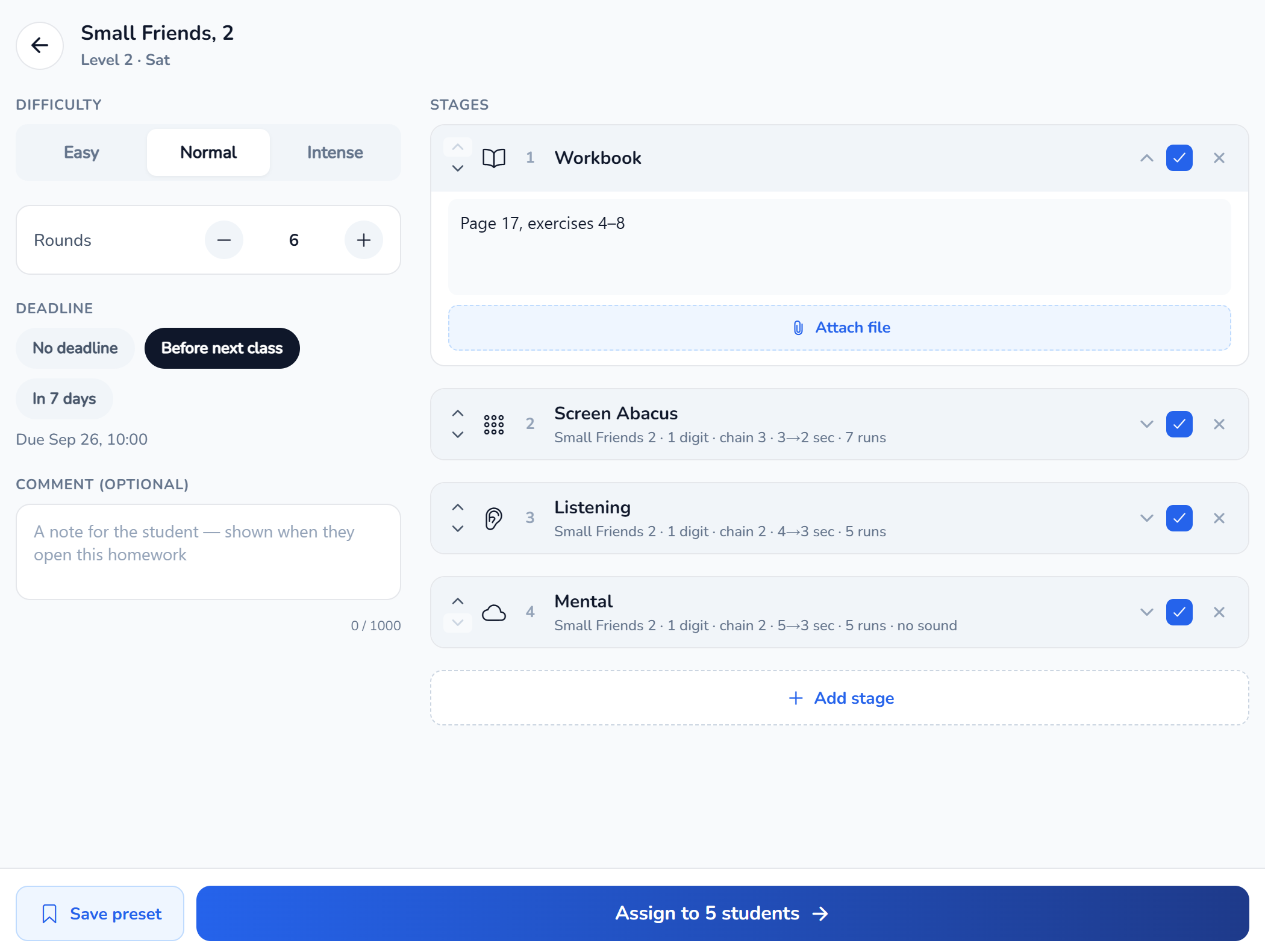
For example, if a child has difficulty with a particular type of transition, there is no need to give them another 100 random examples and hope that the problematic operation appears often enough.
The teacher can increase the number of exercises involving exactly that topic.
Practice becomes targeted.
The child spends more time working on the operation that is currently causing difficulty.
Previously learned topics should not disappear
There is an important detail.
If a child is weak in one topic, that does not mean everything else should be removed from practice.
Previous topics should continue to appear. But their frequency can be adjusted. For example:
- the weak topic appears more often;
- well-mastered topics appear less often;
- if an older topic starts producing errors again, its frequency can be increased.
This matters because the child should not only be able to solve a topic when they already know exactly which rule is being tested.
They also need to recognise the correct rule among different types of operations.
That is how genuine automaticity develops.
This kind of adjustment is much harder in a printed workbook
In a workbook, the set of exercises is fixed in advance.
If the teacher wants to:
- increase the probability of one topic;
- reduce another;
- change the number of digits;
- increase the number of operations;
- or change the speed,
a new exercise often has to be prepared manually.
A digital platform allows these parameters to be adjusted much more quickly.
This does not mean the workbook and the platform compete with each other. They solve different problems — worksheets and digital practice each have their own role.
The workbook is excellent for building basic technique.
Fixed exercises.
The platform is better suited to precisely adjusting practice for an individual student.
Topic + speed + digits + operations + frequency.
The strongest learning model often combines both.
A new topic should initially appear more often
When a child has just learned a new rule, it can be useful to make that topic appear frequently.
- First, the child needs to understand the mechanism.
- Then they need many repetitions.
- After that, the new topic can gradually be mixed with previously learned operations.
This is an important transition. Because:
solving an example when you already know which topic it tests
and instantly recognising which rule to use among many different operations
are two different levels of skill.
Old topics must not be forgotten
There is also the opposite problem.
Sometimes a child learns a new topic and all homework becomes focused only on that topic.
A month later, the new topic is strong — but an older one has started to weaken.
In mental arithmetic, this can create serious problems. Every new level builds on what came before.
When students work with more advanced combinations, they continue using Simple, Small Friends, Big Friends, and other previously learned rules.
If one older topic remains weak, it can begin producing errors at higher levels.
That is why effective home practice should combine:
- the new topic;
- weak topics;
- revision of well-mastered operations.
Daily practice does not have to look the same every day
Regular practice does not mean repeating exactly the same routine seven days a week. In fact, variety is useful. For example:
- one day may include more workbook work;
- another — mental calculation;
- another — flashcards;
- another — speed training;
- another — focused work on a weak topic.
The child still receives the repetitions they need, but the practice remains more varied.
Why variety matters
One of the biggest challenges in regular learning is boredom.
- The child may understand that practice is useful.
- The parents may understand it.
- The teacher may explain why repetition is necessary.
But if every day looks like this:
- open the workbook;
- complete two pages;
- close the workbook,
motivation gradually decreases.
That is why modern mental-arithmetic training benefits from combining different formats. For example:
- workbooks;
- flashcards;
- virtual abacus;
- mental calculation;
- listening exercises;
- games;
- speed exercises.
The purpose is still repetition. But the form changes.
Mental arithmetic requires hundreds and thousands of repetitions
Fast mental calculation cannot be built from a few dozen examples. It requires hundreds and eventually thousands of repetitions.
- At first, the child consciously thinks about each action.
- Then the action becomes faster.
- Later it becomes almost automatic.
- Only after that can speed increase significantly.
This is true of many complex skills.
- A pianist repeats movements thousands of times.
- An athlete repeats the same technique thousands of times.
- A child learning mental abacus also needs a very large number of correct repetitions.
But practice should never become punishment
It is easy to draw the wrong conclusion:
“If thousands of repetitions are useful, the child should practise for two hours every day.”
That does not work.
Children have limited:
- attention;
- energy;
- motivation.
After a certain point, the quality of work falls sharply.
The child may still be physically sitting in front of the task, but they are no longer concentrating effectively.
Errors increase. Irritation appears. And, most importantly, the child can begin to associate practice with something unpleasant.
The goal is not to maximise the number of minutes. The goal is to maximise the number of high-quality minutes.
It is often better to finish on a successful result
A useful principle is to finish practice while the child still feels successful.
Perhaps the child:
- improved a result;
- completed a difficult exercise correctly;
- beat their previous record;
- reached the daily goal.
That is often better than forcing them to do another 50 examples after a good result and ending the session tired and frustrated.
Ideally, the child should be willing to return to practice tomorrow.
A daily goal often works better than a huge homework assignment
Regular practice becomes easier when the child has a clear daily goal. For example:
- 10 minutes;
- one short training session;
- three exercise blocks;
- a specific number of correctly completed tasks.
This feels manageable. The child thinks:
“I can do this.”
A very different feeling appears when the child sees five full pages of homework before even starting. The task already feels difficult.
Why a streak can help
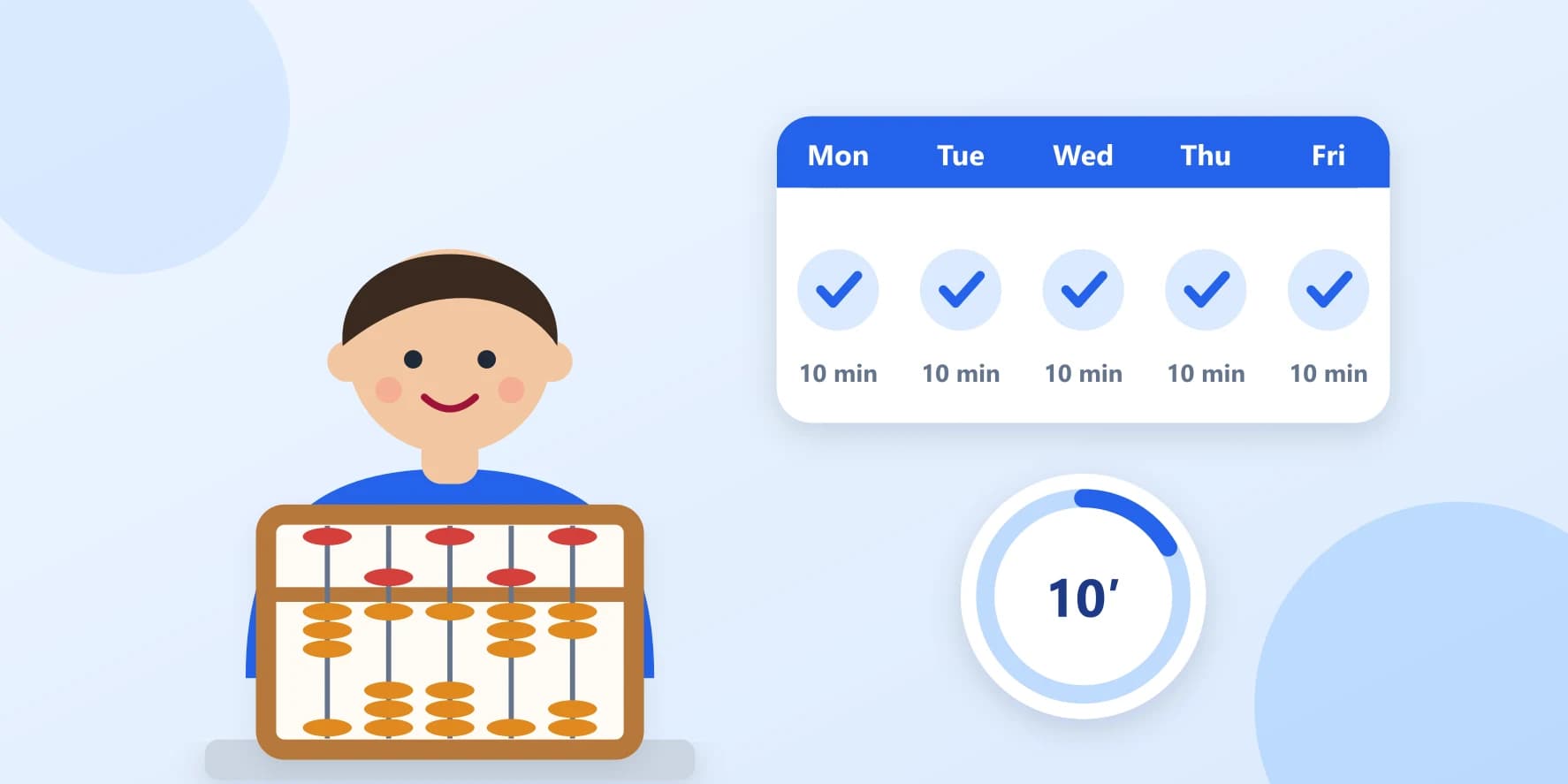
One simple way to encourage consistency is a daily practice streak. For example:
- 3 days;
- 7 days;
- 14 days;
- 30 days.
For a child, this can turn regular practice into a small game.
They are no longer practising only because a parent told them to. There is another goal:
keep the streak going.
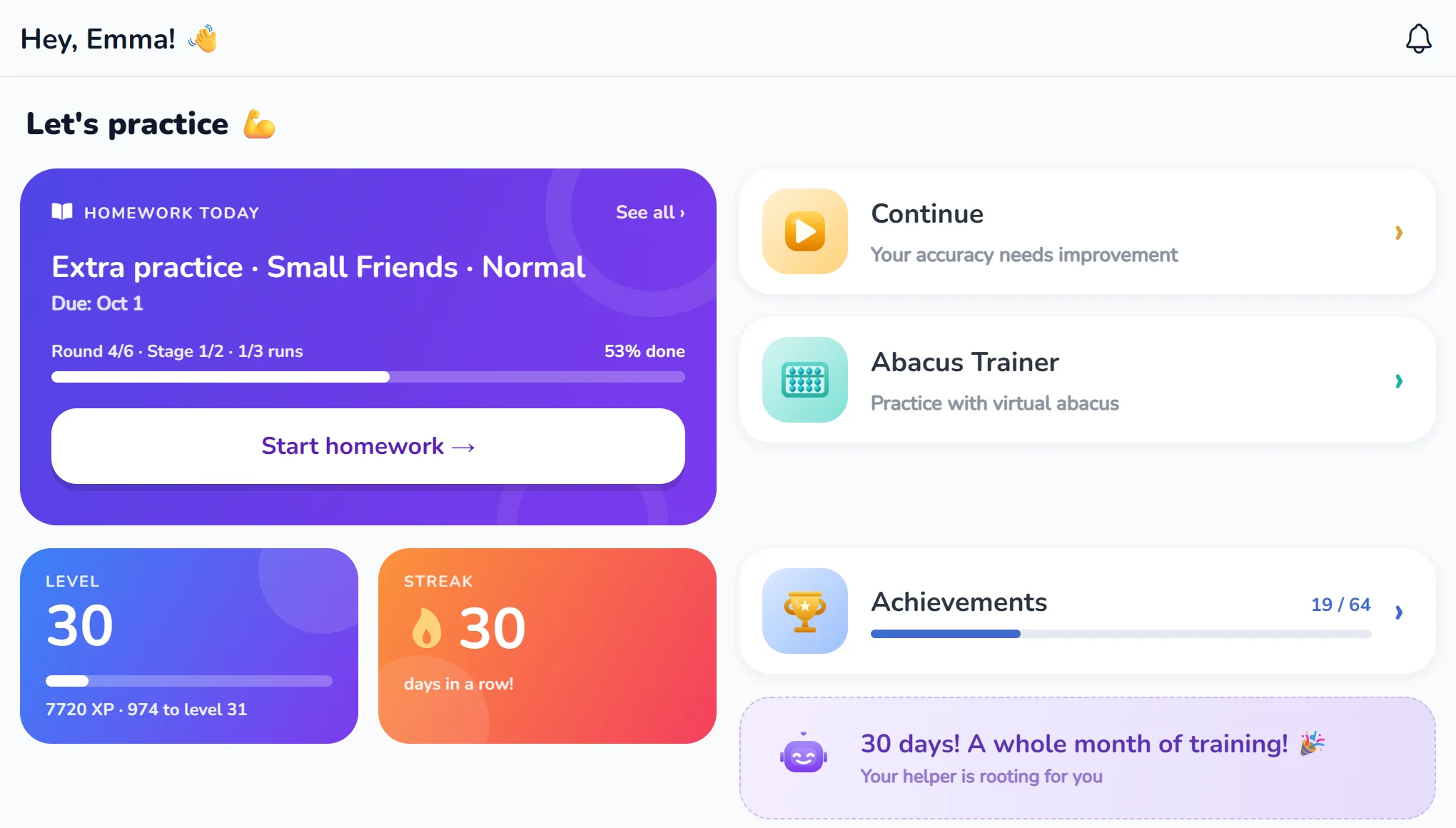
Of course, the streak itself does not create the skill. The exercises create the skill.
But a streak can help the child return to those exercises regularly.
Parents should monitor consistency more than every individual answer
Another common mistake is for parents to become a second teacher.
- They stand next to the child.
- Check every movement.
- Correct every mistake.
- Remind the child of every rule.
Eventually, home practice turns into an argument.
In many cases, a better role for the parent is simply to monitor:
- did the child practise today?
- did they complete the daily goal?
- is the practice regular?
The methodological analysis of mistakes can remain the teacher's responsibility.
Teachers need to know what happens between lessons
If a child practises independently at home, the teacher needs to understand:
- how often the child practised;
- which exercises they completed;
- at what speed;
- where mistakes occurred;
- which topics are still difficult.
This is another area where a digital system is particularly useful.
Without it, the teacher may see only the final result:
the workbook page is complete.
But they may not know:
- how long the child spent on it;
- how many errors occurred;
- which operations caused difficulty;
- whether the child practised throughout the week or completed everything the night before the lesson.
Digital practice provides much more information. And that information can make the next training session more precise — see how teachers can track student progress.
Homework should not be identical for every student
- One child has only just started. Seven to ten minutes may be enough.
- Another is already working confidently and can practise for 15–20 minutes.
- A third is preparing for a competition and needs more.
And even two students at the same level may need completely different exercises.
- One needs more speed.
- Another needs larger numbers.
- A third needs additional work on one weak topic.
As children progress, effective home practice should become increasingly individual.
The main rule is simple
If there is only one idea to remember from this article, it is this:
a little every day is better than a lot once a week.
But there is one important addition:
ten minutes of well-targeted practice can be more valuable than thirty minutes of random exercises.
Mental arithmetic develops through consistency and precision.
- Not through occasional marathons.
- Not through enormous homework assignments before the next lesson.
- Not through trying to complete six missed days of practice in one evening.
The skill develops gradually.
Ten minutes today. Fifteen minutes tomorrow. Another short session the day after.
And each session should match what the child actually needs at that stage.
So how much should a child practise?
There is no universal number. But as a practical guideline:
- beginner level — around 7–10 minutes per day;
- regular training — around 15–20 minutes;
- advanced or competition preparation — around 30–40 minutes.
More important than the exact number of minutes are four things:
- consistency;
- well-selected exercises;
- targeted work on weak topics;
- quality of concentration.
Because in mental arithmetic, progress is not created by the amount of time spent sitting next to an abacus.
It is created by the number of correct, targeted, and regularly repeated actions.
Over time, those repetitions are what create the fast mental calculation that can look almost impossible from the outside.
Free for teachers