What Is the Best Age for a Child to Start Mental Arithmetic?
One of the most common questions parents ask is:
“What is the best age to start mental arithmetic?”
At four? At five? Before school? Or is it better to wait until seven?
In practice, the right answer depends on more than the child's age.
Best age to start mental arithmetic
- 5–7: excellent for many children who are ready for structured learning
- 8–10: still an excellent starting age and often faster at the beginning
- 10–12+: not too late; the teaching approach should simply match the child's age
Readiness and consistency matter more than the exact birthday.
Two children who are both five years old can be completely different in terms of readiness for structured learning.
One may already be able to:
- listen to a teacher;
- follow short sequences of instructions;
- focus for several minutes;
- repeat movements;
- complete a small task.
Another child of the same age may still learn much better through free play.
And that is completely normal.
So when deciding when to start mental arithmetic, it is more useful to look not only at the birth date, but also at the child's overall maturity and readiness to learn.
A simple physical test some parents know
There is an old, simple test that is sometimes used as one of several indicators of physical maturity.
The child is asked to reach the left ear with the right hand by passing the arm over the top of the head.
Then the child tries the same movement on the other side: the left hand reaches toward the right ear over the top of the head.
This is sometimes called the Philippine test.
Historically, it has been used as a rough indicator of physical maturation.
As children grow, body proportions change:
- the arms become longer;
- the shoulder area develops;
- overall body proportions change.
Being able to perform this movement comfortably can therefore be one small sign that the child has reached another stage of physical maturity.
But there is an important clarification.
This test should never be used as the only measure of school readiness or readiness for mental arithmetic.
It does not directly measure:
- intelligence;
- attention;
- memory;
- emotional readiness;
- or the ability to learn.
It is only one additional observation. The child should always be assessed as a whole.
Important: The Philippine test is only one rough indicator of physical maturity. It should not be used alone to decide whether a child is ready to learn.
What does “ready to learn” really mean?
- A child does not need to sit at a desk for a long time.
- They do not need to know addition tables in advance.
- They do not need to read or write fluently.
But ideally, the child should already be able to:
- listen to a short instruction;
- repeat an action shown by an adult;
- complete a short sequence of actions;
- maintain attention for several minutes;
- recognise basic numbers;
- interact calmly with a teacher.
These signs are often more important than the exact age.
Why ages 5–7 are often a very good time to start
For many children, the period between approximately five and seven years old is an excellent time to begin.
The child is already becoming capable of structured learning. At the same time, thinking is still highly visual and imaginative.
That fits mental abacus training very well.
- At first, the child sees a physical abacus.
- Touches the beads.
- Moves them with the fingers.
- Connects a number with a particular bead pattern.
Gradually, the physical movement begins to become an internal image.
Eventually, the child can start imagining the abacus without the physical tool.
That is the beginning of mental abacus — and of what mental arithmetic develops beyond calculation.
Why this age can also be useful from a school perspective
There is another reason why starting around ages 5–7 can work particularly well.
At this stage, schoolwork is usually not yet dominated by highly complex subjects. The child is only beginning structured education.
They are not yet dealing with:
- advanced algebra;
- geometry;
- physics;
- chemistry;
- or large numbers of abstract multi-step problems.
This creates a useful period in which a child can train foundational cognitive skills alongside regular school learning.
Mental arithmetic exercises place demands on:
- attention;
- concentration;
- working memory;
- visualisation;
- processing speed;
- the ability to maintain a sequence of actions.
In other words, at this age mental arithmetic does not have to feel like another difficult school subject.
It can act as training for some of the cognitive processes that will later be needed when school becomes more demanding.
School becomes much more complex later
Several years later, the academic environment changes.
Children begin to encounter subjects where simply remembering one rule is no longer enough.
They need to:
- keep several conditions in mind;
- work with abstract concepts;
- see relationships between information;
- switch between operations;
- solve multi-step problems;
- retain intermediate information.
This is when subjects such as:
- algebra;
- geometry;
- physics;
- chemistry;
- and more advanced mathematics
become increasingly demanding.
Age 5–7
Attention → Visualisation → Working memory → Processing speed
Later school years
Algebra · Geometry · Physics · Chemistry · Multi-step problems
Mental arithmetic does not teach these subjects directly. It trains cognitive processes that are also used when learning becomes more complex.
Prior experience with intensive mental work can help
A child who has already spent several years practising mental arithmetic is familiar with:
- concentrating;
- holding sequences in mind;
- working accurately;
- increasing speed;
- switching between operations;
- persisting with difficult tasks;
- repeating a skill until it becomes more automatic.
From our practical teaching experience, children who develop these habits often find it easier to adapt to more demanding academic work later.
That does not mean mental arithmetic teaches physics or prepares a child directly for geometry.
The point is different.
The child has already spent years becoming accustomed to working intensively with information and handling structured, multi-step cognitive tasks.
Mental arithmetic does not replace school subjects. It can help prepare the child for the type of mental effort that becomes increasingly important in later school years.
Imagining an abacus can feel natural to a young child
Adults sometimes need to be told:
“Do not calculate in your usual way. Try to see the beads.”
For a five- or six-year-old, this can feel much more natural.
Young children already use imagination constantly. It is normal for them to:
- picture an object;
- imagine movement;
- see something in the mind.
So the transition from a physical abacus to an imagined one can sometimes happen very naturally.
But this does not mean that starting earlier always produces a better result.
Starting earlier does not mean practising more
A five-year-old does not need forty minutes of daily homework. Quite the opposite.
At this age, it is especially important to:
- keep practice short;
- change activities;
- use visual exercises;
- include game elements;
- avoid excessive workload.
Sometimes 7–10 minutes of high-quality practice can be much more useful than 40 minutes of conflict between a child and a parent — see how much daily practice a child needs at each level.
At the beginning, two things matter most:
correct technique
and a positive attitude toward practice.
Speed can come later.
What happens if a child starts too early?
Sometimes parents want to begin at three or four years old because they have heard:
“The earlier you start, the better the brain develops.”
But if the child is not yet ready for structured learning, starting early may offer no advantage.
The child may:
- struggle to understand instructions;
- become tired very quickly;
- feel frustrated;
- refuse exercises;
- associate learning with pressure.
The family may gain a few months on the calendar but lose the child's interest.
That is not a good trade.
It is better to start slightly later and continue successfully than to start too early and stop after a few months.
What if the child is already eight or nine?
That is also an excellent age to begin.
In fact, older children have some advantages. They often:
- understand rules faster;
- maintain attention longer;
- can complete more practice;
- understand explanations more easily;
- move through the first topics more quickly.
A five-year-old may need more time simply to become comfortable with the abacus and the learning routine.
An eight-year-old may move through those early stages much faster.
So the idea:
“We did not start at five, so now it is too late”
is simply wrong.
Starting at 10–12 is not too late either
An older child already has established ways of calculating from school. And this creates an interesting challenge.
A younger child may simply accept the abacus as another way to work with numbers.
A ten-year-old may automatically try to:
- calculate;
- remember an intermediate answer;
- say the number internally;
- use familiar school arithmetic.
The teacher may therefore need to gradually introduce a different strategy:
- not to calculate in the usual way;
- but to visualise bead movement.
At the same time, an older child has other advantages. They can:
- focus for longer;
- understand methodology faster;
- work consciously on speed;
- handle a larger training load.
So later does not mean worse. It simply means a different starting point.
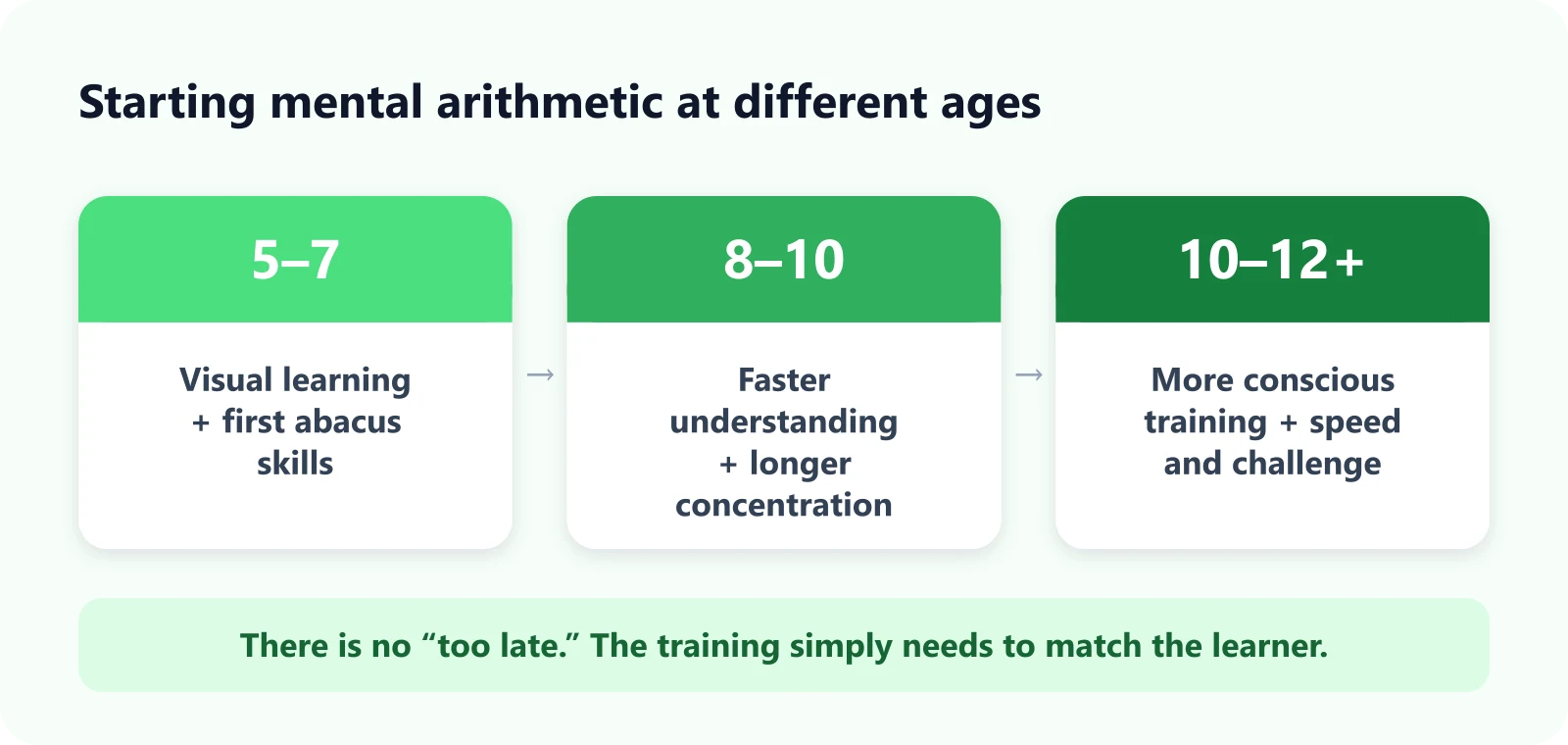
What matters more: age or consistency?
Imagine two children.
The first starts at five but almost never practises at home.
The second starts at eight and trains consistently.
There is no reason to assume the first child will necessarily progress further.
Results depend on many factors:
- quality of teaching;
- consistency;
- home practice;
- motivation;
- appropriate workload;
- duration of training.
Starting age is only one factor.
Parents often ask the wrong main question
The usual question is:
“When should we start?”
But an even more important question is:
“How long should the child continue?”
A child can start perfectly at five and stop after four months.
Another can begin at eight and complete several years of serious training.
The second child may develop a much more stable skill.
Mental arithmetic depends on a very large number of repetitions. A child progresses through stages such as:
- physical abacus;
- correct finger movements;
- learning formulas;
- mental abacus;
- increasing speed;
- larger numbers;
- longer chains;
- Anzan;
- advanced operations.
The skill needs time to consolidate.
From our practical experience, around two years of regular learning should be viewed more as a minimum full training cycle than as a natural stopping point — see why children lose interest and how to keep them motivated.
The program can continue far beyond that
Mental arithmetic does not end with simple addition and subtraction.
As the student develops, training may include:
- multiplication;
- division;
- powers;
- roots;
- larger numbers;
- longer chains;
- very high speed — from 3 seconds to 0.1 seconds per operation;
- Anzan;
- competition formats.
The program can develop together with the child.
This is important for maintaining interest. A child should not spend two years doing exactly the same exercise.
They should feel:
I have grown — and the challenges have grown with me.
The program should mature with the child
A five-year-old may be motivated by:
- a bright exercise;
- a short game;
- a chest;
- a medal;
- teacher praise.
At nine, motivation may come from:
- beating a personal record;
- increasing speed;
- moving into a new league;
- competing with other students.
At twelve:
- Anzan;
- complex calculation;
- competitions;
- extreme speed;
- intellectual challenge.
A good program should not only increase the mathematical difficulty. It should mature with the student.
How Amavit can adapt the training
A digital platform is especially useful here because the teacher can gradually change:
- exercise type;
- topic;
- speed;
- digit length;
- chain length;
- number of operations;
- training format.
A five-year-old and a ten-year-old do not need to have exactly the same learning experience even when they are working on a similar topic.
The methodological objective can be the same. The way it is reached should fit the child's age and readiness.
How can you tell whether a child is ready?
Look for several simple signs.
- The child can work with a teacher for several minutes.
- They understand a simple instruction.
- They can copy a movement.
- They recognise basic numbers.
- They do not constantly resist the idea of participating.
- They can finish a small task.
Physical maturity, including simple observations such as the so-called Philippine test, can also be considered.
But the decision should be based on the whole picture. Not on one test. And not only on age.
So what is the best age?
As a simple practical guideline:
- 5–7 years — an excellent starting period for many children who are ready for structured learning.
- 8–10 years — also a very strong age to begin, and children may move through the initial stages faster.
- 10–12 years and older — still absolutely possible, but the teaching style and motivation should match the age.
The important thing is not to look for a magical number. A better question is:
- is the child ready?
- is there a good teacher?
- can the program grow with them?
- and can they continue long enough for the skill to become stable?
Because the outcome of mental arithmetic is not determined by whether lessons started at five or seven.
It is built through thousands of correct actions that gradually become a stable skill.
And the best age to begin is the point when the child is genuinely ready to take the first step.
Free for teachers