Why Children Keep Making the Same Mistakes in Mental Arithmetic — and How to Find the Weak Topic
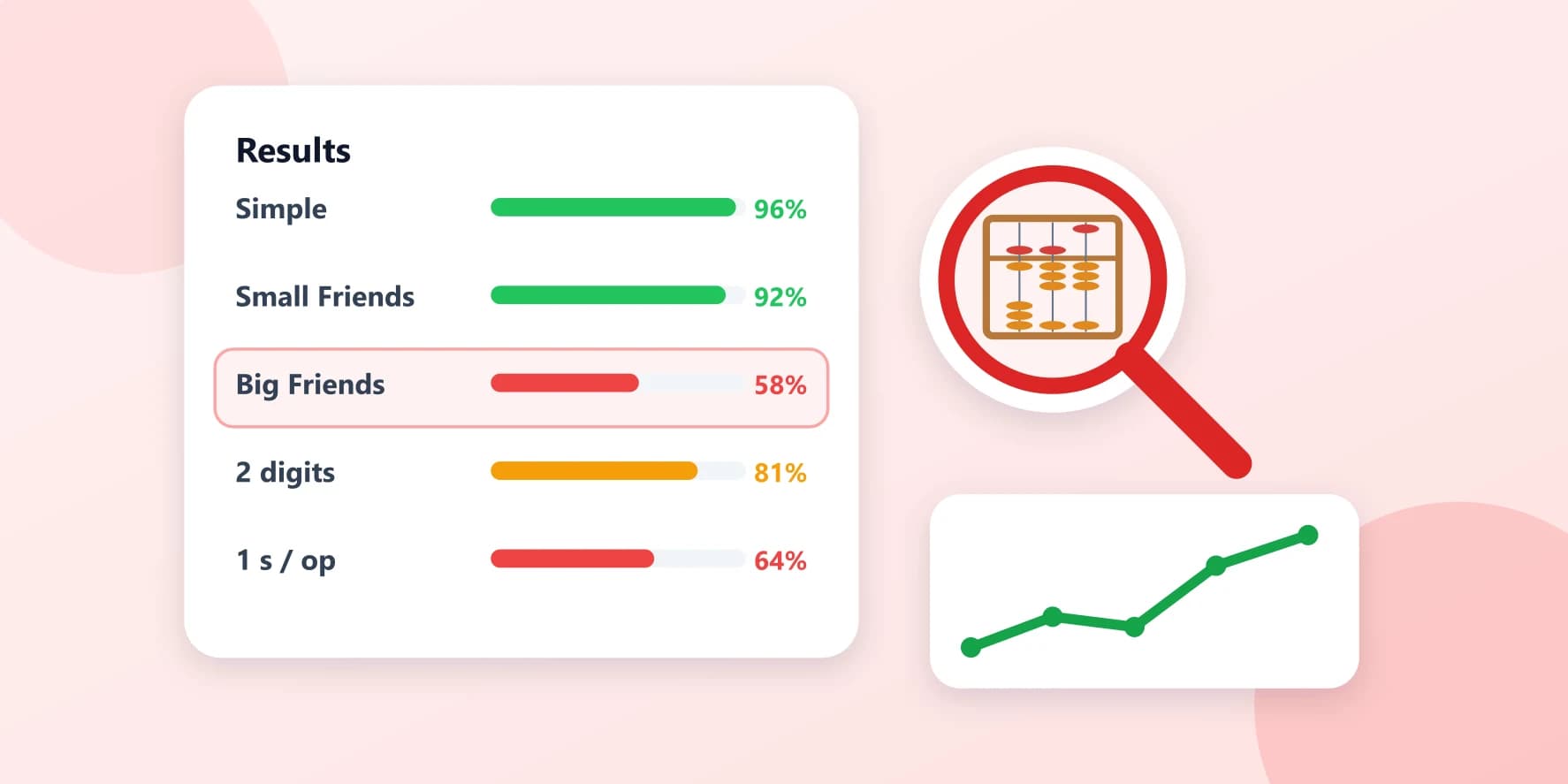
Mental arithmetic becomes progressively more complex.
- A child begins with simple operations.
- Then comes Small Friends.
- After that, Big Friends.
- More advanced transitions appear.
- The number of digits increases.
- Calculation chains become longer.
- Speed goes up.
And at some point, one of the most common problems appears:
the child seems to know the topic, but keeps making mistakes.
Very often, the real problem is not where it first appears to be.
A wrong answer does not always reveal the real problem
Imagine a child solving a long calculation chain and giving the wrong final answer.
The teacher can see:
the answer is incorrect.
But that does not automatically show where the mistake happened.
The chain may contain:
- 10 operations;
- 20 operations;
- 30 operations;
- several different topics;
- different types of transitions.
The child may have made one mistake near the beginning and then completed the next twenty operations correctly.
At the end, we see only one wrong answer. The actual cause is hidden somewhere inside the chain.
Wrong answer ≠ clear diagnosis. Possible causes: topic, speed, digit length, chain length, insufficient automaticity.
At the beginning, mistakes are easier to diagnose
When children first start learning mental arithmetic, the situation is relatively simple.
For example, the lesson may focus on one specific topic. Most exercises are built around that topic.
If the child makes mistakes, it is usually easy for the teacher to understand:
this particular skill has not yet been mastered.
But as the curriculum progresses, diagnosis becomes much harder. New exercises begin to include everything the child learned before.
New topics always depend on old ones
This is one of the most important principles in mental arithmetic.
When children move to more advanced topics, earlier rules do not disappear. They become part of more complex calculations.
For example, a child may already have learned:
- Simple;
- Small Friends;
- Big Friends;
- several types of transitions.
Now they begin solving more advanced chains. One exercise may include several different rules.
If one earlier topic was never fully automated, it can begin causing mistakes again.
The real problem may have started months ago
This is one of the most difficult situations.
A child learned a topic several months earlier. At the time, everything seemed fine.
- The child completed the exercises.
- The teacher moved on.
- New topics were introduced.
But the old skill was never fully automated.
While the exercises remained simple, the weakness was barely visible.
- Then speed increased.
- The number of digits increased.
- The tasks became more complex.
And suddenly the old weakness started producing errors.
From the outside, it may look like:
“The child does not understand the new topic.”
But the actual problem is an older one.
Knowing a rule is not the same as using it automatically
There is a big difference between:
knowing the rule
and applying the rule automatically.
If the teacher asks:
“What should you do here?”
the child may explain it perfectly.
If given one example with unlimited time, the child may solve it correctly.
But at one second per operation, there is no time to stop and consciously remember a formula. The response has to happen almost automatically — in mental abacus calculation, the beads move in the mind without stopping to name each step.
This is where weak topics reveal themselves.
The child understands the rule consciously. But the skill has not yet become automatic.
Sometimes the problem is speed, not understanding
A teacher may think:
“We need to explain the topic again.”
But the child may already understand it.
The problem is not comprehension. The problem is that the skill is not yet fast enough.
Another explanation may change very little.
What the child needs is enough correct repetition. First at a comfortable speed. Then gradually faster.
Sometimes speed was increased too early
The opposite problem also happens.
A child performs well at, for example, two seconds per operation. Then the speed is suddenly changed to one second.
The number of mistakes rises sharply.
That does not necessarily mean the child has forgotten the topic. The brain may simply not yet be able to complete the whole process at the new speed — speed has to grow in stages.
The right solution is not always:
“Concentrate harder.”
Sometimes the correct solution is:
- slow down;
- stabilise the skill;
- then increase speed again.
Errors can also be caused by digit length
Another important factor is:
the number of digits.
A child may work perfectly with single-digit numbers. But start making mistakes with two-digit numbers.
Or calculate two-digit numbers confidently and struggle with three-digit ones.
The topic itself may be fully understood. The additional difficulty comes from higher demands on:
- visualisation;
- working memory;
- the mental abacus;
- information-processing speed.
That means error analysis should never look only at the topic. It should also consider:
- speed;
- number of digits;
- chain length;
- number of operations.
The longer the chain, the harder the mistake is to locate
Imagine a chain of 30 operations.
The child makes one mistake on operation five. After that, all remaining operations are performed correctly.
The final answer is still wrong.
If the teacher sees only the final answer, the information is:
incorrect.
But that does not show:
- where the error happened;
- what type of operation caused it;
- why it happened.
If a student completes 50 such exercises, the teacher may end up with 50 correct-or-incorrect results.
But that is not yet a complete diagnosis.
Manually checking hundreds of exercises is difficult
Imagine a group of 10 students. Each child completes 100 examples at home.
That is already 1,000 results.
A teacher may be able to check:
correct; incorrect.
But if the goal is to understand which operation inside each chain caused the problem, the workload becomes enormous.
This is one of the main limitations of traditional homework checking — and one of the reasons worksheets and digital practice work best together.
The teacher often sees the symptom. But not necessarily the cause.
This is where digital analytics becomes especially useful
A digital platform can analyse much more than the final answer.
It can record:
- which topics were used;
- at what speed;
- with what number of digits;
- in which exercises mistakes appeared;
- which topics produce mistakes most often;
- how accuracy changes over time.
That allows the teacher to move from:
“The child is making mistakes.”
to something much more useful:
“The child repeatedly makes mistakes in one specific topic at a particular speed.”
That is a completely different level of diagnosis.
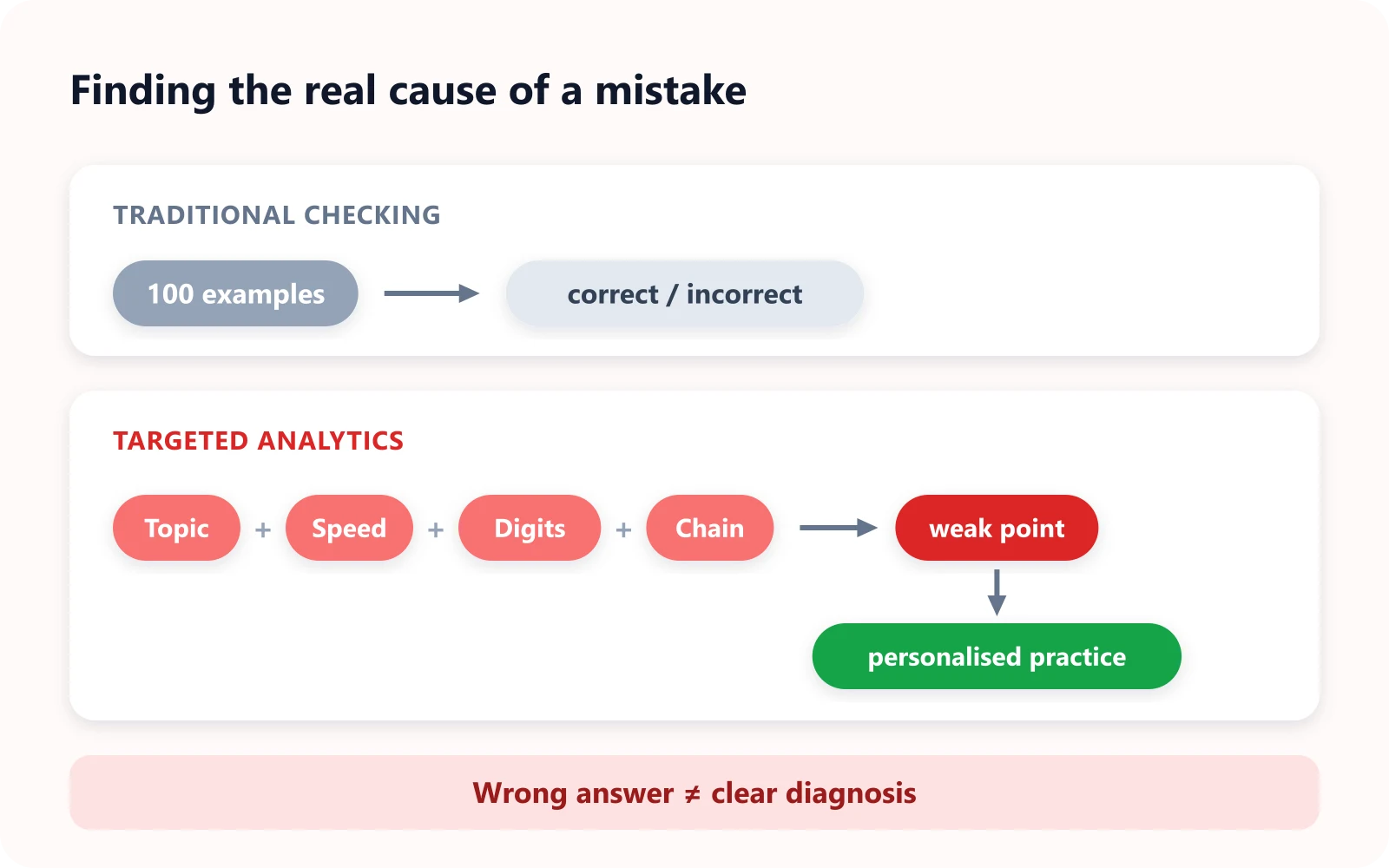
Amavit helps identify the weak area
In Amavit, the teacher can see where a student's difficulty begins. For example:
- Simple — stable;
- Small Friends — stable;
- Big Friends — frequent errors;
- single-digit numbers — strong;
- two-digit numbers — errors begin;
- 2 seconds per operation — accurate;
- 1 second per operation — accuracy drops sharply.
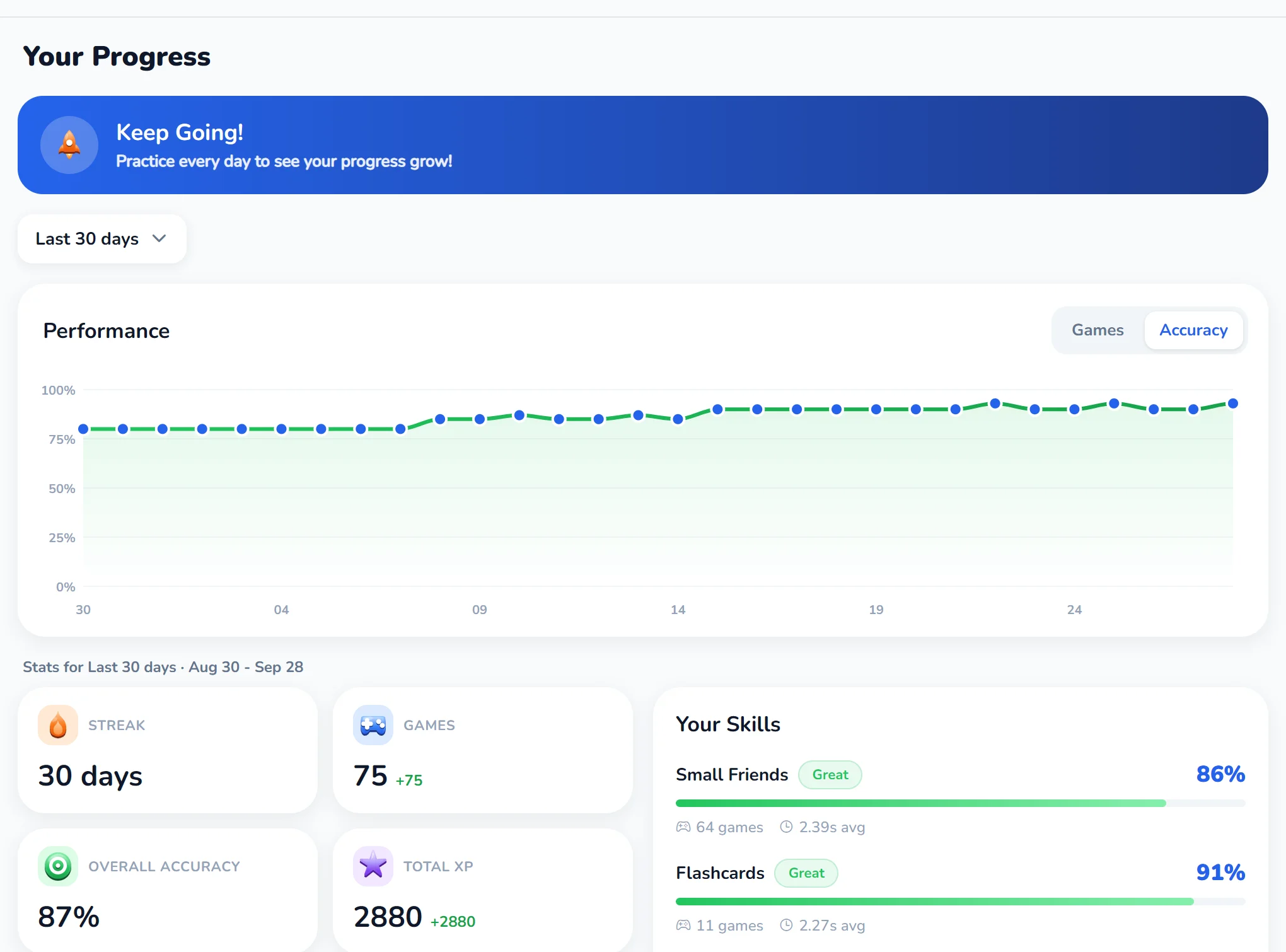
Now the next step becomes much clearer.
There is no need to make the child repeat the entire curriculum. The teacher can focus on the weak area — and see how it changes over time, as described in how to track student progress.
Diagnosis should lead to targeted practice
Finding the problem is only the first step. The next task is to correct it.
If one topic is weak, that topic should appear more frequently in practice.
But previously learned topics should not disappear completely.
Otherwise, the child may learn to solve the rule only when they already know in advance which rule is being tested.
A better approach is:
- weak topic — more frequent;
- well-mastered topics — less frequent;
- older topics — still included.
This teaches the student to recognise the correct rule inside mixed practice.
That is how real automaticity develops.
This is the difference between “more practice” and the right practice
When parents see mistakes, the first reaction is often:
“The child needs to solve more examples.”
But more is not always better.
If the child completes 200 examples and only 10 of them involve the real weak topic, the problem may barely improve.
Thirty carefully selected exercises can sometimes be much more useful.
More practice is not always better. Better-targeted practice is.
The important question is not only:
“How many examples did the child solve?”
but:
“Did the child practise the skill that is actually weak?”
Here we explain what to train; for how much to train, see how much mental arithmetic practice a child needs each day.
Sometimes a weak topic should be trained again at a lower speed
Suppose a child makes errors in Big Friends at one second per operation.
The teacher could continue giving Big Friends at the same speed. But the child may simply keep repeating the same mistakes.
A better approach may be to temporarily reduce the speed. For example:
- 1.5 seconds;
- or 2 seconds.
First restore high accuracy. Then gradually increase speed again.
This allows the correct mechanism to become stronger before additional speed pressure is added.
You should not practise a mistake
This is a crucial principle.
If a child repeatedly performs an operation incorrectly, that repeated action can also become familiar. But it becomes the wrong habit.
That is why large amounts of repetition are useful only when most of those repetitions are correct.
The order matters:
- accuracy first;
- then repetition;
- then speed.
Not the other way around.
Parents may think the child has suddenly become worse
Sometimes a child performs well for several months. Then the number of mistakes suddenly increases.
Parents may start worrying:
“Did they forget everything?”
“Is the program no longer working?”
“Are they getting worse?”
Very often, the explanation is simpler.
- The curriculum became more difficult.
- Speed increased.
- Digit length increased.
- Chains became longer.
- New topics were added.
An old weakness simply became more visible.
That is a normal part of learning. The important thing is not to panic, but to diagnose the cause correctly.
A mistake is useful information
In good teaching, a mistake is not only a failure. It is information.
It can show the teacher:
- where the student is struggling;
- which topic is weak;
- which speed is currently too high;
- at what digit length the problem appears;
- how many operations the child can currently maintain with good accuracy.
Every incorrect answer can help make the next training session more precise.
Individual practice becomes more important over time
At the beginning, students in one group may complete similar exercises.
But as the course progresses, their needs become increasingly different.
- One student increases speed quickly.
- Another works well with larger numbers.
- A third needs much longer to automate one particular topic.
- A fourth calculates accurately but begins making mistakes in longer chains.
That is why identical homework for every student becomes less effective at higher levels.
Each child gradually needs a different balance of:
- topics;
- speed;
- digit length;
- chain length;
- number of repetitions.
The platform does not replace the teacher
This is important.
Analytics does not teach the child by itself. It helps the teacher identify the problem faster.
The decision still belongs to the teacher.
The teacher determines whether the student needs to:
- review the explanation;
- reduce speed;
- complete more repetitions;
- reduce digit length;
- return temporarily to a physical abacus;
- or simply spend more time consolidating the skill.
The platform is a tool for diagnosis and targeted practice. The teacher remains the person who manages the learning process.
The goal is to find the cause, not simply mark the answer wrong
In mental arithmetic, it is easy to say:
“The child made a mistake.”
It is much harder to answer:
“Why?”
But the second question is the important one.
A mistake may be caused by:
- a weak topic;
- insufficient automaticity;
- speed that is too high;
- increased digit length;
- a chain that is too long;
- or an older topic that was never fully consolidated months earlier.
That is why good mental-arithmetic teaching is not simply about counting correct answers. It is about continuously identifying the reasons behind mistakes.
And the more accurately we identify the cause, the less unnecessary work the child needs to do.
Not another 500 random examples.
But the exact exercises that address the real weak point.
That is how mistakes stop being a problem and become a tool for progress.
Free for teachers