What Is an Abacus and How Does It Work? A Simple Guide for Parents
When parents first see a mental arithmetic class, many of them ask the same question: why does a child in the 21st century need to calculate on a frame with beads when we already have calculators, phones and computers?
It is a fair question. From the outside, an abacus looks extremely simple: a frame, rods and beads that a child moves with their fingers. But the purpose of abacus training is not to replace a calculator.
In my experience, the real value of the abacus is that it gives the child a physical and visual way to understand numbers. First, the child sees a number. Then they connect that number with a movement. Later, those movements gradually move into the imagination. That is where mental calculation begins.
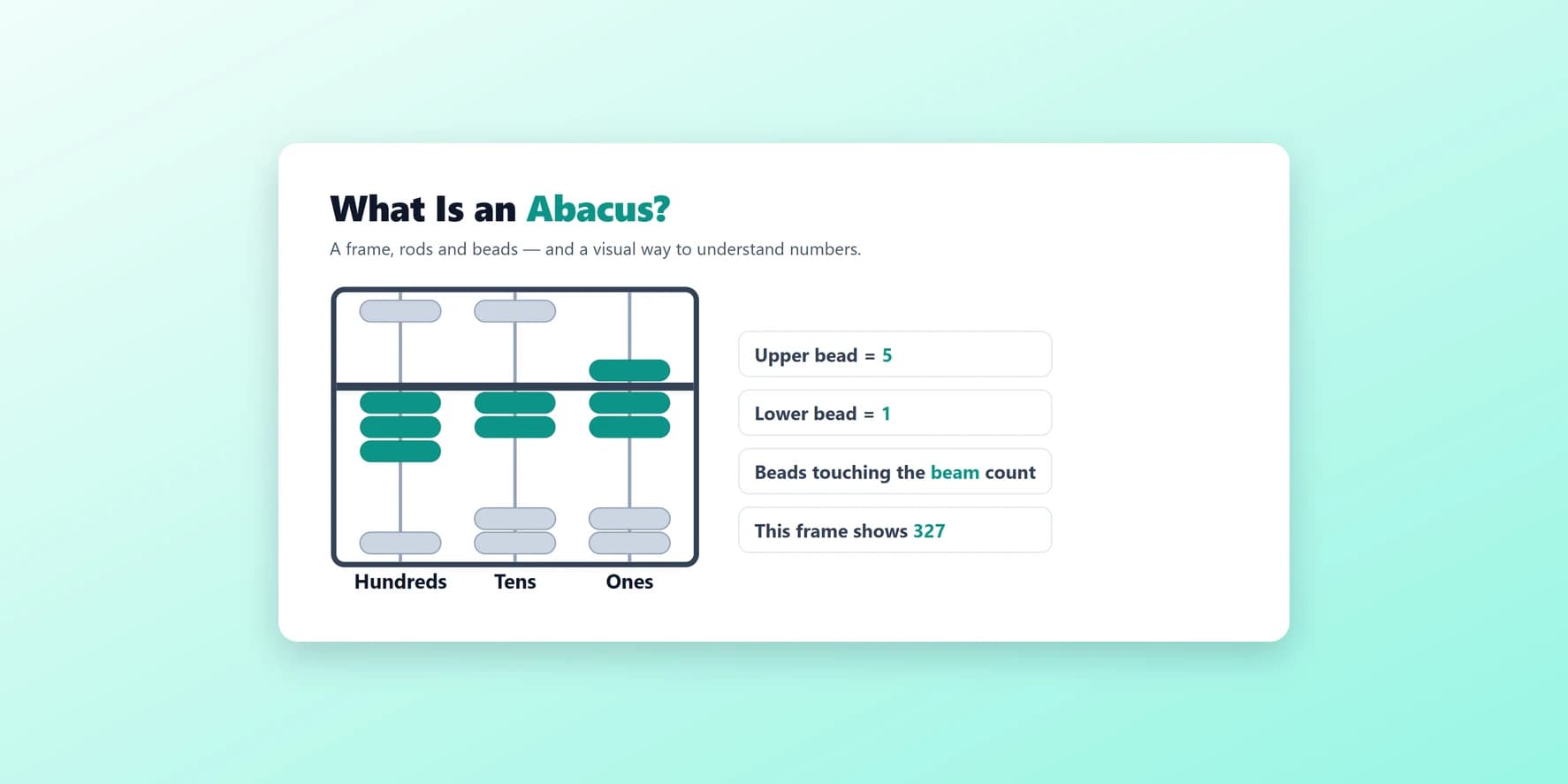
What is an abacus? An abacus is a counting tool made of a frame, rods and beads. In mental arithmetic, children usually use a soroban-style abacus: each rod has one upper bead worth 5 and four lower beads worth 1. Beads moved to the central beam are counted, and each rod stands for a place value — ones, tens, hundreds. Over time, the child learns to imagine the abacus and calculate mentally.
What is an abacus?
An abacus is a counting tool made of a frame with rows of beads. In mental arithmetic, one of the most common versions is based on the Japanese soroban. Each rod usually has:
- one upper bead;
- four lower beads;
- a central beam between them.
A bead becomes active when it is moved toward the beam. Each lower bead has a value of 1. The upper bead has a value of 5. Using these simple elements, a child can build every digit from 0 to 9.
How do numbers look on an abacus?
To show the number 3, the child moves three lower beads toward the beam. To show 5, they move one upper bead toward the beam. Then:
- 6 is 5 + 1;
- 7 is 5 + 2;
- 8 is 5 + 3;
- 9 is 5 + 4.
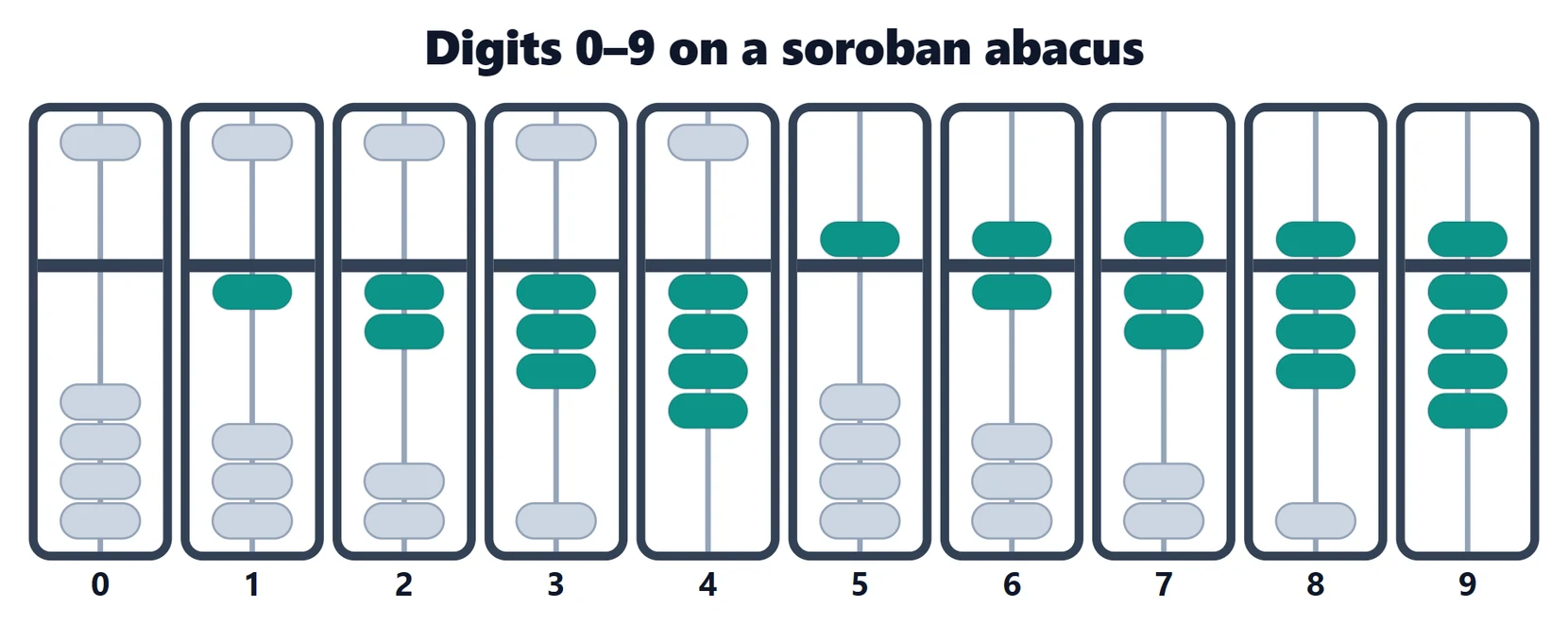
This may seem simple, but it changes the way the child experiences numbers. The number is no longer only a symbol written on paper. It becomes a visual pattern and a physical action.
How does an abacus show tens and hundreds?
Each rod represents a different place value. One rod represents ones. The next represents tens. Then hundreds. Then thousands. So the same bead position can represent very different values depending on the rod:
| Bead position | Ones rod | Tens rod | Hundreds rod |
|---|---|---|---|
| Three lower beads | 3 | 30 | 300 |
This makes the decimal system visible. The child does not only memorise that a digit changes value depending on its position. They work with that idea physically.
How does a child start learning?
The beginning is usually very simple. First, the child learns to represent numbers correctly: 1, 2, 3, 4, 5, 6, 7, 8, 9. Then come basic operations where no special rule is needed.
For example, 2 + 1: the child sets 2 and adds one more bead. The result is 3. Or 4 − 1: the child removes one bead and gets 3.
At this stage, the logic is very direct. But soon the child reaches examples that cannot be solved with one simple movement. That is when the real system behind the abacus begins.
Why can't you always just add more beads?
Suppose the child has 3 on the abacus and needs to add 4. Only one lower bead is still available. So the operation cannot be completed by simply moving four more lower beads.
The child now has to use the relationship between 4 and 1 around 5. This is where Small Friends, also known as Friends of 5, appear:
At first, the child consciously remembers the rule. Then they repeat it many times. Later, the movement becomes familiar enough that they no longer need to think through every step. That transition from conscious rule to automatic movement is one of the central parts of abacus training.
What are Small Friends?
Small Friends are number pairs that add up to 5: 1 and 4, 2 and 3. They are also often called Friends of 5, or complements to 5. Different schools may use different terminology. The mathematical idea is the same. These relationships are used when a direct movement is not possible.
What are Big Friends?
The next major step is working across 10. This is where Big Friends, or Friends of 10, become important. The basic pairs are 1 and 9, 2 and 8, 3 and 7, 4 and 6, 5 and 5.
These relationships become especially useful when calculation moves from one rod to the next — for example, from ones into tens. At that point, the child is no longer simply moving beads. They are working with a structured number system.
Friends of 5
1 + 4 · 2 + 3
Friends of 10
1 + 9 · 2 + 8 · 3 + 7 · 4 + 6 · 5 + 5
Two families of number pairs — the full explanation is in our guide to Small Friends and Big Friends.
Why is this more than memorising rules?
If you simply give a child a list of formulas and ask them to memorise them, the result will usually be limited. The real learning process connects three things: understanding, correct movement and repetition.
First, the child understands why the movement works. Then they learn to perform it correctly. Then they repeat it enough times for the movement to become familiar.
This is very similar to sport or music. You can explain how to serve a ball once. But for the movement to become automatic, it needs to be repeated many times. The same is true with the abacus.
Why does finger technique matter?
From the outside, it may seem that finger technique is a small detail. It is not. At the beginning, a child may still get the correct answer using inefficient movements. But later, as calculations become faster and more complex, those inefficient movements can start limiting progress.
In a typical soroban-style method:
- the thumb moves lower beads upward toward the beam;
- the index finger moves lower beads downward;
- the upper bead is also controlled with the index finger.
A good teacher therefore watches more than the final answer. They look at finger position, movement direction, unnecessary movements, coordination, and whether the child is trying to compensate for weak technique with speed.
Accuracy comes before speed
This is one of the principles I consider especially important. Parents naturally enjoy seeing a child calculate quickly. Fast calculation looks impressive. But if technique is still unstable, speed can simply reinforce mistakes. A better sequence is:
- Understand the rule
- Perform the movement correctly
- Repeat it
- Make it stable
- Increase speed
Speed should be the result of good technique. Not a substitute for it.
When does mental calculation begin?
Some people think a child should completely finish physical abacus work before starting mental arithmetic. In practice, that is not necessary. Physical and mental work can develop in parallel.
For example, the child may first set a number on a real abacus. Then close their eyes and try to imagine the same bead position. At first, the image may be weak. Later, it becomes more stable. Eventually, the child begins to imagine not only bead positions but also bead movements. That is how the mental abacus develops.
What is a mental abacus?
A mental abacus is an internal visual image of the physical abacus. The child imagines the rods, the beads, their positions and their movements. Instead of moving real beads, the child performs the same calculation mentally. This is often called Anzan.
This is also why experienced mental arithmetic students sometimes move their fingers even when there is no physical abacus in front of them. They are still following the same movement pattern in their imagination.
Does the physical abacus become unnecessary later?
No. I do not believe the physical abacus should disappear completely once mental calculation begins. It remains useful for learning new rules, correcting technique, analysing errors, rebuilding accuracy and working through difficult transitions. Even strong students may return to the physical abacus when necessary.
What does the learning path usually look like?
If we simplify it, the progression often looks like this:
- How the abacus works
- Representing numbers
- Simple addition and subtraction
- Small Friends — complements to 5
- Big Friends — complements to 10
- Longer chains, more digits, more speed
Mental calculation develops alongside this process. But there is one important point: not every school teaches these topics in the same order.
Different methodologies can use different sequences
For example, Small Friends can be taught from 1 → 2 → 3 → 4. But they can also be taught in the opposite direction: 4 → 3 → 2 → 1. The same applies to Big Friends. One school may teach from 1 up to 9. Another may go from 9 down to 1.
The mathematics does not change. The teaching sequence does.
Small Friends
1 → 2 → 3 → 4 or 4 → 3 → 2 → 1
Big Friends
1 → 2 → … → 9 or 9 → 8 → … → 1
Different methodologies. Same mathematics. Your methodology, your sequence — Amavit supports the practice.
Why do schools use different orders?
Because teachers and academies build their programmes differently. Some teachers prefer to start with combinations they consider easier. Others build the sequence from larger complements downward. Some connect Small Friends and Big Friends in a particular way. Some introduce mental practice earlier. Others wait longer.
I do not believe every teacher needs to follow one universal sequence. What matters is that the methodology is logical and consistent.
A platform should not dictate the methodology
This is an important issue with many educational systems. Software often arrives with its own fixed curriculum and expects the teacher to adapt. But if a teacher has used their own methodology successfully for years, there is little reason to force them to rebuild everything.
That is why Amavit was designed around a different principle. Basic topics follow the standard progression. But for Small Friends and Big Friends, the teacher chooses which number to practise in each assignment — Small Friends 1, 2, 3 or 4, and Big Friends 1–4 and 6–9 separately. So homework can go 1 → 2 → 3 → 4 or 4 → 3 → 2 → 1, and Big Friends can go up from 1 or down from 9, matching the teacher's own programme.
The platform should adapt to the methodology. Not the other way around — see how teachers can use Amavit as a practice tool.
Can a child practise independently?
If the child already knows the topic, yes. This is where independent practice becomes especially useful. A teacher does not need to sit next to the child for every tenth, fiftieth or hundredth example.
The teacher is most valuable when they need to explain a new rule, set the technique, identify the reason for a mistake or correct an incorrect movement. Familiar material can be practised independently — see online abacus practice for independent training.
What can parents do?
Parents do not need to become abacus teachers themselves. Their role can be much simpler:
- help make practice regular;
- remind the child;
- support them;
- avoid turning practice into punishment.
If the child forgets how to perform a particular exercise, practical video guidance can also help — for example, the videos on the Amavit YouTube channel — and then the child returns to practice.
How long should a child practise?
There is no universal number for every child. But short, regular practice usually works better than one very long session once a week. For a beginner, that may be around 7–10 minutes. For a child who has been studying for some time: 15–20 minutes. Advanced or competition-focused students may practise longer.
But I would not make time the main metric. More important factors are regularity, correct technique, attention and quality of practice.
Where is digital practice useful?
A physical abacus is excellent for technique. A workbook is still useful. Digital practice becomes especially valuable when a child needs many repetitions. A platform can:
This can save a teacher a significant amount of routine work. A child who already knows the basics can follow the same idea at home — see how a child can practise mental arithmetic at home without a teacher.
But digital practice does not replace the teacher
The teacher and the platform solve different problems.
The teacher
Explains · observes technique · understands the cause of errors · decides when the child is ready to move forward
The platform
Provides practice · repetition · automatic checking · helps maintain regularity
The combination is usually much stronger than either one alone.
What is online abacus practice?
Today, children do not need to complete every exercise only in a workbook. They can also practise on a computer, a tablet or a phone. The mathematical topic remains the same — for example, Small Friends, Big Friends, a particular digit length, a particular speed or a specific chain length.
The method does not change. Only the organisation of practice changes.
How does this work in Amavit?
Amavit was created for teachers and students who may already follow different schools and different methodologies. The goal is not to tell a teacher: "This is the correct way to teach mental arithmetic." The goal is to provide tools.
The teacher chooses the topic. The student practises. The practice can be adjusted by difficulty, speed, number of actions, digit length and practice format. With auto difficulty switched on, the trainer also makes practice easier or harder depending on how the child is answering.
The abacus is not only about fast calculation
For parents, speed is usually the most visible result. When a child starts calculating quickly, it looks impressive. But the learning process is much broader than that. The child is learning to follow a structured sequence: see the problem, recognise the rule, make the correct movement, check the result, repeat, increase complexity.
That is why I would not reduce abacus training to one question: "How fast can my child calculate?" Fast calculation is an outcome. The real work happens before that.
Is abacus training right for every child?
Not necessarily. Like any educational method, it may suit some children better than others. Some children enjoy structure, repetition, visual patterns, games, competition and speed challenges. Others may prefer different learning formats.
For me, a good test is simple: Does the child understand what they are doing? Are they making progress? Is the practice manageable rather than stressful? If yes, the learning process is probably working well.
What should parents look for in an abacus school?
Not only speed. I would look at:
- how the teacher sets technique;
- whether mistakes are corrected;
- whether difficulty increases gradually;
- whether practice is regular;
- whether children are pushed toward speed too early;
- how the school develops mental calculation;
- whether the teacher understands why a child is making a particular mistake.
Good results do not begin with impressive numbers on a screen. They begin with good fundamentals.
The main idea
The abacus is a very simple-looking tool. But behind it is a structured learning system. The child moves gradually:
- Number
- Movement
- Visual image
- Automaticity
- Mental calculation
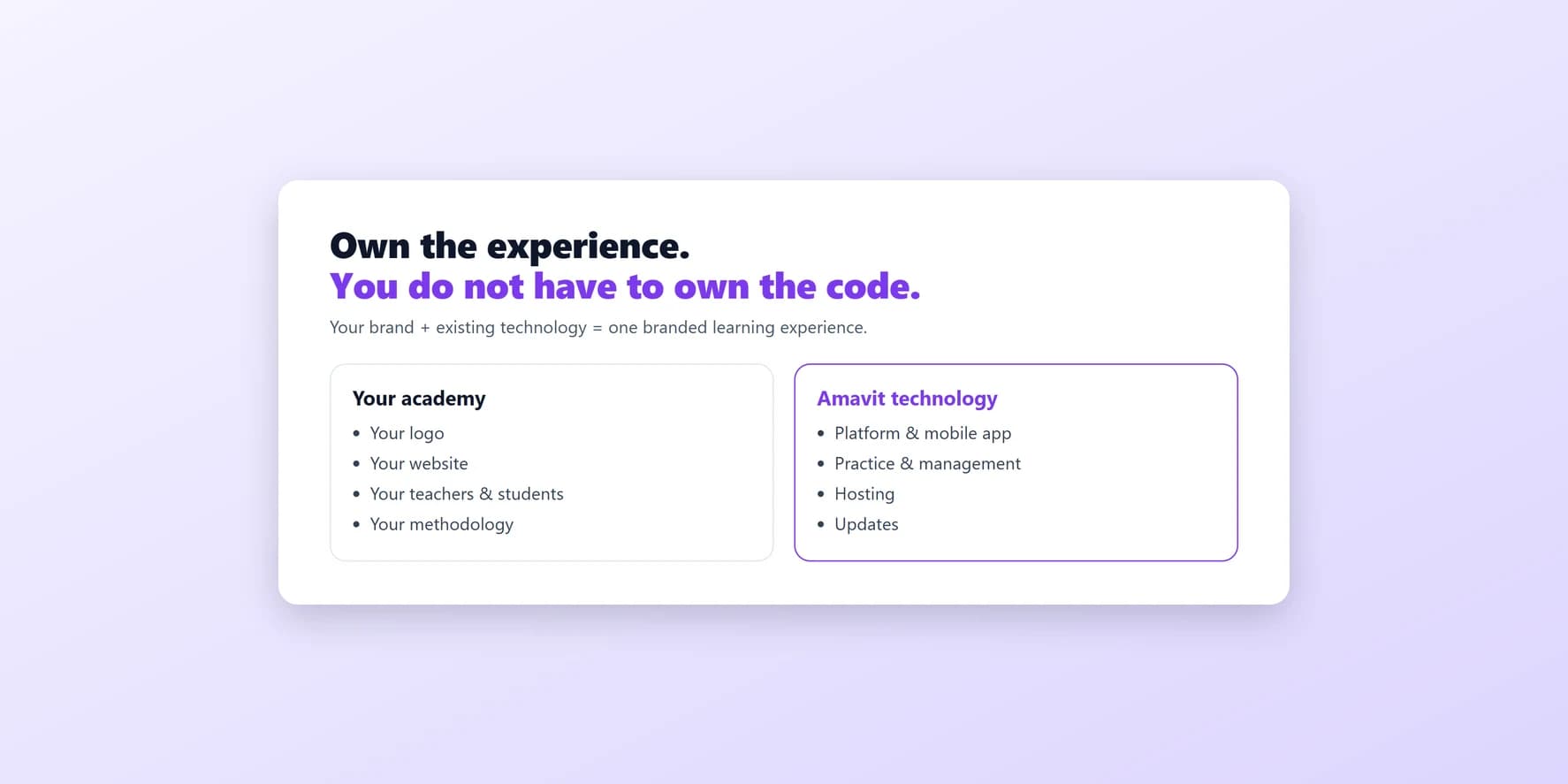
Different schools may use different methodologies. Different teachers may organise topics in different sequences. That is completely normal. Technology should support the teacher's system, not force the teacher to change it — whether that is one teacher or a whole academy (Amavit for academies).
That is one of the main principles behind Amavit: you teach using your methodology — the platform helps your students practise it.
Frequently asked questions
What is an abacus?
An abacus is a manual counting tool that uses beads on rods to represent numbers and perform arithmetic operations.
How does an abacus work?
Each rod represents a place value, while beads moved toward the central beam represent numerical values.
What is a soroban abacus?
A soroban is the Japanese form of the abacus commonly used in modern mental arithmetic training.
What are Small Friends in abacus?
Small Friends are complements to 5, such as 1 and 4 or 2 and 3.
What are Big Friends in abacus?
Big Friends are complements to 10, such as 1 and 9, 2 and 8, or 3 and 7.
What is a mental abacus?
A mental abacus is the visual image of a physical abacus that a child learns to manipulate mentally.
Is an abacus only used for fast calculation?
No. Speed is one visible result, but abacus training also involves technique, visualisation, repetition and structured number work.
Do all abacus schools teach the same sequence?
No. Different methodologies may teach Small Friends and Big Friends in different orders while using the same mathematical principles.