What Are Small Friends and Big Friends in Mental Arithmetic — and Why Do They Matter?
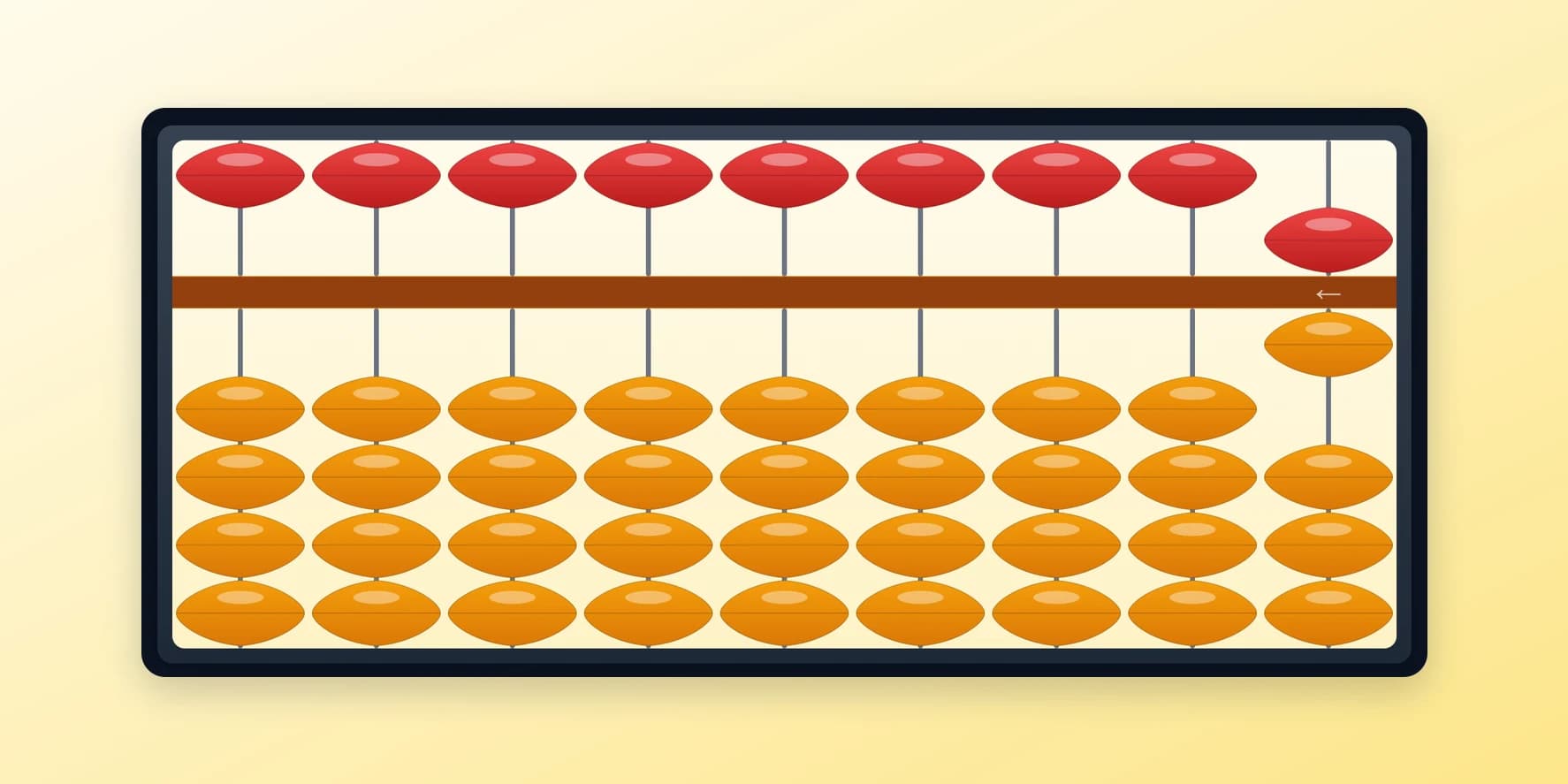
When a child first starts learning mental arithmetic, the earliest examples seem very simple. For example:
1 + 2 · 4 − 1 · 2 + 1 · 3 − 2
At this stage, the child simply moves the required number of beads on the abacus.
But very soon, a situation appears where the operation can no longer be performed directly.
For example, the child needs to add 4, but there are not four available lower beads.
This is where two important sets of rules appear:
Small Friends
and Big Friends.
This is one of the most important stages in learning mental arithmetic.
Because calculation stops being simple mechanical bead movement and begins to develop into a structured system.
In short
- Small Friends use complements to 5.
- Big Friends use complements to 10.
Both must be practised with correct finger movements on a physical abacus before they become stable mental-abacus patterns.
First, the child needs to master Simple
Before Small Friends and Big Friends, children usually learn what is often called Simple.
These are operations that can be performed directly on the abacus without using complementary rules.
For example, if the child needs to add 2 and two beads are available, they simply move them.
If they need to subtract 3 and three beads can be removed directly, they remove them.
At this stage, it is especially important to:
- position the hand correctly;
- move beads with the correct fingers;
- avoid counting beads one by one;
- recognise numbers from bead positions;
- gradually increase speed.
This is the foundation.
If Simple is not mastered correctly, everything that comes later becomes more difficult.
Correct finger movement is the foundation of future calculation
During Simple, Small Friends and Big Friends, getting the correct numerical answer is not enough.
The child also needs to perform the correct movement with the correct finger.
This is fundamental.
A physical abacus does more than show a number. It helps create a motor pattern that can later become part of the mental abacus.
If an incorrect movement becomes a habit at the beginning, that habit can remain with the child and become especially problematic at higher speeds.
That is why correct technique needs to be established from the very beginning.
The basic finger rule
When a lower bead moves up toward the beam, the child uses the thumb.
When a lower bead moves down away from the beam, the child uses the index finger.
The basic rule is therefore very simple:
up — thumb;
down — index finger.
For example, if the child calculates:
4 − 2
two lower beads are moved down away from the beam. This movement is performed with the index finger.
If lower beads need to be added without crossing 5, they are pushed upward toward the beam with the thumb.
This may sound like a small technical detail. In practice, it is one of the foundations of both future speed and accuracy.
Why children should not move beads “however feels comfortable”
At a slow speed, a child may use the wrong finger and still arrive at the correct answer.
That is why poor technique can remain unnoticed at first.
Later, however, speed increases. The child begins working with:
- longer chains;
- Small Friends;
- Big Friends;
- two- and three-digit numbers;
- mental calculation.
At that stage, incorrect technique begins to interfere.
- Extra movements appear.
- The fingers become confused.
- The child loses time.
- Errors increase.
That is why a teacher should correct finger technique from the beginning, before the wrong movement becomes automatic.
Why you cannot always add the required number of beads directly
The abacus has a specific structure. Within each place value, its bead arrangement is organised around 5.
When there are not enough available beads to perform an operation directly, the child needs to use another movement.
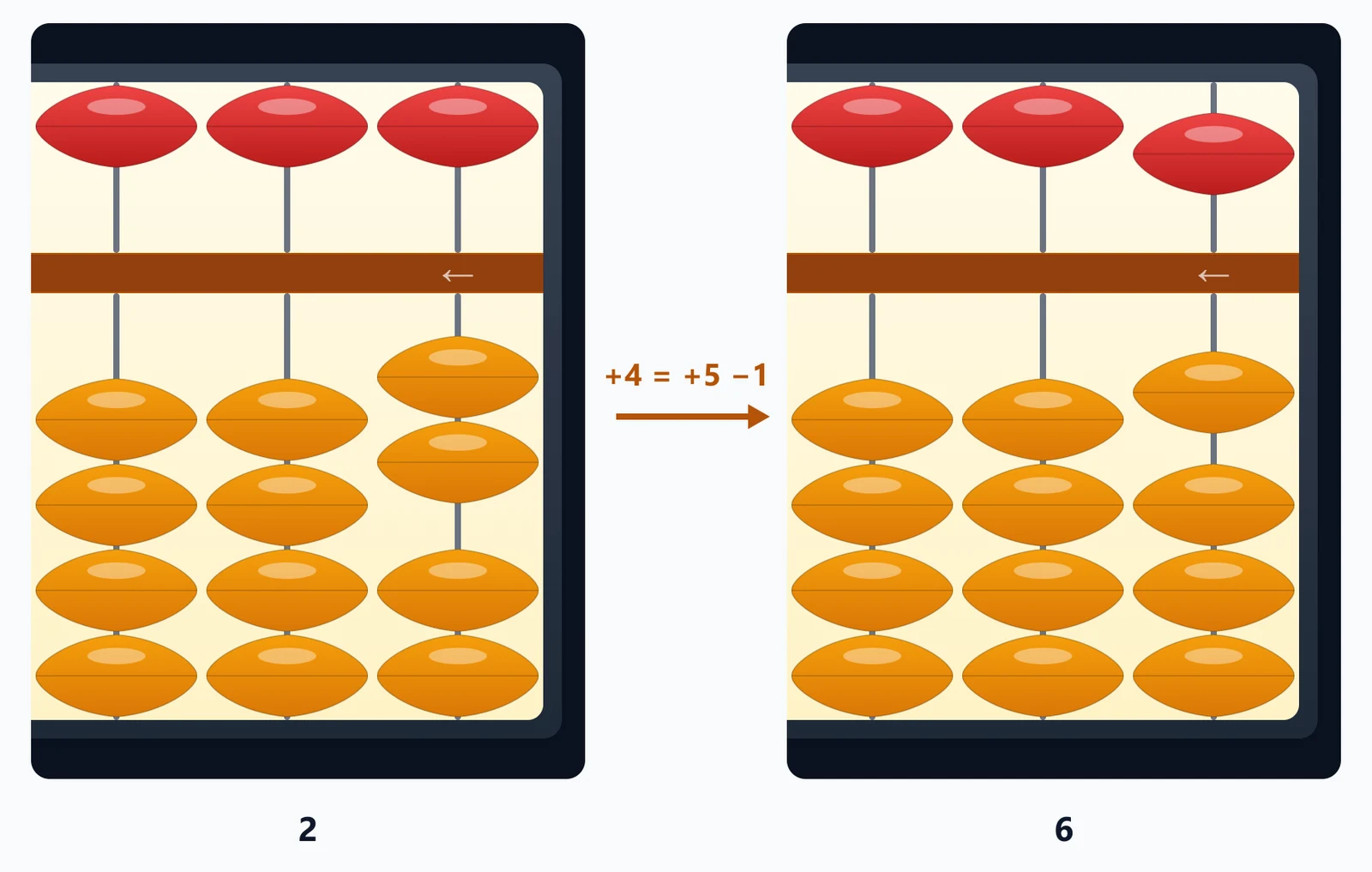
Imagine that the abacus shows 2. Now we need to add 4.
Four lower beads cannot simply be added directly. Instead, the child can use 5.
So rather than performing a direct +4, the child performs an equivalent operation using 5.
This is an important conceptual step:
the same mathematical result can be produced through a different abacus movement.
What are Small Friends?
Small Friends are complementary rules built around the number 5.
The pairs are:
- 1 and 4;
- 2 and 3;
- 3 and 2;
- 4 and 1.
Why these pairs? Because each pair adds up to 5:
1 + 4 = 5 · 2 + 3 = 5 · 3 + 2 = 5 · 4 + 1 = 5
When an operation cannot be performed directly, the child uses 5 and compensates for the difference.
A Small Friends example
Suppose the abacus shows 2. We need to add 4.
Adding four lower beads directly is not possible. So the child uses:
+4 = +5 −1
The mathematical result is the same. But the operation can now be performed correctly on the abacus.
Another example is:
+3 = +5 −2
And this is where one of the most important specialised finger movements appears.
Small Friends introduce the “crab” movement
When a child begins calculating through 5, a simple one-finger movement is no longer enough.
Two fingers work together in a coordinated movement that we call the “crab” movement.
Take:
2 + 4
The rule is:
+4 = +5 −1
The 5-bead moves toward the beam with the index finger.
At the same time, one lower bead is moved down with the thumb, often using the thumbnail.
The fingers work as a single mechanism. They stay in a stable position and perform the movement together.
This is why the movement resembles a small crab.
The hand should not have to reset its position after every operation.
The more stable and compact the movement becomes, the easier it will be to calculate quickly later.
Why the “crab” movement matters so much
At a low speed, a beginner may consciously think:
“First +5, then −1.”
That is completely normal at the start. But this is not the final goal.
After enough repetitions, the child should stop experiencing it as two separate conscious steps.
They see +4 and immediately perform the correct movement.
Eventually, +5 −1 feels almost like a single action.
That is automaticity.
The same principle applies to other Small Friends:
- +3 = +5 −2
- +2 = +5 −3
- +1 = +5 −4
and to the corresponding subtraction operations.
Small Friends must become automatic
At the beginning, a teacher may ask:
“What is the friend of 3?”
The child thinks for a moment:
“2.”
That is normal.
Later, however, there is no time for this conscious recall.
When numbers appear every two seconds, then every second, and later even faster, the child cannot repeatedly stop and think:
“3 needs 2 to make 5.”
The child needs to recognise the operation and perform the correct movement almost immediately.
Small Friends gradually stop being formulas the child consciously remembers. They become automated visual-motor patterns.
First the hand learns the movement — then the mind reproduces it
This is one of the main reasons children should not abandon the physical abacus too early.
Mental abacus does not appear from nowhere. First, the child sees hundreds of repetitions of:
- the number;
- the bead position;
- the correct finger movement;
- the resulting bead pattern.
Over time, the brain connects these elements.
Later, the physical abacus can gradually be used less. But the child continues to visualise the same beads and familiar movements mentally — this is how the mental abacus develops.
When physical technique is correct, the mental abacus has a much stronger foundation.
If the original movement pattern is incorrect, the child may carry that incorrect pattern into mental calculation.
The physical abacus is especially important during the Friends stage
During Simple, Small Friends and Big Friends, the physical abacus remains a particularly important learning tool.
It should not be replaced too early by screen-only practice or mental calculation.
The child needs to:
- see the beads;
- move them with the correct fingers;
- feel the correct mechanics;
- repeat the movements many times;
- build automaticity.
This is why a good teacher does not look only at the answer. The teacher also watches the child's hands.
- Is the thumb working correctly?
- Is the index finger moving correctly?
- Is the hand position stable?
- Is the “crab” movement being performed properly?
- Are there unnecessary movements?
This is where the technique that later determines both speed and accuracy is established.
What are Big Friends?
The next major stage is Big Friends.
Here the complementary structure is based on 10.
The pairs are:
- 1 and 9;
- 2 and 8;
- 3 and 7;
- 4 and 6;
- 5 and 5;
- 6 and 4;
- 7 and 3;
- 8 and 2;
- 9 and 1.
Every pair adds up to 10.
When an operation cannot be completed within the current place value, the child uses a transition through 10.
A Big Friends example
Consider:
8 + 6
It is not possible to add 6 directly in the current place value. So the child uses:
+6 = +10 −4
because 6 and 4 together make 10.
Other examples include:
- +8 = +10 −2
- +9 = +10 −1
Corresponding complementary movements are used for subtraction.
This is how the child learns to work across place values.
Small Friends and Big Friends are not just tables to memorise
One common teaching mistake is to treat Friends as nothing more than pairs that children must learn by heart.
Of course, the pairs do need to be remembered. But memorisation alone is not enough.
The child needs to develop several things simultaneously:
- understanding of the complement;
- correct finger movement;
- a visual bead pattern;
- fast recognition of the situation;
- automatic application of the rule.
A child may perfectly answer:
“The friend of 7 is 3.”
But if they still need to pause before performing the movement in a fast exercise, the skill has not yet become automatic.
Teachers should not move on too quickly
Sometimes a child understands the idea of Small Friends very quickly.
The teacher sees correct answers and immediately introduces the next topic.
That can be a mistake.
Understanding is not the same as automaticity.
The child needs enough repetitions — see how much practice a child needs each day.
- First slowly.
- Then faster.
- In different combinations.
- With different numbers.
- Using correct finger technique.
Only when the rule begins to operate with little or no conscious hesitation should the training confidently progress.
A new rule should initially be practised separately
When a child has just learned Small Friends, focused practice on that topic is useful. The same applies to Big Friends.
This helps the child:
- understand the mechanics;
- reinforce correct movements;
- reduce random errors;
- automate proper finger technique.
But isolated practice should not continue forever.
In real calculation, no one tells the child:
“The next ten examples will all use Big Friends.”
The learner has to recognise which rule is needed.
Then the topics need to be mixed
Once the new topic becomes stable, earlier operations should return to the exercises. For example:
- Simple;
- Small Friends;
- Big Friends.
The child sees a number and must quickly recognise:
- Can this be done directly?
- Do I need to use 5?
- Do I need to cross 10?
This is where real automaticity develops.
The child is no longer repeating one memorised formula. They are selecting the correct action from a mixed stream of operations.
Why old mistakes often reappear during Big Friends
When a child reaches Big Friends, exercises become significantly more complex.
A single calculation may now contain:
- Simple;
- Small Friends;
- Big Friends;
- place-value transitions.
If an earlier topic or finger movement was not properly consolidated, this is often the point where the weakness becomes visible.
A parent may think:
“My child does not understand Big Friends.”
But sometimes the child understands Big Friends perfectly well.
The actual problem may be an older Small Friends rule. Or even incorrect basic technique from Simple.
That is why the teacher needs to observe not only the final answer, but also how the child performs the calculation — see why children keep making the same mistakes.
Speed should come only after accuracy
Suppose a child performs Big Friends accurately at three seconds per operation.
- The teacher changes the speed to two seconds.
- Accuracy remains high.
- Then 1.5 seconds.
- Then one second.
This is a healthy progression.
If the child begins making many mistakes at two seconds, there is little benefit in immediately moving to one second.
Accuracy needs to be stabilised first.
A good sequence is:
correct technique → understanding → repetition → automaticity → speed.
Not the other way around.
Correct technique matters even more at high speed
At slow speeds, a child can sometimes compensate for poor technique by concentrating harder.
At high speed, that becomes impossible.
When numbers appear:
- every two seconds;
- every second;
- or even faster,
there is no time to consciously remember:
- which finger to use;
- which direction to move;
- which complementary rule applies.
The movements have to start automatically.
That is why incorrect finger technique established at the beginning almost always creates problems later.
Digit length should also increase gradually
Children usually learn these rules first with single-digit numbers. Later they move to:
- two-digit;
- three-digit;
- four-digit;
- and more complex numbers.
Small Friends and Big Friends do not disappear. They continue to operate within each place value.
But the total cognitive load becomes much greater. Now the child needs to:
- visualise several place values;
- maintain the structure of the mental abacus;
- perform the correct transitions;
- avoid losing the previous state.
This makes strong basic technique critical.
High speed is built from these basic rules
When someone watches an advanced student calculate extremely quickly, it can look as though the child simply “knows the answers instantly.”
That is not what is happening.
High speed is built on thousands of correctly performed basic actions:
- Simple;
- Small Friends;
- Big Friends;
- transitions;
- place values;
- correct finger movements.
Once each element becomes automatic, the child no longer has to consciously analyse every rule.
That is how calculation speed can gradually progress toward one second, 0.5 seconds, 0.3 seconds, and even faster — from 3 seconds to 0.1 seconds per operation.
Fast mental calculation is built on an exceptionally strong foundation.
Why a digital platform becomes useful at this stage
A printed workbook contains a fixed set of exercises.
For example, a page may include a certain number of Small Friends tasks.
If one particular child needs twice as many repetitions on one topic, the teacher has to find or manually create additional exercises.
A digital system allows practice to be adjusted much more precisely. For example, the teacher can:
- increase the frequency of Small Friends;
- keep a smaller proportion of Simple;
- introduce Big Friends later;
- change the speed;
- increase chain length;
- adjust digit length.
The teacher can therefore control not only the number of exercises, but also the structure of the practice.
How this works in Amavit
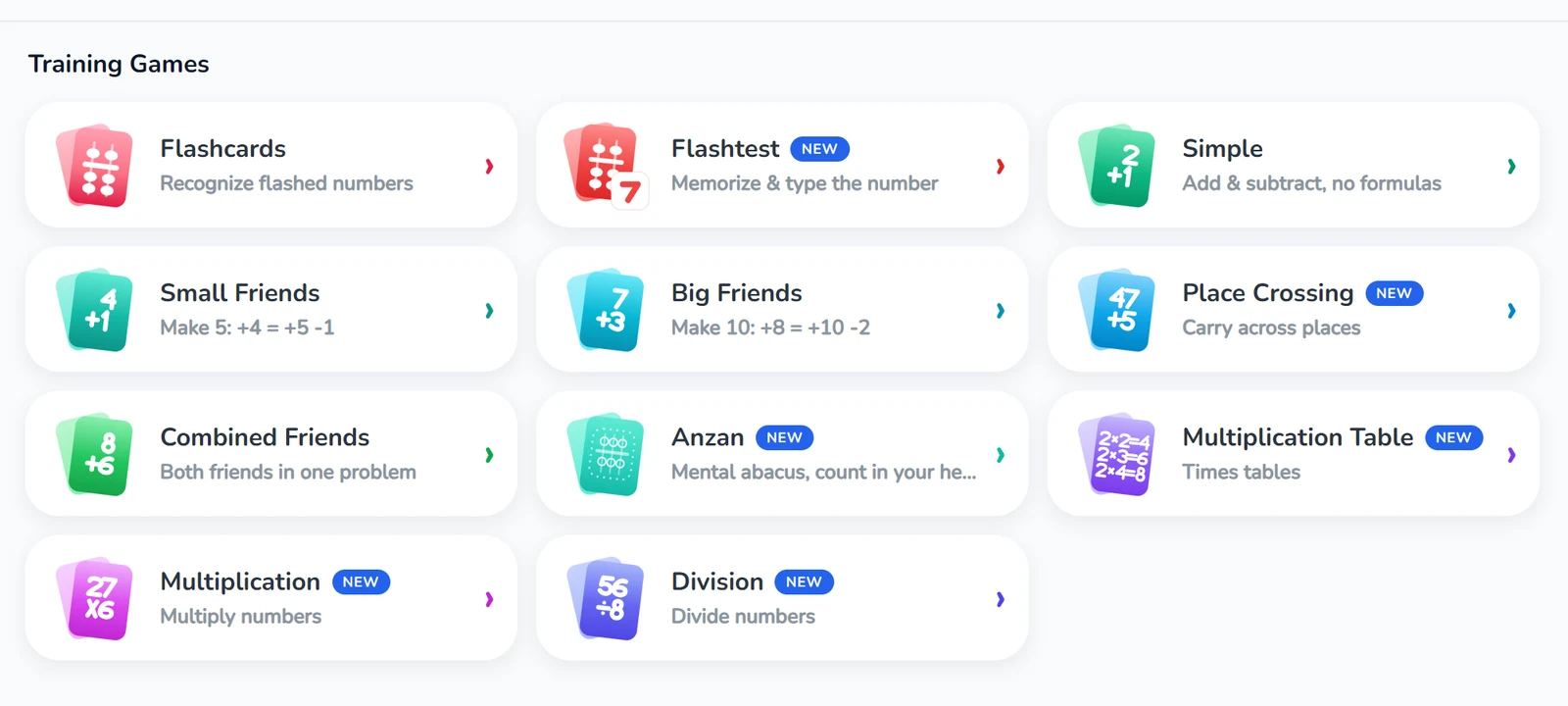
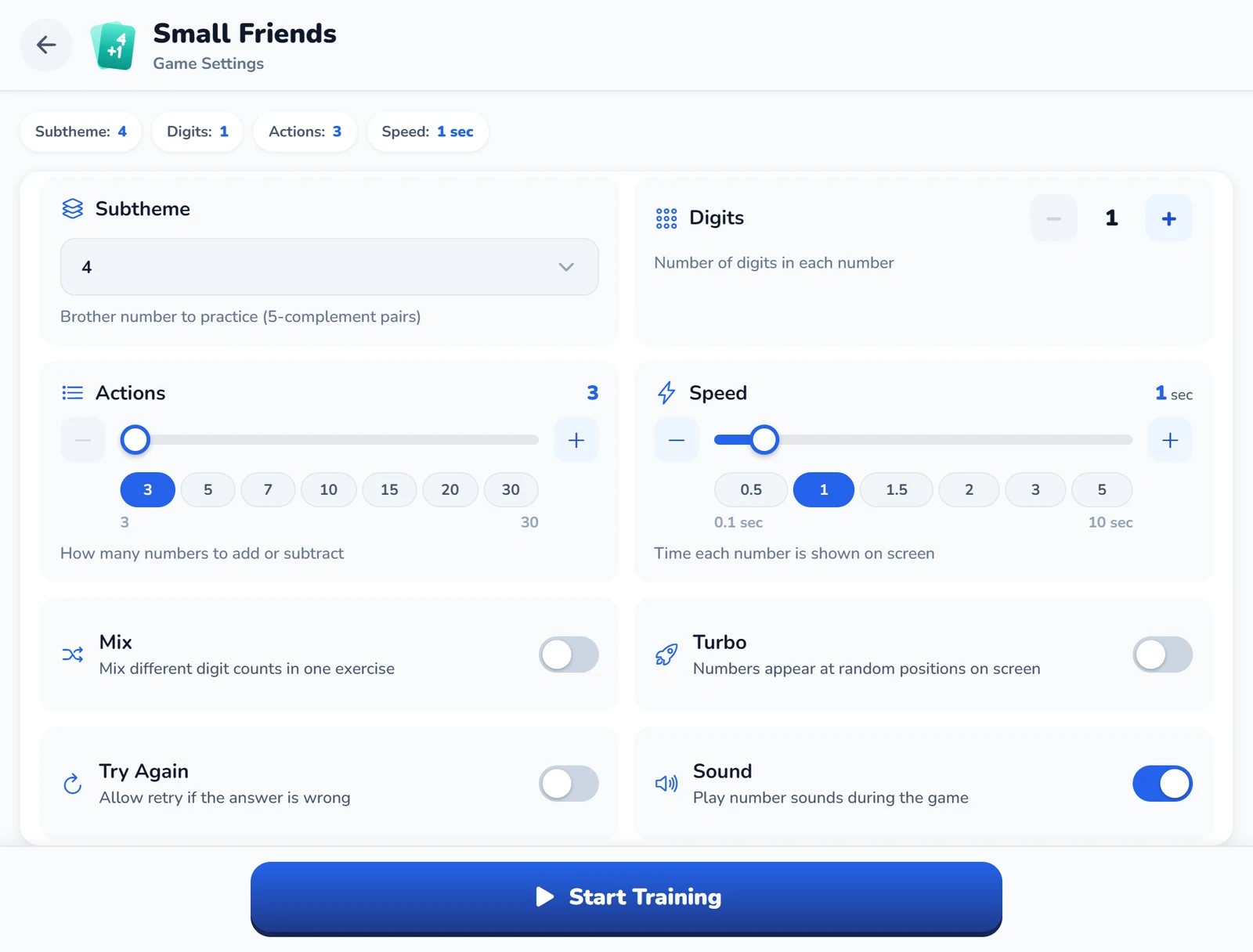
In Amavit, teachers can select a specific topic and configure the training parameters. For example:
- Small Friends;
- a specific digit length;
- a selected speed;
- a selected number of operations;
- a required chain length.
Once the student has mastered the topic, it can gradually be mixed with previously learned operations.
If errors begin to appear, the weak topic can be given a higher frequency again.
At the same time, correct finger technique should first be established by the teacher on the physical abacus.
The digital platform then helps provide the required volume and structure of practice.
This division of roles is important:
the physical abacus establishes correct mechanics;
the digital platform helps scale and precisely adjust the practice.
Children should not learn Small Friends and Big Friends like a school multiplication table
Of course, the complementary pairs need to be remembered.
But the objective is not simply for the child to recite:
1–4; 2–3; 3–2; 4–1.
Or:
1–9; 2–8; 3–7.
The real goal is for the hand — and later the mental abacus — to perform the correct operation almost automatically when the action appears.
Knowledge needs to become a skill.
From physical movement to mental abacus
Once correct movements have been established on the physical abacus, the child gradually performs them faster.
At some point, the physical tool no longer needs to be present for every exercise.
The child visualises the bead positions and mentally reproduces the familiar movements.
Mental abacus is therefore not a completely separate skill that suddenly appears later. It grows from thousands of correctly performed physical actions.
That is why finger technique in the early stages is not a minor detail or simply a matter of neat movement.
It is the foundation of future mental calculation.
Small Friends and Big Friends are one of the key transitions in mental arithmetic
Before this stage, the child is mainly learning how to move beads.
After this stage begins, they are learning a complete abacus calculation system.
They learn to:
- recognise number structure;
- use complementary operations;
- calculate through 5 and 10;
- move across place values;
- select the correct movement quickly;
- use correct finger technique automatically.
This foundation later supports:
- multi-digit numbers;
- high-speed calculation;
- mental calculation;
- Anzan;
- multiplication;
- division;
- and more advanced operations.
Small Friends and Big Friends are therefore not a small intermediate chapter in the curriculum. They are one of the foundations of mental arithmetic.
And the better a child masters both the rules and the correct physical movements, the easier it becomes to progress to advanced mental calculation.
Frequently asked questions
What are Small Friends in abacus?
Small Friends are complementary pairs that add up to 5.
What are Big Friends in abacus?
Big Friends are complementary pairs that add up to 10.
Which fingers should children use on an abacus?
For lower beads, upward movement toward the beam is performed with the thumb, while downward movement is performed with the index finger.
Why is finger technique important in mental arithmetic?
Because repeated physical movements help establish the automatic visual-motor patterns later used in mental-abacus calculation.
Free for teachers