How a White-Label Learning Platform Can Make a Small Academy Look Like a Large Education Brand
Small education academies often face the same challenge. They may have excellent teachers, a strong methodology, happy parents and good student results. But from the outside, they can still look like a small local school.
Why? Because large education networks usually have their own website, student accounts, mobile apps, digital homework, scheduling, payment systems, analytics, consistent branding and their own digital platform. A smaller academy often relies on WhatsApp, Excel, Google Calendar, separate apps — different tools for different tasks.
From the parent's perspective, the experience feels completely different.
A white-label learning platform allows an academy to offer students and parents a branded digital experience without developing its own software. The academy keeps its logo, website, teachers, methodology and customer relationships, while the technology provider maintains the platform, mobile app and infrastructure.
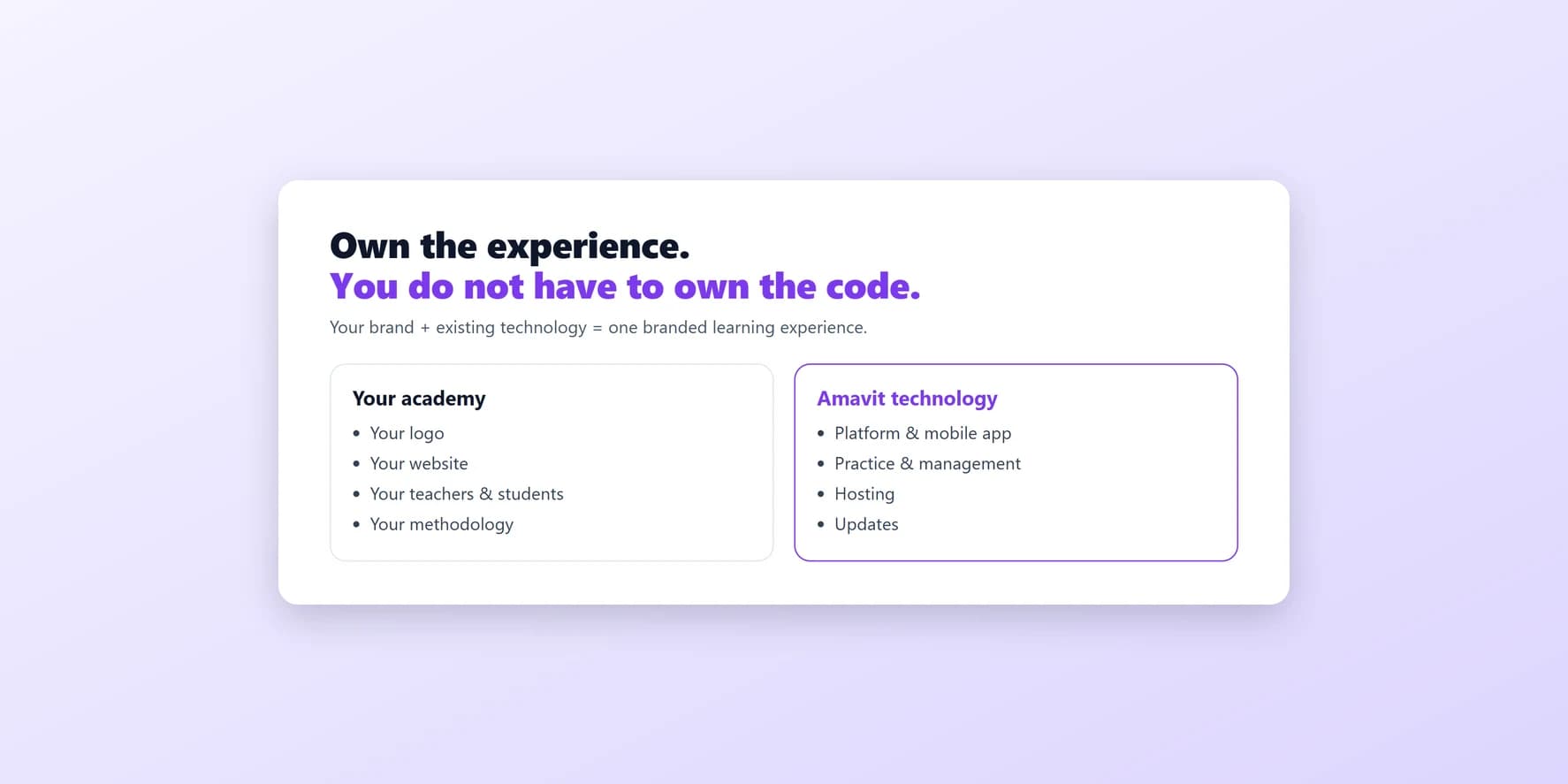
Your brand
Your academy · your logo · your website · your teachers · your students · your methodology
Amavit technology
Platform · mobile app · practice · management · hosting · updates
Your brand + existing technology = one branded learning experience. Own the experience — you do not have to own the code.
Parents judge more than teaching quality
Parents do not see only the teacher. They experience the whole service. How do they enrol? Where do they find the schedule? Where is the homework? Where can they see progress? How do they log in? How do they pay? Is there a mobile app? Does everything feel organised and professional?
Even when the teaching itself is strong, a fragmented digital experience can reduce the overall perception of the academy.
Building everything independently is expensive
To create the same digital experience as a larger education network, an academy may need a web platform, a mobile app, student and teacher accounts, manager access, homework and practice tools, payments, analytics, branding and notifications.
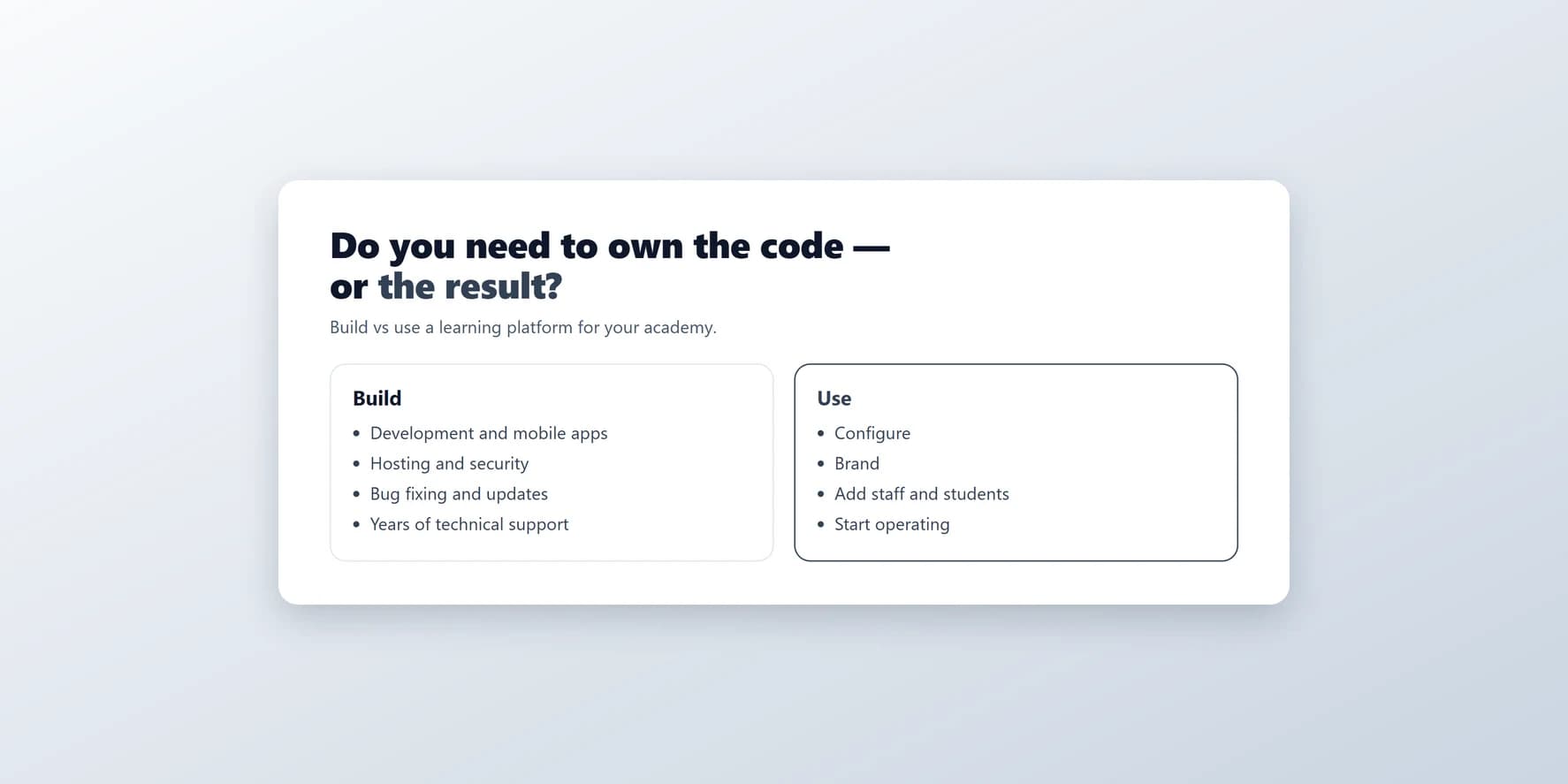
Building all of this from scratch is expensive. Maintaining it is even more expensive — see why small academies should not build their own learning platform. That is why a white-label or branded learning platform can be a much more practical option for a smaller academy.
What is a branded learning platform?
The idea is simple. The technology already exists. The academy uses that technology within its own branded environment.
The user sees the academy logo, the academy name, its teachers, its groups, its students and its learning process. The underlying technology is developed and maintained by a specialist provider.
You do not need to own the code to own the customer experience
This is the key idea. Parents usually do not care who wrote the backend, where the servers are located or which framework is being used. They care about something else: is the platform easy to use? Does it work reliably? Does it show the academy's identity? Can they log in quickly? Is there a mobile app? Can they see homework and results?
The academy may not own the code, but it can still own the customer experience.
Your academy. Your brand. Your students. Our technology.
Own the customer experience — not necessarily the code.
A logo is not a small detail
It may seem that a logo does not change much. In reality, it matters. When a child regularly opens the learning environment and sees the academy's branding, the platform starts to feel like part of the school. Not like a random third-party service, but like:
“This is our academy's learning platform.”
That can be especially important for parents.
Branding connects offline and online learning
Imagine that a child attends a specific academy. In the classroom they see the academy name, logo and colours, the learning materials and their teacher. If they go home and use a completely unrelated digital service, the experience becomes fragmented.
If the digital environment reflects the academy's brand, the connection is much stronger. Offline and online learning begin to feel like one system.
Platform access can start from the academy website
This is one of the strongest elements. The parent visits the academy website. There is a button such as Student Login, Learning Platform or Open Academy Platform. They click it and enter the working environment.
From the customer's perspective, this feels like a natural part of the academy website. There is no need to search for another service. No complicated explanation. No repeated links sent through messaging apps.
The website remains the main brand entry point
This is convenient for the academy too. The website continues to handle presentation, SEO, advertising, lead generation and enquiries. The platform becomes the working layer behind it. The structure becomes clear:
academy website → login → academy digital environment.
There is no need to rebuild the existing website
If the academy already has a good website, it does not need to replace it. A platform login can simply be added. The academy keeps its existing marketing infrastructure and adds the technology layer behind it.
See Amavit for schools & academies. Add a branded learning environment to your existing academy website. Amavit for academies.
Inside the platform, users see their academy
After login, students and parents can enter an environment connected to their school: academy branding, academy groups, teachers, assignments, learning activities and results. The academy identity remains visible even though the underlying technology is provided by Amavit.
What about the mobile app?
This is where transparency matters. The academy does not receive a separate App Store or Google Play application under its own name. The mobile application remains Amavit. But inside the app, users can work within the environment of their academy.
| Mobile app | What the user gets |
|---|---|
| App name | Amavit |
| Inside the app | Your academy environment, your logo, your students, your groups, your teachers |
A branded academy experience inside the Amavit app — not a separate app under the academy's name.
This provides many of the benefits of having a mobile app without the cost of developing and maintaining a separate application.
This can save a small academy significant development costs
Building a separate mobile app requires iOS development, Android development, testing, publishing, updates, technical support, push notifications and compatibility work. And all of that continues over time. Using shared mobile infrastructure removes most of this burden.
The academy brand still needs to be visible
That is why academy customisation matters. The user should understand which academy they belong to, who their teacher is, which group they are in, which assignments belong to them and which organisation provides their education. That is what creates the feeling of a complete digital ecosystem.
White-label does not always mean the technology provider must be invisible
Sometimes white-label is understood as “the technology brand must never appear anywhere”. That is not always necessary. For a smaller academy, it may be enough that the main customer experience belongs to the academy, academy branding is visible, the entry point comes from the academy website and internal processes are connected to the academy.
Amavit can still remain the technology brand of the mobile application.
Parents care about consistency
Parents do not need to understand the term “white-label”. They see the school, its website, its logo, its teachers, its digital tools, its homework and its learning environment. If those things feel connected, the academy looks significantly stronger.
A small academy can look more professional
Imagine two schools.
Before
WhatsApp · Excel · Google Calendar · separate homework · separate payments · no consistent student environment
After
Academy website → student login → branded learning environment → app + practice + homework + results
One academy. One digital experience.
The first sends homework through WhatsApp, keeps schedules in Google Calendar, shares results through messages, checks payments separately and has no mobile learning environment. The second offers a branded digital environment, student login from its website, mobile access, home practice, teacher accounts, manager access, results, payment workflows and one learning system.
Even if both schools teach equally well, the customer experience feels different — compare moving abacus homework beyond WhatsApp.
Technology strengthens the brand
Technology alone does not create a strong academy. If teaching is poor, a platform will not solve the problem. If the methodology is weak, branding will not fix it.
But when the educational product is already strong, technology can amplify it. It can make the service clearer, operations easier, the brand stronger and the customer experience more professional.
This matters when new parents compare academies
Before a family starts lessons, it can be difficult to judge the quality of a methodology objectively. So part of the decision is based on visible signals: how professional does the academy look? Is there a clear system? Is there an app? Is there a student account? Is the learning process easy to understand?
Digital infrastructure becomes part of trust.
The effect can be especially strong for a small school
For a large network, a platform is expected. For a smaller academy, a strong digital environment can become a competitive advantage. Parents see not just a local teacher, but an organised education system.
Branding also helps when the academy expands
Brand consistency becomes even more important when the academy grows. New groups appear. New teachers join. New managers may be added. New branches may open. If every branch works differently, the brand becomes fragmented. A shared digital environment can help standardise the customer experience — see how to manage multiple abacus groups.
Everyone works inside the same system
This matters internally too. The teacher should not have one system, the manager another, the owner a third and the student a fourth. Ideally, the main roles are connected through one environment. That makes the brand not only more attractive externally, but more organised internally.
Branding is more than a logo
A real branded experience includes more than visual design. It includes how users enter, what they see, which roles exist, how groups are organised, how homework works and how the academy manages the process. The logo is only the visible surface.
The academy can keep its own teaching method
This is one of the most important principles. A branded platform should not force the academy to become someone else's school. The academy may already have its own curriculum, workbooks, topic sequence, teacher standards and teaching style.
Amavit should function as the technology layer — not as a replacement for the academy's educational identity.
This is especially important for abacus and mental arithmetic academies
Schools in this field may differ in topic sequence, finger technique, homework structure, speed progression, mental transition and competition preparation. So the academy should not have to rebuild its methodology around software. The software should support the academy's method — the same principle as in using Amavit as a practice trainer.
Branding should work inside the learning experience too
If the academy has its own methodology and internal standards, the digital platform should support those processes. Then technology becomes part of the education product. Not just an external app where children occasionally practise.
Academy-wide Premium can strengthen the “own platform” effect
One of the strongest models is when the academy includes Premium access for all students. Then there is no situation where one child has full access, another does not, and a parent needs to decide whether to buy something separately. All participating students receive the same digital package.
For parents, this feels like part of the academy programme
The academy can say: “Our programme already includes digital practice.” The package may include practice, games, progress tools, mobile access and Premium functionality. For the family, this becomes part of the school service.
Branding becomes even stronger in this model
When the academy provides Premium centrally, the platform stops feeling like a separate subscription. It becomes part of the academy's own product. The parent pays for the educational programme. Digital access is already included.
The academy can increase the perceived value of its programme
Imagine that the academy previously sold only lessons. Now it can offer lessons, home practice, a digital trainer, mobile access, progress tracking, game-based practice and an academy platform. Even if the pricing structure changes only slightly, the perceived value can increase significantly.
Parents do not need to be told to buy another app
Every additional purchase creates another decision. Another account. Another subscription. Another point of friction. If the academy includes Premium itself, the parent simply receives the service.
Explore academy-wide Premium. Give every student full digital access under one academy agreement. Amavit for academies.
A simpler model is still available
Not every academy needs to sponsor Premium for everyone from day one. It can begin with the basic branded model: the academy receives branding, management tools and the platform environment, and parents decide individually whether they want Premium. This allows the academy to start with a lighter level of integration.
Branding can be introduced in stages
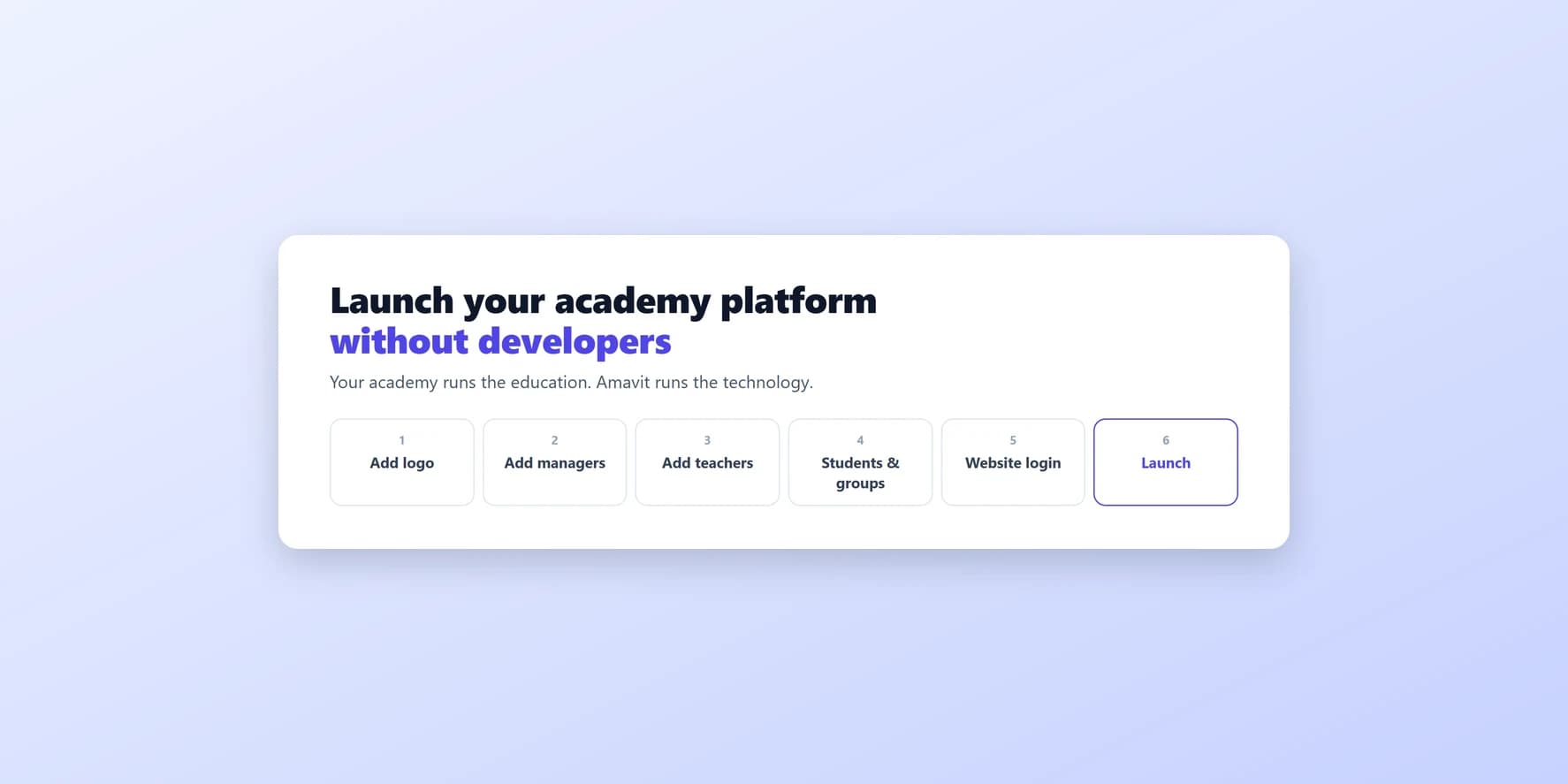
- Academy logo — branded academy environment
- Website login — plus managers, teachers and students
- Staff, students & groups
- Payments — deeper operational integration
- Academy-sponsored Premium for all students
The academy chooses how far it wants to go.
A small school does not need to become a large company first
A branded platform is not only for academies with 500 students, 10 branches and 20 managers. Even a smaller academy with 50–100 students can use professional digital infrastructure. That is part of the value.
Technology can make the customer experience larger than the team
This does not mean pretending to be a huge company. It means giving customers a level of service that previously required a much larger organisation. The academy can remain small. But the digital experience can be much stronger.
This helps academies compete on more than price
Without technology, smaller schools often compete on price, teacher personality and location. A digital platform adds another dimension: quality of service. The academy is no longer selling only a lesson. It can sell a more complete educational experience.
This is especially useful in competitive markets
When many abacus academies offer similar programmes, parents may find it difficult to understand the difference. Most of them offer lessons, teachers, workbooks and mental arithmetic. A strong digital environment becomes a visible differentiator.
Do not overpromise
A branded platform will not turn a small school into an international education network overnight. It will not automatically increase retention. It will not replace strong teachers. It will not fix a weak methodology.
But it can make the service more professional, simplify processes, strengthen the brand and create a more consistent customer experience.
And it does this without building everything from scratch
That is the economic advantage. The academy can receive a branded environment, website login, mobile access, management tools, digital practice and Premium options — without having to take responsibility for a development team, hosting, mobile app maintenance, software updates or technical debt. The technology provider handles that layer, as described in how to launch a digital platform for your abacus academy without hiring developers.
What can the student journey look like?
- A parent discovers the academy website
- The child joins the academy
- The child becomes a student of that academy inside the platform
- The family enters the learning environment from the academy website
- The child sees their academy inside the system
- They receive assignments and practise
- They use the mobile app
- The academy relationship stays visible at home
That creates a consistent digital experience.
What can the owner journey look like?
The owner opens the system and sees staff, teachers, groups and students, and controls operations. Managers receive their own access. Teachers receive theirs. Students receive theirs.
At this point, the platform is no longer just a branded screen. It becomes part of the academy's operating system.
The main conclusion
A small education academy does not need to build its own software company in order to look professional. It can use existing technology and create its own branded customer experience around it — its own logo, website, teachers, students, groups, methodology and customer relationships — while still gaining access to a digital platform, mobile access, practice tools, management, Premium options and technical infrastructure.
For the parent, this can feel like one integrated education system. For the academy, it is a way to offer a stronger digital experience without years of custom software development.
The principle is simple: your academy, your brand, your students — powered by existing technology.
Build your brand — not your software. Bring your academy's logo, teachers and students into one branded learning environment — request academy access.
Frequently asked questions
What is a white-label learning platform?
A white-label or branded learning platform lets an education business use existing technology while presenting its own brand, staff, students and learning environment.
Can my academy use its own logo in Amavit?
Yes. Academy environments can be customised with the academy's branding.
Can students enter from our existing website?
Yes. The academy can add a platform login or access button to its existing website.
Do we need to replace our current website?
No. The existing website can remain the main marketing and information site while Amavit provides the working learning environment.
Will our academy have its own mobile app?
The mobile app remains Amavit. Inside the app, users can access their academy-specific environment and branding.
Can we keep our own curriculum and teaching method?
Yes. The academy can continue using its own methodology, workbooks and teaching structure.
Can different managers and teachers use the same platform?
Yes. The academy model supports different organisational roles and levels of access.
Can the academy provide Premium to every student?
Yes. Academy-sponsored Premium can be arranged so participating students receive the same full digital access.
Is a white-label platform only useful for large schools?
No. Smaller academies can use branded digital infrastructure without needing their own development team.