Is Mental Arithmetic Right for Every Child — and How Can Parents Know Whether It Is a Good Fit?
Mental arithmetic is sometimes presented as something every child should study.
That is the wrong approach. Children are different.
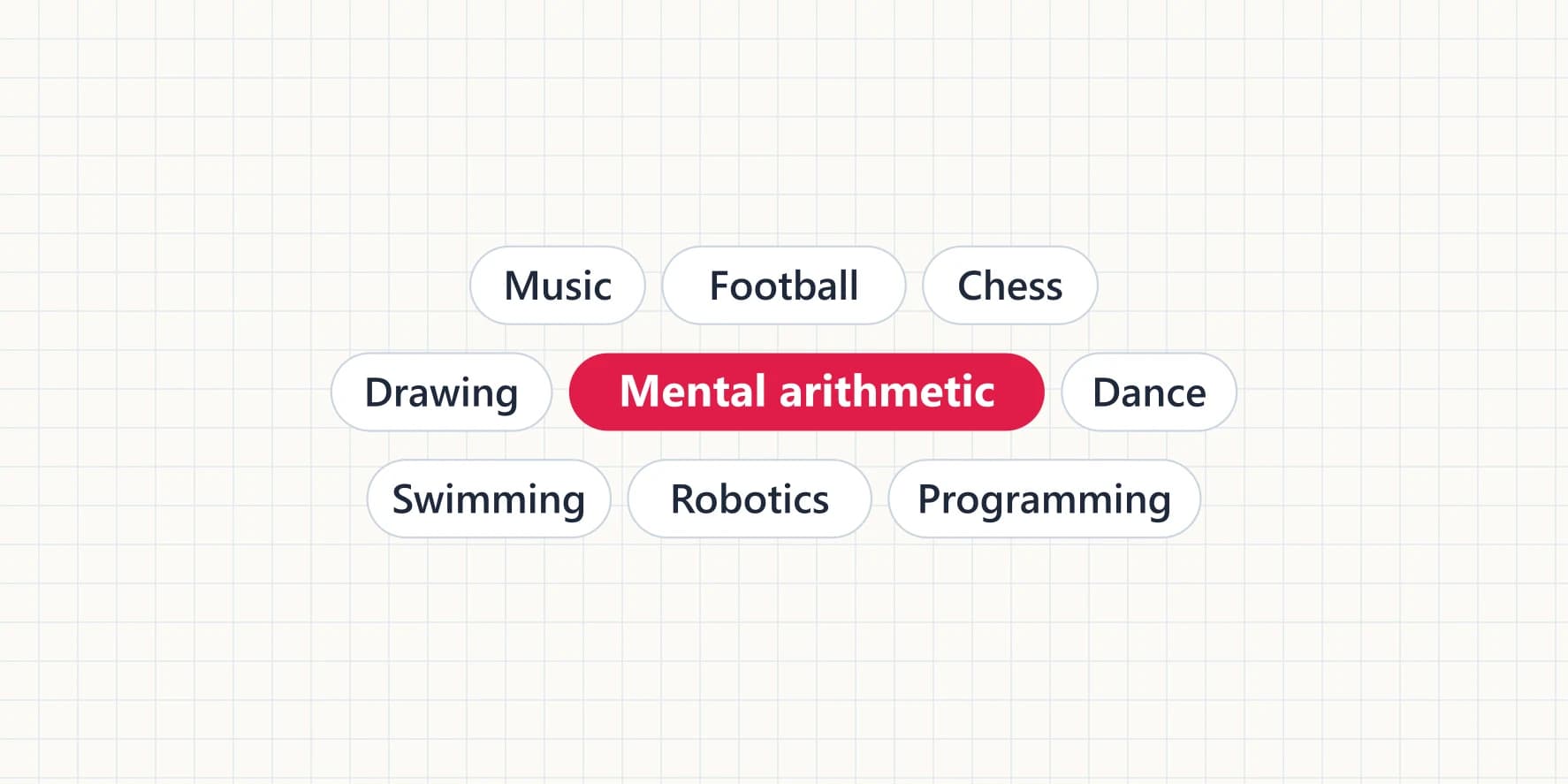
One child loves mathematics. Another prefers drawing. A third loves football. Some enjoy chess. Others are interested in robotics. Some want to learn programming. Others simply need more physical activity.
And it is completely normal if mental arithmetic is not the activity that fits a particular child.
Mental arithmetic is not a universal solution. And it is not a mandatory part of childhood. It is one possible developmental activity among many.
Mental arithmetic is not the right activity for every child. Parents should first allow the child to try it, then look at long-term interest, progress and learning experience. Temporary boredom is normal in any serious skill, but constant resistance over a long period may be a sign that another activity is a better fit.
Children should be allowed to try different activities
During childhood, it can be difficult to know in advance:
- what the child will genuinely enjoy;
- where they will feel confident;
- which teacher will be a good match;
- which learning format will work best.
Trying different activities is normal. A child may try swimming, football, music, drawing, chess, robotics, dance — or mental arithmetic.
Not everything needs to become a long-term activity. That is completely fine.
If a child says “This really is not for me” after a trial period, they may be right
Imagine a child starts mental arithmetic. Several lessons pass.
- They are not engaged at all.
- The abacus does not interest them.
- They dislike the type of tasks.
- There is no connection with the teacher.
- Home practice constantly creates strong resistance.
There is no reason to insist:
“You must study for two years because mental arithmetic is good for you.”
It may be better to stop. Try something else. Find a direction that fits the child better.
Child development is not limited to one type of activity
Sometimes parents focus too heavily on intellectual classes. But children develop in many different ways.
For one child, the most useful activity right now may be:
- sport;
- movement;
- team play;
- music;
- creativity;
- social interaction.
Another child may genuinely enjoy:
- mathematics;
- logic;
- rapid calculation;
- robotics;
- programming.
There is no single correct path for everyone.
Different children grow through different activities.
But there is an important difference between “This is not for me” and “I am tired of repeating”
This is where the situation becomes more interesting.
Almost every serious skill goes through two phases. First:
“This is exciting! Everything is new!”
Then:
“Why do I have to repeat this again?”
This happens in swimming, boxing, hockey, music, drawing, chess — and mental arithmetic.
Any skill that becomes strong requires repetition. And at some point, novelty disappears.
A child can like the activity and still not want to practise every day
That is normal.
Adults do not want to attend every training session either. Musicians do not always feel like practising scales. Athletes do not always enjoy every repetition.
That does not automatically mean they chose the wrong activity. So:
“I do not want to do homework today”
is not the same as:
“Mental arithmetic is completely wrong for me.”
Parents need to look at the wider pattern.
How can you tell that a child genuinely likes the activity?
You do not need enthusiasm before every lesson. Look at the general picture. For example:
- the child enjoys success;
- wants to show results;
- likes the teacher;
- feels proud of progress;
- sometimes chooses to return to the activity voluntarily;
- is curious about the next level;
- likes competition or personal records.
At the same time, the child may still occasionally say:
“I don’t want to practise today.”
There is no contradiction. That is a normal relationship with training.
What does it look like when the activity genuinely does not fit?
The situation is different when, over a longer period:
- there is no interest at all;
- the child constantly resists;
- they dislike the format itself;
- success brings no satisfaction;
- progress creates no positive emotion;
- every practice session becomes a family conflict.
At that point, it is reasonable to reconsider the activity. A different direction may suit the child better.
| “Not for me” | “I don’t feel like practising today” |
|---|---|
| Long-term rejection | Occasional boredom |
| No enjoyment from progress | Still enjoys success |
| Every lesson creates conflict | Likes the teacher |
| No format creates interest | Wants to reach the next level |
Temporary training fatigue is not the same as a poor fit.
Development should not become constant coercion
Mental arithmetic can only be valuable when it fits into the child's life in a healthy way.
If two years of study mean that every evening ends in conflict over ten minutes of practice, simply staying enrolled is not a success.
The goal is not to write on a certificate:
“Completed two years.”
The goal is to build a real skill and a positive educational experience.
But stopping every activity at the first sign of boredom is also a poor strategy
There is another extreme.
The child studies for three months. Things are going well. Then the first difficult topic appears. The child says:
“I don't want to do this anymore.”
The next day:
“I want to play football instead.”
Three months later, football also requires regular practice:
“I don't want football. I want chess.”
Then chess becomes difficult:
“I don't want chess either.”
If every activity is abandoned as soon as repetition or difficulty appears, the child may never stay long enough to develop a real skill.
Real skill develops after the novelty phase
This is a very important point.
A skill does not become strong only when everything feels new and exciting. It develops when the child learns to:
- repeat;
- make mistakes;
- correct them;
- return to difficult tasks;
- practise again.
This is true across many disciplines.
You cannot become a musician after learning one song
This is an easy analogy to understand.
A child may learn a simple melody after a few lessons. That is wonderful. But playing one melody does not make them a musician.
To really learn an instrument, they need:
- scales;
- exercises;
- new pieces;
- repetition;
- technique;
- time.
Mental arithmetic follows a similar pattern. A child can learn something impressive relatively quickly. But a stable skill requires continued practice.
The same is true in sport
Learning to stay afloat does not mean a child is a strong swimmer.
Learning to kick a ball does not mean they play football well.
Completing five boxing sessions does not mean technique has been formed.
Almost every strong skill needs time.
First choose the direction, then give it a real chance
The logic can be simple. First: try it.
Observe:
- Does the child find it interesting?
- Is the teacher a good fit?
- Does the format work?
- Can the activity fit into family life?
If the answer is:
“No, this is really not for us,”
look for something else.
If the answer is:
“Yes, the child likes it, it works, and we want to continue,”
then the activity should be given enough time.
- Try Does the child engage?
- Observe Progress, teacher fit, motivation, family routine
- Decide Right fit or better alternative?
- Commit If it fits, give the skill enough time
Not every activity fits every child. Real skills still require consistency.
Three months can be an awkward moment to decide “That’s enough”
Why? Because after three or four months, the child has often moved beyond the introduction. But they have not yet reached the deeper result.
They are somewhere between:
“I tried it”
and “I developed a skill.”
If the activity suits the child overall, stopping at this point only because the novelty has disappeared may not be the best decision.
If the activity has been chosen seriously, it deserves a meaningful cycle
After the trial period, the program should be viewed differently. Not as:
“We will continue only while every lesson feels exciting.”
But as education.
One year can already be a serious cycle. Around two years can be a useful benchmark for a complete basic foundation — we explain why in how long children should study mental arithmetic.
Not because the number itself is magical. Because skills need time.
Parents should also understand the goal
It helps to ask: why is the child studying this?
- General development?
- Calculation speed?
- Competitions?
- Concentration?
- Because the child personally enjoys it?
If there is no clear goal, almost any program begins to feel pointless after a few months.
When the goal is clear, temporary drops in motivation are easier to manage. The age at which the child starts matters too — see the best age to start mental arithmetic.
How can you distinguish temporary boredom from a real rejection?
Look at what happens over several weeks, not during one evening.
If the child:
- sometimes does not want to practise but is happy about progress;
- sometimes feels lazy but enjoys going to class;
- complains about repetition but wants to reach the next level,
this is probably normal training fatigue — and there are practical ways to keep a child motivated.
If, however:
- the child does not want lessons or practice;
- has no interest in results;
- no training format creates engagement;
- this continues for a long time,
then it is reasonable to ask whether the activity truly fits.
Sometimes the problem is not mental arithmetic, but the learning format
This is another important point. The child may dislike:
- the particular teacher;
- a very large group;
- too much homework;
- repetitive exercises;
- an inappropriate pace;
- lack of motivation.
Before leaving the subject completely, it may be worth changing the conditions.
The same child may respond very differently to different formats
For example:
- workbooks may feel boring, but flashcards may be engaging;
- the child may dislike ordinary oral calculation, but enjoy Anzan;
- they may dislike practising alone, but love competition;
- they may resist a long homework session, but happily practise for 10–15 minutes every day — see how much practice a child needs each day.
So the question is sometimes not:
“Does mental arithmetic fit this child?”
but:
“Which mental arithmetic format fits this child?”
This is where variety becomes useful
In Amavit, practice can use different formats. For example:
- workbook;
- flashcards;
- screen-based exercises;
- audio tasks;
- mental calculation;
- different speeds;
- achievements;
- streaks;
- leagues;
- competition elements.
The goal is not to entertain the child every second. The goal is:
to provide enough repetition without making every practice session feel identical.
Motivation should not replace the underlying skill
There is an important boundary.
If the child participates only because of a chest, medal or league position and has no interest in the activity itself, gamification alone may not be enough.
Motivation systems should help the child move through repetitive stages. They should not hide a complete rejection of the activity.
Parents should not choose an activity only because it is “good for development”
A parent may think:
“Mental arithmetic develops the brain, so my child must study it.”
That is too simplistic. Children can also benefit from:
- sport;
- music;
- reading;
- communication;
- creativity;
- programming;
- languages;
- other intellectual activities.
There is no single course that replaces everything else.
The strongest option is to find something the child genuinely wants to improve at
Once a child finds a suitable direction, the role of the parent changes.
At first, parents help the child explore. Later, they help the child avoid quitting too early. These are different tasks.
During the exploration stage, flexibility matters. During the skill-building stage, consistency and some discipline become important — see how parents can support a child without becoming a second teacher.
Discipline and coercion are not the same thing
Sometimes a parent needs to say:
“Yes, I know you do not feel like it today, but you still have training.”
That is a normal part of serious learning. It does not automatically mean the child is being forced into something unsuitable.
But if every lesson creates strong resistance for months, that is a different situation. A balance is needed.
A useful question for parents
Instead of asking:
“Does my child want to practise right now?”
ask:
“Looking at the last two or three months, does my child generally like this activity and want to become better at it?”
That is a much more useful question.
If the answer is yes, the program needs time
If the child:
- sees progress;
- wants to continue;
- is interested in higher levels;
- generally accepts the training,
then the skill deserves enough time to develop.
In that case, a few months is usually too short a horizon. One year can already produce a serious result. Around two years can support a full basic cycle. After that, the decision can be reviewed again.
If the answer is no, the search continues
And that is not a failure.
The child may be much happier in tennis, robotics, drawing, music, dance, programming or swimming.
The goal is not to prove that mental arithmetic is right for everyone. The goal is to find a direction in which a particular child can grow.
The main conclusion
Mental arithmetic is not necessary for every child. And that is completely normal.
It can be tried just like many other activities. If it becomes clear:
“No, this really is not for us,”
the family can calmly move on.
But if the child generally likes it, is progressing and the family sees value in the program, it may be a mistake to stop simply because the novelty disappears after a few months.
Almost every real skill requires repetition. Music. Sport. Chess. Drawing. Mental arithmetic.
A good approach can be summarised very simply:
- first find the right direction;
- then give it enough time to produce a real result.
That is more reasonable than either extreme: forcing every child to study mental arithmetic or quitting every activity as soon as it stops feeling new.
Frequently asked questions
Is mental arithmetic suitable for every child?
No. Children have different interests, learning styles and developmental needs. Mental arithmetic is one possible activity, not a universal requirement.
How long should a child try mental arithmetic before deciding?
There is no universal trial period. Parents should look at engagement, the teacher relationship, progress and how the child responds to practice over several weeks.
What if my child says they are bored?
Occasional boredom is normal in any skill that requires repetition. Look at the overall pattern rather than one difficult day.
When should a child stop mental arithmetic?
If there is persistent strong resistance, no enjoyment of progress and the activity creates ongoing conflict despite reasonable changes in teacher or format, another activity may be a better fit.
Should parents force children to continue because mental arithmetic is useful?
No. Consistency is important, but long-term coercion is different from healthy discipline. The activity still needs to be a reasonable fit for the child.