How to Launch a Digital Platform for Your Abacus Academy Without Hiring Developers
Small education academies increasingly need a digital infrastructure. Parents expect easy access. Students need practice between lessons. Teachers need groups, homework and results. Managers need schedules, student records, payments and control. Owners need visibility into what is happening across the academy.
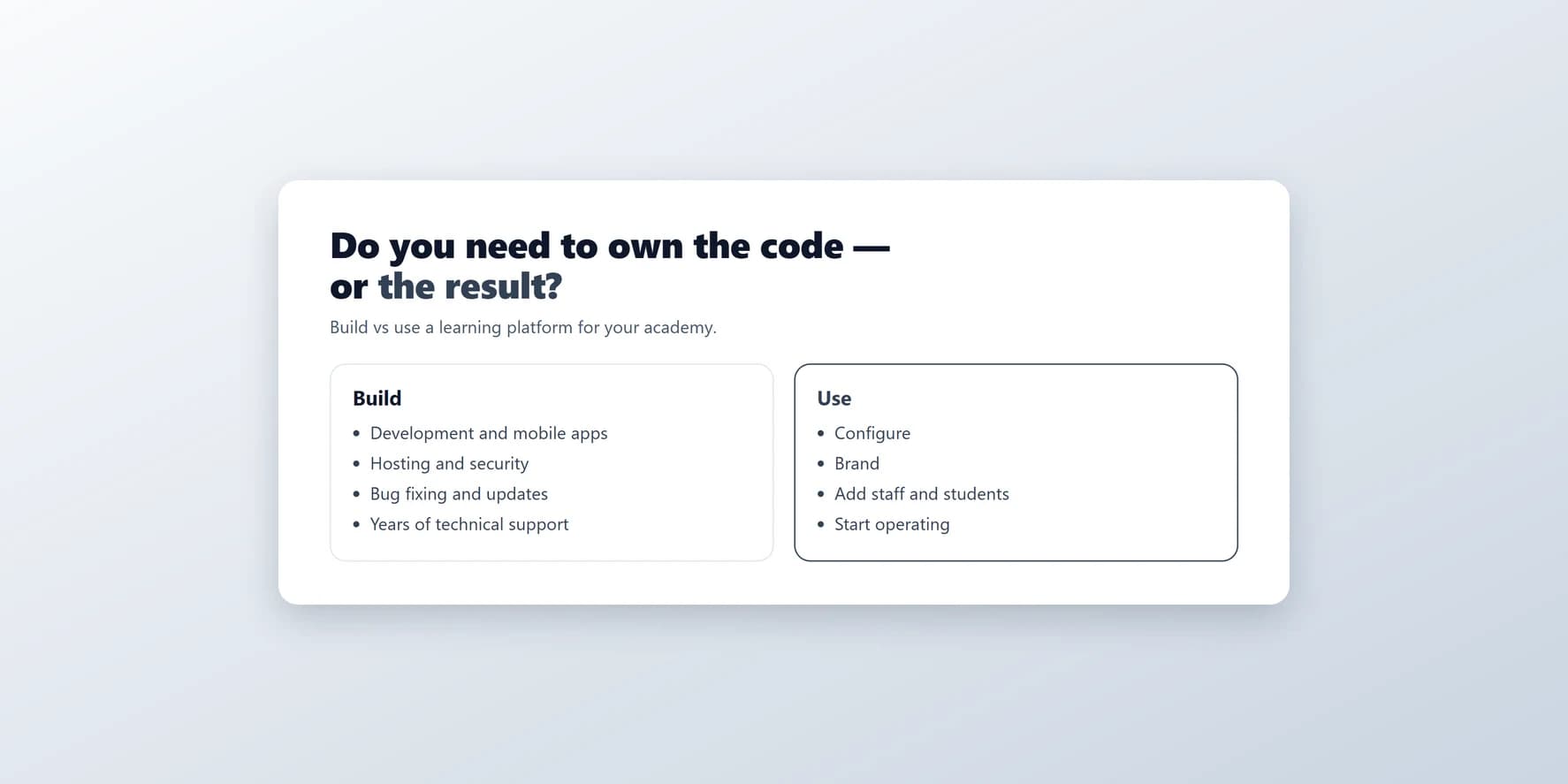
The problem is that building all of this from scratch usually requires developers, designers, servers, mobile apps, testing, technical support and continuous updates. For a small or medium-sized academy, that can become too expensive and too complicated.
There is another option: instead of building a platform, use an existing technology infrastructure and configure it around your academy.
An abacus academy does not need to build its own software to offer a professional digital experience. A ready platform can be configured with the academy's branding, teachers, managers, students, schedules, practice tools, payments and mobile access — while the technology provider handles development, hosting and updates.
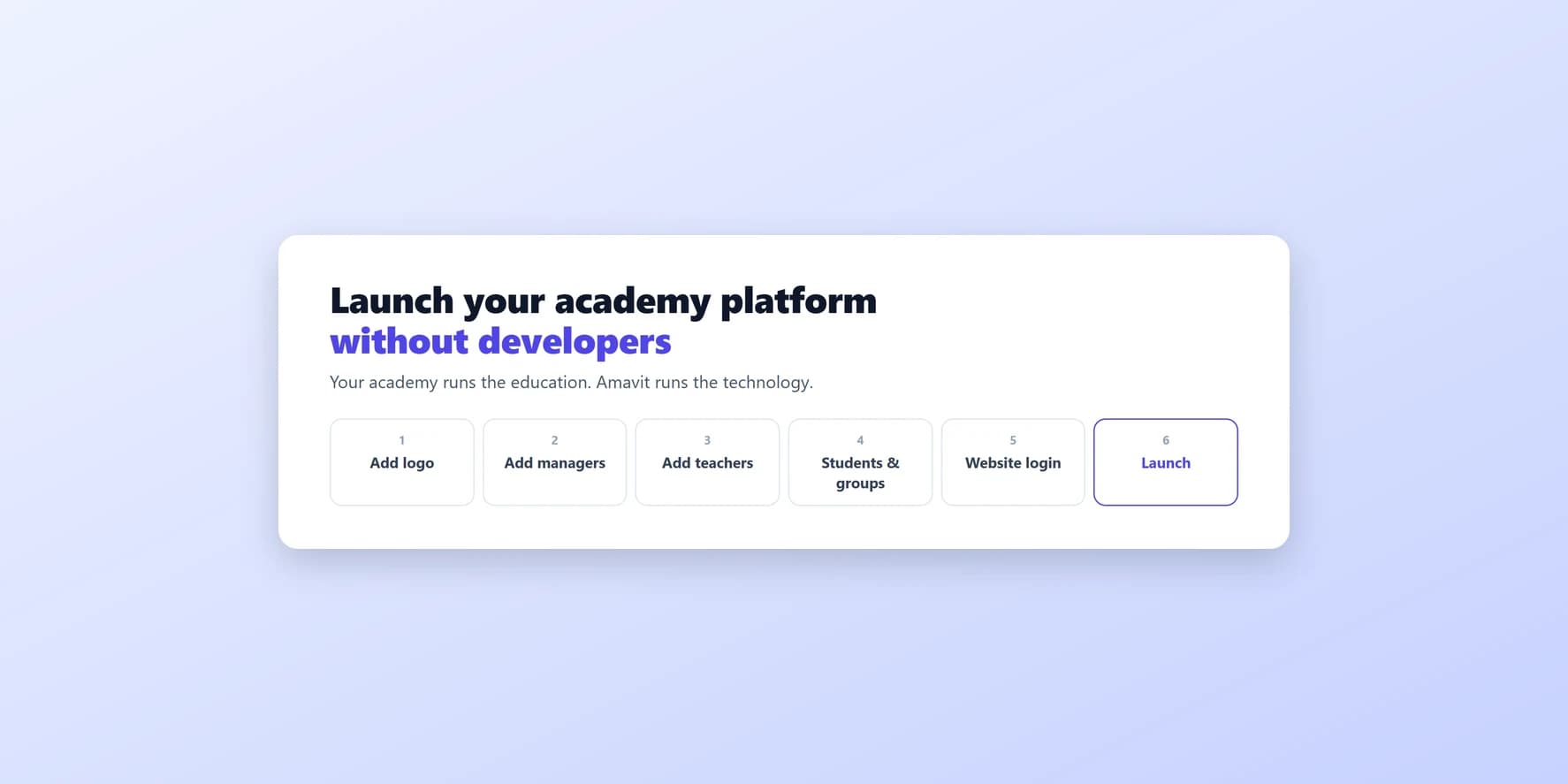
- Your academy
- Add logo
- Add managers
- Add teachers
- Add students & groups
- Add website login
- Choose Premium model
- Launch
Launch without development — no software project required.
Your academy needs the result — not a team of developers
Imagine a small mental arithmetic academy. It has 100 students, several teachers, several groups, its own website, its own logo and its own curriculum. The academy wants to offer a more professional digital experience. But that does not mean it needs to create an internal IT department.
The academy does not need to know which backend technology to use, where the database should be hosted, how push notifications work, how mobile apps are updated or how servers are maintained. It needs working tools.
What does an academy usually need?
That is already a substantial software system. If the academy builds everything internally, the project can quickly become a separate business of its own — see why small academies should not build their own learning platform.
Start with configuration instead of development
With an existing platform, the process can look completely different. Not:
specification → design → development → testing → bug fixing → launch.
But:
academy → configuration → branding → staff → students → launch.
That is a fundamentally different model.
Step 1. Create the academy environment
The first step is to configure the digital environment around the school. The system should reflect the academy name, its structure, staff, groups and students. The platform stops feeling like an abstract third-party service and starts functioning as the academy's operational environment.
Step 2. Add your branding
Academy owners do not want parents and students to feel that they have been sent to an unrelated external product. Branding matters. The academy can use its own logo, its own visual identity and its own branded environment inside the platform.
The user does not simply see Amavit. They see their academy inside Amavit's technology infrastructure.
Step 3. Add platform access directly to your website
This is one of the strongest parts of the model. The academy can add a button to its existing website, such as Student Login, Learning Platform or Open Academy Platform. Parents and students visit the academy's normal website and enter the digital environment from there.
This creates a much more integrated customer experience.
See Amavit for academies. Use your own brand, teachers and methodology — without building your own platform. Amavit for academies.
You do not need to rebuild your website
This is important. The academy does not need a new website. If the current website already works well, the platform can simply become an extension of it.
The website continues to handle marketing, information, lead generation and enquiries. The platform handles existing students, teachers, managers, internal processes and practice.
Step 4. Add owners and managers
The platform is not only for students. For the academy owner, management visibility is often even more important. The owner can monitor staff, groups, schedules, teachers, students and internal processes. Managers can receive their own roles and permissions.
This is far more efficient than keeping operational information across Excel, WhatsApp, calendars, banking apps and private messages.
Step 5. Add teachers
Teachers need a practical workspace for their groups. The platform can support homework, practice, results, groups, scheduling and other teaching workflows — see your first week with Amavit.
At the same time, the academy does not need to force teachers to change their entire methodology. Amavit can become part of the teaching process — or simply an additional digital tool, as described in how teachers can use Amavit as a practice trainer.
Keep your own teaching method
This is especially important for abacus and mental arithmetic schools. Many academies already have their own workbooks, their own topic sequence, their own rules, their own teacher standards and their own methodology. Connecting a platform should not mean:
“Now you must teach someone else's curriculum.”
Technology should support the academy. It should not replace the academy's educational identity.
Step 6. Add students
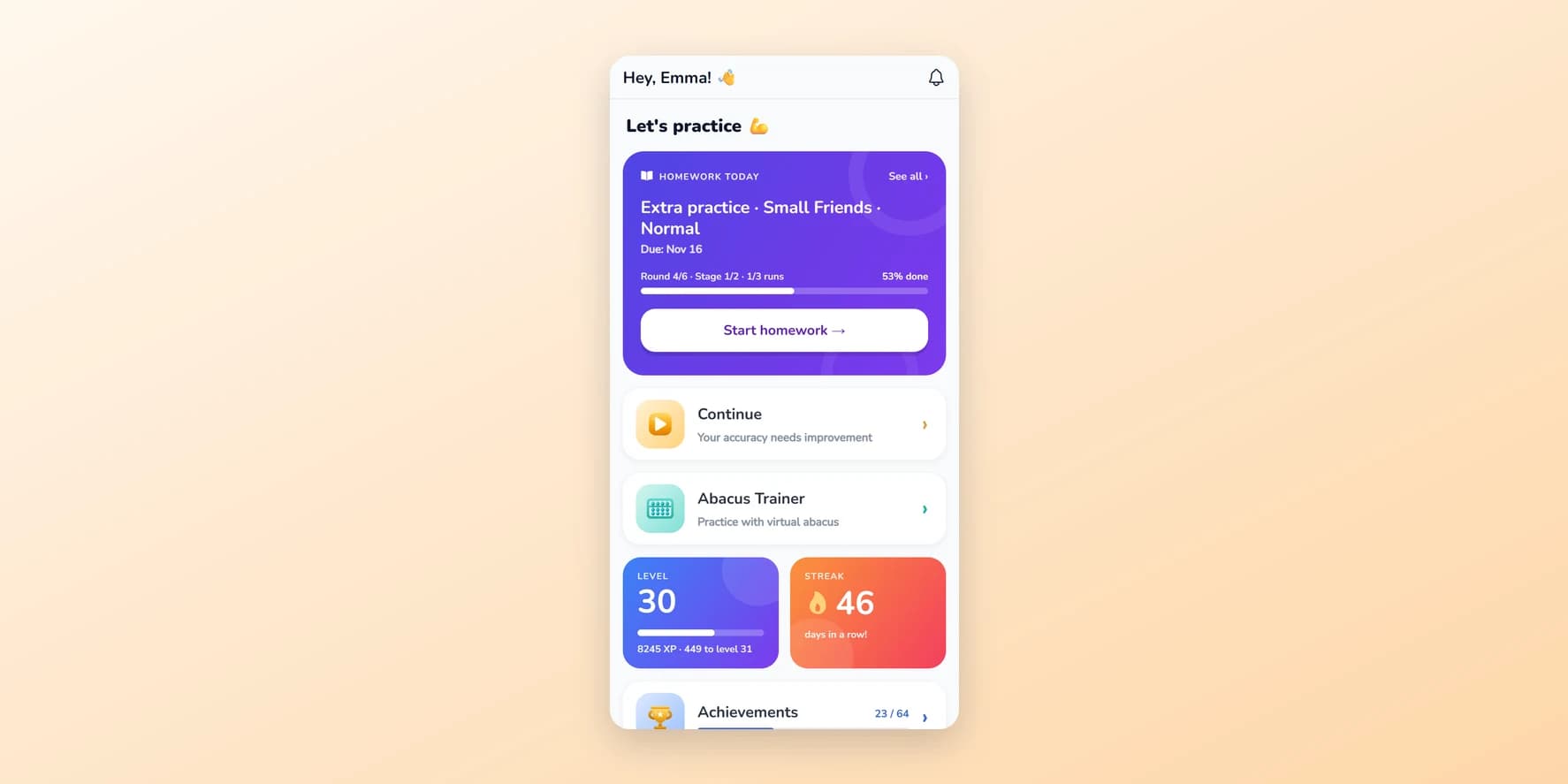
Once the academy environment is configured, students receive access to the digital system. They can practise, complete assignments, review results, use the mobile app and continue learning between lessons.
This is valuable because the digital experience becomes part of the academy's own service.
The mobile app already exists
Building a mobile app is a separate and expensive project. The academy would otherwise need to develop for iOS, develop for Android, test, publish, update and maintain both versions.
With Amavit, the academy does not need to build this layer itself. Students and parents can use the existing Amavit app. Inside the app, their experience can still be connected to their academy and its branding.
The app name remains Amavit
This point should be clear. The academy does not receive a completely separate App Store application under its own name. The application remains Amavit. But inside the app, users can work within the environment of their academy.
This gives the school many of the benefits of having its own app without the cost of developing and maintaining one.
Step 7. Configure schedules and workflows
As an academy grows, scheduling becomes increasingly complex. There may be multiple teachers, different groups, rescheduled lessons, new students, teacher substitutions and individual lessons.
If all of this is managed through separate spreadsheets and messages, mistakes become much more likely. A centralised system simplifies operations.
Step 8. Connect payments
If the academy wants more processes inside one system, payment integration can become the next step. Depending on the country and available infrastructure, an appropriate payment gateway or banking integration can be connected. This can help link payments with specific students and academy workflows.
The payment itself is processed by a specialist payment provider. The platform helps integrate payment information into the academy's operating environment.
Reduce the number of disconnected tools
Without one central system, an academy may use WhatsApp, Excel, Google Calendar, banking tools, a separate homework service, a separate trainer and a separate analytics tool. Each one may work well on its own. The problem is the constant switching between them.
As the academy grows, this administrative fragmentation becomes more expensive — see moving abacus homework beyond WhatsApp.
One system saves more than money
It can save owner time, manager time, teacher time, manual work and avoidable errors. This matters especially in small academies where one person may perform several roles.
You can start small
There is no need to move the entire academy at once. You can begin with one branch, one teacher, a few groups, 20–30 students. Then evaluate how easy it is to use, how parents respond, how teachers work with it and which functions are actually needed.
Only after that do you need to expand.
- 20–30 students
- One teacher
- Several groups
- Whole academy
- Multiple managers
- More students / branches
Start small → scale later.
You do not need to change everything on day one
This is one of the strongest advantages of an existing platform. Implementation can happen gradually. Start with students + practice. Then add groups. Then homework. Then manager access. Then payments. Then deeper analytics. The academy chooses the pace.
Two ways to manage Premium access
There is another important decision.
Option 1. Parents pay for Premium individually. The academy uses branding, platform tools, management functions and digital practice. Each family decides whether Premium is useful for their child. This is the simpler model. The academy does not take on the Premium subscription cost for every student.
Option 2. The academy includes Premium for all students. A more integrated model is for the academy to provide Premium centrally. Then all students receive the same full access; teachers know that every student has the same digital tools; parents do not need to purchase anything separately; the academy can include digital access in the tuition fee. This model feels much closer to having the academy's own digital product.
Model A — family choice
Academy platform → basic student access → parents decide whether to upgrade
Model B — academy included
Academy platform → Premium for all students → included in academy tuition
Volume terms are available for academy-wide Premium access.
Volume Premium can be more economical
If the academy provides Premium to a larger number of students, special commercial terms can be agreed. The academy does not need to purchase many separate retail subscriptions one by one. This makes a different pricing model possible.
Digital access can become part of the tuition package
This is a powerful model. For example, the academy can sell a programme that already includes lessons, workbooks, home practice, mobile access, Premium, digital exercises and progress tracking.
For the parent, this becomes one integrated service. Not “Here are the lessons, and now please buy another platform separately.” But:
“Our digital learning platform is already included in the academy programme.”
This increases the perceived value of the academy
Compare two schools. The first says “We provide two lessons per week.” The second says “We provide lessons + home digital practice + mobile access + progress tracking + game-based activities + a branded learning environment.”
Even when teaching quality is similar, the second academy looks more technologically advanced.
A small academy can look like a large education network
This is especially important in competitive markets. Large education networks often have websites, CRM systems, learning platforms, mobile apps, student accounts and digital homework. A small academy may not be able to fund all of that independently.
But using shared technology allows it to offer a comparable digital experience. Without building a large IT infrastructure.
What remains Amavit's responsibility
The technology layer: development; product updates; platform maintenance; hosting; improvements; mobile app development; core infrastructure. The academy does not need to hire a separate team just to keep all of this running.
What remains the academy's responsibility
The academy continues to own what actually makes its business valuable: methodology; teachers; teaching quality; parent relationships; groups; sales; service; business development. That is a much more natural division of responsibility.
| Academy owns | Amavit provides |
|---|---|
| Brand | Technology |
| Methodology | Platform |
| Teachers | Hosting |
| Students | Updates |
| Customer relationships | Mobile app |
| Tuition | Practice system |
| Service | Core infrastructure |
Your academy runs the education. Amavit runs the technology.
Do not compete with a software company
Building your own platform means solving the same problems a technology company solves. But one academy may have 100, 300, 500 or 1,000 students. The cost of serious product development is still significant.
A shared technology platform spreads the development cost across a much larger user base. That is why this model can make economic sense.
When does custom development still make sense?
It can be justified when the academy is very large, software itself is a strategic asset, the organisation has genuinely unique processes, there is a strong internal IT team and there is a long-term budget for continuous development.
But if the main goal is simply to offer students a strong digital experience, manage the academy, support the academy's brand and move away from spreadsheets and messaging apps, using an existing platform may be the more rational option.
A simple example
Imagine an academy with 150 students. It has 3 teachers, 6 groups, its own website and its own logo. It wants to improve its digital experience. Instead of building an app and a platform from scratch, it can:
- Connect the academy to Amavit.
- Upload its logo.
- Add teachers and managers.
- Create groups.
- Add students.
- Add a platform login button to its website.
- Choose the Premium model.
- Start using the system.
This is much closer to configuring a service than developing software.
The first advantage is speed
The academy does not need to wait for developers to build the backend, design every interface, create mobile apps, configure servers and complete testing. The core technology already exists. The task is to configure it around the academy.
The second advantage is predictability
Custom development always carries uncertainty. The project may be delayed. The budget may increase. A developer may leave. A feature may be more difficult than expected. An app update may fail review. An integration may break.
Using an existing platform reduces many of these uncertainties.
The third advantage is continuous development
A strong platform keeps evolving. New features appear. Existing functions improve. New practice formats are added. Interfaces are updated.
If the academy builds everything itself, every improvement must be funded internally. With Amavit, core product development is managed centrally.
The platform should grow with the academy
Today the school may have 50 students, 2 teachers, 1 manager. In two years it may have 500 students, 10 teachers, several managers and multiple branches. The technology should allow the academy to scale without having to replace the entire system again.
The real question is not “Can we build it?”
Almost any system can be developed. The better question is:
Does it make sense for our academy to spend money, time and management attention building it?
If the technology already exists, can be adapted to the academy's brand and processes, and proprietary development does not create a unique strategic advantage, building from scratch may simply be unnecessary.
The main conclusion
An academy does not need to hire developers and build its own platform in order to provide a modern digital experience. It can use an existing technology infrastructure and configure it around its own business.
The academy can receive its own environment, its own logo, its own managers, its own teachers, its own students, groups, schedules, practice tools, mobile access, payment integration options, two Premium models and a direct entry point from its own website — without having to manage software development, hosting, mobile development, platform updates or ongoing technical maintenance.
The result is what matters most: a professional digital product for your students and parents — without turning your academy into a software company.
Launch your academy platform. Start with a few groups or connect the whole academy — request academy access.
Frequently asked questions
Do I need developers to launch Amavit for my academy?
No. The core platform and mobile technology already exist. The academy mainly needs configuration, branding and setup.
Can I use my own academy logo?
Yes. The academy environment can be customised with its own branding.
Do I need to replace my current website?
No. A login or platform button can be added to the academy's existing website.
Can I keep my own teaching methodology?
Yes. Amavit can support the academy's existing curriculum and teaching system rather than requiring the academy to replace it.
Can managers and teachers have different access?
Yes. The academy structure can support different organisational roles and permissions.
Is there a mobile app?
Yes. Students and parents can use the Amavit mobile app. The app remains under the Amavit name, while the internal academy environment can be customised.
Can we integrate student payments?
Payment integrations can be configured depending on the academy's country, provider and commercial setup.
Can parents pay for Premium individually?
Yes. This is one available model.
Can the academy include Premium for all students?
Yes. Academy-wide Premium access can be arranged under a separate agreement and can use volume-based terms.
Can we start with only a few students?
Yes. An academy can begin with a limited number of groups or students and expand later.