Moving Abacus Homework from WhatsApp to a Structured Workflow
For many mental arithmetic teachers, WhatsApp becomes the first homework management system. That is understandable. Parents already use WhatsApp. Teachers already use WhatsApp. It is easy to send a quick message:
“Pages 24–27 for this week.”
Or:
“Please revise Small Friends +4 / −4.”
Or send a photo, a voice message, a link, a video, workbook pages, a few additional exercises.
With five students, this can work perfectly well. With twenty students, it becomes more difficult. With fifty or one hundred students, WhatsApp can gradually turn from a convenient communication tool into a place where it is very easy to lose track of:
- who received what;
- who completed the homework;
- who needs a reminder;
- who is making repeated mistakes;
- which topic a particular child needs to revise;
- which workbook pages were sent to which family.
The problem is not WhatsApp itself. WhatsApp is an excellent communication tool. The problem begins when one messenger is expected to work simultaneously as a chat, a homework system, a learning-material library, a progress record, an analytics system and an archive.
It was not designed for all of those tasks.
WhatsApp works well for communication, but it becomes difficult to manage individual homework, learning materials and results as the number of students grows. A structured homework system allows teachers to keep assignments, digital practice, printable workbook pages and progress in one place while continuing to use WhatsApp for parent communication.
| Communication | |
| Amavit | Learning workflow |
| Workbook | Paper practice |
They do not need to replace one another.
WhatsApp is excellent for communication — but limited as a homework system
Imagine a normal class of ten students. After the lesson, the teacher wants to assign homework. But the children are not all at exactly the same level.
One needs to revise an older topic. Another needs more Small Friends practice. A third child needs higher speed. A fourth needs the opposite: slower practice to restore accuracy. A fifth also needs several workbook pages.
If all of this is managed through messages, the teacher quickly accumulates multiple chats, screenshots, photos, documents, voice messages and questions from parents.
Two days later, the teacher may be scrolling through the conversation trying to remember:
“What exactly did I assign to this student?”
Sending homework is easy. Tracking what happened next is harder.
Sending “Complete pages 10–12” takes only a few seconds. But then other questions appear:
- Did the child actually complete them?
- When?
- How much did they practise?
- Where were the mistakes?
- What speed could they maintain?
- Did they stop after three minutes?
- Was the same mistake repeated several times?
WhatsApp cannot answer most of these questions. It can show that the message was sent. Sometimes it can show that the message was read. But there is a big difference between:
“The parent read the message.”
and:
“The child completed meaningful practice.”
Asking for screenshots does not fully solve the problem
Some teachers ask parents:
“Send me a photo after the homework is finished.”
Or:
“Send me a screenshot of the result.”
That is better than having no feedback. But now the teacher needs to open every message, review every image, remember previous results, compare them manually and reply individually.
The educational task gradually turns into message administration.
Administrative work grows quickly with the number of students
With ten students, a teacher may remember a great deal. With thirty, it becomes harder. With fifty, mistakes become increasingly likely. With one hundred students, managing individual homework only from memory becomes extremely difficult.
This is not a question of teacher quality. Human memory simply has limits.
A teacher's time is more valuable when spent on teaching, diagnosis, student communication, technique correction and planning the next learning step. Not searching for:
“What did I send this student last Thursday?”
There is no need to stop using WhatsApp
This is important. WhatsApp remains an excellent communication channel. It is useful for reminders, schedule changes, short feedback, answering parents and organisational messages.
The goal is not “Remove WhatsApp.” The goal is: separate communication from the learning workflow.
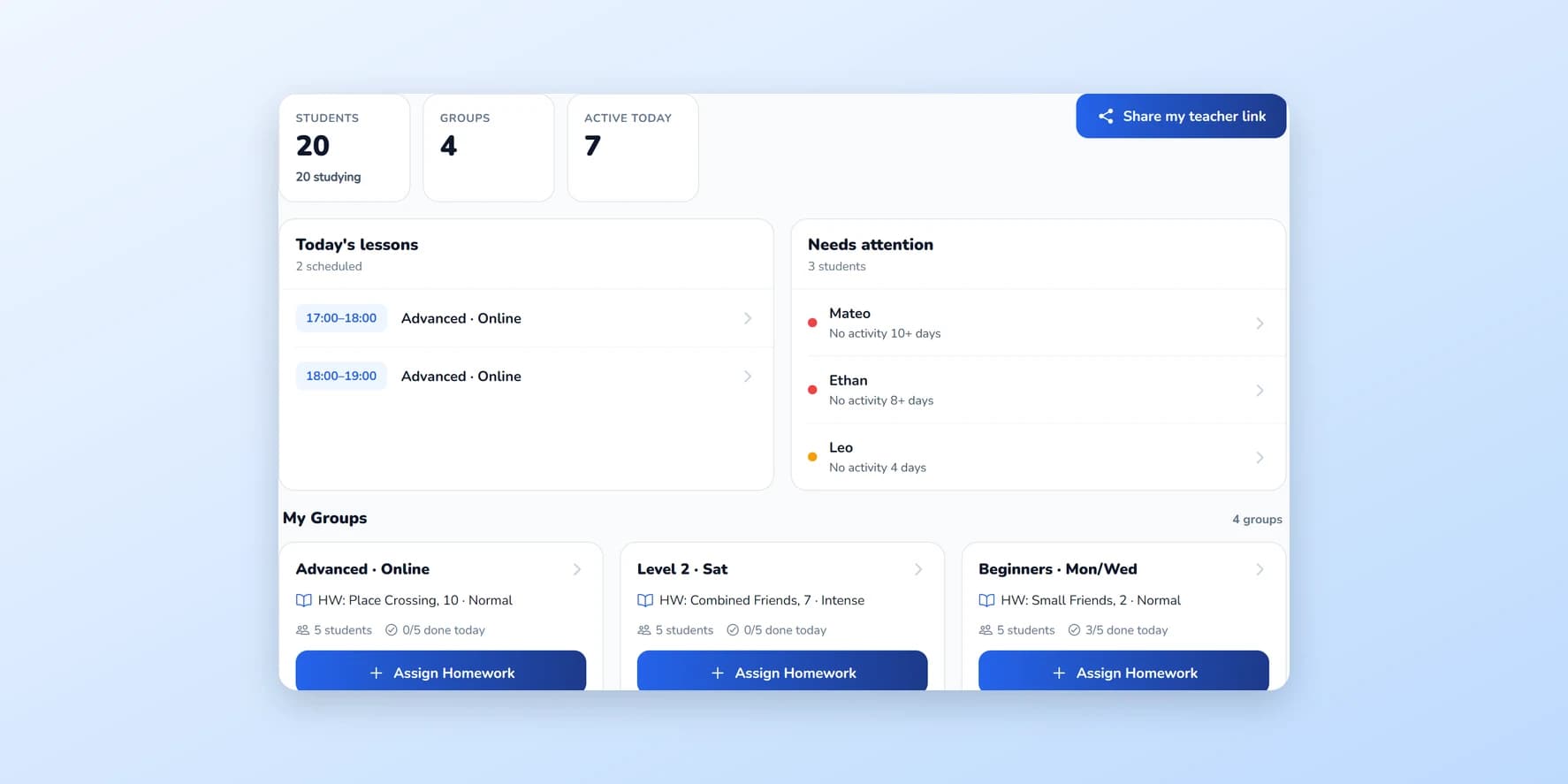
WhatsApp can remain the communication tool. Amavit can hold assignments, learning materials, practice, results and practice history.
What should move out of WhatsApp?
The first things to structure are usually:
- homework assignments;
- practice settings;
- topic revision;
- results;
- completion history;
- materials connected with a particular assignment.
Then a WhatsApp message can become very simple:
“This week's homework is already available in Amavit. Please try to practise regularly.”
The communication stays short. The educational information stays in one place.
Scattered in WhatsApp
Photo · PDF · voice message · page number · reminder · screenshot · result · another PDF
One assignment
Digital practice · workbook pages · instructions · result · history
Communication stays in WhatsApp. Learning stays structured.
What about workbooks and printed exercises?
This is an important question. Moving homework into a digital platform does not mean abandoning workbook practice. Digital practice and paper practice solve different tasks.
A child may still need a physical abacus, a workbook, printed worksheets and written exercises.
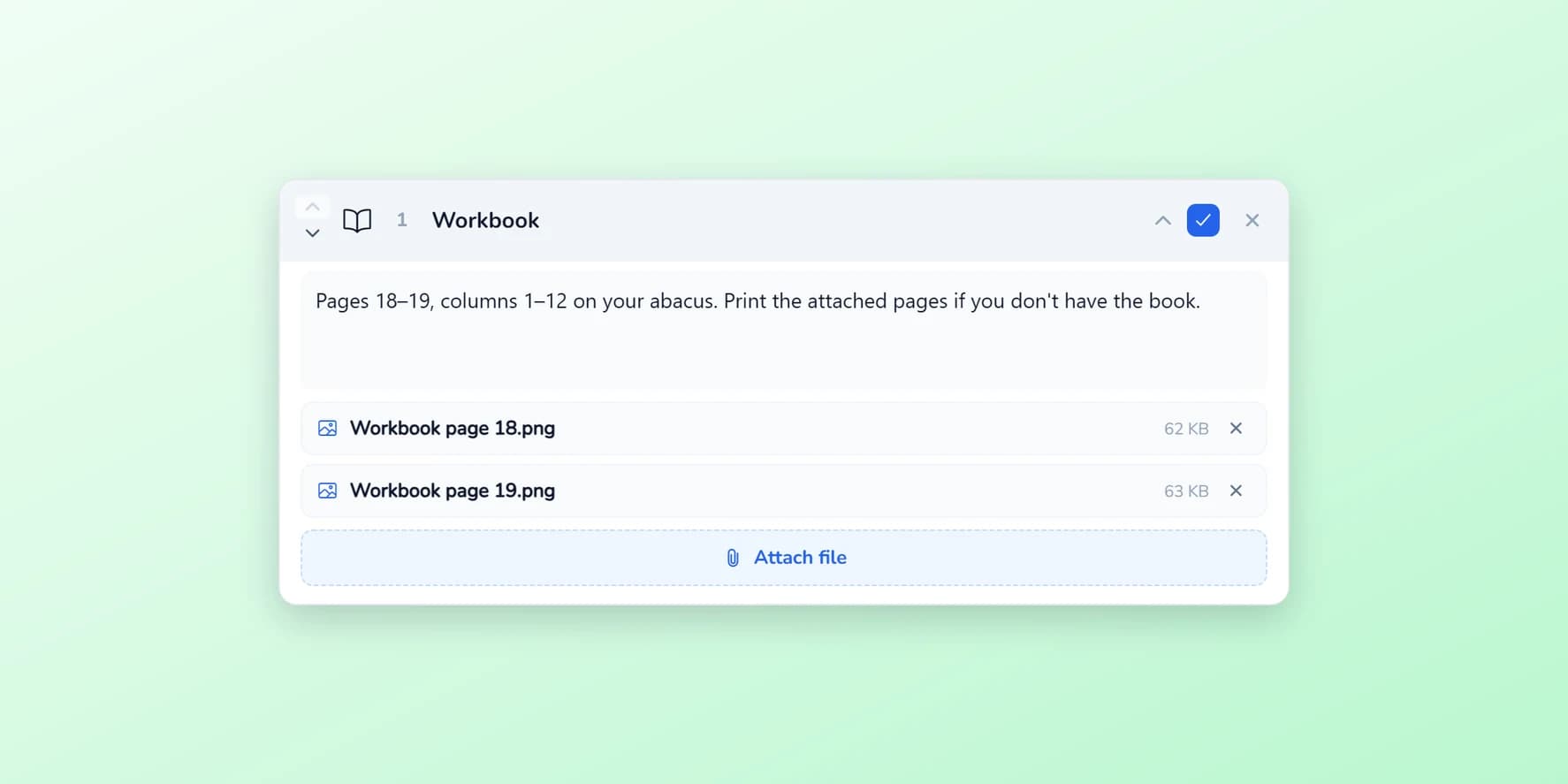
Amavit allows teachers to attach prepared workbook pages or other learning materials directly to the homework assignment.
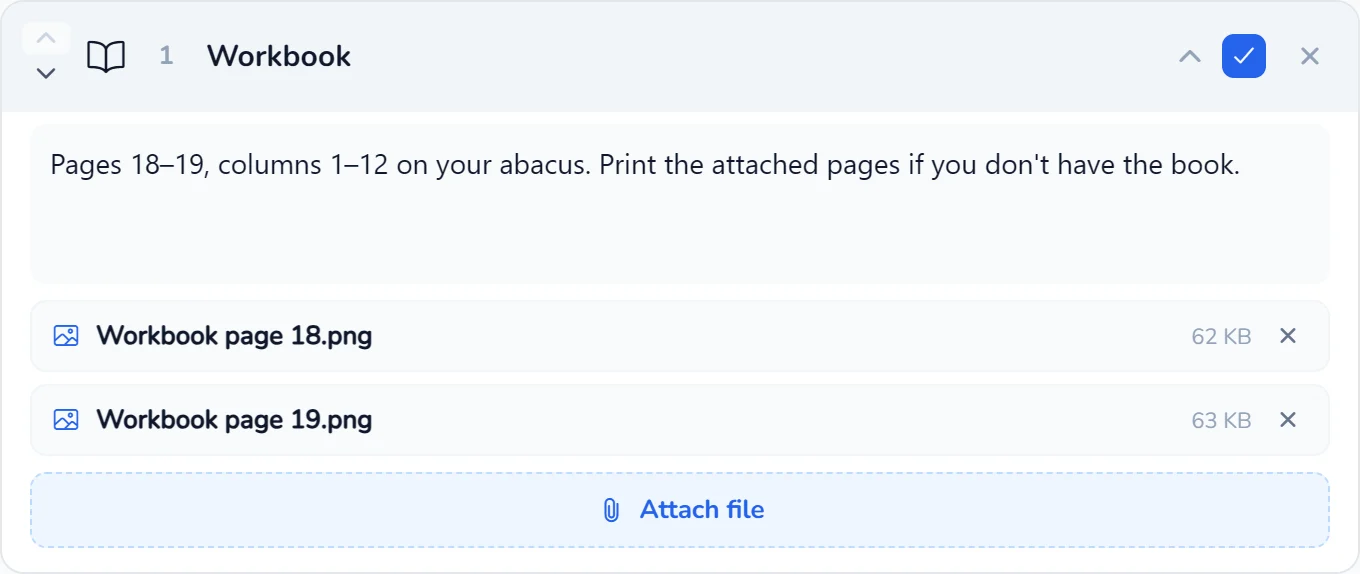
Teachers can attach workbook pages to the assignment
For example, homework may have two parts.
Part 1: Digital Practice. Complete the assigned Amavit training.
Part 2: Workbook Practice. Complete pages 18–21.
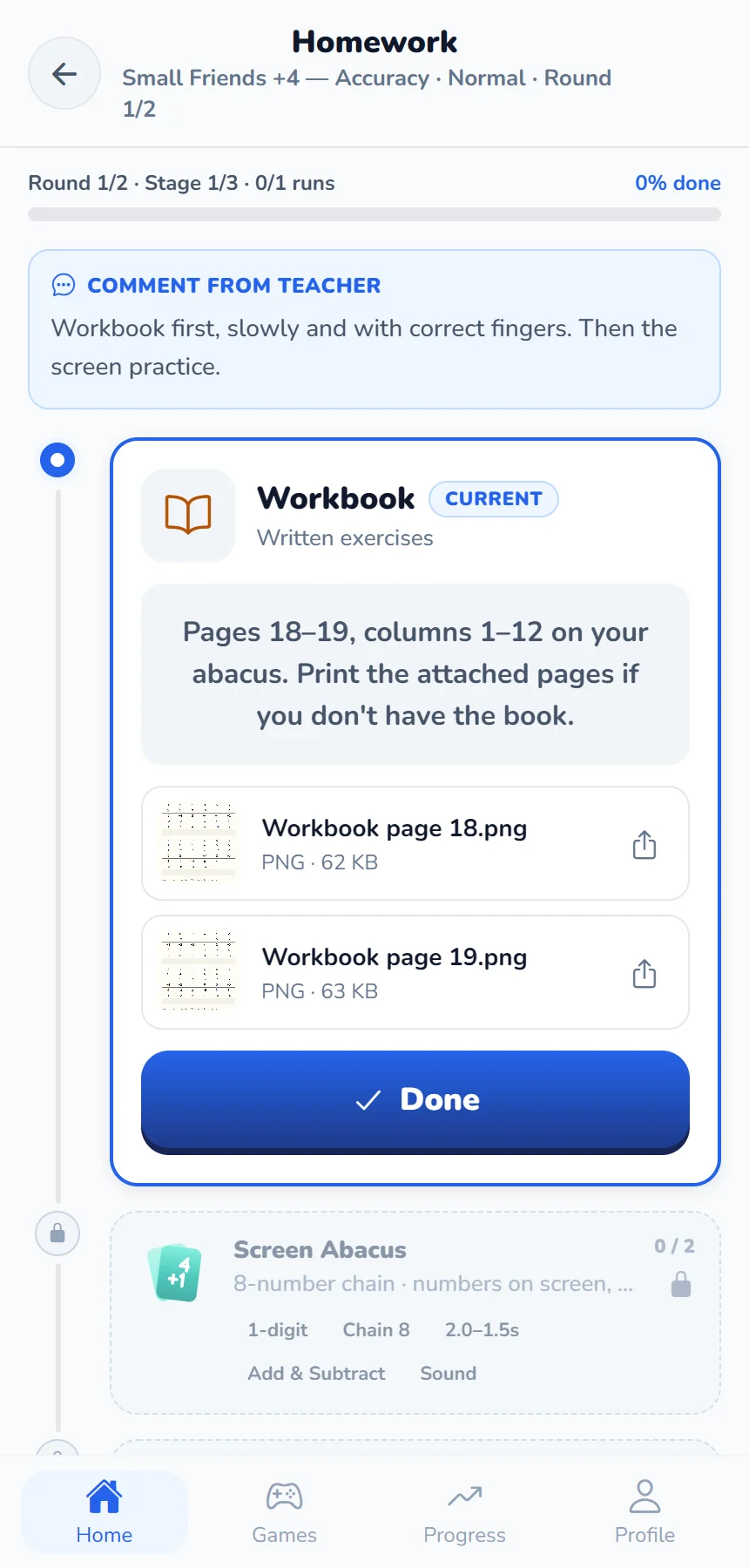
The teacher can attach those pages to the same assignment. The child or parent can find everything in one place. There is no need to search for a photo in WhatsApp, a PDF sent three days ago, a file in another group or an old message with the correct page numbers.
In Amavit, this is the Workbook stage of an assignment: the teacher writes the task (for example, “page 14, tasks 3–7”) and uses Attach file to add up to five pages — a PDF or images, including a photo of the workbook page taken on the phone. Uploaded pages stay in the teacher’s file library and can be reused in later assignments.
This is especially useful when the student does not have the workbook
This situation is quite common. For example:
- the child studies online;
- the family lives in another country;
- a new workbook has not arrived yet;
- the teacher only needs a few specific pages;
- the teacher uses their own worksheets.
In this situation, the required pages can be attached directly to the homework. If the family has a printer, the parent can print them at home and give the child normal paper-based exercises.
So the absence of a physical workbook does not necessarily need to interrupt the learning process.
This does not mean everything should become a PDF
The purpose is not to replace proper workbooks with files. If the child already has the correct workbook, excellent. They can continue using it.
The attachment option is particularly useful as a backup, additional material, a temporary solution or a way to deliver selected worksheets. The teacher decides when it is useful.
One homework assignment can combine different types of practice
For example:
Part 1 — Workbook. Use the attached pages and solve the exercises on the physical abacus.
Part 2 — Digital Practice. Complete a targeted exercise on the current topic.
Part 3 — Mental Practice. Complete a short mental calculation session.
The child no longer needs three separate messages. There is one homework assignment with a clear structure.
- Physical abacus
- Workbook / printable pages
- Digital practice
- Mental practice
One homework — multiple practice formats, in one structured assignment.
This fits the way mental arithmetic is actually taught
Strong mental arithmetic practice rarely relies on only one format. Homework can combine physical abacus, workbook, flashcards, screen practice, audio and mental calculation — see why mental arithmetic needs more than one type of practice.
A digital platform is most useful not when it tries to replace every other learning tool. It is useful when it helps bring those tools together around one learning task.
Do not move everything at once
If a teacher has used WhatsApp for years, a sudden change can frustrate both teachers and parents. Start with one group. For example: one class; 5–10 students; one week.
There is no need to announce to fifty families on Monday morning:
“Everything changes from today.”
Test the workflow on a small scale first — the same principle as in your first week with Amavit.
- Choose one group
- Keep the same methodology
- Move one homework assignment
- Attach workbook pages if needed
- Explain the process to parents
- Review after 7 days
- Fix problems
- Add the next group
How to move one group.
Step 1: Choose one real group
Select a group you already know well. It does not need to be the strongest group. It is more useful if parents communicate reliably, students normally complete homework and you already understand their current levels.
Then you can compare how homework worked before and how it works after the change.
Step 2: Do not change the homework methodology
This is important. If students previously received Small Friends practice, 20 examples, a specific speed and several workbook pages, do not simultaneously change the platform, the methodology, practice volume, speed and lesson structure.
Otherwise, if something improves or becomes worse, you will not know why. At first, change only the way the homework is organised. The teaching methodology remains the same.
If you already send workbook pages, keep doing it
The difference is that they no longer need to be sent as a separate WhatsApp message. Attach the required pages directly to the homework assignment.
This reflects an important principle: a platform should not force a teacher to abandon a good teaching process when there is no reason to change it.
The educational content stays familiar. The organisation becomes clearer.
Step 3: Explain the change to parents
Parents do not need a long manual. A short explanation is enough:
- homework used to arrive through messages;
- now the assignment will be stored in one place;
- any required pages or materials can be attached there;
- the child will have a clearer understanding of what to do;
- the teacher will have better visibility into completion and results;
- WhatsApp remains available for communication.
Parents should not feel:
“Now we have another app we are being forced to use.”
They should understand the practical benefit.
A parent message can be very simple
For example:
Starting this week, home practice will be assigned through Amavit. We will continue using WhatsApp for communication, but the homework and related materials will be kept in one place. If workbook pages are attached to the assignment, they can be printed at home when needed. This will make it easier for the child to understand what to complete and help the teacher identify where additional support is needed.
That is enough for the transition.
Step 4: Start with one clear assignment
Do not begin with five different activities. During the first week, use one clear digital task plus a few familiar workbook pages if needed.
The child should quickly understand what to open, what to complete, which material to use and when the homework is finished.
The fewer questions the family has during the first week, the easier the new habit becomes.
Step 5: Evaluate the workflow, not only the student's score
At the end of the week, evaluate two things. First: What did the students achieve? Second: Did the teacher's workflow become easier? For example:
- Were fewer manual messages needed?
- Was it easier to see who completed the homework?
- Was it easier to remember what was assigned?
- Were workbook pages and digital practice stored together?
- Could weak topics be identified more easily?
- Did parents ask fewer repetitive questions?
If the new system creates more work than before, investigate why. The problem may not be the platform. The workflow itself may simply be too complicated.
A good system should reduce repetitive work
A teacher should not need to message ten parents every day:
“Please remember the homework.”
Or resend:
“Here are pages 18–20 again because the previous message was lost.”
If the assignment and materials already exist in one place, communication becomes simpler. The teacher can intervene when intervention is actually necessary.
One of the biggest advantages is individualisation
WhatsApp naturally encourages one common message:
“Everyone completes pages 20–23.”
Why? Because sending a different message to every student takes time. But children are different. Even in the same group.
One child may need more repetitions. Another: higher speed. Another: mixed topics. Another: revision of an older weakness — the kind of hidden gap described in why children keep making the same mistakes.
A digital system allows a group to follow the same general curriculum while giving students more individualised home practice.
One group can study the same topic but receive different practice
For example, the whole class is learning Big Friend +8. But:
- Student A receives basic practice.
- Student B receives the same rule at a higher speed.
- Student C receives mixed practice.
- Student D revises an older weak topic while also practising some of the new material.
Each student can also receive the required workbook pages or additional materials. That is much closer to real individualisation.
In Amavit, the teacher can assign homework to the whole group and give a particular student personal homework with different settings; that student then sees the personal assignment instead of the group one.
WhatsApp can do this — but it becomes labour-intensive
Technically, a teacher can send individual messages to every student. Of course. They can send photos, PDFs, links and voice explanations.
The question is not “Is it possible in WhatsApp?” It is. The question is:
“Is it convenient to do this every week for dozens of students?”
Homework history matters
In a messenger, old homework gradually disappears higher and higher in the chat history. After one month, it takes time to find. After three months, even more.
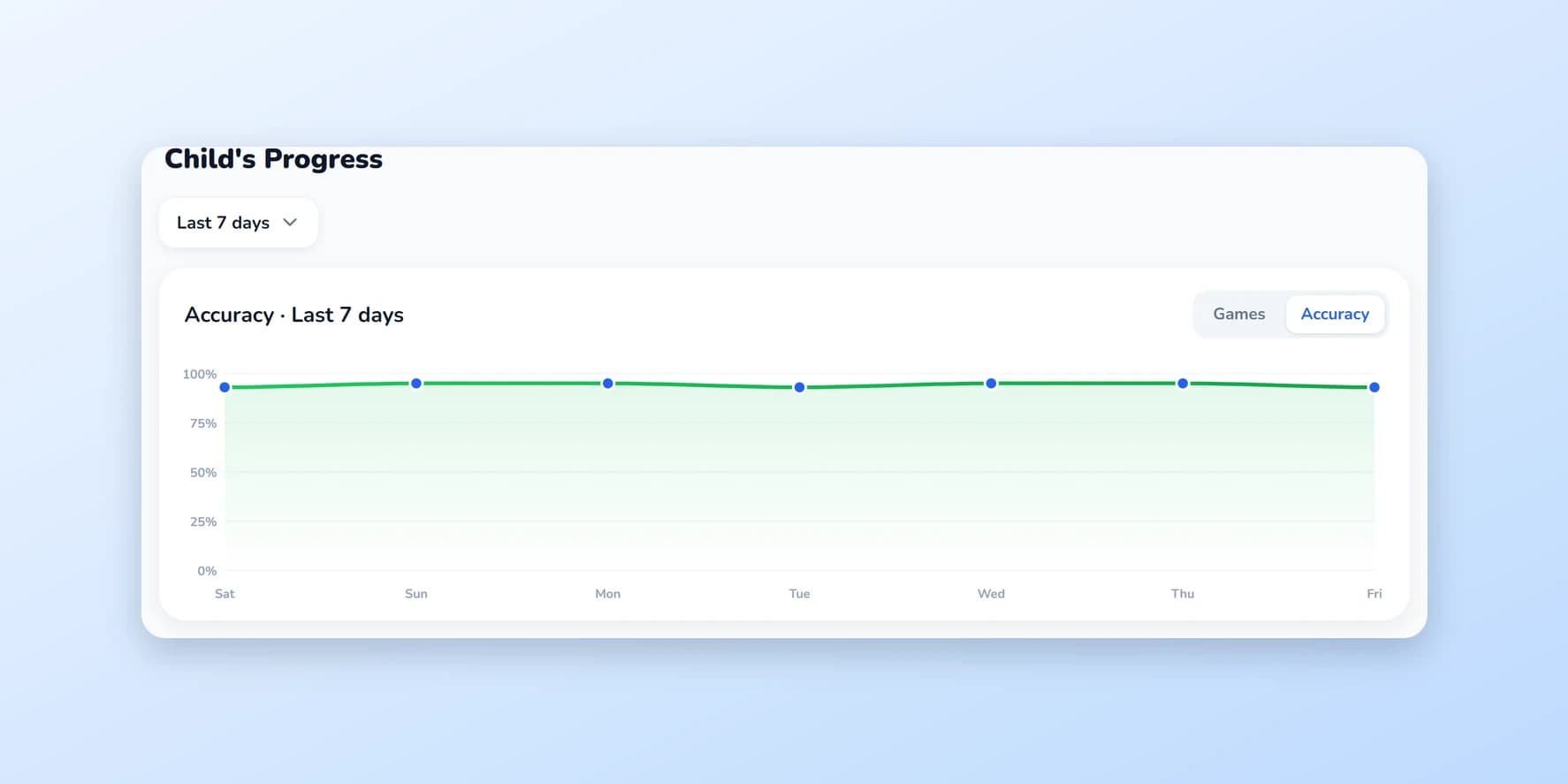
But teachers may want to understand what the child previously practised, which materials were assigned, which topics were weak, what speed the child used and how performance changed — see how to track student progress in abacus classes.
Structured practice history makes this much easier.
The process becomes clearer for parents too
Parents often receive “Pages 32–36.” That may be all the information they have. They may not understand what the child is practising, why those pages were chosen, whether the child is improving, or where to find the material if the workbook is unavailable.
When everything related to the homework is organised in one place, parents can support the process without constant messaging.
Parents should not become homework controllers
The transition from WhatsApp to a platform should not mean that parents now need to monitor statistics every minute. Their role can remain simple:
- help the child access the materials;
- print pages when necessary;
- support regular practice;
- notice if the child stops working;
- contact the teacher when needed.
The teacher remains responsible for interpreting the learning data — much as described in how parents can support a child without becoming a second teacher.
Fewer repetitive questions
A structured homework workflow can reduce questions such as:
“What do we need to do today?”
“Which page?”
“Where is the file?”
“Did you send us the worksheet?”
“Have we already completed this?”
If the assignment and materials are clearly stored in one place, many of these questions disappear. That gives the teacher more time for teaching.
The child's workflow must stay simple
If homework requires the child to open five menus, enter a long password, search for the correct section and switch between multiple screens, families will quickly return to WhatsApp.
A good workflow should be simple. The child should understand:
“Here is my access. Here is my homework. Here are my materials. I complete it — finished.”
Parents do not need the teacher interface
Another common mistake is explaining too much. Parents do not need to understand every analytics metric, all practice settings, group management or chain length configuration. They only need to know:
- how the child gets access;
- where the homework appears;
- how to open or print attached materials;
- where to ask for help if something does not work.
How to know whether the transition worked
After one or two weeks, ask:
- Are there fewer manual messages?
- Do children understand their homework better?
- Are workbook pages and additional materials easier to find?
- Is completion easier to track?
- Do you have better visibility into weak topics?
- Is individualisation easier?
- Do parents understand the new process?
If yes, add another group.
Do not add the second group until the first workflow is clear
This is the same principle as introducing any new system. Do not scale confusion. If five parents are constantly asking “Where is the homework?”, fifty parents will not make the process easier.
Fix the workflow first. Then expand.
Do not scale confusion.
WhatsApp and Amavit can work very well together
For example. In Amavit: assignment; workbook pages; additional materials; digital practice; results; history. In WhatsApp:
“Good evening. The new homework is available in Amavit. The required pages are attached there as well. This week, please pay particular attention to accuracy. If you have any technical questions, message me here.”
This is a good balance. Communication remains human. The learning workflow becomes structured.
There is usually no need to import old chats
When teachers move to a new system, they may think:
“Now I need to transfer every old message, file and assignment.”
Usually, that is unnecessary. Create a simple boundary:
From this week onward, new homework is organised through the new system.
The old WhatsApp conversations remain as an archive. Do not spend hours transferring historical information unless it has real educational value.
Start from today
The simpler the transition, the more likely it is to happen. Not:
“First I will build the perfect system, then I will begin.”
But:
“The next homework assignment for this group will be organised differently.”
How Amavit brings digital and paper practice together
Amavit is not designed to replace teacher-parent communication. It is also not designed to force teachers to abandon workbooks or physical abacus practice. Its role is different: to bring home practice into one clear workflow.
In Amavit, teachers can organise:
- groups;
- homework;
- digital practice;
- different practice parameters for different students;
- results;
- progress;
- and attach prepared workbook pages or other learning materials directly to an assignment.
If the student already has the workbook, they can continue using it. If they do not, the required pages can be opened digitally or printed at home when a printer is available.
Digital and paper practice therefore do not compete. They become parts of the same homework system.
You do not need to choose between a workbook and a digital platform. Use both for what each does best.
This becomes especially important for small academies
A system that works in the teacher's head may work perfectly with a few students. But once there are several groups, multiple teachers and dozens of students, memory and messaging become increasingly difficult to scale.
At that stage, structure is no longer simply about convenience. It becomes part of managing the academy.
The main conclusion
WhatsApp is an excellent messenger. But it does not need to be the entire mental arithmetic homework management system. The two roles can be separated.
Use WhatsApp for
Communication · reminders · short feedback · organisational questions
Use a structured learning system for
Who received the homework · what was assigned · which materials were attached · who completed it · what the result was · what should happen next
And moving to digital homework does not mean abandoning traditional learning. The physical abacus stays. The workbook stays. Paper exercises stay. When necessary, the teacher can simply attach the required workbook pages to the homework so the family can use them at home.
The best transition is gradual:
one group → one week → one clear workflow → review → scale.
There is no need to change the whole academy in one day. There is no need to change your methodology. There is no need to abandon your workbooks. There is no need to stop communicating with parents.
The goal is simply to move out of the messenger what messengers are not particularly good at: systematic management of home practice.
When communication, learning materials, assignments and results are no longer scattered across dozens of messages, teachers can work more efficiently, parents can support the process more easily, and children can focus on the practice they actually need.
For a detailed methodology of choosing what homework a child actually needs, see our guide to assigning abacus homework.
Frequently asked questions
Should abacus teachers stop using WhatsApp?
No. WhatsApp remains useful for communication, reminders and parent questions. The goal is to move assignments, materials and progress tracking into a more structured learning workflow.
Can I still use my existing mental arithmetic workbooks?
Yes. Digital homework does not replace workbooks. Teachers can continue using their existing books and combine paper practice with digital exercises.
Can teachers attach workbook pages to Amavit homework?
Yes. Teachers can attach prepared workbook pages (PDF or images) to the workbook stage of an assignment so families can access them together with the homework.
What if the student does not have the workbook?
The teacher can provide the required pages with the assignment. If the family has a printer, the pages can be printed for paper-based practice.
Should I move all my groups from WhatsApp at once?
Usually no. Start with one group, test the workflow for a week, solve any problems and then expand gradually.
Can different students in the same group receive different homework?
Yes. A group can follow the same curriculum while individual students receive different practice parameters or additional work according to their needs.
Does Amavit replace communication with parents?
No. Amavit structures the learning workflow. Teachers can continue using WhatsApp or another messenger for personal communication with families.
Free for teachers