Preparing an Abacus Class for a Competition: Accuracy Before Speed
Before a competition, teachers can easily fall into one trap: thinking that everything is about speed. More examples. Faster pace. Longer chains. Harder tasks.
But if a child becomes faster only by making significantly more mistakes, this type of preparation can reduce rather than improve competition performance. A useful basic principle is:
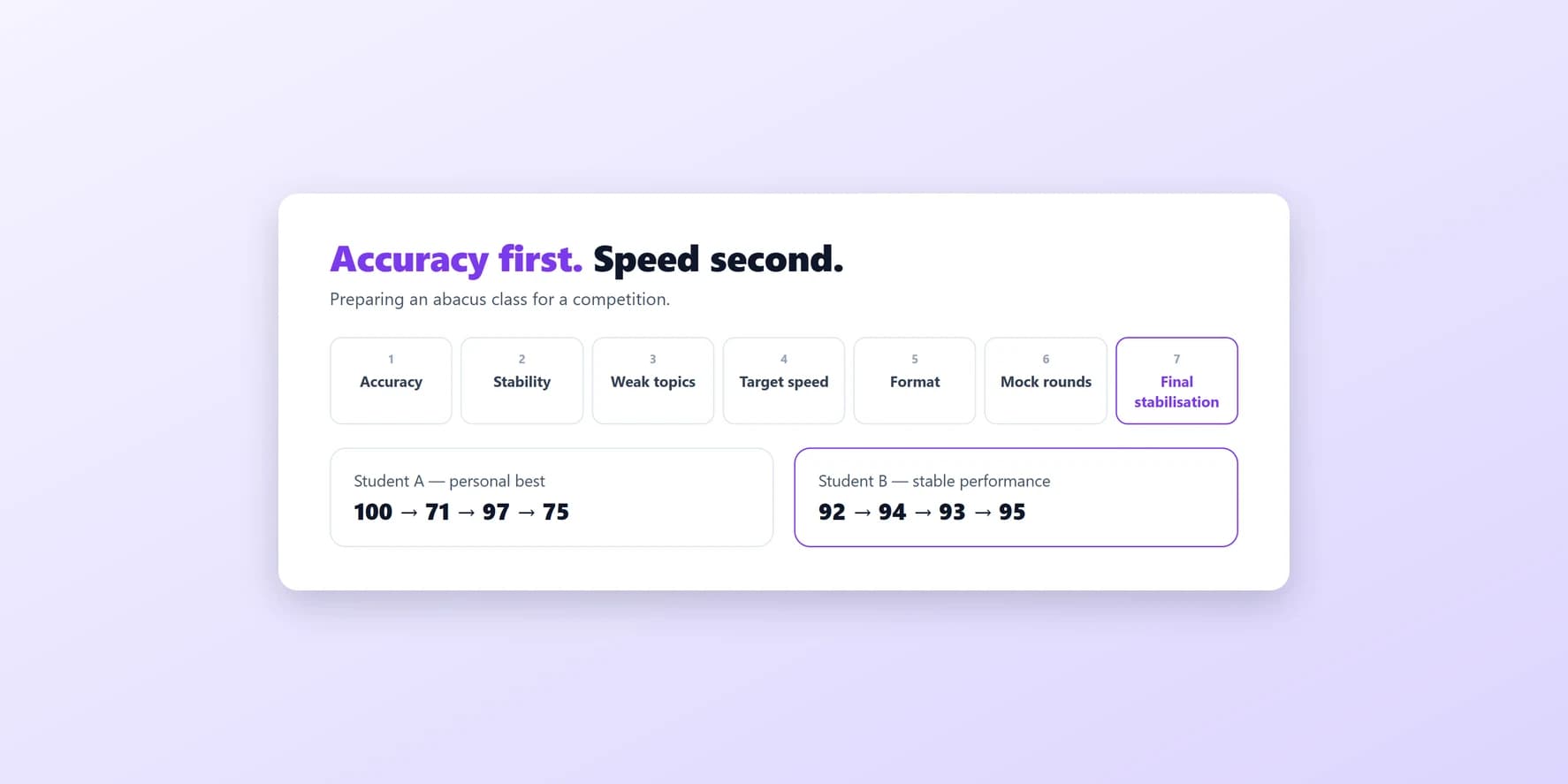
accuracy first — speed second.
Effective abacus competition preparation should build stable accuracy before maximum speed. Teachers should identify weak topics, gradually increase pace, practise the actual competition format, use mock rounds and reduce unnecessary changes in the final days before the event.
A competition is different from a normal lesson
During a normal lesson, the teacher can stop the student, correct a movement, explain a rule, give another example and reduce the speed.
During a competition, the child has to work independently. They need to:
- understand the format;
- start quickly;
- maintain concentration;
- work at the required pace;
- recover after a mistake;
- finish the round.
Competition preparation therefore needs to develop more than calculation. It needs to develop stable performance.
Competitions also show children that they are part of something bigger
There is another important reason to participate in competitions. A child normally sees their teacher, their classmates, perhaps a few students from the same academy. It can feel as if mental arithmetic exists only inside that small group.
A competition changes this perspective. The child sees other students, other schools, other cities, other countries. They understand:
“I am not the only one learning this. Children in many other places are working on the same skill.”
This can make training feel more meaningful. The child becomes part of a larger learning community.
Ranking should motivate, not humiliate
A ranking can be useful. But only if it is designed intelligently. Imagine that a child is 1,500th in a global ranking. Presented alone, this number may not feel very motivating.
But the same child might also be 45th in the country, 5th in the city, 2nd in the academy, or 1st in their own learning centre. Now the picture is very different. The child can see a real achievement.
A good competition should not show children only one global rank. Multi-level rankings — global, national, school or academy — give students more meaningful ways to see progress and achievement.
Multi-level rankings give children more ways to see progress
A well-designed competition can include several ranking levels: global; continental; country; city or regional; school / academy; learning centre.
The exact structure depends on the competition. But the principle is important: one global number should not be the only way a child sees their performance.
| One result — multiple rankings | |
|---|---|
| Global | #1,500 |
| Continent | #210 |
| Country | #48 |
| City | #1 |
| Academy | #2 |
| Previous city rank → current | #5 → #1 ↑ |
An illustration: one competition result can show achievement at several meaningful levels.
A child can improve without becoming a world champion
For example: last year — 5th in the city. This year — 1st in the city. The child may still be far from the global top positions. But this is a clear achievement.
Another student may move 20th → 8th in their academy. Another: 300th → 170th nationally. These improvements matter.
Competition should help children see where they are improving, not only who won overall.
A child can improve without becoming a world champion.
Different children need different reference points
Children differ in age, experience, training history, natural speed, practice volume and current level. So comparing every child only against the absolute strongest student in the world is not always meaningful.
A multi-level ranking creates more relevant reference points. It can show the child where they stand globally, where they stand locally and how they are progressing personally. These three perspectives can coexist.
The most important comparison is still personal progress
External ranking is useful. But it should not replace: child today vs child before.
A student may move from 1,800th to 1,500th globally. That may look modest. But at the same time their score increased, their accuracy improved, and they moved from 5th to 1st in their city. That is meaningful progress.
Rank should provide context. It should not define the child's ability or value.
Rank gives context. It does not define the child.
Before training, understand the competition format
Before preparation begins, the teacher should know:
- which exercises are included;
- how much time is available;
- chain length;
- digit length;
- which topics are tested;
- whether physical abacus is used;
- whether mental calculation is included;
- how scoring works;
- what happens when an answer is wrong.
Without this information, preparation becomes guesswork.
Do not train everything at once
When a competition approaches, it is tempting to think “We need to review everything.” A better approach is to separate preparation into components: accuracy; weak topics; speed; competition format; stability; mental endurance.
Then the teacher can identify what is already competition-ready and what still needs work.
- Accuracy
- Stability
- Weak topics
- Target speed
- Competition format
- Mock rounds
- Final stabilisation
- Competition
The competition preparation ladder.
First remove systematic errors
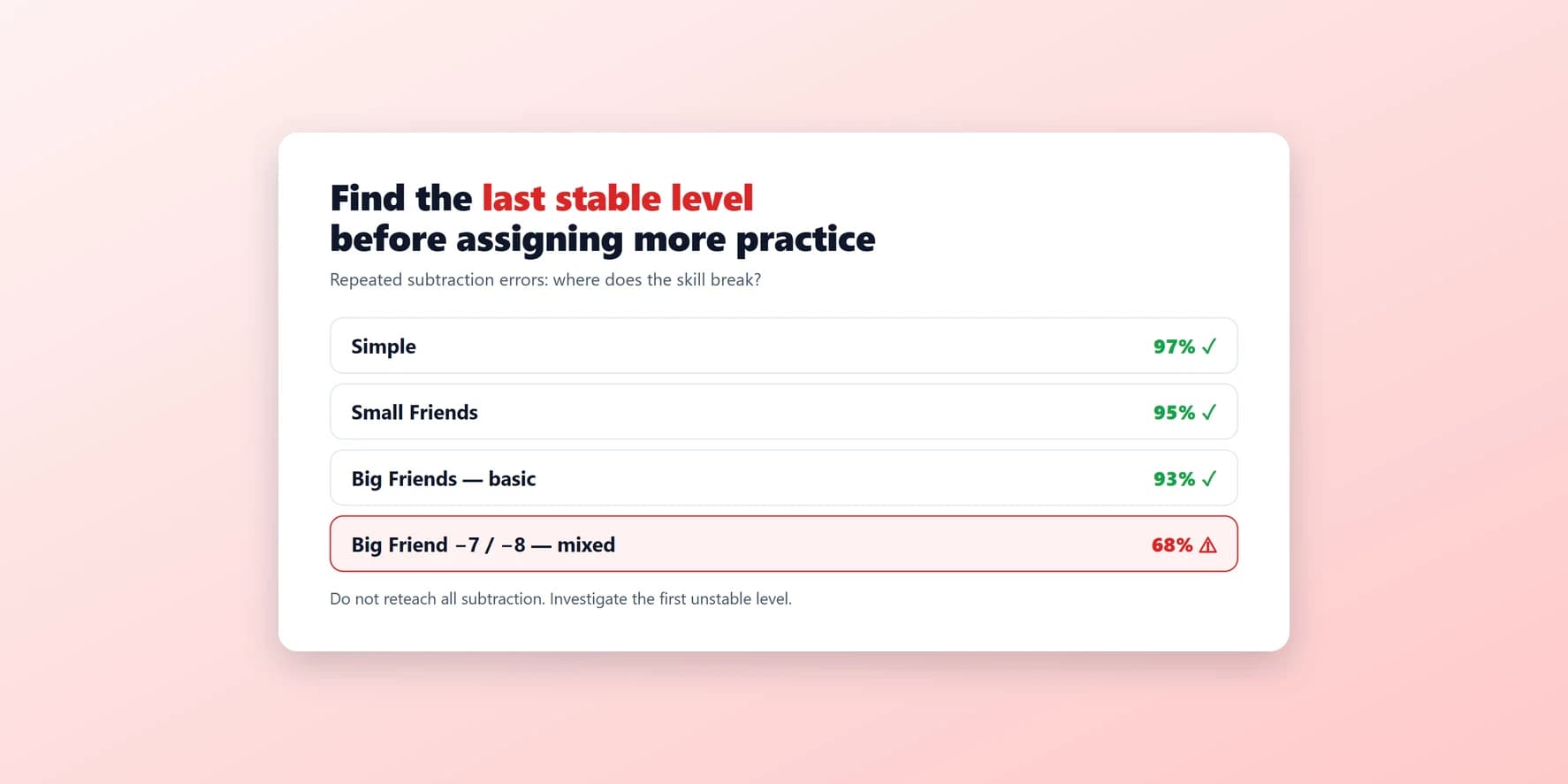
If a child repeatedly fails one topic, increasing speed usually makes the problem worse. First identify repeated mistakes, weak Friends combinations, unstable finger technique, place-value problems and weak mixed combinations.
Correct those before serious speed training.
Find the weak point before increasing speed
For example, a student may show 95% accuracy across most topics but only 70% on one combination. There is little value in accelerating the whole training block.
First determine why this particular area is weak. Repair it. Then return it to competition practice — the method we describe in the diagnostic checklist for repeated subtraction errors.
Do not increase competition speed until you know which skill is causing the errors.
Accuracy should be stable, not accidental
One excellent result is not enough. A child may score 98% today and 76% tomorrow. That skill is not yet stable.
Student A — personal best
100% → 71% → 97% → 75%
Student B — stable performance
92% → 94% → 93% → 95%
For competition, repeatable performance matters.
Stability matters more than a personal record
Competition performance happens on one particular day, in one particular round. The teacher should therefore monitor not only personal best but also normal repeatable performance.
Stability matters more than one personal record.
Increase speed only after stability
Once accuracy is stable, speed can gradually increase. For example: 2.0 seconds; 1.5 seconds; 1.2 seconds; 1.0 second.
Continue only while performance remains technically clean and reasonably accurate. If errors suddenly increase after one step, the new speed is probably too high for stable competition performance — see how speed develops in mental arithmetic.
Do not jump directly to competition speed
If the student normally trains at 2 seconds and the competition target is around 1 second, suddenly switching to 1 second is usually a poor strategy. Build speed in stages. This helps preserve technique, accuracy and confidence.
Sometimes training slightly faster can help
Once the actual competition speed is stable, an advanced student may occasionally practise slightly faster. For example: competition speed — 1.0 second; challenge practice — 0.9 or 0.8. Then the competition pace may feel more comfortable.
But this is advanced preparation. It should not replace stable work at the real target speed.
Do not confuse speed training with panic training
If the child starts guessing, loses the rules, makes chaotic movements or cannot keep up, that is not useful speed training. It is rehearsal of mistakes.
Practise the competition format
A common preparation mistake is to train the content but ignore the actual competition experience. Students should know how the round starts, how long it lasts, how answers are entered, what happens after a missed example and when the next task begins.
The fewer surprises on competition day, the better.
Use full mock rounds
Not every training session should be fragmented exercises. Occasionally run a complete competition-style round with the correct time, similar structure, no teacher assistance and recorded results. Then analyse what happened.
Analysing a mock round is more important than repeating it ten times
After a simulation, ask: Where did errors begin? Did concentration fall? Which topics were weaker? Was speed sustainable? Were most mistakes early or late?
Then use the answers to design the next practice block.
Do not run a full competition every day
Constant competition simulation can create fatigue, stress, loss of motivation and the feeling that every lesson is an exam. Instead, alternate technical work, weak-topic practice, speed blocks, mock rounds and lighter sessions.
Reduce chaos as the competition gets closer
In the final days, avoid unnecessary experiments. Do not suddenly introduce a difficult new topic, change technique, double the workload or change the format. The final stage should focus more on stabilisation, confidence and familiar conditions.
The final week should feel predictable
The child should know what they are doing, what the format looks like, which speed is expected and how the round works. Predictability reduces unnecessary stress.
Even strong students do not need infinite speed
A fast student can always try to go faster. But competition performance is: fast + correct. If higher speed creates more errors, poor technique or loss of concentration, stop increasing it.
A slightly slower student can sometimes score better
Suppose one speed allows the child to answer more tasks but creates 15% errors. At a slightly lower pace, they complete fewer tasks but almost everything is correct. Depending on the scoring system, the second strategy may produce a better score.
Speed should therefore always be evaluated together with accuracy.
Competition preparation should be individual
Children in the same class can have completely different needs. One student: very accurate but too slow. Another: very fast but unstable. Another: strong on physical abacus but weaker mentally. Another: good at short chains but loses accuracy on longer ones.
The same competition homework is therefore not optimal for everyone.
Train together, practise individually
The class can still share competition simulations, format explanations, group motivation and general preparation. But individual homework can differ. For example: one child receives a speed block; another an accuracy block; another weak-topic practice.
This is often more efficient than making everyone do the same work — see teaching a mixed-ability group.
| Same class — different preparation | |
|---|---|
| Student A | Accuracy |
| Student B | Speed |
| Student C | Weak topic |
| Student D | Mental stability |
One group. Different practice needs.
This is where a digital platform helps
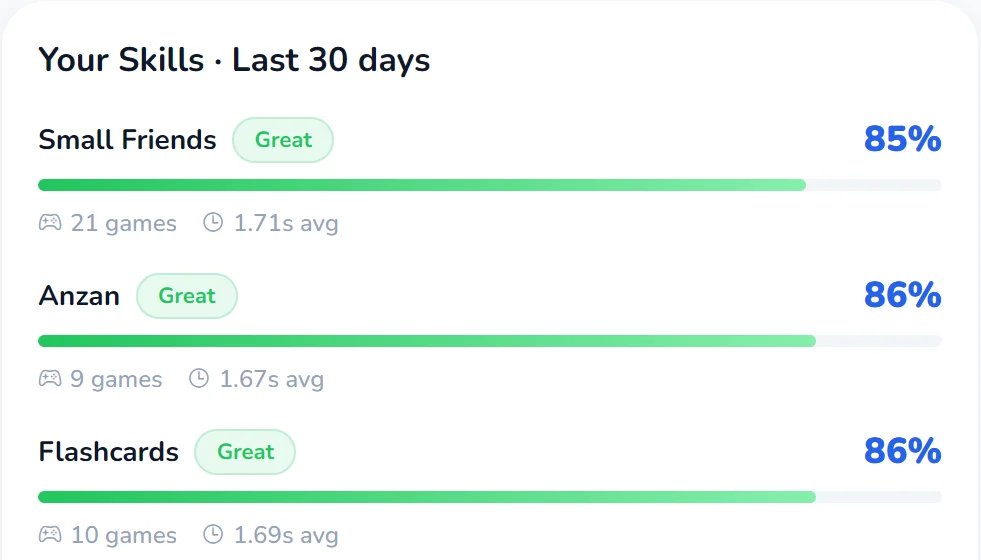
When the teacher can see individual results, it becomes easier to identify who loses accuracy, who has a speed plateau, which topic is weak, who performs well on short chains but poorly on long ones and who is stronger physically than mentally. Practice can then be adjusted accordingly.
In Amavit, a short test run on the teacher’s Games tab shows accuracy and average time for a chosen topic and speed, and the child’s progress screen shows accuracy by type of practice over time.
One group does not require one identical competition plan
Competition preparation is a good example of: shared class + individual practice. The goal can be common. The weak points are not.
A useful preparation cycle
- Test run a mock round
- Diagnose review the data, find the weak area
- Correct work on it for several sessions
- Retest run another mock round
If the result improves, continue. If it does not, investigate again.
Test → Diagnose → Correct → Retest.
Do not forget the physical abacus
As competitions approach, children sometimes spend more and more time working mentally. But if the teacher sees a repeated technical error, falling accuracy or an unstable algorithm, a short return to physical abacus practice can be extremely useful.
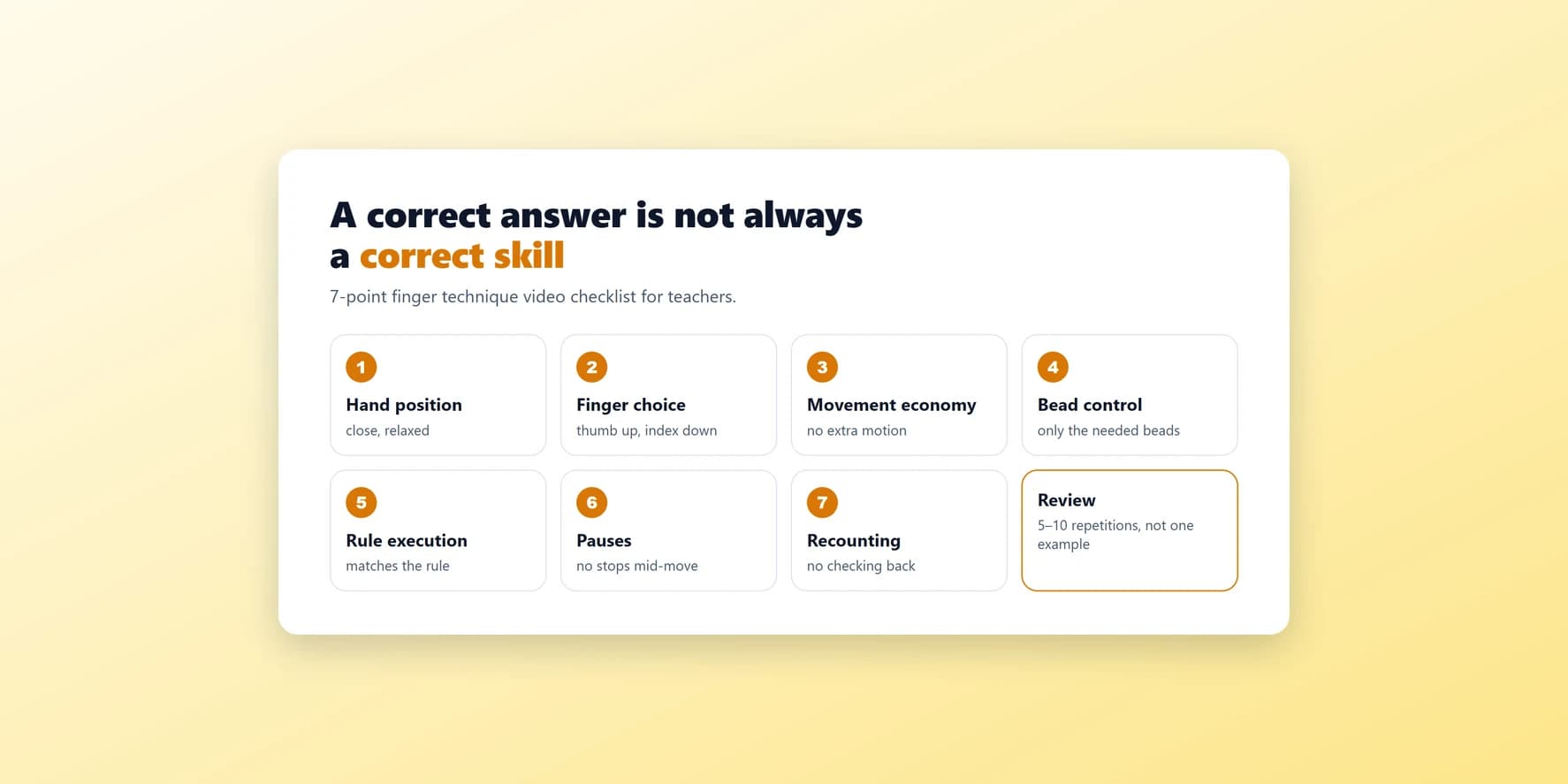
The teacher can again observe movement, rule, sequence and technique — see the finger technique video checklist.
Check mental and physical performance separately
A student can be strong physically and average mentally. Or the reverse. Therefore “The child is competition-ready” is too broad. The teacher needs to know: competition-ready for which format or nomination?
The competition level should match the child
Parents or teachers sometimes want the hardest level, the fastest category, the strongest nomination. But the level should correspond to the child's current skill.
An excessively difficult category can lead to very low results, stress and a sense of failure. A good competition provides challenge without making meaningful performance impossible.
Competition should be a challenge, not a punishment
The child should understand: we do not expect perfection. The goal is to show what you can already do, test yourself, see your current level and identify the next target. This is especially important for a first competition.
Competition should be a challenge, not a punishment.
A first competition does not have to be about winning
For a beginner, success may mean remaining calm, finishing the round, maintaining technique and receiving a first official result. That already creates experience. The next competition will feel much more familiar.
Use rankings to show achievement at more than one level
After the competition, do not show only “You are number 1,500 in the world.” Show the wider picture. For example: Global: 1,500th · Country: 48th · City: 1st · Academy: 2nd.
Now the child understands the result very differently. A well-designed ranking system creates several achievable horizons.
Ranking can turn competition into a progress map
The child might not become a global medalist this year. But they may aim to become top 10 in the city, top 3 in their centre, top 100 nationally. Then later: higher again.
This creates intermediate goals. And intermediate goals are often much more motivating than one distant world ranking.
Why multi-level rankings matter
International competitions can become more motivating when students can see not only their global position, but also their progress within more relevant groups.
For example, the online VF CUP olympiad in mental arithmetic shows a worldwide ranking for each level (PRO, MASTER, EXPERT and GURU — from Simple to Anzan), together with country and school or educational centre rankings.
Do not use rank as a measure of intelligence
A ranking reflects performance in a particular competition, in a particular format, on a particular day. It does not measure intelligence, future potential or the child's value. Teachers and parents should be very clear about this.
After the competition, compare the child with their own previous result
For example: previous competition — 63 points; current competition — 78. Or: previous city ranking — 5th; current — 1st. Or: accuracy improved from 82% to 93%.
These are powerful indicators of progress. Competition becomes much more useful when it creates a historical record.
Teach children how to recover after a mistake
Some students make one error and then panic, keep thinking about it and miss the next several tasks. This can be trained. The rule is simple:
the previous example is over; the next example is a new task.
A mistake should not destroy the rest of the round.
Do not try to “win back” a mistake
After making an error, children sometimes suddenly accelerate. That often creates another mistake. Teach them to return to their normal working rhythm. This is also part of competition skill.
Train concentration separately
Sometimes calculation is not the main problem. A student may perform perfectly for three minutes and then deteriorate. Then preparation needs to include duration, focus and working continuously without distraction. The duration can increase gradually.
But do not turn concentration training into exhaustion
If the competition round lasts five minutes, there is little benefit in forcing maximum-intensity work for 40 minutes every day. Training should reflect the real performance requirement.
Competition homework can have three levels
- Base — accuracy + weak topics.
- Competition — target speed + competition format.
- Challenge — slightly higher speed or complexity.
Most training should remain in Base and Competition. Challenge should be limited.
The day before the competition
Avoid marathon practice, new topics and dozens of mock rounds. Use short familiar practice, a few confident tasks, a quick technique check and a positive finish. The child should arrive rested.
Sleep is more valuable than one final late-night round
If the choice is another 30 minutes of late practice or adequate sleep, for most children sleep is the better preparation. Fatigue reduces performance.
Do not change the system on competition day
Immediately before the start, avoid a new algorithm, a new technique, different finger rules and “Try to go faster today.” The child should use what has already been practised.
A competition dashboard can help teachers
For each student, track accuracy, target speed, weak topics, physical / mental performance, mock-round results and stability across several attempts. This makes readiness easier to judge objectively.
Amavit can support individual competition preparation
One child may receive accuracy-focused homework. Another: speed-focused practice. Another: weak-topic work. Another: competition simulation. The students can remain in the same class while practice becomes more individual.
In Amavit, this is a group homework plus personal homework for the students who need something different — with its own topic, speed range, chain length and Easy, Normal or Intense difficulty.
This reduces teacher administration
Without a structured platform, the teacher may need to prepare exercises manually, keep separate notes, remember individual weak topics, send different assignments and collect results.
A platform can structure part of this work. That becomes particularly useful when one teacher is preparing many students for the same competition.
How do you know a student is ready?
Not from one personal record. Look for several signs together:
- accuracy is stable;
- target speed is sustainable;
- weak topics no longer collapse;
- the student understands the competition format;
- several mock rounds produce similar results;
- the student can continue after a mistake;
- physical technique remains stable.
That is a much better definition of competition readiness.
A simple teacher checklist
Before the competition, ask:
- Does the student understand the format?
- Is accuracy stable?
- Can the student maintain target speed?
- Have weak topics been identified and corrected?
- Is physical technique stable?
- Is mental performance appropriate for the selected level?
- Does chain length remain manageable?
- Has the student completed several mock rounds?
- Can the student recover after a mistake?
- Is the final week free from unnecessary overload?
- Does the child understand that rank is only one part of the result?
- Can the child see progress at a personal, local or broader ranking level?
If most answers are yes, preparation is on the right track.
Always review the competition afterwards
Do not look only at place, score or medal. Review what worked, where errors occurred, what differed from training, how the student handled pressure, how the ranking changed and what should improve before the next competition.
Then competition becomes part of the learning process.
Competition is also a diagnostic tool
Competition shows how stable the skill is outside the normal lesson, what happens under time pressure, how independently the student works, which topics survive pressure and which skills still need reinforcement.
So the final result is not only a place in the ranking. It is data for the next stage of learning — the same idea as in how to measure a child’s progress.
The main conclusion
Competition preparation is not simply: calculate faster. A better sequence is:
accuracy → stability → weak-topic correction → competition format → target speed → mock rounds → final stabilisation
The student should arrive at the competition not maximally exhausted from training, but ready to reproduce a stable performance.
And the competition itself should do more than identify one winner. It should help children understand:
- I am part of a much larger community.
- I can compare myself with others at several meaningful levels.
- I can see how I have improved since my previous result.
A child may be 1,500th in the world and still have a very real reason to be proud: they may now be first in their city, first in their centre, or significantly better than they were six months ago.
That is one of the best ways competition can support long-term motivation. Because real competition performance is not one extraordinary result. It is the skill a child can reproduce: quickly, accurately and independently — when it matters.
Frequently asked questions
Should accuracy or speed come first in abacus competition training?
Accuracy and stable technique should usually come first. Speed can then be increased gradually while monitoring whether accuracy remains stable.
How often should students practise full competition rounds?
Mock rounds are useful, but they should be combined with technical work, weak-topic practice and lighter sessions rather than repeated continuously.
Should every student in the same class receive the same competition homework?
Not necessarily. Students may share the same competition goal but have different weak areas, speeds and accuracy levels.
Is global ranking the most important competition result?
No. Global ranking provides useful context, but national, school and personal-progress comparisons can be more meaningful for many children.
How can rankings motivate children?
Multi-level rankings create achievable intermediate goals. A student may improve within their school or country even before reaching the top of a global ranking.
Should children be compared with other competitors?
External comparison can provide useful context, but personal improvement over previous performance should remain an important measure of progress.
What should teachers do during the final days before a competition?
Focus on familiar tasks, stable performance, the known competition format and adequate rest rather than major technical changes or excessive training.
What should happen after the competition?
Review accuracy, weak topics, concentration, ranking changes and differences from training, then use those findings to plan the next development stage.
Free for teachers