Can Adults and Seniors Learn Mental Arithmetic?
When people hear the words mental arithmetic, they usually imagine a child using an abacus.
Five years old. Seven years old. Ten years old.
But there is another important question:
Is it too late to start as an adult?
At 30? At 50? At 60? At 70 or beyond?
No.
The human brain retains the ability to learn and adapt throughout life.
Learning may become slower with age, and some cognitive processes change over time, but the ability to develop new skills does not simply disappear.
Can you learn mental arithmetic as an adult?
Yes. Adults can learn mental abacus at 40, 60, 70 and beyond. The goals and pace may differ from children's training, but the ability to learn new cognitive skills remains throughout life.
That means mental arithmetic does not have to be seen only as a children's program.
For adults and older people, it can become a very different kind of activity:
a structured cognitive challenge.
Starting at 60 is not too late
An adult already has decades of established habits. That includes habits of calculation.
If an adult sees:
37 + 18,
they will usually begin calculating in the familiar way.
Mental abacus requires something different — see how mental abacus works.
Instead of holding an intermediate answer as a number, the learner begins to:
- visualise an abacus;
- see the bead positions;
- mentally move the beads;
- maintain the visual image.
For an adult, this can feel unfamiliar. And that is exactly what makes the task interesting.
The learner is not simply practising arithmetic. They are learning a new way to perform a familiar operation.
The brain can continue learning throughout life
Neuroplasticity does not disappear when childhood ends.
Adults can still learn new skills and develop new patterns of neural activity.
Of course, a seven-year-old and a seventy-year-old do not learn in exactly the same way.
- The speed of learning can differ.
- The training load should differ.
- The amount of repetition may differ.
But age itself does not mean:
“My brain can no longer learn.”
It can.
And this is one reason why learning unfamiliar, demanding skills can remain valuable later in life.
Mental abacus creates an unusual cognitive challenge
When adults solve an ordinary arithmetic problem, they often use a calculation strategy that has been familiar for decades.
Mental abacus changes the task.
The learner needs to:
- recognise a number;
- connect it with a bead pattern;
- create a visual image;
- change that image mentally;
- hold a sequence of actions;
- monitor accuracy.
This places demands on several processes at the same time, including:
- attention;
- visual-spatial processing;
- working memory;
- sequencing;
- concentration.
The arithmetic itself may be simple. But the way the brain is asked to process it is new — the visual image of the beads replaces step-by-step counting.
Could this kind of training be useful in later life?
This question is beginning to be studied scientifically.
A small randomized controlled trial published in 2024 tested a digital abacus-based mental calculation program in healthy adults aged 42 to 79.
The study included only 20 participants, so it was far too small to support broad conclusions.
The researchers did not find improvements in the overall cognitive test scores they measured, but they did observe differences in some specific tasks related to working memory, attention and planning.
The authors described the results as promising but preliminary.
That distinction matters.
The evidence is interesting.
But it is not strong enough to claim that mental-abacus training prevents dementia or produces broad cognitive improvement in every older adult.
Mental arithmetic should not be presented as a treatment for dementia
This is especially important.
Important note: Mental arithmetic is not an established treatment for dementia. It should not be marketed as a cure.
And no responsible program should promise:
“Do abacus training and you will not develop dementia.”
Current evidence does not support that claim.
However, cognitive training and cognitive stimulation are part of the broader discussion around healthy ageing and dementia-risk reduction.
The World Health Organization's 2026 dementia-risk guidelines include cognitive training, cognitive stimulation and social engagement among the interventions that may be considered as part of risk-reduction strategies for adults without dementia, including those with normal cognition or mild cognitive impairment. The recommendations are based on varying levels of evidence and do not imply that any single activity prevents dementia on its own.
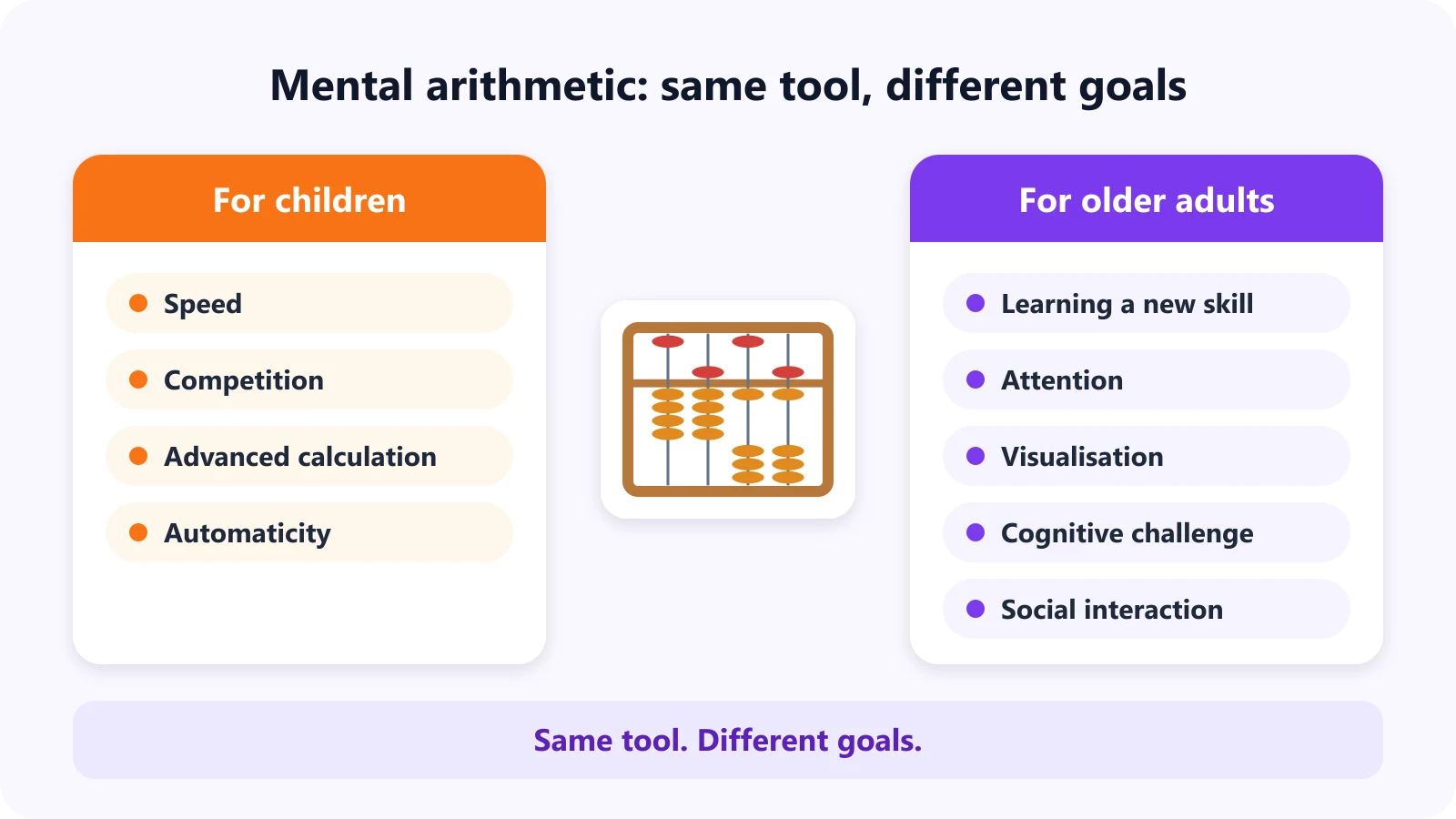
So the goal for an older learner is different
For a child, the goals may include:
- progressing through a curriculum;
- increasing speed;
- preparing for competitions;
- developing advanced mental abacus.
For a person aged 60 or 70, the goals can be very different:
- learn something genuinely new;
- regularly challenge attention;
- work with memory and visualisation;
- maintain a structured intellectual routine;
- experience measurable progress.
There is no need for every older learner to aim for 0.3 seconds per operation.
Speed does not have to be the main objective. The process of learning itself can be the challenge.
Novelty matters
If a person has completed the same type of crossword puzzle for twenty years, the activity may still be enjoyable. But it is no longer entirely new.
Mental abacus can be different because most adults have never learned to calculate this way.
The learner has to:
- use the hands differently;
- see numbers differently;
- create bead images;
- move from a physical tool to visualisation;
- gradually perform calculations without the physical abacus.
For many adults, this is genuinely unfamiliar.
That makes it a learning task rather than simply a repetition of something they already know.
But there is another benefit that may be just as important: social connection
Older adults do not only need intellectual stimulation. Many also need meaningful social interaction.
Retirement can dramatically change everyday life.
- Colleagues disappear from the daily routine.
- Children may live elsewhere.
- The number of regular social contacts can decline.
Structured group learning can therefore offer more than cognitive exercise.
A person comes not only to “train the brain”. They also come to:
- meet people;
- talk;
- learn together;
- compare progress;
- share mistakes;
- encourage each other;
- have a reason to leave home and participate in something.
WHO's updated dementia-risk guidance also highlights social engagement as part of broader risk-reduction strategies.
Sometimes the social component may be as valuable as the arithmetic
Imagine a group of adults aged 60 to 75 meeting twice a week.
- They learn to use an abacus.
- They compare results.
- Laugh about mistakes.
- Show each other progress.
One person is the first to calculate without looking at the physical abacus.
Another improves accuracy.
Another simply enjoys coming every Tuesday and Thursday.
After several months, this is no longer only a class. It becomes a community.
For many older adults, that sense of belonging can be extremely valuable.
This should not simply be a children's course with older students
A program for older adults should not be designed by taking a course for seven-year-olds and changing the pictures.
The objectives are different.
A child may be motivated by:
- speed;
- medals;
- competitions;
- olympiads.
An older adult may care more about:
- novelty;
- steady improvement;
- enjoyment of learning;
- social interaction;
- confidence in being able to master something new.
Even the thought:
“I am 70, and today I learned something I could not do last month”
can be deeply motivating.
Speed should not be the main measure of success
This is important.
For children, we may deliberately train toward:
2 seconds; 1 second; 0.5 seconds; 0.3 seconds.
For a 65-year-old learner, this may be completely unnecessary.
More relevant goals may be:
- regular participation;
- good accuracy;
- gradual progress;
- learning new operations;
- maintaining concentration;
- enjoying the process.
If speed improves, that is excellent. But speed does not need to define success.
A physical abacus can be a very good starting point
The physical abacus creates a multi-step task.
The learner:
- looks;
- counts;
- moves the fingers;
- follows a sequence;
- receives tactile feedback.
At first, the entire process can remain physical. Then visualisation can be introduced gradually. For example:
- look at a number;
- create the bead pattern;
- close the eyes;
- try to keep the image;
- perform one simple mental movement.
There is no need to rush immediately into high-speed mental calculation.
Progress itself becomes motivating
For an older adult, one of the most rewarding experiences can be seeing clear improvement.
A month ago: “I could not do this.”
Previously: “I could hold only two operations.”
Previously: “I needed the physical abacus every time.”
Today: “I can.”
Now: “I can manage five.”
Now: “I can visualise part of the calculation.”
Learning a new skill later in life can change the way a person thinks about ageing.
Instead of:
“Every year I can do less,”
there is another experience:
“I can still learn something completely new.”
A digital platform can also be useful
Individual pacing becomes especially important for adult learners.
- One person progresses quickly.
- Another needs more repetition.
- One works comfortably with short chains.
- Another becomes tired when exercises are too long.
A digital platform can adjust:
- speed;
- digit length;
- exercise length;
- difficulty;
- number of operations.
This allows learners to practise at their own level instead of constantly comparing themselves with faster participants.
But technology should not replace real human contact
For older adults, we would not build the program as an app-only experience.
A much stronger model can be:
group learning
plus short individual practice at home.
During the group session:
- a teacher;
- live explanation;
- conversation;
- shared exercises;
- light competition;
- social interaction.
At home:
- 10–15 minutes of individual practice.
In this model, technology supports the learning process without removing the social side.
Time guidelines for adults differ from those for children; for how practice time is usually planned for children, see how much mental arithmetic practice a child needs each day.
Can mental arithmetic become part of healthy ageing?
Potentially, yes — when it is described correctly.
- Not as a miracle treatment.
- Not as a cure.
- Not with promises that: “Abacus training will prevent dementia.”
But as a combination of:
- learning something new;
- regular cognitive challenge;
- attention and memory work;
- fine-motor activity;
- social interaction;
- an enjoyable hobby.
That is already a meaningful proposition for many older adults.
And perhaps one of the greatest benefits is having a new goal
Childhood is full of learning.
School. University. Work. New skills. New responsibilities.
Later in life, the number of new structured challenges can become smaller.
Mental arithmetic can create one.
- Today: learn the abacus.
- Next month: calculate more accurately.
- Later: begin visualising the beads.
- After several months: complete something that once seemed impossible.
Learning something new at 60 or 70 is not an attempt to become young again. It is simply part of being a person who is still capable of developing.
So is it ever too late?
- Can someone begin mental arithmetic at 40? Yes.
- At 50? Yes.
- At 60? Yes.
- At 70 or later? Also yes, provided that the difficulty and pace are appropriate for the individual and any relevant medical limitations are taken into account.
Age changes the way the program should be designed. It does not eliminate the ability to learn.
For an adult or older learner, mental arithmetic does not have to be about becoming the fastest calculator in the room.
It can become:
- a new intellectual challenge;
- a regular cognitive activity;
- an enjoyable hobby;
- and a reason to spend time with other people who are also learning something new.
Research and further reading
- World Health Organization (2026). New WHO guidelines: up to 45% of dementia risk could be prevented or delayed.
- World Health Organization (2026). Risk reduction of cognitive decline and dementia: WHO guidelines, second edition.
- Takaoka T. et al. (2024). Effects of the abacus-based mental calculation training application “SoroTouch” on cognitive functions: A randomized controlled trial. PLOS ONE, 19(3): e0299201.
- Lima-Silva T. B. et al. (2021). Cognitive training using the abacus: a literature review study on the benefits for different age groups. Dementia & Neuropsychologia, 15(2).
Frequently asked questions
Can adults learn mental arithmetic?
Yes. Adults can learn mental abacus at 40, 60, 70 and beyond. The goals and pace may differ from children's training, but the ability to learn new cognitive skills remains throughout life.
Is 60 too old to learn abacus?
No. Starting at 60 is not too late. Age changes the way the program should be designed — the difficulty and pace should suit the learner — but it does not eliminate the ability to learn.
Can mental arithmetic prevent dementia?
No one should promise that. Mental arithmetic is a cognitive activity, not a proven way to prevent or treat dementia. Cognitive training and social engagement are part of broader dementia-risk reduction strategies, but no single activity prevents dementia on its own.
Is mental arithmetic good for seniors?
It can be an interesting form of learning, cognitive challenge and social activity: learning something genuinely new, working with attention, memory and visualisation, and spending time with other people who are also learning.
Do older adults need to calculate fast?
No. Speed does not have to be the main goal. Regular participation, good accuracy, gradual progress and enjoying the process can matter much more for an older learner.