Vedic Mathematics, Powers and Roots: What Comes After Classical Mental Arithmetic?
When a child can already add, subtract, multiply and divide quickly, it may seem that there is nowhere else to go.
In reality, this is where one of the most interesting stages can begin.
Advanced mental calculation is not limited to the abacus. It can also include:
- alternative multiplication algorithms;
- different approaches to division;
- number patterns;
- Vedic mathematics techniques;
- powers;
- roots;
- other forms of rapid mental calculation.
And sometimes a calculation that looks extremely difficult can be performed mentally much faster than most people expect.
Advanced mental calculation can go far beyond the abacus. After multiplication and division, students may learn fast algorithms, number patterns, powers, roots and selected Vedic-mathematics techniques, gradually building a wider toolkit for working with numbers.
Advanced mental arithmetic can go beyond the abacus
At the beginning of the program, the abacus is central. The child learns to:
- recognise numbers;
- move beads;
- use Friends;
- work across place values;
- transfer these movements into a mental abacus.
But at more advanced levels, additional tools become available. The child can also begin using:
- number decomposition;
- mathematical patterns;
- shorter algorithms;
- rapid transformations.
Mental calculation therefore becomes broader than one single method.
- Mental abacus
- Anzan
- Multiplication & division
- Fast algorithms
- Powers & roots
- Advanced calculation toolkit
The same multiplication problem can be solved in different ways
There is no single universal method for fast multiplication. Different educational traditions use different algorithms.
There are approaches commonly taught in Europe. There are Asian calculation techniques. There are methods historically common in former Soviet educational traditions. And there are fast-calculation systems built around entirely different numerical patterns.
Two children may therefore arrive at the same correct answer using very different paths.
Why some Asian approaches are particularly interesting
Many Asian fast-calculation approaches pay close attention to the structure of the number itself.
Instead of following only a standard long algorithm, the student may learn to recognise:
- how close a number is to a convenient base;
- whether a factor can be decomposed efficiently;
- whether the number of intermediate steps can be reduced;
- whether a particular pattern applies.
A long calculation can sometimes become just a few short steps.
That is why these methods can initially look like mathematical tricks. But there is logic behind them.
What is Vedic mathematics in fast calculation?
In modern educational use, the term Vedic mathematics generally refers to a collection of calculation techniques built around patterns, shortcuts and alternative algorithms.
These methods are often applied to:
- multiplication;
- division;
- squares;
- some power-related calculations;
- rapid number transformations.
It is important to understand what this means. Vedic mathematics is not a replacement for mathematics as a whole. It is a toolkit of calculation methods.
When taught well, it can expand the number of strategies available to a student.
Amakids has used elements of Vedic mathematics
In some Amakids programs, elements of Vedic mathematics were used for advanced multiplication and division.
This allowed students to move beyond only one classical calculation algorithm. Children were introduced to alternative ways of working with numbers.
In some situations, a problem could be solved using a much shorter route. Sometimes the mental abacus did not even need to be the primary tool.
This creates a very interesting transition:
from being able to calculate quickly on a mental abacus
to being able to choose the most efficient calculation tool for a particular problem.
A simple example: numbers close to a round base
Consider:
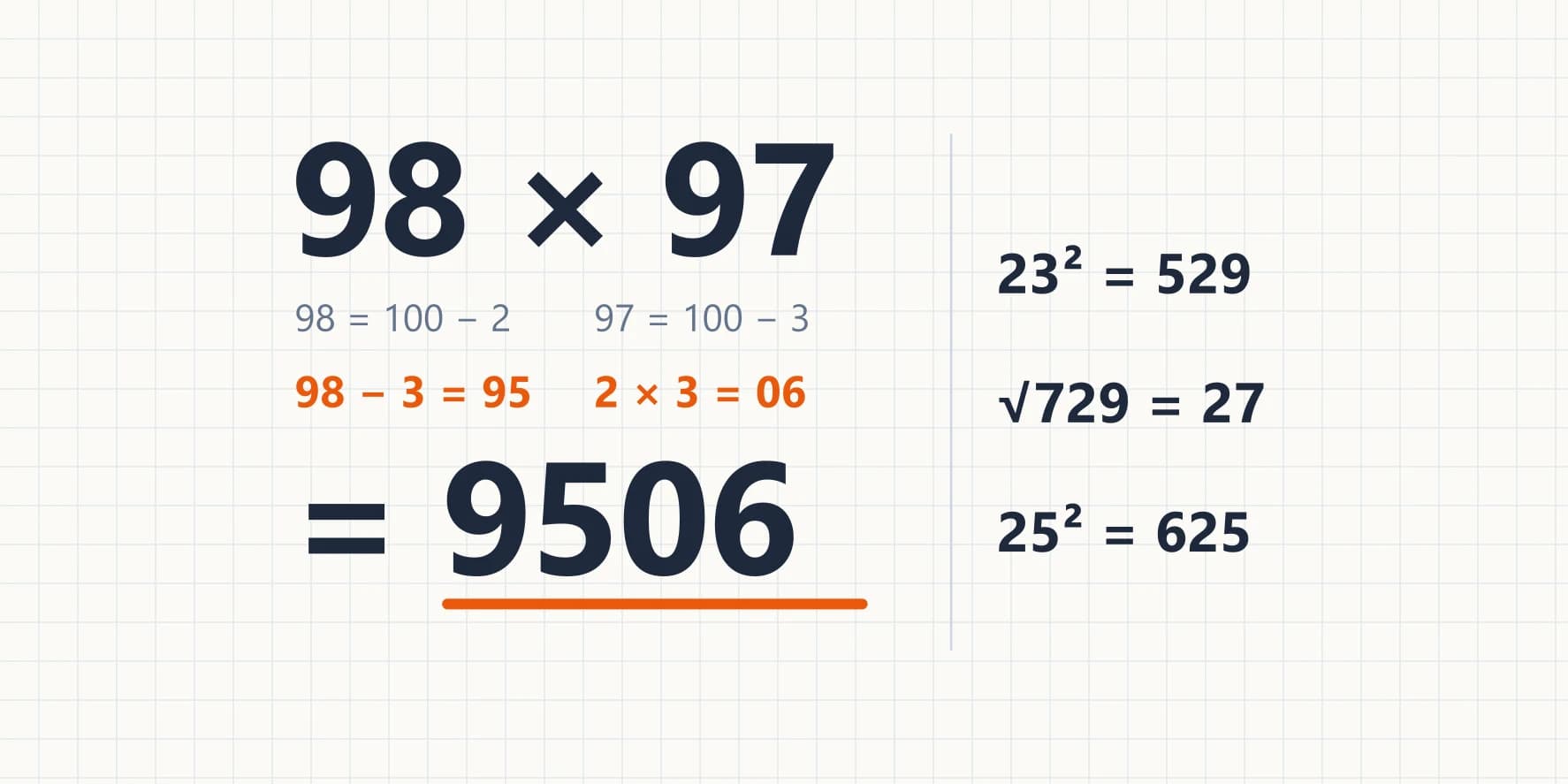
98 × 97
A standard school method would be to perform long multiplication. That is perfectly valid.
But other fast-calculation techniques may use the fact that:
- 98 = 100 − 2
- 97 = 100 − 3
Now the calculation can be organised around the common base of 100: 98 − 3 = 95 gives the first part of the answer, and 2 × 3 = 06 gives the last two digits — 9506.
| Method | How the child works | Answer |
|---|---|---|
| School algorithm | Long multiplication: 98 × 7 and 98 × 90, then add the partial products | 9506 |
| Mental abacus | Partial products are placed on the mental abacus digit by digit, keeping track of place value | 9506 |
| Base-100 pattern | Both numbers are close to 100: 98 − 3 = 95, then 2 × 3 = 06 | 9506 |
One problem — several possible methods. Different methods can reach the same answer.
For a child, this can be fascinating. The student begins to see more than digits. They begin to see relationships between numbers.
This creates a different kind of mathematical interest
With the abacus, the child primarily develops a fast calculation skill.
With more advanced techniques, another element appears: pattern recognition.
The child begins asking:
- Can this problem be simplified?
- Is there a shorter route?
- Why does this method work?
- What do these numbers have in common?
This can create a very interesting transition from pure automaticity toward understanding number structure.
But not every problem has a “secret trick”
This is important. Children should not be taught that every calculation has a magical shortcut. It does not.
Some problems are ideal for a specialised technique. Others are easier to solve with a standard algorithm.
Advanced skill therefore does not mean memorising hundreds of tricks. It means learning to recognise:
which method is most useful here?
Powers are another advanced stage
After multiplication, children can also begin working with operations such as 5², 12², 23² and more complex powers.
Again, different approaches are possible. Sometimes ordinary multiplication is used. Sometimes a numerical pattern provides a shorter method. Sometimes several strategies are combined.
First, the child needs to understand what the operation means. Then speed can gradually develop.
Some squares are especially convenient for pattern-based calculation
Certain groups of numbers allow very efficient shortcuts.
Over time, the child begins to see not only a number, but a type of problem.
Instead of thinking:
“I need to perform a long multiplication,”
the student may recognise:
“I know which pattern this belongs to.”
That can significantly reduce the number of steps.
Roots can look even more impressive
When a child quickly identifies a square root — or even works with cube roots — it can look almost magical.
But again, the answer is not a random guess. It may rely on:
- known number patterns;
- relationships between final digits;
- recognising the approximate range;
- well-learned powers;
- a specific step-by-step algorithm.
With enough practice, that algorithm can become extremely fast.
Why a child may find a root faster than an adult
An adult who does not know a specialised method looks at the problem and may try to solve it using a general-purpose approach.
A trained child already knows:
- where to look;
- which pattern matters;
- which possibilities can be eliminated immediately.
The child is not necessarily “thinking faster about everything.” They are using a more appropriate algorithm.
That distinction matters.
Fast calculation is often about choosing a better algorithm
Many impressive demonstrations are not produced by performing the same long algorithm ten times faster.
They are produced by using a different algorithm. A shorter one.
Instead of ten intermediate actions, perhaps only three are needed. Then the speed advantage becomes much easier to understand.
Fast calculation is not always about thinking faster. Sometimes it is about using a shorter algorithm.
Why children often enjoy these techniques
Because they create a sense of discovery.
The child sees a problem and thinks:
“This looks difficult.”
Then the teacher reveals a pattern. Suddenly:
“There is another way to solve it.”
That feeling can be highly motivating. The program also becomes less repetitive. There is a new intellectual challenge.
Advanced techniques can support long-term motivation
This matters especially for children who have already trained for several years.
If they can already:
- calculate quickly;
- perform Anzan;
- work with larger digit lengths;
- multiply and divide,
they need new goals. Powers. Roots. Fast algorithms. Unusual numerical patterns.
The child can once again feel:
“I have not reached the end yet.”
There is another level ahead.
Advanced methods should not be introduced too early
As with every part of the program, sequence matters.
If a child still does not understand basic multiplication well, there is no reason to teach ten shortcut algorithms at once.
First comes the foundation. The child should understand:
- what the operation means;
- why the result works;
- how the standard process is structured.
Only after that should specialised methods become additional tools.
Otherwise, the child may memorise a “trick” without understanding it.
Advanced programs should expand the toolkit, not create confusion
If a child is shown five methods for the same calculation at once, confusion can easily follow.
It is better to introduce new strategies gradually:
- First: one core method.
- Then: one additional fast method.
- Then the child learns when the first method is better — and when the second is better.
Over time, a genuine calculation toolkit begins to develop.
Mental abacus and Vedic mathematics do not have to compete
There is no need to choose: mental abacus or Vedic methods. They solve different problems.
Mental abacus is particularly strong for:
- visual representation;
- automaticity;
- rapid sequential calculation;
- working with long chains.
Vedic and other fast-calculation techniques can be especially useful when the structure of a particular number allows the calculation to be shortened significantly.
Together, they give the student more options.
Advanced students begin choosing the method
A beginner usually follows the method they were taught.
A more advanced student can eventually ask:
“What is the most efficient way to solve this problem?”
Mental abacus? A fast algorithm? Number decomposition? A numerical pattern? Ordinary mental calculation?
That is a much more interesting level of numerical fluency.
The goal is not simply to impress other people
Fast squares and roots look impressive. Children often enjoy demonstrating these skills.
But the deeper value is not the performance.
The child discovers that one mathematical problem can have several different solution paths. That broadens the way they think about calculation.
“Mathematical magic” stops being magic once the algorithm is understood
For someone who does not know the method, calculating 98 × 97 in a few seconds can look extraordinary.
A rapid square of a large number can look magical. A mental root can look even more impossible.
But once the algorithm is understood, the magic disappears. What remains is:
- structure;
- pattern;
- algorithm;
- practice.
And that is one of the most interesting parts of advanced mental calculation.
How far can mental calculation go?
Very far. Addition and subtraction are only the beginning.
Later, students may encounter:
- multi-digit operations;
- Anzan;
- multiplication;
- division;
- powers;
- roots;
- fast algorithms;
- simultaneous calculations;
- other advanced formats.
Not every child needs to complete the entire path. But the fact that such a path exists matters.
It means there is always another target available.
Advanced mental arithmetic becomes a toolkit
At a high level, the student is no longer dependent on one single method. They may gradually gain:
- mental abacus;
- ordinary mental calculation;
- fast algorithms;
- number patterns;
- elements of Vedic mathematics;
- other mental calculation techniques.
The student does not gain one “trick.” They gain a toolkit for working with numbers.
This is what makes a long program interesting
If a program ends after basic addition and subtraction, eventually there is little new to discover.
But if the student can later progress into:
- Anzan;
- Double Power;
- multiplication;
- division;
- powers;
- roots;
- new fast-calculation systems,
the program can continue developing for years.
Each stage teaches the child that something which looked impossible yesterday can become understandable today.
That is why advanced mental calculation can sometimes look like magic. But behind that “magic” there are usually three things:
a good algorithm, a strong methodology and a lot of practice.
Frequently asked questions
Is Vedic mathematics the same as mental arithmetic?
No. Mental arithmetic is a broader training area. Vedic mathematics refers to a collection of alternative calculation techniques and patterns that can be used alongside other methods.
Can children calculate powers mentally?
Yes. With suitable algorithms and practice, some powers and squares can be calculated mentally.
Can children calculate square roots mentally?
Certain root calculations can be performed mentally using learned patterns and algorithms, especially after strong preparation.
Does a child need an abacus for advanced mental calculation?
Not always. At advanced levels, students may combine mental abacus with decomposition, numerical patterns and other rapid-calculation methods.
Are fast mental math methods just tricks?
No. Good fast-calculation methods are based on mathematical structure and algorithms. They only look like tricks when the underlying method is not visible.
Build a strong foundation before advanced calculation
Advanced techniques become useful only when basic arithmetic skills are stable. Amavit helps teachers structure practice, control difficulty and build automaticity before students move to more complex calculation methods.
Explore Amavit for TeachersFree for teachers