Multiplication and Division in Mental Arithmetic: When Children Are Ready and Why It Is a New Level
Once a child becomes confident with addition and subtraction on both the physical abacus and the mental abacus, parents usually ask the next question:
“Can my child also multiply and divide mentally?”
Yes. But multiplication and division represent a new level of the program.
They are not simply two more topics added after addition and subtraction. The structure of the calculation itself becomes more complex.
The child has to manage more information, work with intermediate results, control place value and follow a multi-step sequence.
That is why multiplication and division should not begin simply because a child has “been studying for a long time.” The foundation needs to be strong enough.
Multiplication and division should begin only after addition, subtraction, Friends, place value and mental-abacus skills are stable. These operations introduce more complex multi-step algorithms and place greater demands on automaticity.
Addition and subtraction need to be stable first
Multiplication and division are built on everything the child learned earlier.
Before moving forward, the student should be confident with:
- Simple;
- Small Friends and Big Friends;
- transitions;
- multiple digit positions;
- mental calculation;
- a stable mental abacus.
Why? Because during more advanced calculations, the child should not still be stopping to think:
“Which Big Friend do I need here?”
or:
“How do I make this transition?”
If basic operations still require too much conscious effort, multiplication adds too much additional load.
The foundation needs to work almost automatically.
- Addition & subtraction
- Friends
- Mental calculation
- Anzan
- Multiplication
- Division
- Advanced calculations
Each new operation is built on top of the previous level — not instead of it.
Knowing multiplication tables and multiplying on an abacus are different skills
A child may know perfectly well that 7 × 8 = 56, but that does not yet mean the child knows how to perform multiplication correctly on an abacus.
The student also needs to understand:
- what is being multiplied;
- what it is being multiplied by;
- which digit position is being processed;
- where the intermediate result belongs;
- how the calculation should continue.
Multiplication tables are important. But mental-arithmetic technique is a separate skill.
Why multiplication is more complex than ordinary addition
In a standard addition chain, the child may see:
24 + 13 − 5 + 8
Each new number simply changes the current mental-abacus state.
Multiplication is structured differently. Take:
23 × 4
Now the child needs to understand more than just the current total. They also need to know:
- which place value is being processed;
- which product has been produced;
- where that product should be placed;
- what comes next.
There is an additional organisational layer inside the calculation.
More digits mean much greater complexity
Compare 3 × 4 with 347 × 26.
Both are multiplication problems. But the cognitive and technical demands are completely different.
In the second example, the child has to:
- process several digits;
- control place value;
- retain intermediate results;
- combine parts correctly;
- maintain the mental abacus.
That is why digit length should increase gradually.
Do not increase every difficulty at once
This is one of the most important principles in good training.
When a child is learning a new algorithm, there is no reason to simultaneously:
- increase digit length;
- increase speed;
- make exercises much longer;
- introduce more difficult combinations.
First, the mechanics should become stable. Then one parameter becomes harder. After that, another.
This helps the child understand exactly what is changing instead of failing across several dimensions at once.
Division requires even more sequencing
For many students, division becomes an even more demanding stage.
The child needs to follow several steps in order. They need to understand:
- how many times the divisor fits into the current part of the number;
- which result digit should be used;
- what remains;
- which place value comes next;
- how the calculation continues.
This is already a structured multi-step algorithm.
If earlier skills are not sufficiently automated, the child can easily lose the sequence. That is why division should be introduced carefully.
Why the physical abacus becomes useful again
After a child becomes confident with Anzan, it can seem that the physical abacus is no longer necessary.
That is not always true.
When a new and complex operation is introduced, the physical abacus can once again become extremely useful. It allows the child to see:
- how the new algorithm works;
- where place values are located;
- where intermediate results go;
- which sequence of actions is required.
First, the new structure becomes clear physically and visually. Then it can gradually be transferred into mental calculation.
The same principle applies again:
first the physical model — then the stable mental image.
Multiplication tables should become automatic
If a child needs a long time to remember 6 × 7, a large amount of attention is already being used before the advanced calculation has even started.
But the child still needs to:
- place the result correctly;
- control digit position;
- continue the algorithm;
- retain earlier calculations.
The stronger the multiplication-table recall, the easier it becomes to learn advanced multiplication.
Understanding comes before speed
When a child first learns a new operation, speed should not be the main target.
First, the student understands the algorithm. Then performs it correctly. Then repeats it. Automaticity develops. Only after that should speed increase.
- Understanding
- Correct technique
- Repetition
- Automaticity
- Speed
Trying to calculate quickly too early usually produces more mistakes rather than better skill.
Why multiplication errors are harder to diagnose
In a short addition example, the source of an error may sometimes be obvious.
In multi-digit multiplication, a wrong answer can come from many different causes:
- an error in the multiplication table;
- incorrect place value;
- a lost intermediate result;
- an error when combining parts;
- an unstable mental abacus;
- too much speed or complexity.
That means a single wrong final answer does not tell the teacher very much. The important question is:
At which stage did the algorithm begin to break down?
Analytics becomes even more important
The more advanced the curriculum becomes, the less useful a simple correct / incorrect result is.
The teacher needs context. For example:
- At which digit length do errors appear?
- At which speed?
- With which type of problem?
- After how many steps?
- Does the same pattern repeat?
This helps distinguish between:
- lack of understanding;
- insufficient automaticity;
- excessive difficulty.
These are very different problems and require different solutions — the same logic we describe in why children keep making the same mistakes.
Why workbooks are still useful
When introducing a complex new operation, paper-based work can be particularly valuable.
A workbook allows the child to:
- pause;
- see the structure;
- analyse the sequence calmly;
- check intermediate stages;
- work without pressure from screen speed.
A strong combination is therefore:
teacher explanation + physical abacus + workbook + digital practice
Each tool has its own role.
When digital practice becomes especially valuable
Once the child understands the mechanics, a large volume of high-quality repetition becomes necessary — see how much practice a child needs each day.
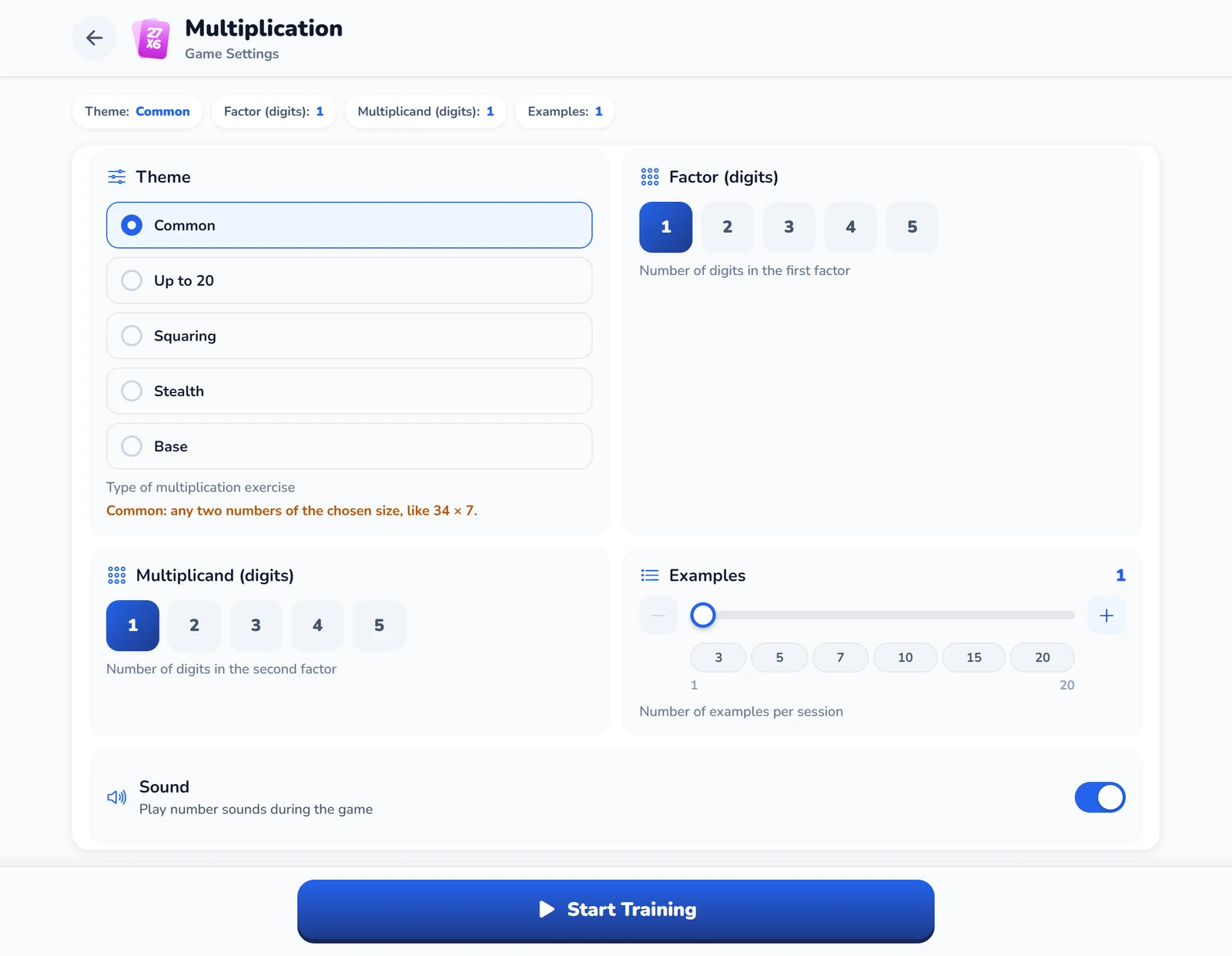
This is where a digital system becomes particularly effective. The teacher can gradually adjust:
- digit length;
- difficulty;
- speed;
- number of tasks;
- problem type.
The child does not make one huge jump. They move through many small steps.
That is how a new algorithm becomes automatic.
How Amavit can support this stage
In Amavit, the platform is not designed to replace the teacher.
The teacher explains the algorithm. The platform helps provide the exact practice volume and difficulty level needed by a particular student.
For example: the child understands the algorithm but accuracy drops with two-digit multiplication. Then extra practice can focus on that specific level.
Or: everything is correct at a slow speed, but errors appear when the pace increases. Then the problem is no longer understanding. It is automaticity.
Starting multiplication earlier does not automatically mean better progress
Parents sometimes begin comparing children:
“My child is already multiplying. Yours is not.”
But an early transition proves very little.
If addition and subtraction were learned superficially, more advanced topics simply add more weak points.
Sometimes it is much better to start multiplication later on top of a strong foundation.
Mental arithmetic is a long program. The quality of each layer matters more than the speed at which the curriculum is completed.
Why some children suddenly slow down at multiplication
This is normal. Multiplication introduces new demands.
If the child begins struggling, the teacher needs to identify why. For example:
- the algorithm is not understood;
- place values are being confused;
- multiplication-table recall is slow;
- intermediate results are being lost;
- the mental abacus becomes unstable;
- the child becomes tired during longer tasks.
The solution depends on the cause. More examples are not always the answer.
Division is not an intelligence test either
A child may be excellent at Anzan and very fast at addition, yet learn division more slowly.
That does not mean the child has become weaker. The new operation simply requires a different combination of skills.
Individual learning pace is completely normal at this stage.
Multiplication and division are not the end of the program
Parents often see these operations as the highest level. But advanced mental calculation can go much further.
After stable multiplication and division, children may work with:
- more complex multi-digit calculations;
- fast algorithms;
- powers;
- roots;
- combined operations;
- different methods of mental calculation.
The program can therefore go far beyond ordinary addition and subtraction.
Every new level tests the quality of the previous one
- At Simple, everything may look easy.
- At Small Friends, finger technique begins to matter.
- At Big Friends, weaknesses from earlier topics become visible.
- At Anzan, the stability of the mental abacus is tested.
- At multiplication and division, the quality of the entire earlier foundation becomes even more obvious.
An advanced topic therefore does two things at once:
it teaches something new
and it tests what was learned before.
Multiplication and division show the real value of automaticity
When a basic skill becomes automatic, it stops consuming all of the child's attention.
The student no longer needs to consciously think about:
- which finger to use;
- which Friend applies;
- what a number looks like on the abacus;
- how to perform a simple transition.
Those processes begin working automatically. The freed attention can then be used for a more complex algorithm.
That is why thousands of repetitions in the early stages matter. They do not prepare the child only for faster addition. They build the foundation for advanced calculation.
The key is not to rush
Multiplication and division look impressive, especially when performed mentally. But the impressive result comes after a large amount of preparation.
The sequence is still:
- physical abacus;
- correct movements;
- Simple;
- Small Friends;
- Big Friends;
- transitions;
- digit length;
- mental calculation;
- Anzan;
- and only then more complex operations.
A strong program should not try to impress parents by saying:
“Look, your child is already multiplying.”
The better question is:
“Is the foundation strong enough for the next level to become a stable skill?”
If the answer is yes, then the child is ready to move forward.
Frequently asked questions
When should a child start multiplication in mental arithmetic?
When addition, subtraction, Friends, place value and mental-abacus skills are stable enough to work almost automatically.
Does a child need to know multiplication tables first?
Strong multiplication-table recall makes advanced multiplication significantly easier because it reduces the amount of attention needed for basic products.
Is division harder than multiplication on an abacus?
For many students it can be, because division requires maintaining a structured sequence of intermediate decisions and results.
Should children learn multiplication directly in the mind?
Usually the new mechanics are easier to establish first with teacher guidance and, where appropriate, a physical abacus before being transferred into mental calculation.
Are multiplication and division the final level of mental arithmetic?
No. Advanced programs may later include powers, roots, fast calculation algorithms and other complex formats.
Free for teachers