What Is Anzan in Mental Arithmetic — and When Is a Child Really Ready for It?
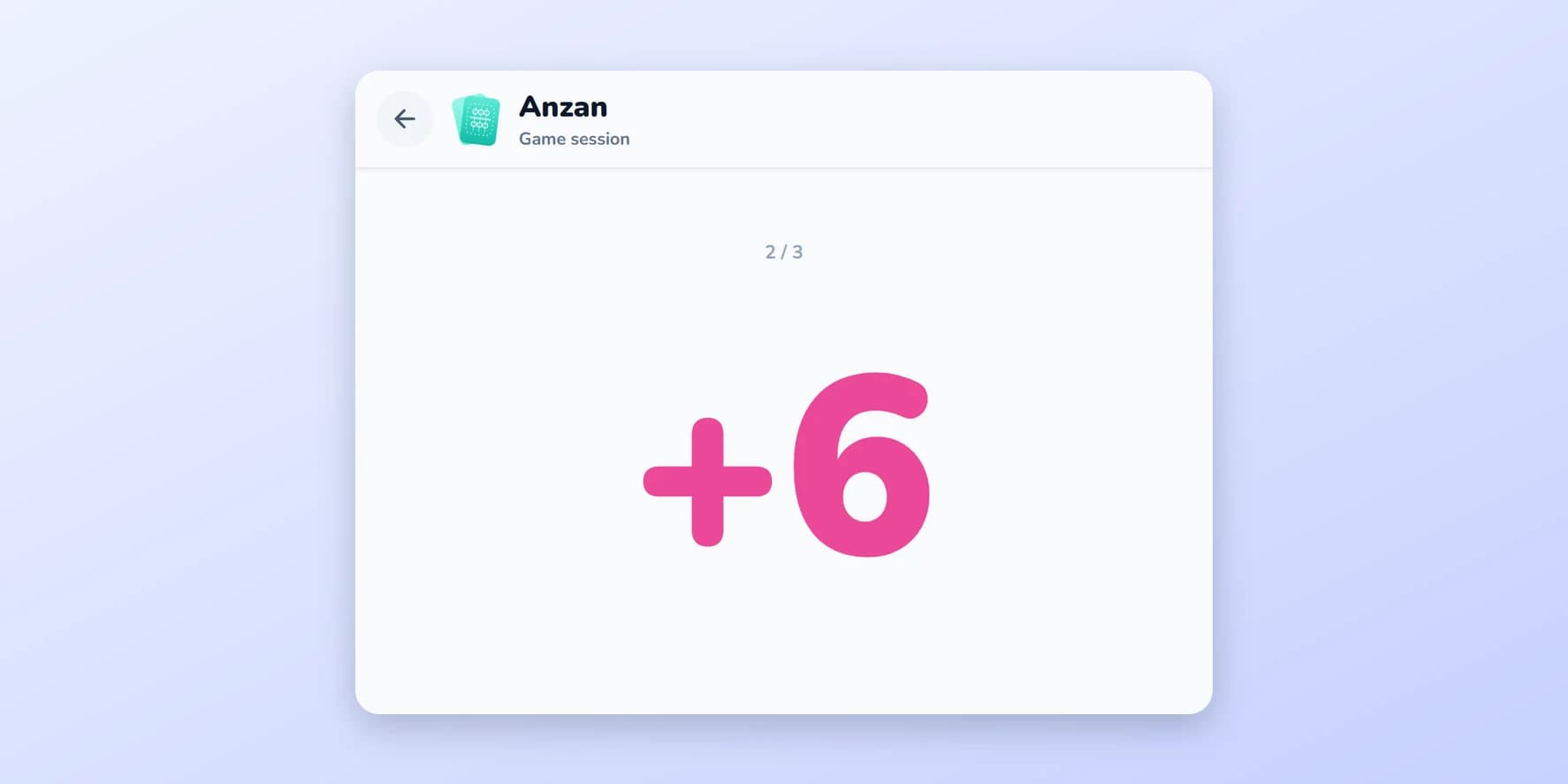
When people first watch a mental arithmetic competition, Anzan is often the part that surprises them most.
Numbers flash on a screen at high speed. Sometimes they appear so quickly that an adult can barely recognise them.
A child watches for a few seconds — and then gives the correct answer.
From the outside, it can look almost like a trick.
But Anzan is not a separate “superpower”. It is an advanced stage of a long, structured learning process built on mental abacus skills.
And there is one important distinction to make from the beginning:
mental calculation
and Anzan are not the same thing.
What is Anzan?
Anzan is an advanced form of mental-abacus calculation. Mental calculation can begin much earlier, while full Anzan usually comes only after a child has mastered and consolidated most of the core addition and subtraction curriculum.
Mental calculation can begin much earlier
A child can start calculating mentally long before reaching full Anzan.
Some methodologies introduce mental calculation relatively early.
- First, the child learns a topic on a physical abacus.
- Then the same topic is introduced in mental calculation.
- After that, another topic is added.
In this model, physical abacus and mental calculation develop almost in parallel. But mental calculation usually stays slightly behind.
This is an important principle.
A child should not be expected to visualise a movement mentally before that movement has been properly learned with the hands.
A real example: how Amakids introduces mental calculation
For example, in the Amakids methodology, mental calculation may begin from around the third lesson.
The physical abacus remains the foundation, while mental calculation follows approximately one topic behind. For example:
the child may already be learning +4 / −4 on the physical abacus,
while practising +3 / −3 mentally.
A new topic is therefore learned physically first. The child:
- sees the beads;
- performs the correct movements;
- develops the correct mechanics.
Soon afterwards, the same skill begins to transfer into visualised calculation.
Physical and mental calculation therefore develop almost in parallel.
By the end of the first year, a child following this approach can already work confidently both on a physical abacus and with mental calculation.
But this still does not necessarily mean the child has reached full Anzan.
This is the gradual early development of mental abacus. Anzan comes later.
In more classical approaches, mental calculation may begin much later
Other schools use a more traditional progression.
A child may spend most of the first year working primarily with the physical abacus. They progress through:
- Simple;
- Small Friends;
- Big Friends;
- transitions;
- digit length;
- mixed operations;
- the main addition and subtraction curriculum.
Only after these skills have been strongly consolidated does systematic mental calculation begin.
The child may then spend several more months learning to:
- hold a stable visual image of the abacus;
- calculate without the physical tool;
- work with longer chains;
- increase speed.
With this approach, full Anzan may appear only after 18 months or even two years.
And there is nothing wrong with that.
Different methodologies, the same underlying principle
Mental calculation can begin:
- after just a few lessons;
- after several months;
- after six months;
- or after most of the physical-abacus curriculum has been completed.
There are many different teaching methodologies. But the underlying principle remains the same:
mental calculation should be built on a physical skill that has already been learned correctly.
If a child still performs the movement incorrectly on a real abacus, there is little value in rushing to reproduce that movement mentally.
Anzan is a much later stage
Full Anzan should not be defined as the first moment when a child puts the physical abacus aside. It is an advanced stage.
Before reaching it, the child usually needs to complete most or nearly all of the core addition and subtraction curriculum.
A simplified progression might look like this:
- +1 / −1;
- +2 / −2;
- +3 / −3;
- +4 / −4;
- then Small Friends;
- Big Friends;
- transitions;
- mixed operations;
- larger digit lengths;
- longer chains.
If each major rule or block takes approximately one week, completing the core addition and subtraction curriculum can require around 38–40 lessons.
That is essentially an academic year.
Only when this foundation is properly consolidated does full Anzan become appropriate.
Why there is no reason to rush
Parents naturally want to see the impressive result: their child looking at a screen and calculating without an abacus.
But rushing can weaken the entire learning process.
Before advanced Anzan, the child should have a strong command of:
- correct finger technique;
- Simple;
- Small Friends and Big Friends;
- transitions;
- place values;
- core formulas;
- mixed operations;
- a stable mental abacus.
And it is not enough simply to have “covered” these topics. They need to become automatic.
The child should not need to stop and consciously think:
- Which rule is this?
- Which complement should I use?
- Which finger should move?
- How do I make this transition?
If those actions still require significant conscious effort, there is no reason to hurry into advanced Anzan.
Why 38–40 lessons is a useful practical benchmark
Every topic takes time. For example:
- +1 / −1 — one stage;
- +2 / −2 — the next;
- +3 / −3 — the next;
- then transitions;
- Friends;
- mixed practice;
- digit length.
A sequential curriculum quickly adds up to roughly 38–40 teaching weeks. And that is without long breaks.
That is why saying that a child “should reach Anzan after three months” confuses two very different things.
The child may already have started mental calculation. But full Anzan is another level entirely.
Progress should be measured by consolidation, not by calendar speed
A topic can formally be introduced in one week. But if the child is still making frequent mistakes, it is not fully consolidated.
- One student progresses faster.
- Another needs more repetition.
- Sometimes the teacher follows the planned pace.
- Sometimes the class needs to remain on one weak area longer.
That is normal.
The goal is not simply to tick off:
“Topic completed.”
The goal is for that topic to later operate automatically inside the mental abacus.
The physical abacus remains the foundation
Mental abacus does not appear by itself.
First, the child sees hundreds and thousands of repetitions involving:
- a number;
- a bead position;
- the correct finger movement;
- the resulting bead pattern.
Over time, the brain links these components into a stable pattern — which is why regular daily practice matters so much.
Eventually, the physical abacus can be gradually removed. But the child continues performing the familiar movements mentally.
The progression can be described as:
physical movement → visual image → mental calculation → stable mental abacus → Anzan.
The final stage is much more reliable when the earlier stages are strong.
What Anzan really means
Anzan is not simply calculation without a physical abacus.
It is the stage at which the child can:
- maintain a stable mental abacus;
- change bead positions rapidly in imagination;
- work with long sequences;
- avoid consciously verbalising intermediate answers;
- maintain accuracy;
- increase speed;
- work with larger digit lengths.
So Anzan is not the beginning of mental calculation. It is a mature form of it.
Ordinary mental arithmetic and Anzan use different strategies
Consider:
7 + 4 − 3 + 8.
An adult using ordinary mental calculation will often think:
- 7 + 4 = 11;
- 11 − 3 = 8;
- 8 + 8 = 16.
After each operation, a numerical intermediate answer is consciously maintained.
In Anzan, the process is different.
The child does not necessarily need to consciously hold 11, then 8, then 16.
Instead, the mental abacus changes. The next number appears — and the bead image changes again.
Only at the end does the child “read” the final bead configuration.
This is one reason very high calculation speeds can eventually become possible — the same mechanism that lets a trained child calculate while reciting a poem.
How early mental calculation begins
At the beginning, mental calculation is not about speed. The main objective is learning to maintain the image of the abacus.
That is why early exercises use:
- simple operations;
- short chains;
- single-digit numbers;
- slow speeds;
- only topics that have already been learned physically.
For example, if a child has already mastered +3 / −3 on the physical abacus, those operations can then be introduced mentally.
In this way, mental calculation gradually follows the physical curriculum.
Why mental calculation should not be confused with Anzan
This distinction is fundamental.
If a child solves a few simple examples mentally during the third or fifth lesson, that is not yet Anzan. It is the beginning of mental-abacus development.
Anzan comes much later, when the child has:
- completed nearly all of the core addition and subtraction curriculum;
- consolidated Friends;
- mastered transitions;
- developed high accuracy;
- built a stable mental abacus;
- become comfortable with longer chains;
- started increasing speed.
There may therefore be a year — or considerably more — between the first mental exercise and mature Anzan.
| Early mental calculation | Anzan | |
|---|---|---|
| When it begins | Can begin with the first topics | After the core curriculum has been seriously mastered |
| Physical abacus | Actively used in parallel | The skill is already well consolidated |
| Goal | Learning to visualise | Calculating mentally — quickly and reliably |
| Speed | Low | Gradually becomes high |
| Topics | Only those already mastered physically | A large mixed set of topics |
Some schools reach full Anzan after 18–24 months
And that is completely normal.
If a school spends more time building strong physical-abacus technique and introduces mental calculation later, the overall path simply takes longer.
The advantage is an extremely solid physical foundation.
- One child may approach mature Anzan after around a year.
- Another may need 18 months.
- In some programs, two years.
This is not a race to finish the curriculum.
Speed comes later
Once the mental abacus becomes stable, speed can gradually increase. For example:
3 seconds; 2.5; 2; 1.5; 1; 0.8; and later faster.
But speed is only one variable — see how speed develops from 3 seconds to 0.1 seconds per operation.
Other variables can also increase:
- digit length;
- number of operations;
- chain length;
- topic complexity.
Anzan therefore cannot be reduced to one number measured in seconds.
Speed and digit length are different dimensions
One child may calculate single-digit numbers extremely quickly.
Another may work more slowly but already handle three-digit numbers.
It is impossible to judge the entire skill level by speed alone.
Advanced performance develops across several dimensions:
- accuracy;
- speed;
- digit length;
- chain length;
- operation complexity.
Why audio can help at slower speeds
At slower training speeds, a child can sometimes see the number and hear it.
This provides an additional support.
But as speed increases, there comes a point when spoken numbers can no longer keep up with the visual display.
This is particularly noticeable with two-digit and larger numbers.
Eventually, advanced training becomes primarily visual.
Moving from “seeing and hearing” to “seeing only” is another difficulty step
For some children, accuracy temporarily falls when audio support is removed.
That does not necessarily mean the skill has become worse.
Previously, there were two supports: visual and auditory.
Now there is only the visual stream.
The child needs time to rely more fully on the mental abacus.
This is simply another stage of progression.
Why advanced Anzan cannot be trained effectively with a book alone
At slow speeds, a teacher can still show cards manually. At high speeds, this becomes unrealistic.
When numbers appear:
- once per second;
- every 0.5 seconds;
- 0.3 seconds;
- 0.1 seconds,
a human cannot present them manually with perfect consistency and timing.
This is where a digital system becomes essential. It can control:
- exact timing;
- speed;
- digit length;
- number of operations;
- chain length;
- specific topics.
How Amavit supports this stage
In Amavit, teachers can gradually control:
- speed;
- number of operations;
- digit length;
- chain length;
- specific topics;
- presentation format.
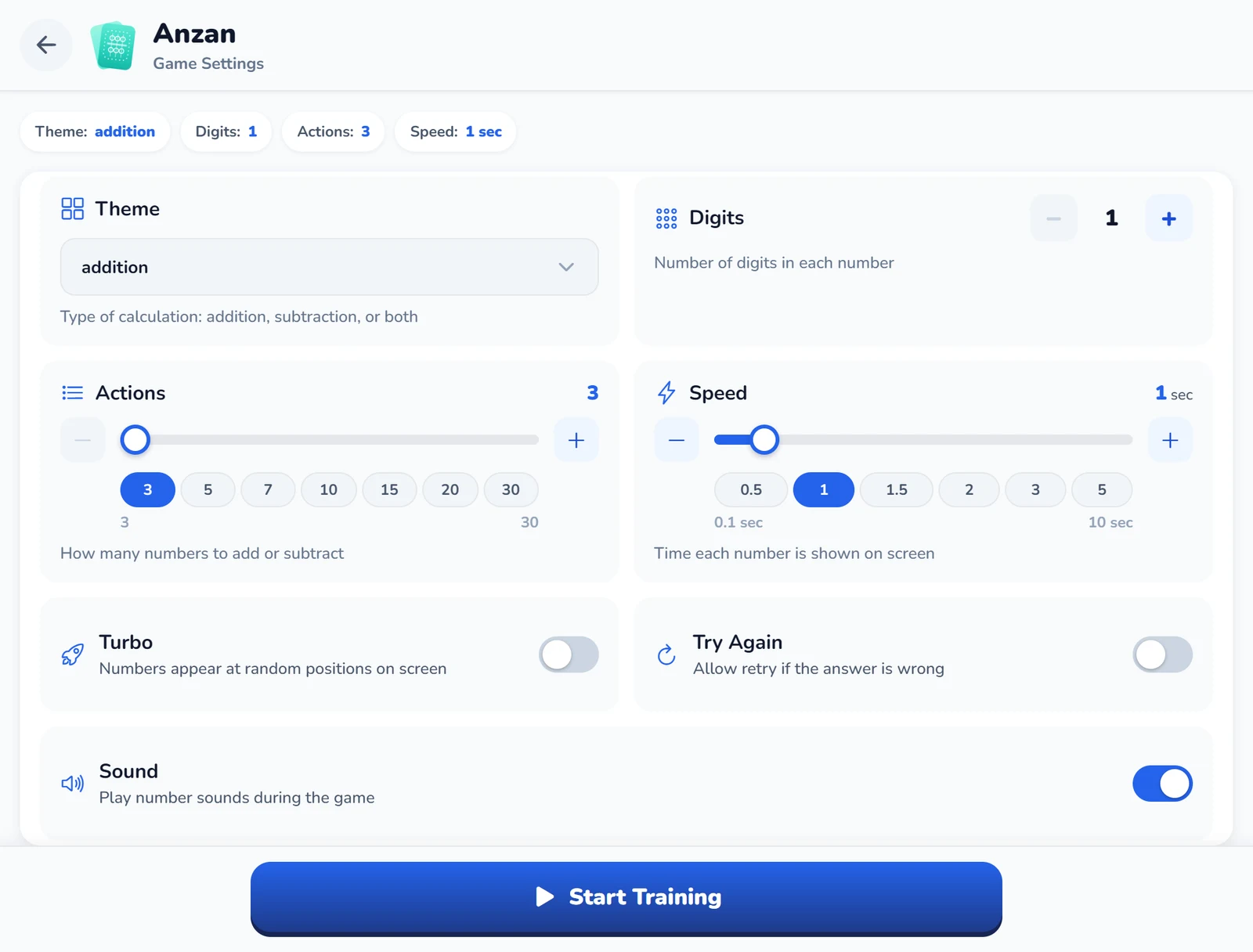
But the platform should not replace the physical abacus during the early stage.
First, the teacher establishes correct physical mechanics. Then the platform helps:
- provide sufficient practice volume;
- introduce mental calculation;
- control speed;
- increase difficulty precisely;
- progress gradually toward Anzan.
The role of the platform is especially strong in the transition:
physical abacus → mental calculation → Anzan.
Very high speed is the result of a large amount of training
When a child calculates at 0.5 or 0.3 seconds per operation, it can look like extraordinary natural talent.
But behind that performance are:
- dozens of learned topics;
- a year or more of structured training;
- thousands of physical movements;
- Simple;
- Small Friends;
- Big Friends;
- correct finger technique;
- mental calculation;
- hundreds of speed exercises.
Anzan is not magic. It is the result of a systematic learning process.
The biggest mistake is rushing toward the impressive result
Parents want to see the child calculate without an abacus.
Teachers may also want to demonstrate a spectacular result quickly.
But introducing mental calculation too aggressively — and especially treating early mental exercises as advanced Anzan — can create an impressive result on simple examples while leaving the later foundation weak. Those gaps tend to show up later as the same mistakes repeating.
A better progression is:
- physical abacus;
- correct movements;
- formulas;
- Friends;
- transitions;
- digit length;
- mixed topics;
- mental calculation;
- and only then mature Anzan.
Anzan is the advanced stage of the core addition and subtraction curriculum
This is probably the most accurate way to understand it.
- It is not the first exercise without a physical abacus.
- It is not simply “mental arithmetic”.
It is a mature form of mental calculation that appears after a child has learned and consolidated a substantial part of the curriculum.
One school may reach this stage after about a year. Another after 18 months. Another even later.
At the same time, mental calculation may begin much earlier and develop alongside physical-abacus training.
Different methodologies use different timelines. But the underlying principle remains the same:
the stronger the physical foundation, the more stable the mental abacus — and the higher the eventual Anzan level can become.
True Anzan does not begin when the child first puts the abacus aside.
It begins when everything the child has spent months or years learning physically is strong enough to operate quickly, accurately and almost automatically — entirely in the mind.
Frequently asked questions
What does Anzan mean?
Anzan is advanced mental calculation performed using a visualised abacus rather than a physical one.
Is mental calculation the same as Anzan?
No. Mental calculation may begin very early, while mature Anzan develops much later.
How long does it take to learn Anzan?
It depends on the methodology and the child. Full Anzan often comes after around a year or more of structured training, and some programs take 18–24 months.
Can children start mental calculation before learning all abacus rules?
Yes. Some methodologies introduce already-mastered topics mentally while newer topics continue to be learned on the physical abacus.
Why is a physical abacus important before Anzan?
Because repeated physical movements establish the visual and motor patterns that later support stable mental-abacus calculation.
Free for teachers