How Parents Can Support a Child in Mental Arithmetic — Without Becoming a Second Teacher
When a child starts learning mental arithmetic, parents naturally want to help.
- They want to check the homework.
- See whether the answers are correct.
- Explain a formula.
- Correct a mistake.
- Ask the child to do a few more examples.
But this is exactly where problems can begin.
Because in mental arithmetic, the role of the parent and the role of the teacher are not the same.
The teacher is responsible for the methodology.
The parent is responsible mainly for regularity, learning conditions and monitoring the child's overall progress.
When those roles are clearly separated, the learning process usually becomes much more stable.
In short
Parents should not replace the teacher. Their main role is to support regular practice, monitor progress and contact the teacher early when performance begins to change.
Parents should not become a second teacher
Imagine a typical situation.
During the lesson, the teacher explains a specific movement on the abacus. They show:
- which finger to use;
- which rule applies;
- which sequence to follow;
- which Friends formula is required.
At home, the child starts doing homework.
The parent notices a mistake and tries to explain it in a different way.
That explanation may be mathematically correct. But it may conflict with the technique the teacher is trying to establish.
Now the child receives two different instructions. One at the lesson. Another at home.
As a result, the child may start doubting not only the answer, but the whole method.
In mental arithmetic, a correct answer is not enough
In ordinary mathematics, adults often focus mainly on the result:
7 + 8 = 15.
If the answer is correct, everything seems fine.
In mental arithmetic, that is not enough. It also matters:
- how the child moved the beads;
- which fingers were used;
- which formula was applied;
- whether the transition through 5 or 10 was performed correctly;
- whether the mental abacus remained stable.
A child can arrive at the correct answer using the wrong technique.
In one example, the problem may be invisible.
Several months later, when speed increases, the incorrect pattern may start causing serious difficulties.
That is why technique should be corrected by the teacher, who understands the full learning sequence.
The parent's main role is regularity and progress monitoring
The most useful thing a parent can do at home is not to teach a new topic instead of the teacher.
It is more important to help the child:
- practise regularly;
- complete homework consistently;
- see personal progress;
- notice problems early.
In mental arithmetic, short and regular practice usually works much better than rare long sessions.
For example, 10–15 minutes of structured practice on several consecutive days is often more effective than one long session once a week — see how much practice a child needs each day.
The skill depends on repetition.
But regularity is only one part. The second part is understanding how the child is actually progressing.
Parents should not wait until a small problem becomes a serious one
In traditional learning, many problems become visible too late.
- The child appears to be doing the homework.
- Workbook pages are completed.
- Answers are written down.
From the outside, everything may look normal.
But underneath, a weakness may be growing. For example:
- one topic was never fully mastered;
- another becomes unstable;
- speed increased too early;
- accuracy starts dropping;
- older rules begin to fade.
If no one sees this, the child continues moving forward with the group.
Months later, the problem can become much more difficult to correct.
This is why parents need progress data
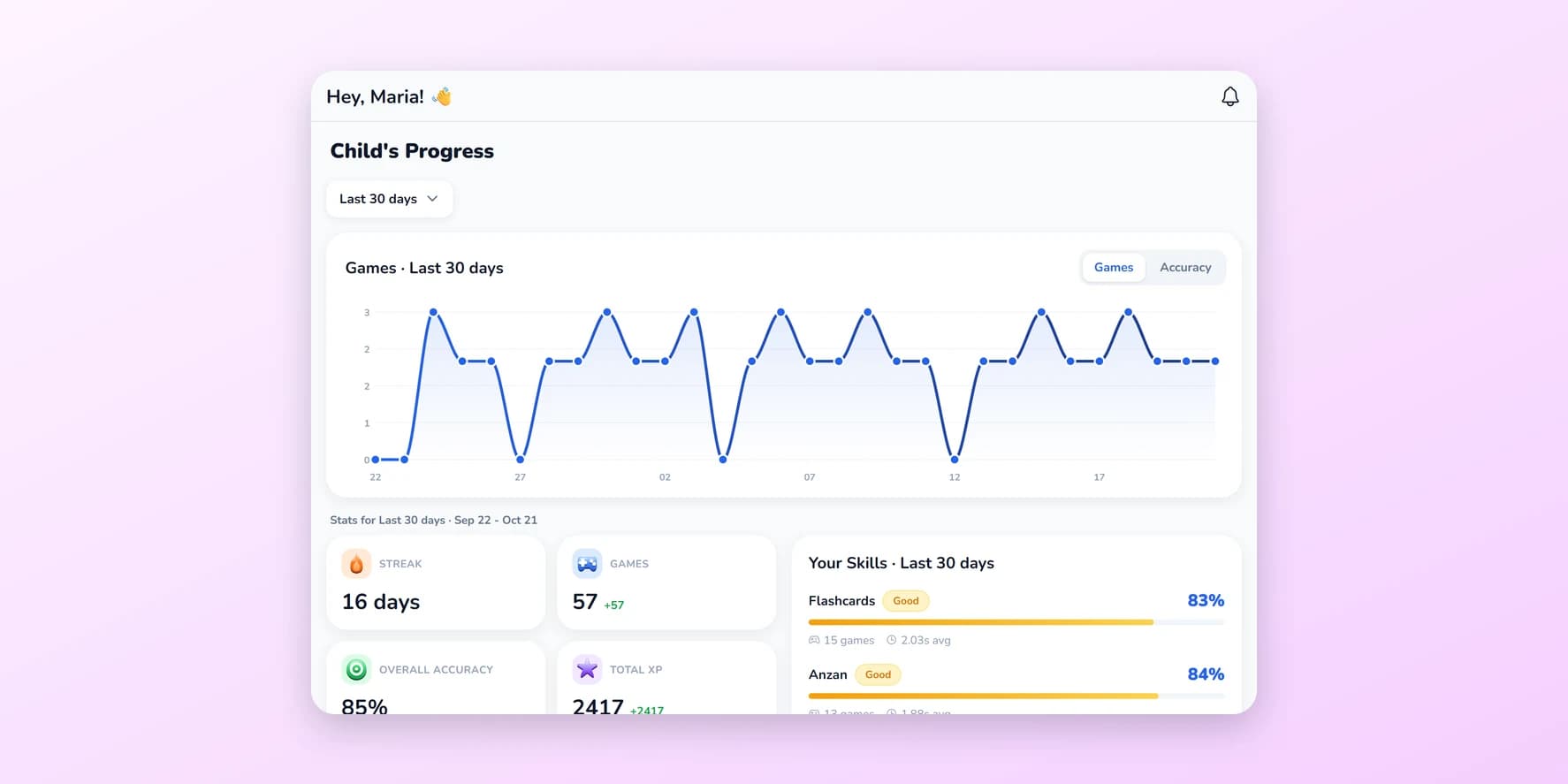
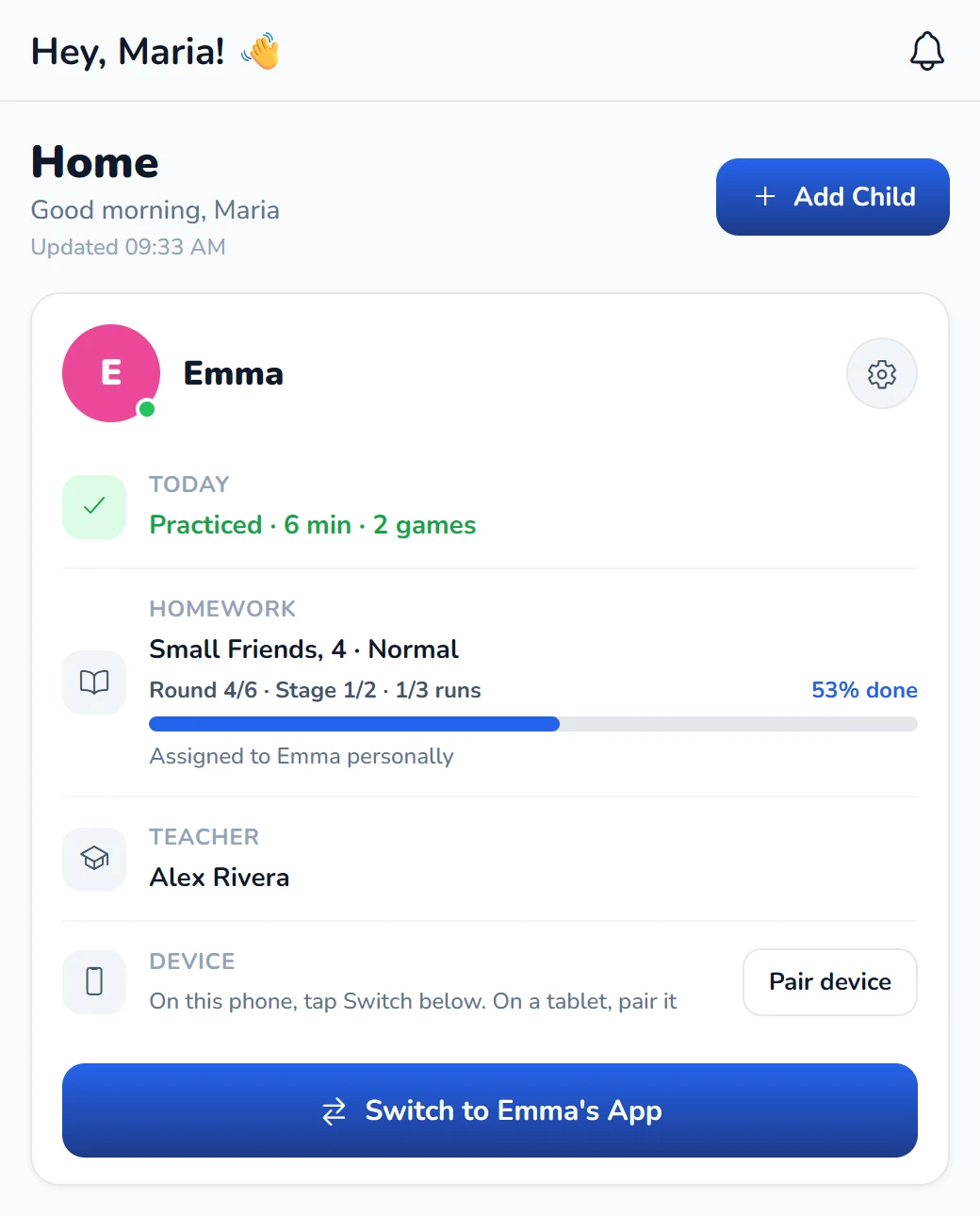
In Amavit, we specifically created a progress-tracking section for parents.
Parents can see much more than:
“Homework completed.”
They can see the learning trend. For example:
- how often the child practises;
- how many tasks are completed;
- how many examples are solved;
- accuracy;
- working speed;
- changes in results;
- progress compared with the previous week;
- progress compared with the previous month;
- homework completion;
- whether certain indicators are beginning to deteriorate.
This changes the parent's role significantly.
The parent does not need to become a teacher.
But they gain the ability to notice very early that something may be going wrong.
It is better to see the problem after one week than after six months
For example, a parent may notice:
- accuracy was strong last week, but suddenly dropped;
- speed increased, but the error rate increased with it;
- the child now completes far fewer examples;
- progress has stopped.
That is already enough reason to act.
There is no need to wait until the child:
- refuses to practise;
- cries before lessons;
- says they understand nothing;
- falls far behind the group.
The parent can simply contact the teacher:
“Could you please look at the statistics? Something seems to have changed this week.”
Then the teacher can analyse the reason.
Why the teacher may not always be the first to notice
A good teacher may work with 30 students. 50. 100 or more.
Even a highly responsible teacher cannot manually analyse every action of every child every day.
A parent, however, usually watches only one or two children.
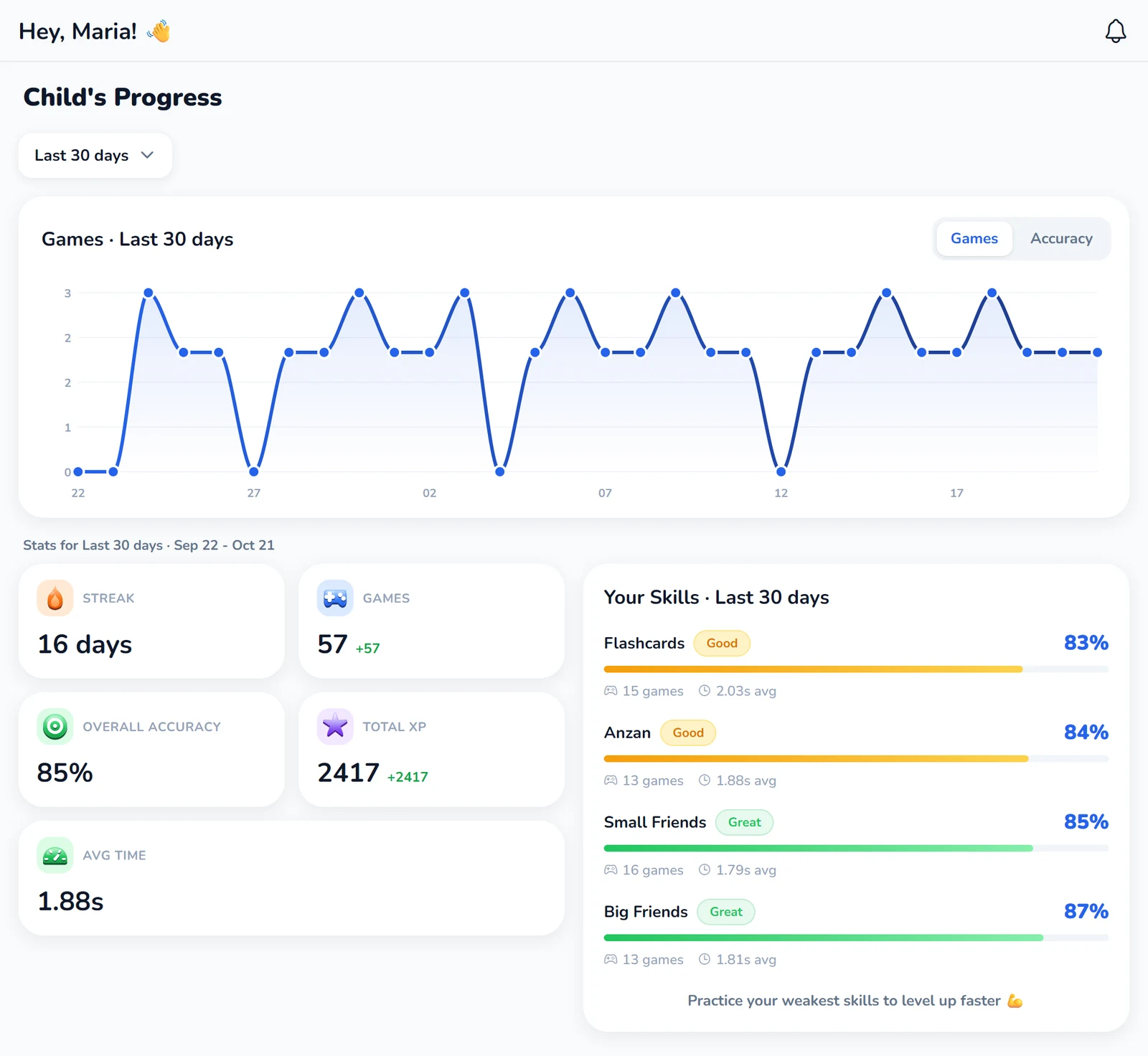
That is why a digital system creates a very useful chain:
- the platform collects the data;
- the parent notices the change;
- the teacher identifies the methodological cause.
This is much more effective than waiting until the problem becomes obvious during a lesson.
What the teacher can analyse after the parent raises a concern
Suppose the parent notices that results are falling.
That does not mean the parent should diagnose the cause.
There may be many possible reasons:
- a weak Small Friend;
- an unstable Big Friend;
- speed that is too high;
- a chain that is too long;
- a new digit length;
- fatigue;
- an older topic beginning to weaken.
The parent sees the signal.
The teacher identifies the cause.
That is how the system should work — and how the teacher then finds the weak topic behind repeated mistakes.
Why this is much harder to see in a workbook
When learning relies only on printed workbooks, parents and teachers have far less information.
There is a page. There are answers. There is completed homework.
But we may not know:
- how long the child actually calculated;
- how many mistakes were made before writing the final answer;
- how speed changed;
- where exactly the difficulty appeared;
- which old topic is beginning to weaken.
And children naturally want to show a good result.
If they cannot solve something correctly, they may find another way to get the answer. They may:
- recalculate it;
- use a slower method;
- count in another way;
- check it;
- or even use a calculator.
The workbook may still show the correct answer. But the correct mental-arithmetic skill may not be there.
A correct written answer can hide a missing skill
This is especially dangerous in mental arithmetic.
- The parent sees: homework completed.
- The teacher sees: mostly correct answers.
- The child continues moving with the group.
But a gap has already appeared.
For example, the child may have poorly mastered a particular group of Big Friends.
- New topics are then added.
- The child starts compensating for the weakness by thinking longer.
- At a slow speed, this may still work.
- Then the pace increases.
- Digit length increases.
- Chains become longer.
At some point, the whole structure starts breaking down.
The worst situation is discovering the problem too late
Imagine a group where everyone has moved far ahead.
Then it becomes clear that one child failed to master several topics months earlier.
Now the teacher has difficult choices:
- keep the child in the current group, where everything is becoming harder;
- move the child backwards;
- or create a large amount of individual corrective work.
For the child, this can be stressful. Especially if friends continue progressing.
Being moved to a younger or weaker group may feel like:
“I am worse than everyone else.”
But the original problem may have been small. It simply was not noticed in time.
Digital analytics is most valuable as an early-warning system
The main value of statistics is not attractive graphs.
The purpose is to identify a small deviation before it becomes a large problem. For example:
- falling accuracy;
- stalled progress;
- unstable speed;
- an increasing error rate;
- declining regularity.
If this is noticed after a week, correction is usually much easier. The teacher can:
- temporarily reduce speed;
- increase practice on a weak topic;
- return one step;
- adjust homework settings.
A week later, the child may be moving forward normally again.
That is far better than discovering four months later that several topics need to be relearned.
Parents do not need to check hundreds of examples manually
This is where a digital system removes a huge burden from the family.
If a child completes 100, 300 or more operations, the parent does not need to sit beside them and check every answer.
- The system records the results.
- The parent sees the overall picture.
- The teacher can look deeper when needed.
The responsibilities are separated.
The parent asks:
Is the child moving in the right direction?
The teacher asks:
What exactly needs to change in the training?
Ask “How is your progress going?” — not only “How many mistakes did you make?”
If the first question after every practice session is:
“How many mistakes did you make?”
the child may gradually start treating practice like an exam.
A broader approach is more useful. For example:
- “Did you practise today?”
- “What felt easier?”
- “What was more difficult?”
- “Did you notice that your speed improved this month?”
- “Look, your accuracy is better than last week.”
This shifts attention from judgement to progress.
A mistake is information
In a well-designed learning system, a mistake is not a disaster. It tells us:
- where the skill is unstable;
- which topic needs more repetition;
- whether the speed is too high;
- whether the workload needs adjustment.
The problem is not the existence of an error.
The real problem is when the same errors continue for weeks and no one notices.
That is exactly why analytics matters.
Parents do not need to sit next to the child for the entire session
At the beginning, a younger child may need help to:
- open the app;
- find the homework;
- start the session.
But independence should gradually increase.
If a parent sits next to the child for the entire 20-minute session and monitors every action, the child may become dependent on external control.
A better progression is:
- the parent helps the child start;
- the child practises independently;
- the parent checks the result and progress afterwards.
But “let the child handle everything alone” is not ideal either
Especially at ages 5–8.
A child may forget today. Then again tomorrow. Then miss several days.
That is why an adult is still needed. But not as a second teacher.
The adult helps maintain the system.
A clear division of roles
The teacher:
- explains the topic;
- establishes technique;
- analyses errors;
- adjusts the program;
- sets speed;
- identifies weak topics.
The parent:
- supports regularity;
- reviews progress data;
- watches trends;
- notices deviations;
- contacts the teacher early;
- supports the child.
The child:
- practises;
- makes an effort;
- makes mistakes;
- corrects them;
- gradually becomes more independent.
The platform connects all three sides through data.
Why this works especially well in Amavit
Both the teacher and the parent have tools that support the same learning process at different levels.
The teacher can manage:
- topic selection;
- speed;
- digit length;
- chain length;
- practice volume;
- frequency of weak topics.
The parent does not need to manage any of this.
Instead, the parent sees a clear picture of the child's progress. And if something changes, they can quickly contact the teacher.
At the same time, Amavit provides its core teaching tools to teachers free of charge, while parents can also participate in monitoring their child's learning without turning home into a second classroom.
Homework should not become a daily conflict
Mental arithmetic requires a large number of repetitions.
If every home session turns into:
- arguments;
- pressure;
- shouting;
- bargaining;
- punishment,
the child will quickly begin associating mental arithmetic with negative emotions.
The parent's goal is not to force the maximum possible volume today. The goal is to help the child continue learning for months and years — see why children lose interest and how to keep them motivated.
Sometimes 10 focused minutes are more useful than 40 minutes of resistance.
Do not force the child to finish at any cost
If the child is tired and accuracy is dropping sharply, more examples may stop being useful.
The goal is to automate correct actions.
Sometimes it is better to:
- stop;
- take a break;
- return later;
- or discuss the workload with the teacher.
Especially if the same pattern appears repeatedly in the statistics.
Compare the child with their own previous results
Not:
“Maria already calculates at one second.”
Not:
“Peter has already finished this topic.”
Instead:
“A month ago you needed three seconds, and now you need two.”
Instead:
“Last week you made many mistakes here, and now there are much fewer.”
Digital statistics are especially useful because progress becomes visible.
The child can literally see where they were a month ago — and where they are now.
Streaks, achievements and visible progress help maintain regularity
Children need to see results not only in the distant future.
That is why tools such as:
- streaks;
- medals;
- personal records;
- levels;
- achievements;
- progress graphs
can be useful. For example:
- 10 consecutive practice days;
- better accuracy;
- a new speed;
- a new level completed.
Small milestones help the child stay engaged through a long learning process.
Parents should intervene early, not late
This is probably the most important principle.
There is no need to wait until the problem becomes serious.
If, within a week, the parent notices that:
- results are deteriorating;
- speed no longer matches accuracy;
- practice volume has dropped sharply;
- progress has stopped;
- homework is being completed less consistently,
that is already enough reason to contact the teacher.
- Do not blame the child.
- Do not try to reteach the topic independently.
Simply say:
“Could you please look at what is happening?”
That is the right kind of parental intervention.
A digital platform changes the role of the parent
Without digital visibility, the choice can often feel like this:
- either the parent understands very little about what is happening;
- or the parent has to become a second teacher.
A digital system creates a third model. The parent understands:
- whether the child is practising;
- whether progress is happening;
- whether problems are appearing;
- whether growth has stopped.
But the parent does not interfere with the methodology unnecessarily.
That is a much healthier model.
The parent is responsible for the environment and timely feedback — not for the child's speed
Parents do not need to decide at home why the child has not yet reached 0.8 seconds.
- They do not need to change formulas.
- They do not need to reteach finger technique.
But they can strongly influence:
- regularity;
- learning conditions;
- motivation;
- a calm atmosphere;
- early detection of problems;
- communication with the teacher.
That is the parent's most important area of responsibility.
Mental arithmetic is a long-distance learning process
Strong results are not built in a few weeks. A child may progress through:
- physical abacus;
- Friends;
- mental calculation;
- Anzan;
- speed development;
- larger digit lengths;
- more advanced operations.
This is a long process.
That is exactly why early detection of small problems matters so much.
A small weakness is much easier to fix today than six months later.
A simple formula for parents
The parent's role can be summarised in one idea:
do not become a second teacher — become an attentive partner in the learning process.
- Support regular practice.
- Watch the trends.
- Notice changes.
- Contact the teacher early.
- Leave methodological correction to the person responsible for teaching.
That is one of the major advantages of a modern digital system:
the teacher sees the methodology, the parent sees the progress, and a problem becomes visible before it turns into serious learning delay.
Frequently asked questions
Should parents teach mental arithmetic at home?
Parents should usually support regularity and progress rather than reteach the methodology. Technical corrections are best handled by the teacher.
How often should parents check mental arithmetic progress?
A weekly review is usually enough to notice changes in accuracy, speed, practice volume or consistency.
What should parents do if accuracy starts falling?
Contact the teacher early and ask them to review the child's training data before trying to change the method at home.
Can a child have correct workbook answers but still have weak mental arithmetic skills?
Yes. A written answer may hide slow calculation, alternative solving methods or weak automaticity.
Why is progress tracking useful in mental arithmetic?
Because it helps identify small problems early, before they grow into larger gaps that are harder to correct.
Free for teachers. Parent access included.