One Platform for Academy Owners, Managers, Teachers and Students
As an education academy grows, one problem appears again and again: information starts living in too many different places.
The schedule is in one tool. Students are stored in a spreadsheet. Payments are tracked separately. Teachers communicate through messaging apps. Homework is sent through WhatsApp. Results are stored somewhere else. And the academy owner is expected to somehow see the whole picture.
When the school is small, this may still work. But once there are several teachers, dozens of groups, hundreds of students, managers and multiple branches, administrative complexity can start growing faster than the business itself. That is why an academy does not only need a platform for students. It needs one operating environment for all key roles.
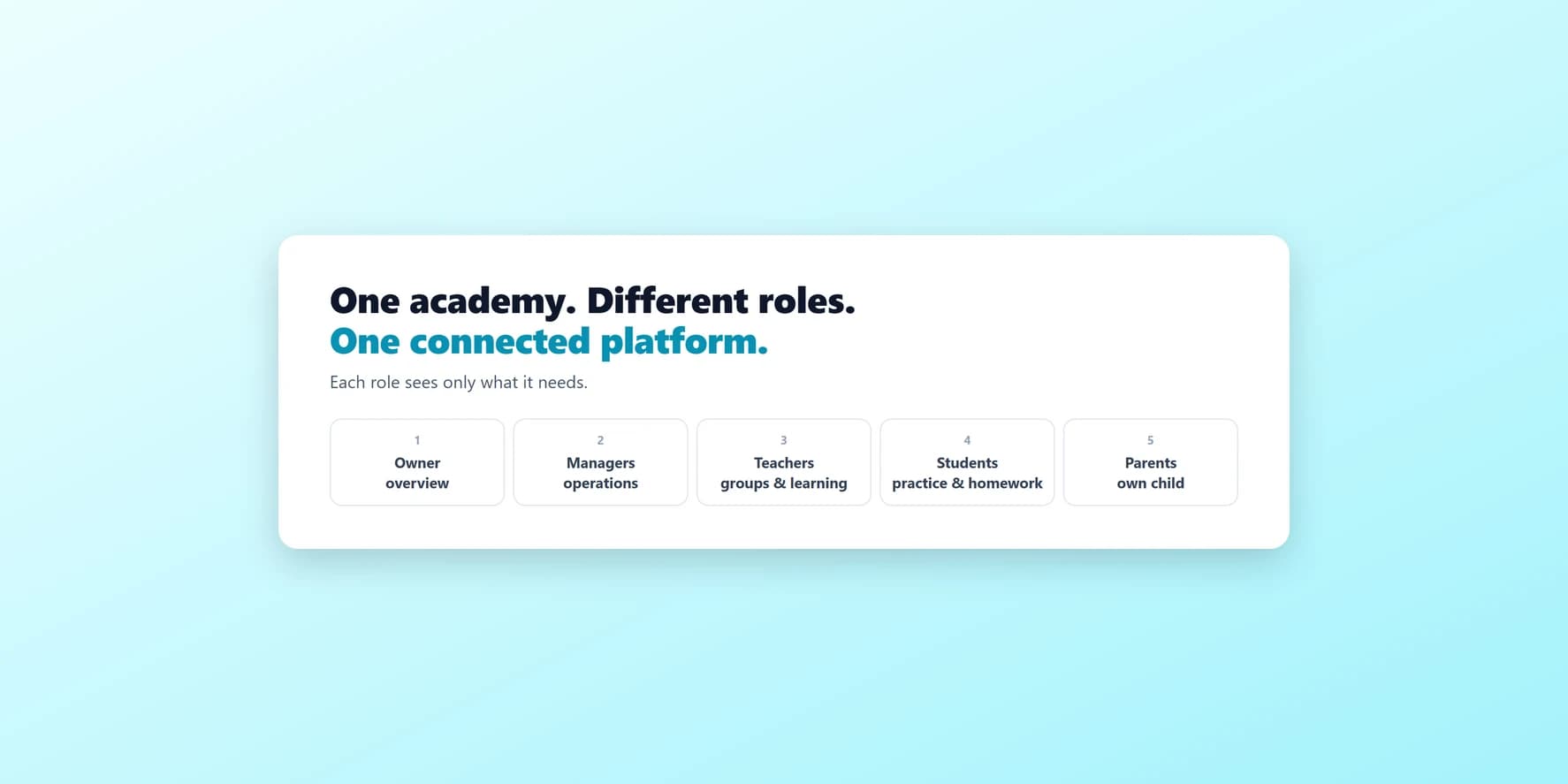
An academy management platform connects owners, managers, teachers, students and parents inside one operating environment. Instead of keeping schedules, homework, student records, results and payments across separate tools, each role can access the information and workflows relevant to them from one connected system.
- Owner — overview & control
- Managers — operations & scheduling
- Teachers — groups & learning
- Students — practice & homework
- Parents — relevant student information
One academy — different roles — one connected platform.
Every role has a different job
A good academy should not give everyone the same interface and the same permissions. The owner has one responsibility. The manager has another. The teacher has another. The student has another.
But they should still be connected inside the same system. This creates a link between management, teaching, scheduling, home practice, results and payments.
Role 1: academy owner or director
For the academy owner, the goal is not to perform everyone else's daily work. The goal is to see the overall picture: how many students are active? How many groups are running? How many teachers are working? How is the schedule organised? Where is activity falling? Which processes require attention?
The owner needs visibility. Not hundreds of separate messages.
The owner needs visibility — not hundreds of messages.
The owner should not have to ask every teacher separately
If an academy has ten teachers, the director should not need to repeatedly ask: “How many students do you have?” “Who was absent today?” “Who completed the homework?” “Which students are struggling?” “What topic is this group working on now?”
The larger the academy becomes, the less sustainable this model is. The information should already exist in the system.
The owner needs to see the academy structure
For example: branches, managers, teachers, groups, students. This makes it easier to understand who is responsible for what, where a particular student belongs, which teacher works with a group and which manager is responsible for the process. This becomes especially important as the organisation grows.
Visibility does not mean micromanagement
The purpose of a management platform is not for the director to watch every action of every teacher. The purpose is to identify when something is moving outside the expected process: a group becomes inactive; students stop practising; homework is not being assigned; an organisational problem appears; a schedule is not being maintained.
The owner sees a signal. They do not become a full-time dispatcher.
Role 2: academy manager
In a very small school, the owner may initially do everything. Eventually, a manager is added. At that point, a separate level of access becomes important.
A manager may need to work with student records, help manage schedules, coordinate groups, work with payments, handle organisational tasks and update operational information. But that does not mean the manager needs full access to every part of the business.
Permissions should match responsibilities
Not every employee should see everything. A teacher may not need access to all academy financial information. A manager may not need access to system-wide settings. A student should never see administrative data.
A clear role structure makes the system both easier to use and more secure.
| Role | Sees |
|---|---|
| Owner | Whole academy |
| Manager | Operations |
| Teacher | Own groups |
| Student | Own learning |
| Parent | Own child |
Different roles. Different permissions. One system.
See Amavit for schools & academies. Give every role its own workspace inside one academy environment. Amavit for academies.
Managers often spend hours on small manual tasks
Without a central platform, a manager may spend the day searching through messages, updating spreadsheets, checking calendars, passing information to teachers, reconciling payments, answering parents and finding which student belongs to which group.
Each task looks small. Together, they consume a significant amount of time.
One system makes management more predictable
The manager knows where students are, where schedules are, where groups are, where teacher information is and where the relevant workflow lives. The less time spent searching for information, the more time remains for customer service and academy growth.
Role 3: teacher
Teachers do not need access to the entire administrative system. They need a practical workspace for their own work: their groups, their students, their schedule, homework, practice and results. The teacher opens the system and sees what is relevant to teaching.
Teachers should spend time teaching — not managing administration
If a teacher has five groups, 50 students, several homework assignments and different ability levels, administrative workload grows quickly. Without a system, the teacher starts messaging students individually, sending links, searching for results, checking tasks manually and trying to remember what was sent to whom.
That is time that could have been spent on teaching — see how to manage multiple abacus groups.
Teachers should spend time teaching, not managing administration.
The platform should reduce repetitive teacher work
One group. One assignment. Students receive it. Results are collected automatically. The teacher sees the outcome.
That is fundamentally simpler than managing the same process through messaging apps, as described in moving abacus homework beyond WhatsApp.
Teachers can still keep their own methodology
Academy management should not become methodology control. Teachers can continue using their own workbooks, topic sequence, lesson plans, rules and teaching methodology. The platform supports the process. It does not have to replace the method — see how teachers can use Amavit as a practice trainer.
Role 4: student
For the student, the system should be as simple as possible. Students do not need management reports, payment settings, teacher permissions or complex administration. They need to understand: What should I do? Where do I practise? What is my homework? What result did I get? What comes next?
The simpler the student experience, the better.
Students should see their learning path — not academy administration
Practice, assignments, progress, streaks, achievements, games, results. That is their working environment. All management complexity should remain on the adult side.
When everyone works in one system, the data connects
This is the real advantage. The teacher creates homework. The student completes it. The result is saved. The manager can see the process when necessary. The owner sees the overall picture.
No one needs to manually move information from one system to another.
One source of data reduces errors
Imagine an academy has an Excel file with students, a separate calendar, a WhatsApp group, a separate payment spreadsheet and another homework system. Eventually, something will become inconsistent: a student changes groups, but one spreadsheet is not updated; the schedule changes, but not everyone receives the message; a payment arrives but is not recorded; a teacher sends different homework from what the system shows.
The more systems there are, the more places an error can appear.
Before — too many systems
WhatsApp · Excel · Google Calendar · bank · homework tool · practice app · reports
After — one academy environment
One student record · one schedule · connected groups · homework · practice · results · payments
Less duplication. Fewer manual transfers. Better visibility.
A central platform reduces duplicate information
Ideally, a student should not exist separately in three spreadsheets, two chats, one calendar and a separate payment list. There should be one student record inside the academy environment. Different roles then interact with that same record in different ways.
Scheduling is especially important to centralise
The schedule is one of the most sensitive academy processes. It affects teachers, students, parents, managers, rooms and sometimes multiple branches. Any change needs to be visible to the right people quickly. If schedules are maintained manually in several places, mistakes become almost inevitable.
An academy should be able to grow without administration growing at the same rate
This is an important business principle. If the number of students doubles, administrative work should not automatically double too. Otherwise growth becomes expensive.
A good system should make it possible to add more students, more groups and more teachers without increasing manual administration at the same pace.
Manage your academy in one system. Connect your staff, teachers, students and learning processes without building your own software. Amavit for academies.
This matters most for small academy owners
In a small business, the owner often does several jobs at once: sales, control, parent communication, teacher recruitment, problem solving, finance. Every manual operation takes time away from higher-value work. That is why centralisation and automation can have an especially large impact on a small academy.
Managers can work according to the same standard
When several managers join, another problem appears: everyone may develop their own process. One person uses Excel. Another uses Google Sheets. Another keeps information in WhatsApp. If everyone works inside one platform, the academy can create a consistent operating standard.
This matters when employees change
If all operational knowledge belongs to one manager's personal spreadsheets and chats, that employee leaving can become a serious problem. The replacement has to search, reconstruct, transfer and understand the previous context. If the operational process already lives in the system, staff changes become much easier.
The same applies to teachers
A teacher may leave. The group remains. The students remain. The history should remain. That is why academy data should belong to the academy rather than existing only in a teacher's private messages.
The academy should own its operational knowledge
An academy should own not only its brand, its methodology and its customer base, but also its operational history: groups, students, homework, results, schedules and processes. The less this information depends on one individual, the more resilient the business becomes.
The academy should own its operational knowledge.
One system helps standardise service
For example, the academy can decide that all teachers assign homework in the same way, all managers maintain schedules in the same system, all students receive access consistently and all groups follow the same structural logic. This improves service quality.
Standardised operations do not mean identical teaching
These are different things. Operational processes can be standardised. Teaching can still be personalised. Teacher A may use one practice intensity. Teacher B may use another. One student may need more practice. Another may need less.
The platform should support individual teaching decisions inside a common operational structure.
The owner can finally see the academy as a system
When a school is small, the owner may know every student personally. At 300, 500 or 1,000 students, that becomes impossible. The business then has to become manageable through systems. The owner needs to see structure, processes, exceptions and workload — not try to remember everything personally.
This becomes even more important with multiple branches
A second branch adds a surprising amount of complexity. If each branch operates separately, the owner can quickly lose visibility. A central platform can preserve one structure: academy → branches → managers → teachers → groups → students.
Digital operations reduce dependence on geography
The owner may be in one city. A manager may be in another. A teacher may work online. Students may be in several countries. When operations live in a digital environment, physical location becomes less important.
Payments can also be connected to the student record
If payment integration is enabled, the academy can connect payment information with the relevant student. This is much easier than repeatedly comparing bank statements, spreadsheets, parent names and group lists — especially once the academy has hundreds of students.
But the platform should not become another source of complexity
A bad management system can create more work than it removes. If a simple task requires ten screens, that is not useful automation. A good system should reduce the number of steps required.
Every role should see what it needs
The basic model is simple:
Owner → overview · Manager → operations · Teacher → teaching · Student → learning
That is a simple but powerful architecture.
Parents can also be part of the system
Depending on the academy workflow, parents may receive access to relevant information: progress, schedule, payments, student-related information. But parents should not be exposed to unnecessary administrative complexity either. The family experience should remain simple.
A simpler parent experience means fewer questions for the academy
If a parent can quickly find the schedule, the assignment, the result and payment information, they have less reason to message the manager asking “Where can I find this?”, “What is today's lesson?”, “Did our payment arrive?” or “What is the homework?” That again reduces administrative workload.
One system improves communication — but does not replace it
WhatsApp and other messaging apps can still be useful: an urgent message, a personal question, a last-minute schedule change. But a messenger should not become the academy database. These are different functions.
Messenger = communication. Platform = operations and learning data.
That helps prevent important information from disappearing inside chats.
Digital transformation is also internal discipline
A professional platform is not only about showing parents a good interface. It also helps the academy organise itself internally. When roles are clear, processes are defined, data is centralised and responsibilities are visible, the business becomes easier to manage.
A simple academy role structure
| Role | What they do in the system |
|---|---|
| Owner | Sees the academy as a whole |
| Manager | Works with operations |
| Teacher | Manages groups and the learning process |
| Student | Receives practice and assignments |
| Parent | Receives information related to the child |
Everyone works inside the same ecosystem, but each person sees only what is relevant to their role.
This becomes more valuable as the academy grows
With 30 students, an academy may still operate through WhatsApp. At 100, it becomes inconvenient. At 300, it becomes difficult. At 1,000, it becomes almost impossible without systematic operations. It is usually better to solve this problem before growth turns into chaos.
You do not need to implement everything at once
The transition can happen gradually:
- Teachers + students + groups
- Homework + practice + results
- Managers + scheduling
- Payments
- Branches + deeper management
The academy grows inside the system step by step.
Amavit can become the academy's shared digital workspace
For academies, Amavit can connect several layers: management, teachers, students, practice, scheduling, homework, results, branding and payment integrations. The important point is not simply how many features exist. The important point is that they are connected.
Branding is its own topic — see how a white-label learning platform can make a small academy look like a large education brand.
The academy does not need to assemble everything from separate tools
An academy can use one tool for schedules, another for homework, another for practice, another for analytics and another for payments. Sometimes that is necessary. But every additional tool creates another login, another integration, another database and another possible source of inconsistency.
If key processes can work inside one environment, operations become much simpler — and the academy does not have to build that environment itself. See why small academies should not build their own learning platform and how to launch a digital platform for your abacus academy without hiring developers.
Centralisation does not mean losing flexibility
A shared system should provide a common structure with different permissions, different groups, different teachers, different student settings and different practice scenarios. Centralised management does not mean everyone has to work in exactly the same way. The same applies to coaching institutes and education centres outside the abacus field: the structure is shared, the teaching stays individual.
The main benefit is visibility
The owner understands what is happening. The manager understands what needs to be done. The teacher understands what is happening with their students. The student understands what to do next. That is the real value of one connected system.
The main conclusion
As an academy grows, the main problem is often not the lack of another digital tool. The problem is that there are already too many tools: WhatsApp, Excel, calendars, payment systems, homework tools, practice apps, separate reports. Each solves one problem.
But an academy needs a connected operational environment. One where the owner sees the business, the manager runs operations, the teacher works with groups, the student practises and the parent receives relevant information.
Amavit can be used in exactly this way: not only as a mental arithmetic trainer, but as a shared digital platform for the academy. And as the academy grows, the most important advantage is not simply the number of functions. It is that the key roles and processes are connected.
Bring your academy operations together. Owners, managers, teachers and students in one connected environment — request academy access.
Frequently asked questions
What is an academy management platform?
It is a digital system that connects academy operations such as students, staff, groups, schedules, homework, learning results and related workflows.
Can owners and managers have different access?
Yes. Different organisational roles can have different permissions and visibility.
Can teachers see only their own groups?
The academy structure can be configured so teachers work with the groups and students relevant to them.
Can students use the same platform?
Yes. Students use their own learning environment for practice, assignments and results.
Can parents also access academy information?
Parents can receive access to relevant student-related information depending on the academy setup.
Can the platform manage schedules?
Yes. Scheduling can be part of the academy's central operating environment.
Can we integrate payments?
Payment workflows can be integrated depending on the academy's country, payment provider and setup.
Do teachers need to change their teaching methodology?
No. The platform can support academy operations and digital practice while teachers retain their existing curriculum and methodology.
Can we start with only part of the academy?
Yes. Academies can begin with selected teachers, groups or students and expand later.
Can one platform support multiple branches?
The academy structure can be expanded as the organisation grows, including additional staff, groups and organisational units.