How to Use an Abacus: A Step-by-Step Beginner's Guide
When a child picks up an abacus for the first time, it can look deceptively simple. There is a frame. There are rods. There are beads. You move them up and down.
But if a child starts moving beads any way they like, confusion can appear very quickly. That is why the first stage is not about speed and not even about solving many examples. It is about understanding a few basic things correctly: where zero is; how numbers are represented; which fingers should control which beads; how to perform the simplest operations; and when the first real abacus rules begin.
If this foundation is built properly, everything that follows becomes much easier. (If you are new to the tool itself, start with what an abacus is and how it works.)
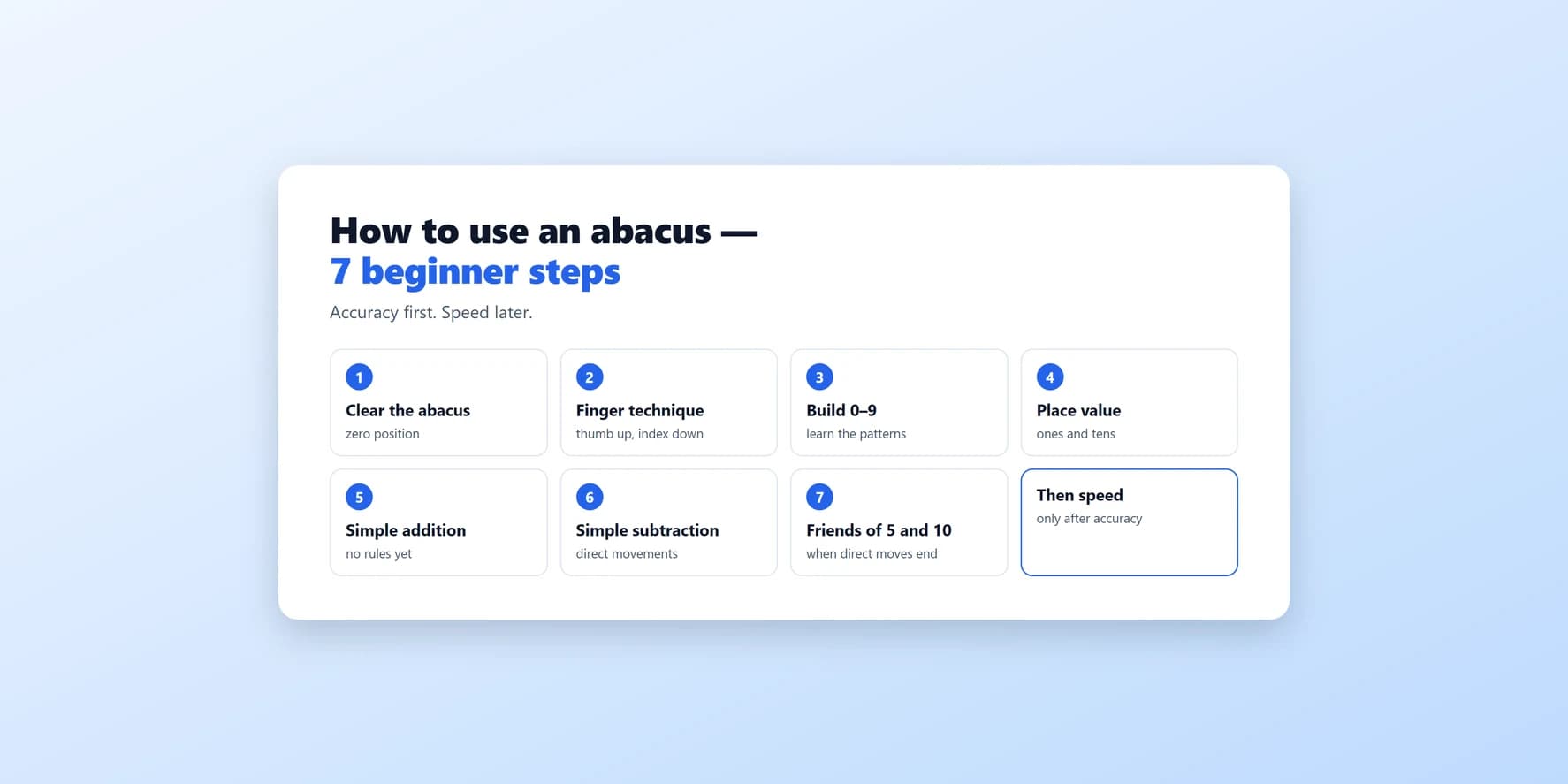
How to use an abacus: to use a soroban-style abacus, first clear all beads away from the central beam. Learn the number positions from 0 to 9, use the thumb and index finger consistently, and practise simple addition and subtraction before moving into Friends of 5 and Friends of 10.
- Clear the abacus
- Learn finger technique
- Build numbers 0–9
- Understand place value
- Practise simple addition
- Practise simple subtraction
- Begin Friends of 5 and 10
Accuracy first. Speed later.
First, understand the structure of the abacus
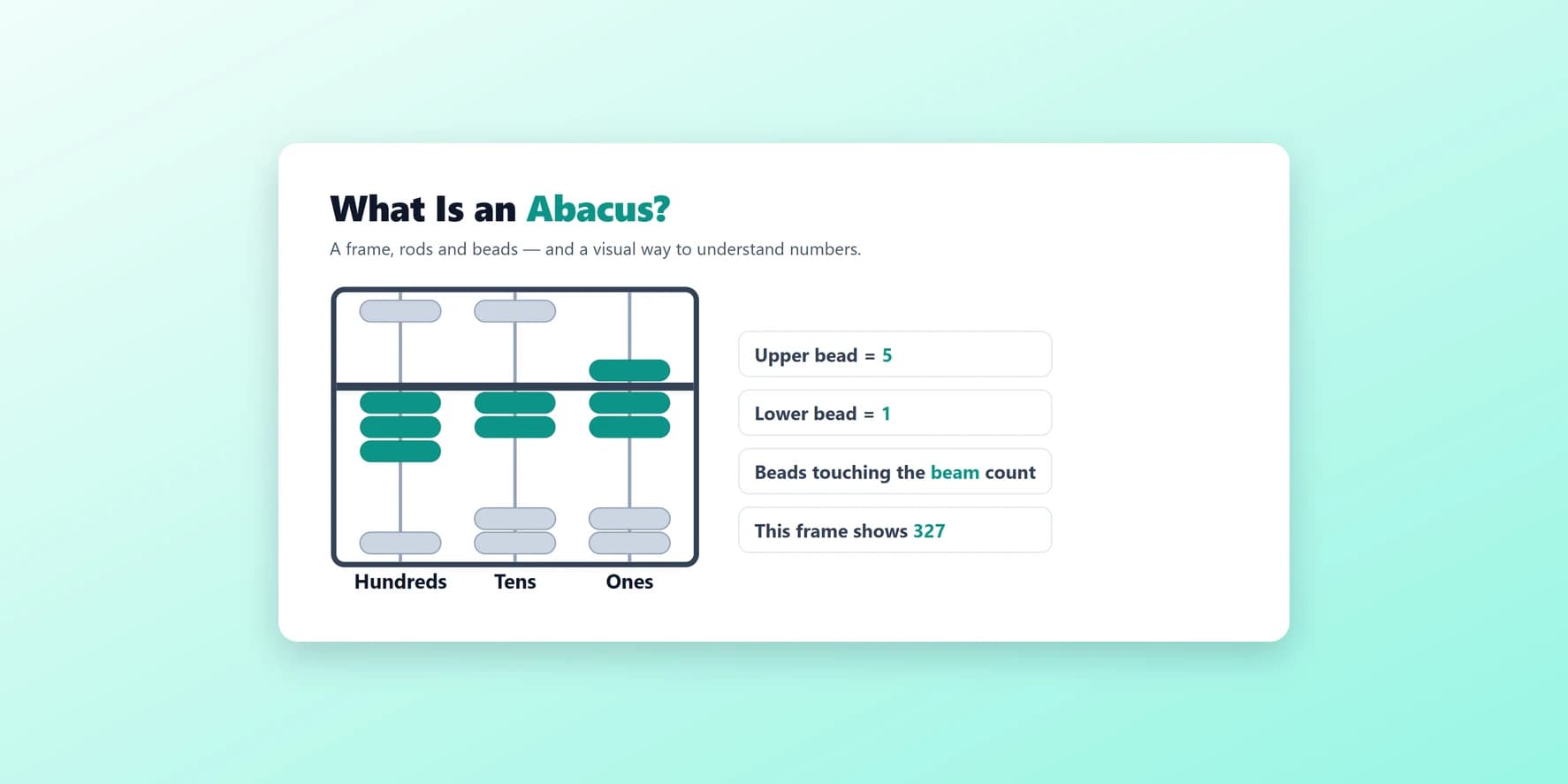
In mental arithmetic, one of the most common models is based on the Japanese soroban. Each rod usually has:
- one upper bead;
- four lower beads;
- a central beam between them.
Each lower bead has a value of 1. The upper bead has a value of 5. Only the beads brought into contact with the beam are counted. That is the first basic principle a beginner needs to understand.
Start by clearing the abacus
Before the first exercise, clear the frame completely. No bead should be touching the central beam. The upper bead stays away from the beam. The lower beads stay on the opposite side.
This is the zero position. It becomes the starting point for every new example. Learning to return to zero quickly is a simple habit, but it prevents many beginner mistakes.
Position the abacus comfortably
The abacus should sit flat and comfortably in front of the child. There should be no need to stretch forward or hold the frame awkwardly. The hand should stay relaxed.
At the beginning, speed does not matter. The goal is calm and accurate movement.
Learn the finger technique from the start
This is one of the most important beginner skills. For lower beads, I teach the child to push them toward the beam with the thumb and return them with the index finger. The upper bead is also handled with the index finger.
| Finger | Movement |
|---|---|
| Thumb | Lower beads → toward the beam |
| Index finger | Lower beads → away from the beam |
| Index finger | Upper bead — toward and away from the beam |
This may look like a small detail. It is not. Once speed increases, changing a poor movement habit becomes much harder. Teachers can use our finger technique checklist to review it.
Why not just use any finger?
When a child works very slowly, it may seem that finger choice does not matter. As long as the answer is correct, what difference does it make?
At the very beginning, the difference may be small. But later, when there are longer chains, higher speed, more complex transitions and more demanding combinations, poor technique starts getting in the way.
That is why I prefer a simple rule: correct movement first, speed later.
Start with the number 1
To show 1, the child moves one lower bead toward the beam. Then 2 = two lower beads; 3 = three; 4 = four.
At this stage, the child should gradually learn to recognise these positions visually. The goal is not to count every bead one by one forever. The child should begin to recognise the pattern.
How to show 5
The number 5 is the first important change. Instead of using lower beads, the child moves the upper bead toward the beam. That represents 5.
Up to 4, the child simply added lower beads. At 5, the structure changes. This is an important step in understanding the abacus.
How to show 6, 7, 8 and 9
The logic is simple: 6 = 5 + 1, 7 = 5 + 2, 8 = 5 + 3, 9 = 5 + 4.
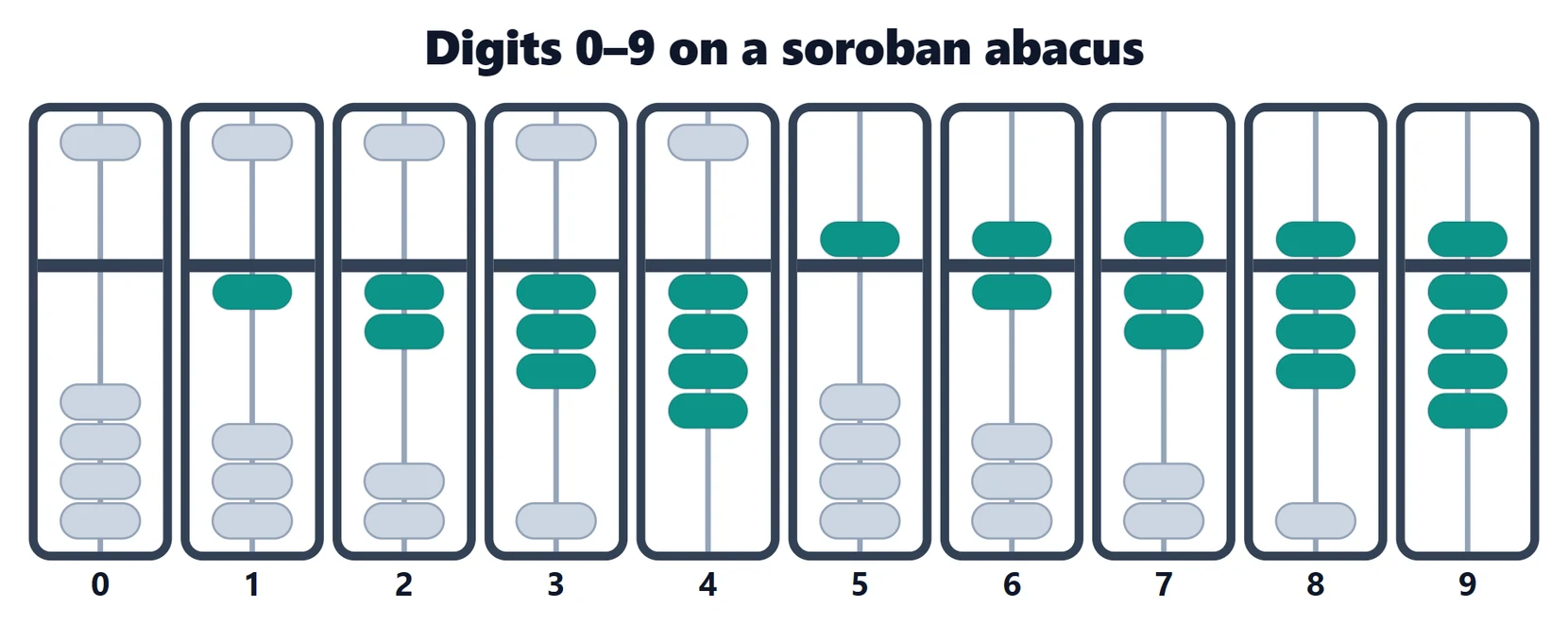
At this stage, numbers begin to look less like separate beads and more like stable visual patterns. That becomes very important later.
First exercise: build numbers
Before moving into addition, I would not rush. A useful first exercise is simply to call out random numbers — 2, 5, 7, 4, 9, 1 — and the child sets each number on the abacus. Then returns to zero.
This simple drill helps build strong visual recognition.
Second exercise: read numbers from the abacus
You can also reverse the task. A parent or teacher sets a number — 3, 8, 5 — and the child says what they see.
This develops visual recognition from the other direction. Later, the child should be able to recognise a bead position without mentally counting every bead.
How place value works
Once the child is comfortable with the digits 0 to 9, the next step is tens. One rod represents ones. The next represents tens. Then hundreds. For example:
- 2 on the ones rod = 2;
- 2 on the tens rod = 20;
- if the tens rod shows 2 and the ones rod shows 3, the number is 23.
The abacus makes place value very visual.
Do not rush into large numbers
At the beginning, it is better for the child to be completely comfortable with ones, tens and moving between them. There is no need to introduce hundreds and thousands immediately. Difficulty should increase gradually.
First addition
Once the child understands the numbers, simple addition can begin. For example, 1 + 1: the child sets 1, then adds one more lower bead. The result is 2. Or 2 + 1 = 3, 3 + 1 = 4.
These examples are useful because no special rule is needed yet.
First subtraction
The same applies to subtraction. For example, 4 − 1: the child removes one lower bead. The result is 3. Or 3 − 2: two beads are moved away from the beam. The result is 1.
At this stage, everything should still feel direct and understandable.
Why I would not introduce complex rules too early
If the child is still unsure what 6 looks like, which finger to use, where zero is or how to show 20, it is too early to rush into complement rules. Otherwise the child has to think about too many things at once.
The foundation needs to become familiar first.
When do Small Friends appear?
Sooner or later, the child reaches an operation that cannot be completed with a direct movement. For example: 3 + 4. There are not enough lower beads available to add 4 directly.
This is where the child begins using a complement to 5. In this example: +4 = +5 −1. This is one of the Small Friends, also called Friends of 5.
At this stage, the important thing is not memorising a long list of formulas. The child needs to understand the movement and repeat it correctly — see what Small Friends and Big Friends are.
When do Big Friends appear?
Later, the child begins working across 10. That is where Big Friends, or Friends of 10, become important. The basic pairs are 1 and 9; 2 and 8; 3 and 7; 4 and 6; 5 and 5.
These combinations help when calculations move between neighbouring place-value rods. The detailed technique is better learned separately, once the child is already confident with the basics.
Not every school teaches Friends in the same order
This is important. One methodology may teach Small Friends in this order: 1 → 2 → 3 → 4. Another may go: 4 → 3 → 2 → 1. The same applies to Big Friends. Some programmes move 1 → 9. Others 9 → 1.
The mathematics does not change. The teaching sequence does. And that is perfectly normal.
Why random videos from different schools can confuse a beginner
This is a common problem. A parent searches online for an explanation. They find one teacher. Then another. The sequence may be different. The terminology may be different. Sometimes even the way the movement is explained differs slightly. The child then becomes confused.
If the child already studies with a teacher or academy, it is usually better to stay within one teaching logic.
How should speed increase?
Very gradually. First, the child should be able to recognise the number, set the beads correctly, use the correct fingers and perform the movement correctly. Only then should speed begin to increase.
I would not start beginners with a timer. At the beginning, a timer often creates pressure without adding much value.
A good beginner exercise
For example: 1 + 1 + 1 − 1 + 1. The child performs the chain slowly. The goal is not to lose the current value, not to rush, to use the correct fingers and to stay accurate. Later, the chain can become longer.
Change only one difficulty parameter at a time
This is a very useful learning principle. If the child has just learned a new topic, do not simultaneously increase speed, increase chain length, increase digit length and add more difficult operations.
Change one thing at a time. Do not make everything harder at once.
For example: keep the same topic and increase speed slightly. Or keep the same speed and increase the chain length. This makes it much easier to see exactly where the child begins to struggle.
When can mental practice begin?
I would not wait too long. Once the child can confidently recognise simple numbers on the physical abacus, basic visualisation can begin. For example: show 4; remove the abacus; ask the child to imagine 4. Then 5. Then 7.
This is not yet full mental calculation. But it is already the first step toward it.
Physical and mental abacus can develop in parallel
Physical abacus gives
Movement · technique · real bead positions
Mental practice develops
Visualisation · internal movement · number images
One does not need to be completely finished before the other begins — see physical vs mental abacus.
What should you do when a child makes a mistake?
Do not immediately give the correct answer. First try to understand what went wrong. Does the child:
- not know the rule?
- move the beads incorrectly?
- lose concentration?
- misread the number?
- rush?
- make the same mistake in the same place?
Different problems require different solutions.
If the same error keeps repeating
Slow down. Return to the physical abacus, a simpler example and the correct movement. Do not try to solve a technique problem by increasing speed or volume. Fix the cause first. Then rebuild repetition — see how to find the exact cause of repeated abacus subtraction errors.
How long should a beginner practise?
Short sessions are usually enough in the beginning. Even 7–10 minutes of regular practice can be more useful than one long home session once a week. Especially for younger children. Practice should not become exhausting.
The parent's role
Parents do not need to know every abacus formula. Their role is simpler:
- help create regularity;
- remind the child to practise;
- avoid correcting every movement themselves;
- avoid rushing the child;
- avoid comparing the child with others.
If the child has a teacher, technical correction is usually better left to the teacher. For a child who already knows the basics, see how a child can practise mental arithmetic at home without a teacher.
Where digital practice helps
Once the movement is already understood, a digital trainer becomes very useful. It can provide many examples, check answers automatically, change speed, change chain length, work with different topics and adjust difficulty to the child's results. That makes it particularly useful for consolidation — see online abacus practice for independent training.
But new technique should still be checked
If a child is learning a new Friend, a new movement or a new type of transition, it is better for the teacher to check the technique. A digital trainer sees the result. It may not always see which finger the child used or whether the movement itself was correct.
How Amavit can be used at this stage
In Amavit, a teacher can use the platform as a practice tool — see how teachers can use Amavit as a practice trainer. The child learns a topic during the lesson. Then practises it independently. The teacher can keep their own methodology.
This is especially important with Friends. In homework, the teacher picks the exact Friend to practise — Small Friends 1, 2, 3 or 4, Big Friends 1–4 and 6–9. If an academy teaches Small Friends 1 → 4, it can keep that sequence. If it teaches 4 → 1, the platform does not force a different programme. The same applies to Big Friends.
Do you need to stop using workbooks?
No. Workbooks, the physical abacus and digital practice can work together. For example:
- the teacher explains the topic on the physical abacus;
- part of the homework is completed in a workbook;
- another part is completed in a digital trainer.
There is no reason to choose only one tool.
What should a child be able to do after the first stage?
At the very beginning, I would not expect speed. I would expect the child to:
If those skills are stable, the foundation is already in place.
The most common beginner mistake
Trying to move too quickly. Parents naturally want to see larger numbers, higher speed, mental calculation. But strong results are built from very simple things. Set 7 correctly. Remove 2 correctly. Use the correct finger. Do not lose the place value. Repeat the movement many times.
The main idea
Using an abacus is not difficult. The challenge is not understanding which bead to move. The challenge is making the movement accurate, correct, stable — and eventually fast.
That is why a beginner should not try to calculate quickly from the start. A better progression is:
- Understand zero
- Learn the number patterns
- Build correct finger technique
- Master simple addition and subtraction
- Move into Friends gradually
- Begin visualisation in parallel
That foundation is what later allows the child to move from physical abacus work into confident mental calculation.
Frequently asked questions
How do you set an abacus to zero?
Move all beads away from the central beam.
Which fingers should beginners use on a soroban?
The thumb is commonly used to move lower beads toward the beam, while the index finger returns them and also controls the upper bead.
What should a beginner learn first on an abacus?
Zero position, numbers from 0 to 9, finger technique and basic place value.
When should a child start addition?
Once number positions and basic movements are stable.
When should Small Friends be introduced?
When direct movement is no longer possible around 5.
What are Big Friends used for?
They help with operations that cross 10 and move between place-value rods.
Should a beginner practise fast?
No. Accuracy and correct movement should come before speed.
Can mental abacus practice start early?
Yes. Simple visualisation can begin once physical number positions are familiar.
Can digital practice replace the physical abacus?
No. Digital practice is useful for repetition, while the physical abacus remains important for learning technique and new movements.
For Teachers: Keep Your Methodology and Use Amavit for Practice
Explore Amavit for TeachersFree for teachers