When Should a Child Reduce Physical Abacus Practice — and Why It Should Never Disappear Completely
When parents see that a child has started calculating mentally, a natural question appears:
“If my child can already imagine the abacus in their head, why do they still need the physical one?”
At first, the logic seems simple: the child used to move beads by hand; then learned to visualise them; so the physical abacus is no longer necessary.
But in mental arithmetic, the transition does not work that way. The better question is not:
“When should we remove the physical abacus?”
but:
“When can we reduce its share of practice?”
Because the physical abacus remains useful throughout almost the entire learning journey.
At the beginning, it may represent close to 100% of practice. Later, its share gradually decreases. At an advanced level, most work may already be mental. But even then, physical abacus practice should usually remain in the program — often around 10–20% as a practical guideline, depending on the child, the stage and the methodology.
Children should not completely stop using the physical abacus after mental calculation begins. Physical practice usually dominates at the start, gradually decreases as mental skills develop, and can remain around 10–20% at advanced stages as a supporting, diagnostic and teaching tool.
The physical abacus is the foundation of the whole system
During the first lessons, the child is literally building the future mental abacus with their hands. They learn to:
- see numbers;
- understand place value;
- move beads correctly;
- use the correct fingers;
- perform Simple;
- learn Small Friends;
- learn Big Friends;
- handle transitions.
At first, everything is physical. The child sees a bead. Touches it. Moves it. Sees the new configuration. And repeats the connection hundreds of times:
number → movement → new abacus state
Later, this structure begins to move into the imagination. But the physical model remains its foundation.
The mental abacus does not simply replace the physical abacus
This distinction is important. The mental abacus is not a completely separate tool that suddenly replaces the physical one. It is an internal version of a system the child already knows physically.
The student has repeatedly seen how a number looks, how the beads move, how transitions work, how Friends are applied and how place value changes. Over time, the child begins to reproduce the same structure mentally.
So the learning path should not be:
physical → finished → mental
but rather:
physical → physical + mental → mostly mental, with physical practice still supporting the system
At the beginning, physical practice dominates
This is completely natural. The child needs to:
- understand the abacus;
- develop finger technique;
- learn the mechanics;
- see each operation clearly;
- build correct habits.
So most early practice should be physical. Mental exercises can already appear fairly early. But initially, they should remain a smaller part of the total practice. The main goal is to build a strong physical model.
Mental calculation can begin early
There is no need to wait a year before a child first tries calculating mentally. In some methodologies, mental exercises appear after only a few lessons.
For example, once the child has mastered a simple physical topic, the teacher may introduce a few familiar operations mentally. This gives the child an important experience:
“I can see the abacus even when it is not physically in front of me.”
But this does not mean the physical abacus should disappear. Quite the opposite. Both modes continue developing together.
Physical and mental practice should develop in parallel
This is one of the most useful ways to explain the process. For example:
- the child learns a new topic on the physical abacus;
- mentally, they continue practising an earlier topic;
- after some time, the new topic is also transferred into mental calculation;
- then another new physical topic appears.
And the cycle continues. In this model, physical work often stays slightly ahead of mental work. That gives the child a stable base before the same skill is required internally.
Why mental work can remain one step behind
Imagine that a child learns a new combination today. They are still thinking:
- Which finger should I use?
- What should I add?
- What should I remove?
- How does the transition work?
If the child is immediately asked to perform the same operation mentally, the load becomes much higher. They must simultaneously remember the new rule, visualise the abacus, change the mental image correctly and retain the result.
It is often more effective to consolidate the new movement physically first. Meanwhile, mental practice can continue on familiar material. Then the new topic can gradually move into the mental stage.
Correct finger technique matters for future mental calculation
Parents sometimes ask:
“If the child will eventually calculate mentally, why does it matter which fingers they use now?”
It matters a great deal. Correct movements create a stable internal structure. If a child repeatedly uses unnecessary movements, changes technique, compensates for mistakes or moves beads inconsistently, the physical model becomes less systematic.
The mental abacus is built from that model. That is why finger technique — especially during Small Friends and Big Friends — is not simply about looking neat. It supports future automaticity, and it is one of the first things a good mental arithmetic teacher watches.
The physical abacus is not only for beginners
This is one of the most important points. Even when a child already calculates confidently mentally, the physical abacus remains useful. Because learning continues. New challenges appear:
- larger digit lengths;
- new combinations;
- Anzan;
- multiplication;
- division;
- more complex algorithms;
- advanced calculation formats.
At each new stage, physical abacus work can again become an important support tool.
Multiplication and division still use the abacus
This is especially important. Sometimes parents assume:
“Addition and subtraction are learned on the abacus, and after that everything is mental.”
That is not correct. When multiplication and division are introduced, the physical abacus becomes valuable again. The child needs to:
- see the structure;
- understand place values;
- follow intermediate steps;
- see where results are placed;
- learn the new algorithm.
The physical abacus therefore continues to play a teaching role even at advanced stages.
Physical practice may temporarily increase when a new complex topic is introduced
This is completely normal. Imagine a child normally works approximately 80–90% mentally and 10–20% physically. Then a new complex operation appears.
For a period of time, the physical share may increase again — perhaps 30%, 40%, sometimes more. Once the new mechanics become stable, mental practice increases again.
So the balance does not necessarily move in only one direction. It can change depending on what the child is learning.
- Physical
- Mental
- New complex topic
- Back to physical
- Back to mental
Advanced learning is not a one-way transition.
At an advanced level, physical practice remains a supporting tool
Even when mental calculation becomes very strong, it is usually not useful to eliminate the physical abacus completely. Returning to it periodically still has value.
As a practical guideline, something around 10–20% physical practice may remain useful at mature stages. This is not a universal rule. It is not a scientific formula. The key idea is simply:
physical practice should usually not disappear completely.
Why keeping some physical practice remains useful
There are several reasons:
- it helps maintain technique;
- it preserves the physical structure behind the mental image;
- it makes it easier to learn new advanced operations;
- it provides an excellent diagnostic tool;
- it can help recalibrate the mental image when necessary.
The physical abacus helps diagnose mental-calculation problems
Suppose the child starts making mistakes mentally. The teacher can give the same type of task on the physical abacus. Two situations may appear.
Physical performance is excellent. The rule itself is understood. The problem may be connected to mental image stability, speed, chain length or maintaining the internal state.
The same errors appear physically. The problem is deeper. The teacher may need to check the rule itself, technique, Friends, place value or the sequence of actions.
Physical practice helps separate these two types of difficulty — the same diagnostic logic we describe in why children keep making the same mistakes.
This is another reason not to remove it completely
If a child works only mentally for months and a problem appears, the teacher has fewer ways to inspect the mechanics.
Physical mode makes it possible to return to the foundation and see what the child is actually doing rather than only what final answer appears.
Physical practice can help reset technique
Sometimes a child becomes careless when working mentally at high speed. They may begin to lose positions, blur the mental image and make more mistakes.
A short return to physical practice can help. Not because the child has “gone backwards.” But because they reconnect movement, structure, place value and visual image. It acts more like technical recalibration.
Returning to the physical abacus is not a step backward
This is important psychologically. An advanced student may say:
“But I can already calculate mentally. Why am I using the abacus again?”
The answer is simple:
“Because this is still one of your core training tools.”
Professional athletes continue practising basic movements. Musicians continue playing scales. Football players continue training simple passes.
Advanced skill does not eliminate fundamentals. It makes the fundamentals even more important.
The higher the level, the more important the foundation becomes
At an early stage, a small technical weakness may not create obvious problems. At high speed, the same weakness becomes much more serious — see how speed develops in mental arithmetic. In multiplication or division, a weak foundation creates even more difficulty.
So as the program becomes more advanced, periodically checking the basics becomes more valuable.
The physical abacus is not like training wheels on a bicycle
It should not be treated as something that is removed forever once the child “graduates” from it. A better comparison is a core training instrument.
At first, the child uses it constantly. Later, less frequently. But it remains part of the system.
How the balance can change over time
Very roughly, the progression may look like this:
- Start physical ~100%, mental minimal
- Early transition physical 70–80%, mental 20–30%
- Developing stage physical and mental mixed, around 50/50
- Advanced mental 80–90%, physical 10–20%
Illustrative proportions only. The exact balance depends on the child, curriculum and learning stage.
These numbers should not be treated as a mandatory standard. Different children and different programs will use different proportions. The principle is more important than the exact percentage:
physical practice gradually decreases, but does not disappear.
A new topic can temporarily change the balance again
For example, the child normally works 90% mentally. Then advanced multiplication begins. For one or two weeks, the teacher increases the physical component.
Later, once the new method is understood and stable, mental work becomes dominant again. This is a natural learning cycle.
The role of the physical abacus changes at each stage
- Beginning it teaches mechanics
- Transition it supports the move into mental calculation
- Intermediate it helps maintain technique
- Advanced it supports new complex operations and helps diagnose errors
The tool stays the same. Its role evolves.
Physical practice decreases. Its importance does not disappear.
Flashcards can act as a bridge between physical and mental work
Flashcards are especially useful in this transition. The child is no longer moving every bead physically. Instead, they see a configuration and need to recognise it quickly.
This helps shift from “I build the number step by step” to “I recognise the image immediately.”
That type of whole-pattern recognition is important for fast mental calculation.
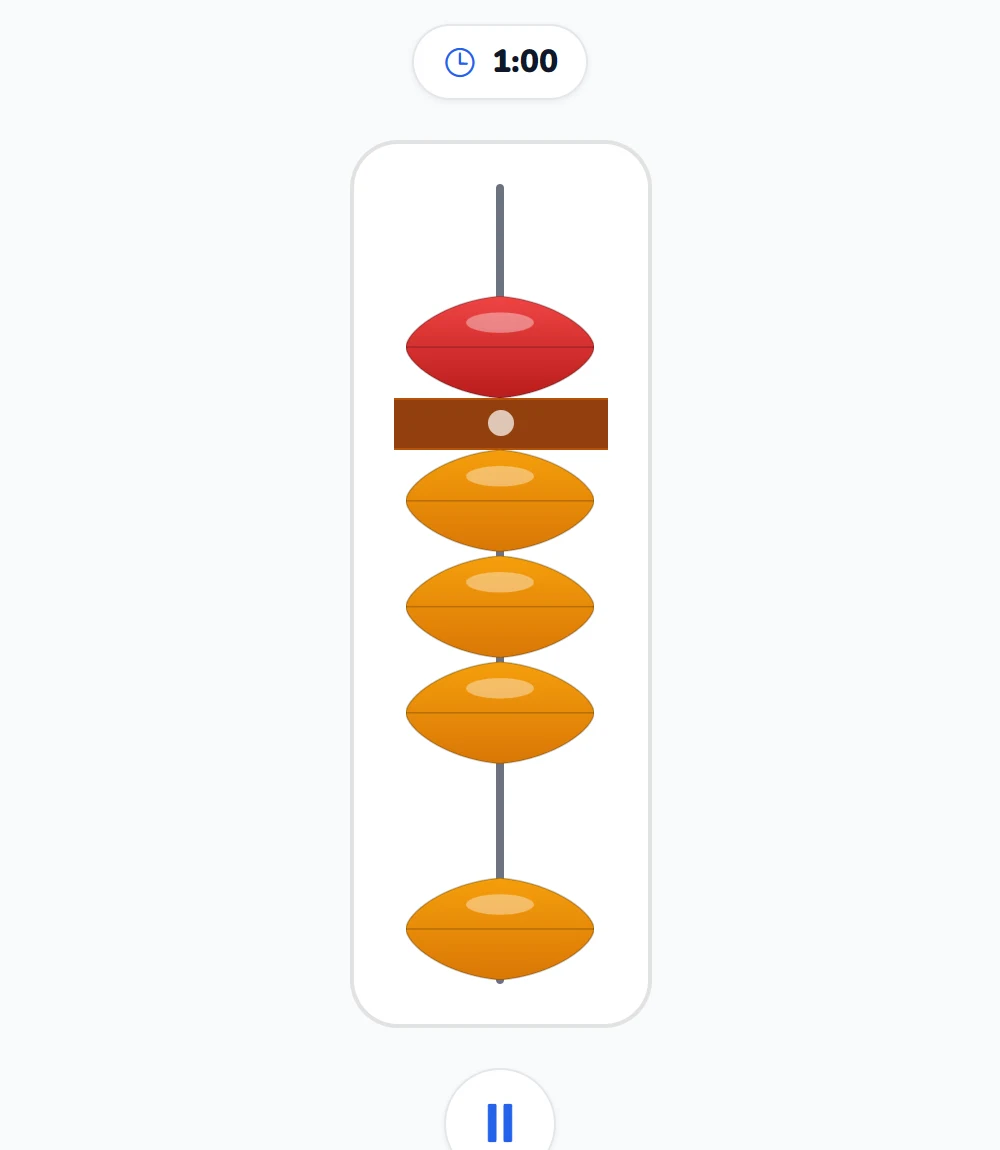
Screen-based practice helps increase speed gradually
Later, numbers can be shown on a screen. At first, slowly. Then faster. For example: 3 seconds; 2 seconds; 1.5; 1 second; and then faster depending on the child's level.
At high speeds, digital presentation becomes especially useful because it is difficult for a teacher to maintain very precise timing manually.
Audio practice develops another channel
When the child hears a number, they need to recognise it, create the mental-abacus image and perform the action immediately.
This differs from visual presentation. That is why audio and screen-based exercises do not replace each other. They develop and test different aspects of the skill.
How Amavit helps maintain the balance
In Amavit, the teacher can combine:
- physical practice outside the platform;
- workbooks;
- flashcards;
- screen-based exercises;
- audio;
- mental calculation;
- different speeds;
- different chain lengths;
- different digit lengths;
- mixed topics.
The digital platform therefore should not replace the physical abacus. It should complement it. That distinction is essential.
A digital platform should not push children away from the real abacus
That would be the wrong approach. The purpose of digital learning is not to say:
“Now the physical abacus is unnecessary.”
Its purpose is to provide things that the physical tool alone cannot deliver as efficiently. For example: precise speed control; large volumes of structured practice; audio formats; mixed-topic training; analytics; progress tracking.
The physical abacus continues to perform its own methodological role.
Amavit is not designed to replace the physical abacus or the teacher. It is designed to extend what both can do.
How do we know whether the physical–mental balance is right?
Not by one fixed percentage. By the result. If the child:
- uses correct technique;
- works stably mentally;
- retains older topics;
- can learn new material;
- increases speed;
- can return to the physical abacus easily when needed,
then the system is working.
What if mental calculation develops faster than physical technique?
Sometimes a child can produce impressive simple mental results while the physical foundation is still weak. This can create a strong early wow effect. But later, more complex topics become difficult.
That usually means the visible mental result appeared before the underlying mechanics were fully developed. In that case, the physical component should be strengthened.
What if physical practice remains almost everything for too long?
That can also become a problem. If the child has studied for a long time, has strong technique and understands the topics, but mental practice remains minimal, the internal image does not receive enough training.
So both extremes should be avoided. Do not remove physical practice too early. But do not be afraid to develop mental calculation either.
Parents do not need to calculate percentages at home
There is no need to say:
“Today exactly 17% of practice must be physical.”
That is not the point. The percentages are only an illustration of the general principle. The teacher determines the balance. Parents mainly need to understand:
the higher the level, the larger the mental component becomes — but physical abacus practice should not disappear completely.
The right question is not “When should the abacus be removed?”
A better question is:
“What role should the physical abacus play at the child’s current stage?”
At the beginning — the main role. Later — a smaller role. During a new complex topic — a larger role again. At an advanced stage — a supporting and diagnostic role.
That reflects the real learning process much more accurately.
The goal is not to remove the physical abacus. The goal is to make mental calculation strong enough that the physical abacus becomes a smaller — but still useful — part of training.
The main conclusion
The physical abacus should not be completely removed from mental arithmetic training. It accompanies the child through almost the entire program.
At first, it makes up almost all practice. Then it gradually gives way to mental calculation. At a mature stage, its share may fall to roughly 10–20%. But it still remains useful for:
- maintaining technique;
- learning new operations;
- multiplication and division;
- diagnosing errors;
- returning to fundamentals;
- preserving the connection between physical mechanics and the mental model.
So the right progression is not:
physical → remove it → mental.
It is:
physical → physical + mental → mostly mental + regular return to physical.
And as the child advances, an interesting paradox appears: the physical abacus may be used less often, but its role remains extremely important.
Frequently asked questions
When should a child stop using a physical abacus?
In most well-structured programs, the physical abacus does not need to disappear completely. Its share usually decreases as mental calculation becomes stronger.
Can mental calculation begin while a child still uses a physical abacus?
Yes. Physical and mental practice can develop in parallel, with mental exercises often using material that is already stable physically.
How much physical abacus practice should advanced students do?
There is no universal percentage, but around 10–20% can be a practical guideline for maintaining technique and supporting advanced learning.
Why do advanced students still use a physical abacus?
It can help maintain technique, learn new algorithms, diagnose mistakes and reconnect the mental image with the original physical structure.
Do multiplication and division still require a physical abacus?
Physical abacus practice can be very useful when multiplication and division are first introduced because the child needs to understand place value and the structure of new algorithms.
Is returning to a physical abacus a sign that a child is going backwards?
No. Returning to physical practice can be a normal part of learning a new topic, correcting technique or diagnosing a mental-calculation problem.