How Education Academies Can Add Online Payments Without Building Their Own Payment System
As an education academy grows, payments often become one of the most repetitive administrative tasks.
When there are only a few students, the process is simple. A parent makes a payment. A manager checks the transaction. The payment is marked in a spreadsheet. If something is unclear, the manager contacts the parent.
But when an academy grows to 100, 300, 500 or 1,000 students, manual payment tracking starts to become unreliable. Questions appear: Who has paid? Which child was the payment for? Which period does it cover? Which group does the student belong to? Which payments are still outstanding? Which transactions cannot be identified?
At that point, many academies begin to think: “We need a proper online payment system.”
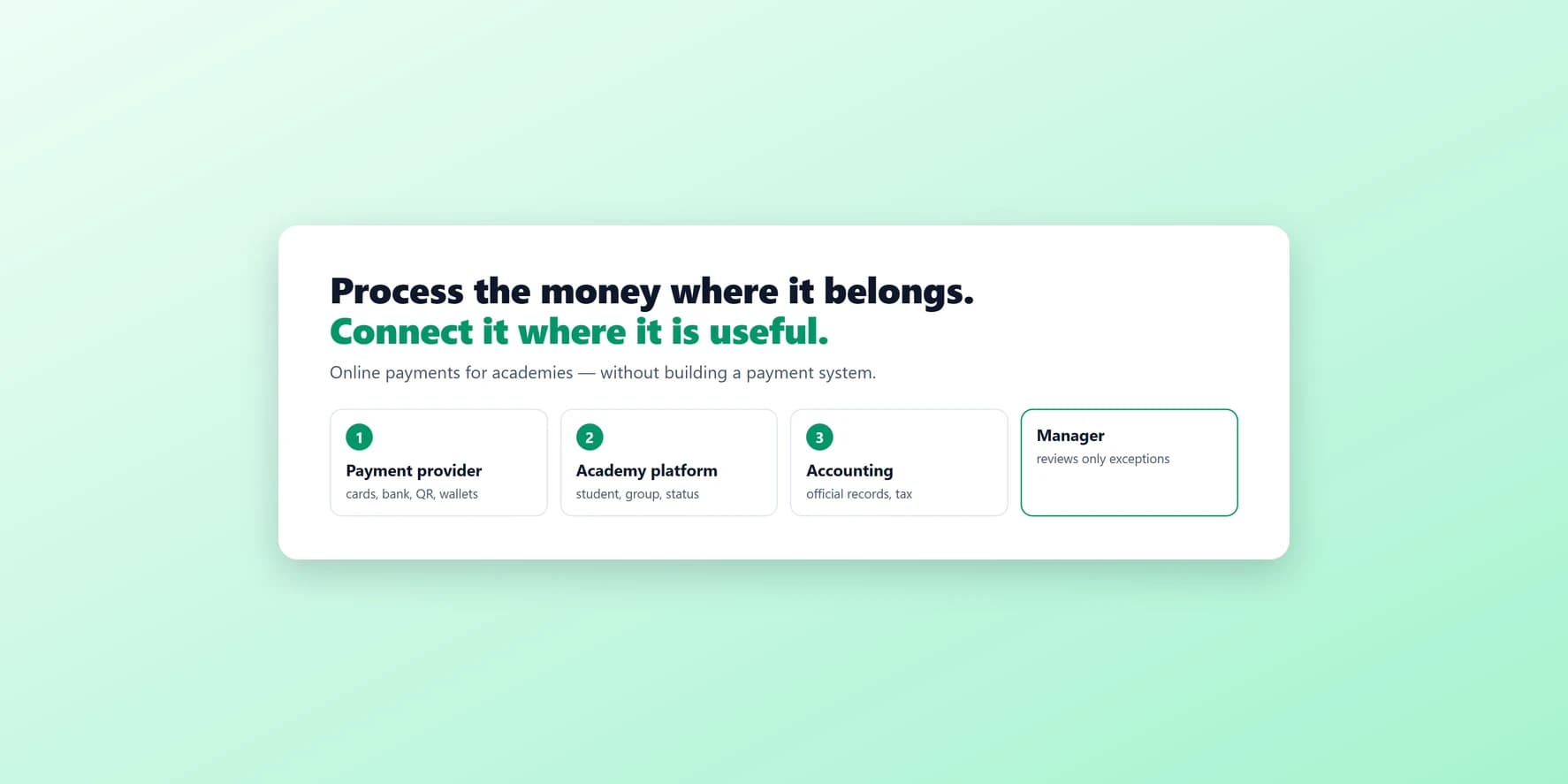
Education academies do not need to build their own payment infrastructure. A specialised payment provider can process transactions while the academy platform connects payment status with individual students, groups and operational workflows. This reduces manual reconciliation without turning the academy into a payment company.
- Payment provider Card / bank / QR / wallet · transaction processing · payment security
- Academy platform Student · group · payment status · manager workflow
- Accounting Official records · tax and financial reporting
Process the money where it belongs. Connect the information where it is useful.
An academy does not need to become a payment company
This is the first important point. To accept payments online, an academy does not need to build its own bank, store card details, develop its own payment processor or process card transactions itself.
That is the role of banks, payment gateways and specialised payment providers. They handle the financial transaction. The role of the academy platform is different: connect the payment with the student and the academy workflow.
The goal is not to build a payment system. The goal is to connect payments with students.
The real problem is usually not receiving the money
Most academies can already receive money somehow. The real problem begins afterwards. The manager has to understand who paid, which student the payment belongs to, which course, which month, which group and whether anything is still outstanding.
So the real value is not simply a payment button. It is the connection between the payment and the student record.
Manual reconciliation works only up to a certain scale
Imagine an academy with 30 students. A manager can open the banking app and check transactions manually. That may take only a little time.
Now imagine 300 students. Every month, hundreds of transactions need to be checked. And the payer's name may not match the student's name. For example:
Student: Arjun Sharma · Payment received from: Priya Sharma
The manager now has to work out: Who is this? Which student is the payment for? Which group? Which month? That becomes administrative work.
More students mean more unidentified payments
Typical situations include: the parent did not include the student's name; another relative made the payment; several months were paid together; the amount is different from expected; the payment arrived late; the payment came from another bank account.
Without a connected system, the manager has to investigate these cases manually.
Online payments should not exist separately from the academy
A weak setup looks like this: the payment provider is separate; the student database is separate; the schedule is separate; the manager manually matches everything together.
A stronger setup looks like this: the student already exists inside the academy system; the payment is connected with that student; the manager sees the relevant status inside the same operational workflow — the idea behind one platform for academy owners, managers, teachers and students.
Payment gateway and academy platform are different things
This distinction is important.
The payment gateway handles
The transaction · cards · local payment methods · bank processing · payment authorisation
The academy platform handles
The student · the group · the service · access · payment status · academy operations
The two systems can work together.
Payment provider = transaction. Academy platform = context.
Academies should be able to use payment providers suitable for their market
Different countries use different payment methods. In some markets, parents prefer cards; in others, bank transfers, local payment methods, digital wallets or QR payments. That is why academies should be able to work with payment infrastructure that makes sense in their own market. A single payment method is rarely ideal for every country.
Local payments matter: the right payment method depends on the academy's market.
This is especially important for international education businesses
An academy in India, Brazil, Cyprus, Vietnam or Bangladesh may face completely different payment habits and payment infrastructure. The technology platform therefore needs flexibility around local payment solutions.
What can the payment flow look like?
- Parent enters the academy environment
- Sees a payment option
- Continues to the payment provider
- Completes the payment
- Provider confirms the transaction
- Payment information returns to the academy workflow
- Manager sees it connected with the correct student
This can remove a significant amount of manual reconciliation.
The experience is better for parents too
Parents should not need to ask every month: “Where should I send the money?” “How much do I need to pay?” “What should I write in the payment reference?” “Did you receive it?” A clear payment flow creates a much better customer experience.
Managers receive fewer repetitive questions
This matters more than it may seem. Managers can receive dozens of small payment-related questions every day: “We have paid.” “Can you check?” “Did you receive the payment?” “What are the bank details?” “How much is due?” Each question takes only a little time. Hundreds of them become hours of work.
Explore Amavit for schools & academies. Connect academy operations, students and payment-related workflows in one environment. Amavit for academies.
Payment status can be linked to the student
This is far more useful than a separate spreadsheet. For example:
| Student | Status |
|---|---|
| Student A | Paid |
| Student B | Pending |
| Student C | Payment issue |
The manager immediately sees the context. There is no need to search for the same person in another system.
This becomes more valuable with multiple groups and programmes
If the academy offers different programmes, different teachers, different groups and different pricing, manual reconciliation becomes even more complicated. Payment information should ideally be linked to the relevant student record.
Manual
Bank → search payer name → find student in Excel → check group → mark as paid → message parent if unclear
Connected
Parent pays → provider confirms → student status updates → manager reviews only exceptions
Manage exceptions — not every transaction.
Part of the workflow can be automated
With deeper integration, payment status can potentially connect with access rules. For example: payment confirmed; access remains active.
However, this kind of automation needs to be handled carefully. A student should not accidentally lose access because of a technical issue. The academy should retain administrative control.
Financial decisions should remain with the academy
The platform can display information, connect payments with students, support managers and automate parts of the workflow. But the academy still makes the business decisions: offer a grace period; apply a discount; correct a payment manually; carry forward credit; handle an exceptional case.
Software should support customer service, not prevent it.
Payment integration is especially useful for recurring tuition
If parents pay monthly, quarterly, for lesson packages or for a full course, the same process repeats again and again. That makes payments a strong candidate for automation.
The more often a process repeats, the more valuable automation becomes
Suppose an academy processes 300 monthly payments. That means 3,600 payment events per year. Even if checking each payment takes only a small amount of time, the annual workload becomes significant.
Example: 250 students × 12 monthly payments = 3,000 payment events per year. Even small manual steps become expensive when repeated thousands of times.
An illustrative calculation, not a statistic.
Online payments are not only about saving time
There is another benefit: a more professional customer experience. Parents see a clear payment process, a connection with their child and one academy environment. That usually feels more professional than: “Send the money here and then send us a screenshot in WhatsApp.”
Screenshot-based payment confirmation does not scale well
With 20 students, it may be manageable. With 500 students, it becomes difficult. The manager receives screenshots, messages, bank notifications and spreadsheets — then manually reconstructs the financial picture. This is exactly the type of workflow that benefits from a system.
Payments can be part of the academy's branded experience
If a parent enters through the academy website and sees their child, schedule, practice, progress and payment information, the experience feels like one connected academy service. This also strengthens the academy brand — see how a white-label learning platform can make a small academy look like a large education brand.
This is particularly relevant to academy-sponsored Premium
An academy can use two models.
Model 1: Parents purchase Premium individually
Digital Premium remains an optional family decision.
Model 2: The academy provides Premium to all students
The academy covers Premium centrally. Families do not need to purchase Premium separately.
Academy-sponsored Premium can be included in tuition
For example, monthly tuition can already include lessons, homework, digital practice, Premium games, mobile access and progress tools. This can simplify the customer journey significantly. The parent makes one payment to the academy. The academy then provides the complete educational package.
This allows the academy to sell one complete product
Instead of selling lessons + separate app, the academy can offer one complete education package. For example: 8 lessons; workbooks; digital practice; Premium; academy platform. That can create a stronger overall offer.
One Premium model also simplifies teaching
If parents choose digital options individually, students may have different access levels. One child has Premium. Another does not. Teachers then have to account for those differences. When the academy includes Premium for everyone, the service becomes more consistent.
But academy-wide Premium should remain optional
Not every academy needs this model. That is why both options are useful: family-paid Premium or academy-sponsored Premium. Flexibility is better than forcing every academy into the same commercial model.
Discuss academy-wide Premium. Include Premium access for all students under one academy agreement. Amavit for academies.
Payment integration does not necessarily mean changing banks
An academy may already have a business account, a bank, a payment provider or a local gateway. The goal should not automatically be to replace the academy's financial infrastructure. The goal is to connect a suitable payment solution with the academy workflow where possible.
Local payment reality matters
One market may favour cards. Another may favour QR payments. Another may rely heavily on bank transfers. Another may use wallets. A useful academy platform should take local payment habits into account.
Security matters more than convenience
Payment integration should not mean the academy starts storing sensitive card data itself. It is usually better for payment credentials to remain with a specialised provider. The academy platform only needs the information required for the operational workflow. That creates a cleaner division of responsibility.
Academies do not need their own payment development team
Building payment infrastructure from scratch introduces an entirely new technical project: security; bank integrations; compliance; payment APIs; error handling; refunds; transaction statuses; testing. For a small or medium-sized education business, that is rarely a sensible core activity — the same logic as in why small academies should not build their own learning platform.
The academy should focus on the business workflow
The academy needs to decide what it sells, how much it costs, which student paid, which service was purchased and how exceptions are handled. It does not need to solve the technical problem of how card processing works.
Payment information is especially valuable for managers
The manager should not only see “Money arrived.” They need context: which student; which group; which period; which status. That makes daily work much faster.
Managers should handle exceptions — not manually reconcile every payment.
Owners need a clearer view too
The academy owner may need a higher-level view: payments received; pending payments; payment issues. Instead of manually combining several sources, the information can be connected to the operating workflow.
An academy platform should not try to replace accounting software
This is another important boundary. A learning and management platform does not need to replace accounting, tax reporting, banking or professional financial software. Its role is to connect payment information with academy operations. That is different.
A clean architecture looks like this
- Bank / payment provider Processes the money
- Academy platform Connects the transaction with the student and academy workflow
- Accounting system Handles official financial records and reporting
Each system does its own job.
That is safer than trying to put everything into one product
There is no need to make one learning platform simultaneously become a bank, an accounting system, a payment processor, an ERP and a CRM. The goal is to connect the important workflows.
A learning platform should not try to become a bank or an accounting system.
When should an academy consider payment integration?
It becomes especially useful when:
- there are more than 100 students;
- payments are recurring;
- managers reconcile bank transactions manually;
- parents send payment screenshots;
- there are many unidentified payments;
- there are multiple groups or pricing plans;
- owners want clearer payment visibility;
- the academy plans to scale.
These overlap with the broader signs that your academy needs a management platform.
Payment integration can be introduced gradually
There is no need to automate the entire financial workflow at once. An academy can begin with a payment link; then student-linked status; then manager visibility; then deeper integration. That reduces implementation risk.
- Payment link
- Student-linked status
- Manager visibility
- Deeper integration
Payments are part of the academy's wider digital transformation
Payments should not live completely separately from students, groups, schedules and learning processes. The more these workflows are connected, the less manual administration remains — see how to launch a digital platform for your abacus academy without hiring developers.
Amavit can act as the connecting layer
For academies, Amavit can connect student identity, groups, teachers, practice, homework, schedules and payment-related information. The actual payment processing remains with a specialised provider. That is the right division of responsibility.
The main benefit is not “accepting cards”
Almost any business can accept card payments today. The real benefit is: the payment becomes part of the student workflow. That is where the operational value appears.
Example
Imagine an academy with 250 students. Every month: 250 payments.
Today the manager opens the bank, searches names, compares a spreadsheet, marks the payment and contacts the parent when something is unclear.
With integration: the payment goes through the provider; the transaction is associated with the relevant student; the status is updated; the manager focuses only on exceptions.
The manager no longer has to manually process all 250 payments. They only work with the cases that actually need attention.
That is what good automation looks like
Automation should not necessarily remove people from the process completely. It should remove repetitive work. People then handle only the situations that genuinely require a decision.
The main conclusion
An education academy does not need to build its own payment system in order to accept online payments professionally. A more practical model is to:
- use a specialised payment provider;
- connect it with the academy platform;
- associate payments with individual students;
- give managers clear payment status;
- keep commercial decisions under academy control.
This can mean less manual reconciliation, fewer errors, fewer repetitive messages, a better customer experience and more visibility.
Most importantly: a payment stops being an isolated bank transaction. It becomes part of the academy's wider digital infrastructure.
Simplify academy payments and operations. Request academy access.
Frequently asked questions
Does an academy need to build its own payment system?
No. A specialised payment provider can process transactions while the academy platform connects payment information with students and operational workflows.
Does Amavit process card payments itself?
The payment itself should be processed through an appropriate specialised payment provider or banking solution. Amavit can connect payment-related information with the academy workflow.
Can payment status be linked to a student?
Payment integrations can be designed to associate relevant payment information with individual student records.
Can an academy use its existing bank or payment provider?
Integration options depend on the provider, country and technical setup. The goal is to work with suitable local payment infrastructure where possible.
Can parents pay online from the academy environment?
Depending on the integration, parents can be directed through an appropriate payment flow connected with the academy system.
Can managers see who has paid?
Payment-related status can be incorporated into academy workflows so managers can more easily identify paid, pending or problem cases.
Does the platform replace accounting software?
No. Academy payment management and official accounting are different functions.
Can payments automatically control student access?
Deeper integrations may allow payment status to interact with access rules, but academies should retain administrative control for exceptions and technical issues.
Can Premium be included in tuition?
Yes. An academy can choose a model where Premium is provided centrally to students under an academy agreement.
Can parents still buy Premium individually?
Yes. The academy can also use a model where families choose Premium independently.