How to Subtract on an Abacus: From Simple Movements to Friends of 5 and Friends of 10
At first glance, subtraction on an abacus can seem even easier than addition. You have 4. Remove 1. You get 3. You have 7. Remove 2. You get 5. As long as the required beads can be removed directly, subtraction really is that simple.
But sooner or later, the child reaches an example where the needed beads are not available in the current position. That is where subtraction becomes much more interesting. Because the child no longer needs to think only “What number should I remove?” They also need to understand “What is the correct way to remove it?”
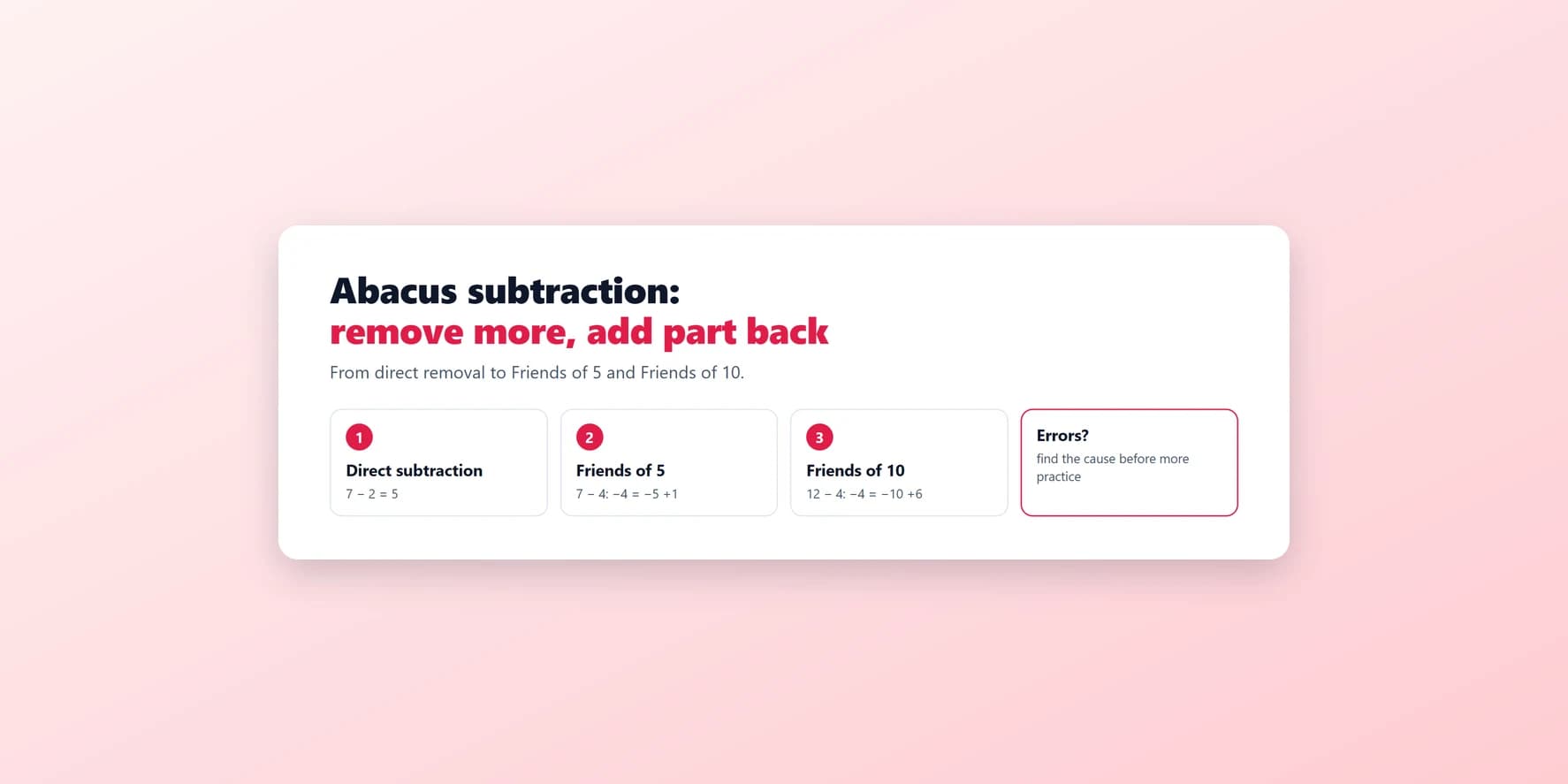
Abacus subtraction begins with direct bead removal. When the required value cannot be removed directly, children use complements to 5 or 10 — commonly called Friends of 5 and Friends of 10 — to complete the operation.
- Direct subtraction — 7 − 2 = 5
- Friends of 5 — 7 − 4: −4 = −5 +1
- Friends of 10 — 12 − 4: −4 = −10 +6
Direct → complement → automatic movement.
First, the child needs to see numbers confidently
I would not rush into subtraction too early. The child should already understand what 1, 4, 6 and 9 look like, where the ones are and where the tens are. If this is still new, start with what an abacus is and how it works.
If the child still has to count beads one by one each time, subtraction quickly becomes too demanding. The number itself should already feel familiar.
The first stage: direct subtraction
The simplest examples are completed directly.
For example, 4 − 1. The child removes one lower bead. The result is 3.
Or 7 − 2. Seven is 5 + 2. The child removes the two lower beads. The result is 5.
No additional rule is needed yet. The basic movements and finger work are described in how to use an abacus.
Why direct subtraction needs to be stable
Later, the child will start using complements. If they are not comfortable with the difference between direct subtraction and subtraction through 5 or 10, they may start using formulas where they are not needed.
This is a fairly common mistake. Sometimes a child knows many rules, but uses them too early and makes a simple example more complicated than necessary.
When direct subtraction is no longer possible
Imagine 7 − 4. On the abacus, 7 is 5 + 2. We need to subtract 4. But there are not four lower beads available to remove directly. So the child needs to use a complement to 5.
Four can be represented as 5 − 1. So in subtraction:
−4 = −5 +1
The child removes 5 and then adds 1 back. The result is 3.
Small Friends in subtraction
Small Friends are the same complements to 5 that appear in addition. But in subtraction, the movement works in the opposite direction:
| Subtract | Movement |
|---|---|
| −1 | −5 +4 |
| −2 | −5 +3 |
| −3 | −5 +2 |
| −4 | −5 +1 |
At first, this can feel strange to a child. They are supposed to subtract 4, but part of the movement involves adding something back. That is exactly why the logic needs to be understood rather than memorised mechanically.
Why children often get confused here
A beginner's natural logic is usually very simple: if we subtract, we should always be taking something away. But with Friends, subtraction may require removing more and then returning part of it.
For example, −4 = −5 +1. Mathematically, the operation is correct. But for a beginner, it is not always intuitive.
Connect the rule to the actual movement
I would not stop at: “Remember: minus four means minus five plus one.” It is much more useful to show:
- what was on the abacus;
- why 4 could not be removed directly;
- what changes after removing 5;
- why 1 needs to be added back;
- what the final value becomes.
Once the child understands the physical movement, the formula stops feeling abstract.
Knowing the formula is not the same as having the skill
A child may correctly say: −3 = −5 +2. But still move the wrong bead, add in the wrong place, lose the current value, confuse the sign or stop halfway through the movement.
So knowing the formula and being able to perform the operation are two different things.
What happens when subtraction crosses 10?
The next stage introduces Friends of 10. For example, 12 − 4. There are only 2 units. So 4 cannot be removed directly from the units rod.
The child can represent 4 as 10 − 6. So:
−4 = −10 +6
The child removes one ten and adds 6 to the units. The result is 8. This is where subtraction begins to involve place value much more actively.
Big Friends in subtraction
Big Friends, or Friends of 10, are complements to 10. The basic pairs are 1 and 9; 2 and 8; 3 and 7; 4 and 6; 5 and 5. They are used when a subtraction operation cannot be completed directly within the current place value. For example:
Again, the goal is not just to memorise a table. The child needs to understand what the movement is doing. Both families of Friends are explained together in what are Small Friends and Big Friends in mental arithmetic.
Why subtraction can feel harder than addition
With addition, the child often thinks: add; increase; move forward. Subtraction can require more mental control. The child may need to remove, add part back, cross place values, hold the current result and remember the correct complement.
It becomes especially demanding when several things appear together: Friends, longer chains, higher speed and multiple digits.
Do not introduce every rule at once
This matters especially in subtraction. If the child learns −1, −2, −3, −4 and Big Friends at the same time, the rules can start mixing together.
It is usually better to work with one topic at a time: learn one relationship; complete several short practice sets; make sure the movement is stable; then move on.
Different methodologies may use different sequences
As with addition, Small Friends and Big Friends can be taught in different orders. Small Friends may be introduced 1 → 2 → 3 → 4 or 4 → 3 → 2 → 1. Big Friends may be taught 1 → 2 → 3 → … → 9 or 9 → 8 → 7 → … → 1.
One school may use one sequence. Another may use another. The mathematics does not change. The methodology does.
Why software should not force one sequence
If a teacher already has a programme that works, they do not need software telling them: “No, teach this topic first and that one later.” Technology should support the chosen methodology.
In Amavit, each Friend is a separate topic the teacher selects individually, so the teacher decides the order. Teachers and academies do not need to rebuild their curriculum around the platform.
Repeated errors are especially important in subtraction
Subtraction shows very clearly why it is not enough to count mistakes. You also need to understand their cause.
Suppose a child repeatedly gets 7 − 4 wrong. You could simply give them another 50 similar examples. But if the reason for the error is not fixed, the child may repeat the wrong movement 50 more times. That is not useful practice.
First, identify the type of error
I would check:
- Does the child know the rule?
- Do they understand why it works?
- Are the bead movements correct?
- Are they confusing plus and minus inside the rule?
- Do they lose the current value during the transition?
- Is the speed too high?
- Does the error happen only in chains, or even in a single example?
These are very different problems. A full step-by-step method is in how to find the exact cause of repeated abacus subtraction errors.
- Wrong rule?
- Wrong movement?
- Lost place value?
- Too much speed?
- Attention?
- Only in long chains?
Fix the cause before adding more repetitions.
If the child only makes errors at higher speed
Then the topic may actually be understood. The automaticity simply may not be stable yet. In that case, the answer is not more speed. The answer is usually to slow down. Restore clean movement. Then increase the pace again gradually.
If the error happens even slowly
Then the problem is deeper. Return to the physical abacus, single examples, the rule itself and the correct movement sequence. That is where the cause is more likely to become visible.
If the rule is known but the finger movement is wrong
Then the problem is technique. This is another reason why the teacher remains important. A digital trainer can see a correct answer, an incorrect answer and response time. But it may not always see the actual finger movement. New technique still needs teacher supervision — the finger technique checklist shows what to watch for.
Short chains are often better than huge practice sets
After learning a new rule, I would not immediately give a chain of 30 or 40 operations. A better progression may be 3 operations, then 5. Then check whether accuracy remains stable.
This matters especially in subtraction, where a child can lose track of the intermediate value.
A good practice set
If the child is learning one particular rule, create a short chain where that rule appears several times. The examples do not need to be identical. The goal is for the child to recognise the situation, choose the correct rule and avoid relying on one repeated pattern.
Do not increase everything at once
If a child has just started solving a new topic successfully, do not immediately increase speed, digit length and chain length, or add another topic. That changes too many things at once.
It is more useful to change one variable. Then you can actually see what made the task harder.
- New rule
- Physical abacus
- Teacher checks movement
- Short chains
- Repetition
- Gradual speed increase
- Mental practice
Good subtraction practice.
How physical subtraction connects to mental subtraction
Mental subtraction is built on the same movements the child first performs physically. At first, they physically remove, return part of a value, cross 5 and cross 10. Later, these movements gradually become internal visual actions.
That is why the quality of physical technique matters so much for future mental work — see physical vs mental abacus.
The physical abacus is especially useful for correcting subtraction errors
If a child keeps making the same mistake in mental subtraction, I often prefer to bring the same type of operation back to the physical abacus. It immediately becomes easier to see where the transition breaks down, what the child forgets, when the current value is lost and which movement is incorrect.
This is far more useful than simply saying: “Be more careful.”
Where workbooks help
A workbook is useful for slower practice, reviewing rules, homework and working with the physical abacus. But a workbook does not react to errors. If a child performs the same movement incorrectly 20 times, the workbook simply continues.
Where digital practice helps
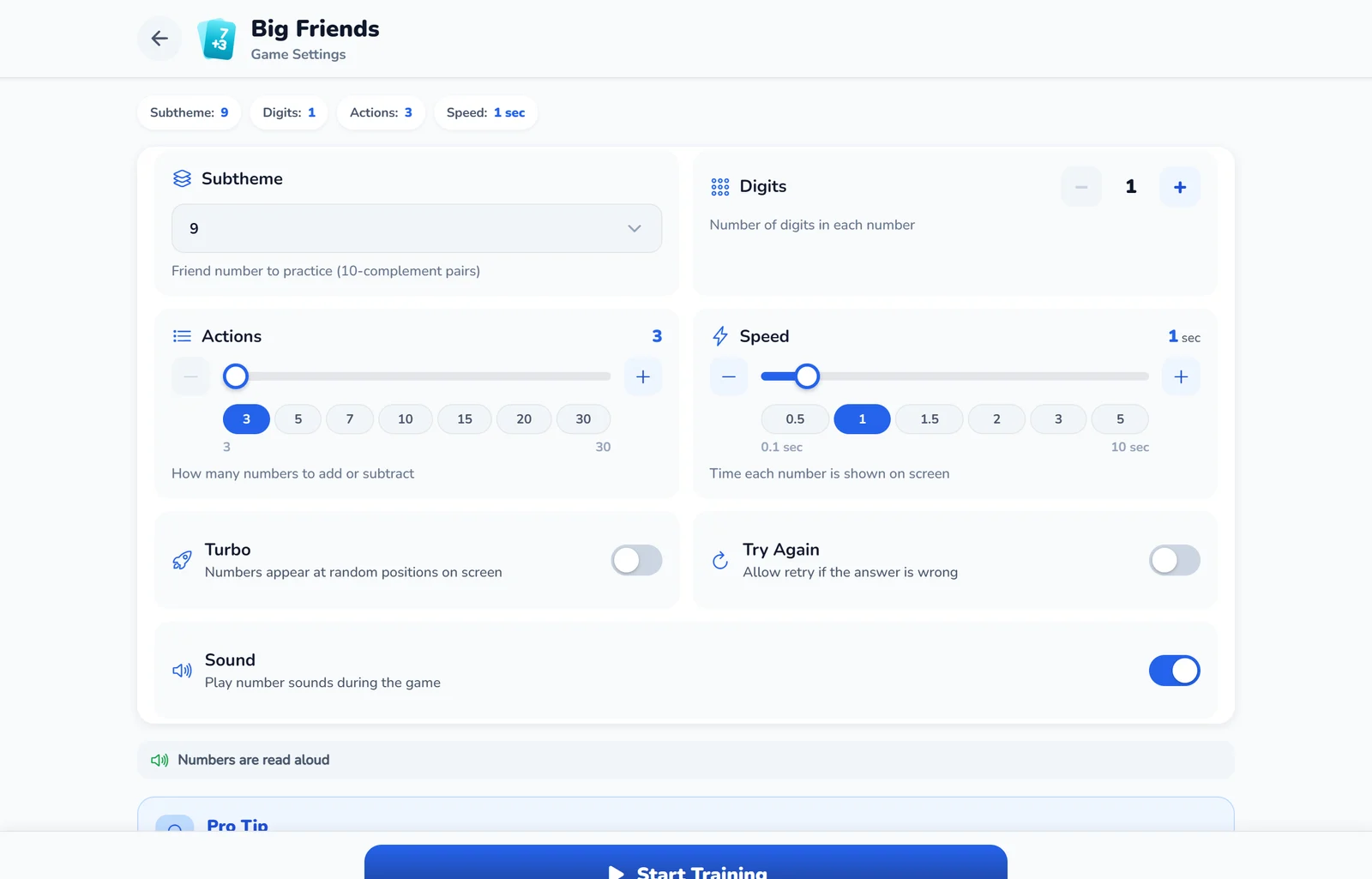
A digital trainer can:
This is where digital practice becomes especially useful.
But adaptive practice is not the same as teaching new technique
If a child does not yet know how to subtract correctly through a Friend, the solution is not simply to give them hundreds of examples. First: explain the rule; show the correct movement; check several examples. Then: independent practice.
That sequence matters.
How this can work in Amavit
The teacher chooses the topic. The child practises it. With Auto difficulty on, speed and the number of operations follow the child's results, and the Recommended card points the child to the game where accuracy is lowest — so a weaker area gets more attention. See online abacus practice with an adaptive trainer.
At the same time, the teacher can keep their own learning sequence. This is especially important for academies that have used their own methodology for years — see how teachers use Amavit as a practice trainer.
Subtraction shows the value of adaptive practice very clearly
Imagine two students. One is confident with Friends of 5 but repeatedly struggles with Friends of 10. The other has the opposite problem.
There is little value in giving both children exactly the same practice in exactly the same volume. Each child benefits more from extra work in the area that is currently less stable.
Strong topics should not disappear completely
If a child has learned a topic well, it can still return occasionally. The skill needs maintenance. The difference is frequency. A weak topic may appear more often. A strong topic may appear less often, but not vanish completely.
When should speed increase?
I would look at three things: accuracy, stability, technique. If the child is solving confidently at the current pace and the movement remains clean, speed can increase slightly. If errors suddenly rise after the increase, the child is probably not ready yet.
When should mental subtraction begin?
Once the physical movement is clear enough. The child needs a stable internal picture of crossing 5, crossing 10 and what happens to the neighbouring rod. Then those movements can gradually move into mental calculation.
What I would avoid
I would not:
- teach every formula at once;
- increase speed just to produce an impressive result;
- make a child repeat the same mistake hundreds of times;
- remove the physical abacus too early;
- mix several methodologies unnecessarily;
- judge a child's ability based on one bad practice session.
An error is information
I think this is an important way to look at mistakes. An error is not simply “the wrong answer.” It is information. It shows where the learning process is still unstable.
If the teacher understands the error correctly, it becomes useful guidance for what should happen next — see also how to work with mistakes and weak topics.
Good progress in subtraction is not only about speed
A child is also progressing when they:
- confuse the rules less often;
- recognise the correct Friend more quickly;
- make cleaner movements;
- lose fewer intermediate values;
- hold longer chains;
- work across 10 more confidently;
- begin transferring physical movements into mental calculation.
These are all meaningful improvements.
The main idea
Subtraction on an abacus begins with a very simple action: remove a bead. But later, the child begins working with number relationships. Sometimes, to subtract a value, they need to remove more, then add part back. First around 5. Then around 10.
And this is exactly where it becomes especially important not to focus only on the number of examples. If a child is making mistakes, first ask: Why is the mistake happening? The rule? The technique? The speed? Attention? Place value? Only then should more practice be added.
Because good subtraction is not built on the number of repetitions. It is built on the number of correct repetitions.
Frequently asked questions
How does subtraction work on an abacus?
Children begin by removing beads directly. When the required value cannot be removed directly, they use complements to 5 or 10 — Friends of 5 and Friends of 10 — to complete the operation.
What is direct subtraction on an abacus?
It is subtraction where the needed beads can simply be removed, such as 4 − 1 or 7 − 2, without any additional rule.
What are Friends of 5 in subtraction?
They are complements to 5 used in the opposite direction to addition: −1 = −5 +4, −2 = −5 +3, −3 = −5 +2 and −4 = −5 +1.
What are Friends of 10 in subtraction?
They are complements to 10 used when a value cannot be removed within the current place value, for example −4 = −10 +6: remove one ten and add 6 to the units.
Why does a child add something back during subtraction?
Because the needed beads are not available to remove directly. The child removes more — 5 or 10 — and then returns the difference. For example, 7 − 4 is done as −5 +1.
Why is abacus subtraction sometimes harder than addition?
The child may need to remove, add part back, cross place values, hold the current result and remember the correct complement — all at the same time.
What should I do if the same subtraction error keeps repeating?
Find the cause first: the rule, the movement, place value, speed or attention. Slow down and return to the physical abacus and single examples before adding more repetitions.
When should subtraction speed increase?
When the child solves accurately and consistently at the current pace and the movement stays clean. If errors rise after an increase, return to the previous pace.
Can digital practice help with abacus subtraction?
Yes. It helps with repetition, automatic checking, focus on a specific topic and gradual changes in speed and chain length. New technique still needs a teacher.
Teach your own sequence with Amavit
Keep your methodology while giving students structured subtraction practice between lessons.
Explore Amavit for TeachersFree for teachers