When Does an Education Academy Really Need Its Own Digital Platform?
A small education academy can operate successfully for quite a long time without a complex digital system. A few groups. One or two teachers. Scheduling in Google Calendar. Homework through WhatsApp. Students listed in Excel. Payments checked manually. At a certain stage, that can be completely sufficient.
The problem appears later. The academy grows. There are more students. More teachers join. Managers appear. Scheduling becomes more complicated. There is more homework, more payments, more information. And at some point, the simple system that used to work begins to slow the academy down.
The real question becomes: how do you know when your academy has outgrown manual management and needs one connected digital platform?
An academy usually needs a management platform when manual tools begin creating more administrative work than they save. Common signs include too many spreadsheets and chats, duplicated student data, scheduling errors, excessive teacher administration, limited owner visibility and plans to scale to more students, teachers or branches.
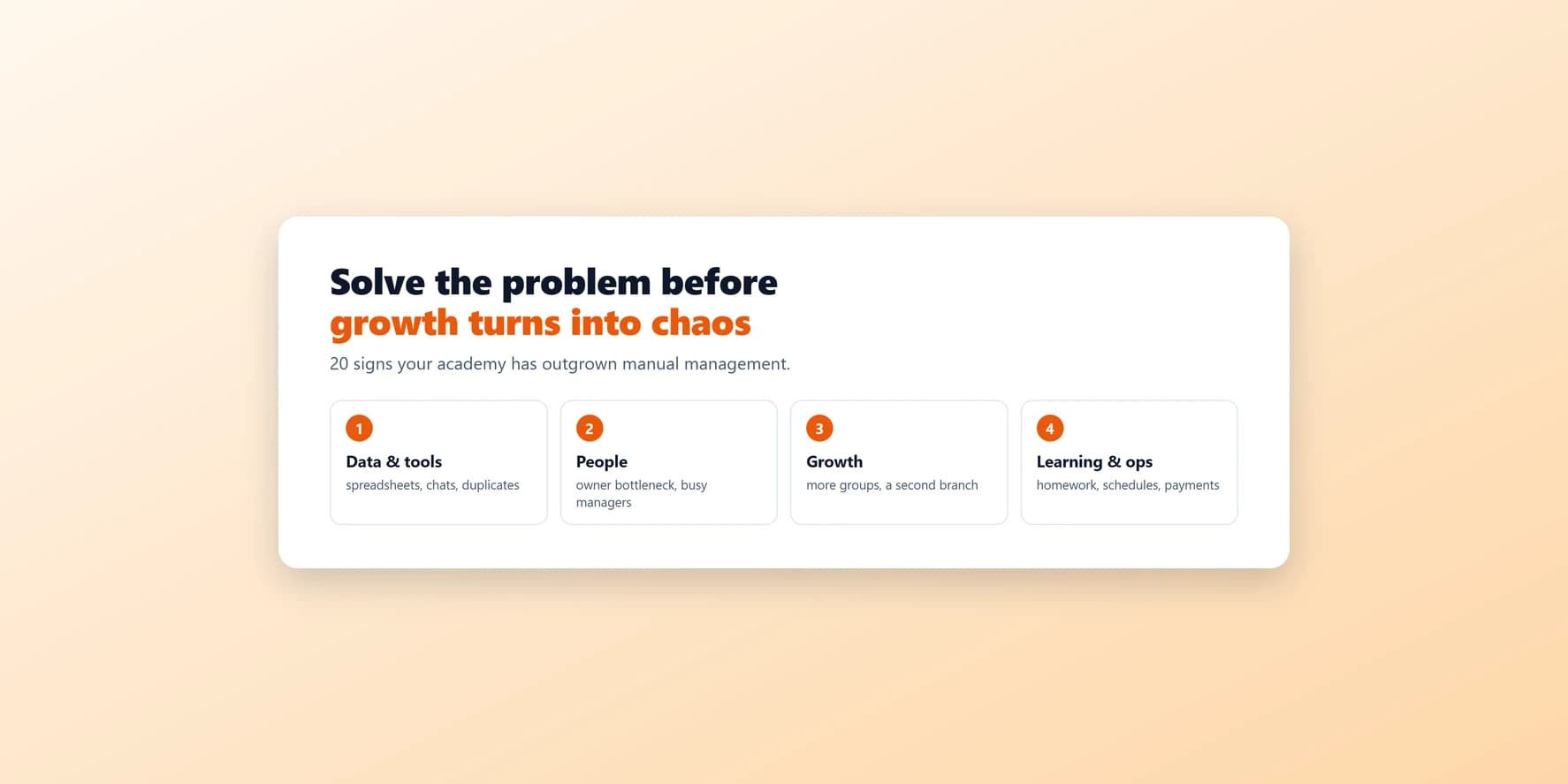
| Data & tools | People | Growth | Learning & operations |
|---|---|---|---|
| Too many spreadsheets | Owner is the bottleneck | More students | Homework is difficult to manage |
| Too many disconnected apps | Managers spend too much time on routine | More groups | Weak topics are hard to identify |
| Duplicate information | Teachers become administrators | Second branch | Scheduling causes errors |
| WhatsApp as a database | Different staff follow different processes | Plans to scale | Payments are disconnected |
| Information leaves with employees | Parents repeatedly ask the same questions | Administration grows too quickly | Students need one digital experience |
20 signs your academy has outgrown manual management. The more boxes you check, the more valuable centralisation becomes.
You do not need a platform just because it is trendy
This is important. Not every small school immediately needs a complex CRM, a mobile app, advanced analytics or dozens of automations. If an academy operates comfortably with 20–30 students using a few simple tools, there is no reason to make the business more complicated.
A digital platform becomes valuable when the existing way of working starts to consume too much time, create errors, reduce visibility, make the customer experience worse or limit growth.
Do not introduce technology because it is fashionable. Introduce it when manual operations start limiting growth.
Sign 1: Too much information lives in different places
For example: students in Excel; schedules in Google Calendar; homework in WhatsApp; payments in another spreadsheet; results stored by individual teachers; parent contacts in a manager's phone.
Each tool may work perfectly well on its own. The problem begins when information constantly has to be moved manually between them — which is exactly what one platform for owners, managers, teachers and students is meant to solve.
More manual transfers mean more errors
A child moves to another group. One spreadsheet is updated; another is not. The teacher receives the old information; the parent receives the new information. Then everyone has to work out which schedule is correct, which group the student belongs to and which homework should be completed.
This is not necessarily an employee problem. It is a process problem.
Sign 2: The owner cannot understand what is happening without asking everyone
When an academy is small, the owner may know almost everything: all the teachers, all the groups, many parents, who paid, who missed a lesson, who has a problem. Growth eventually makes this impossible.
If the owner constantly has to ask “How many active students do we have?”, “Who teaches this group?”, “Why has this group become inactive?”, “Who has not paid?” or “What is happening with this student?”, then the information is no longer organised in one clear place.
Sign 3: Managers spend most of their day searching for and moving information
A manager should be able to support clients, solve organisational issues, help teachers, manage schedules and handle new enquiries. But often, a large part of the day is spent searching through chats, updating spreadsheets, copying information from messages into Excel, reconciling payments, sending the same messages repeatedly and searching for the correct homework.
That is a warning sign. If a qualified employee spends too much time on mechanical tasks, some of those processes should move into a system.
Sign 4: Student numbers grow — and administration grows at almost the same rate
Imagine one manager supports 100 students. Then the academy grows to 200 students, and a second manager is immediately required. Then 400 students — more administrative staff are needed.
Sometimes this is unavoidable. But if the administrative team grows almost proportionally to student numbers, the operating model may not be scaling well. A good digital system should allow the academy to support more students without increasing manual work at the same rate.
Growth without a platform
50 students → manageable · 100 → more spreadsheets · 300 → more managers · 500 → duplicated processes · 1,000 → operational chaos
Growth with systems
Students increase → processes stay structured → administration grows more slowly
Your administration should not grow at the same speed as your student base.
Sign 5: Teachers spend too much time on administration
Teachers should teach. But gradually their workload may start to include sending links, reminders, checking hundreds of answers, searching for results, discussing homework individually, tracking students and looking for old assignments.
At that point, the teacher is partly becoming an administrator. That is expensive. The time of a strong teacher is usually more valuable than the time required for a task that can be automated.
Sign 6: WhatsApp becomes the main operating system of the academy
WhatsApp is excellent for communication. But it is a poor database. It is useful for contacting a parent, announcing a schedule change or answering a question. It is not ideal for storing homework history, managing hundreds of students, controlling groups, analysing results, seeing the academy-wide schedule or tracking payments.
If most business processes live inside chats, the academy becomes dependent on message search — see moving abacus homework beyond WhatsApp.
Messenger = communication. Platform = structured operations.
Messages remain useful. But structured data should live in a structured system.
Sign 7: Scheduling becomes a constant source of problems
With one teacher and two groups, scheduling is simple. Later there may be multiple teachers, dozens of groups, individual lessons, substitutions, rescheduled classes, new students and multiple branches. Every change may need to be communicated to several people.
If the schedule exists simultaneously in a calendar, in Excel, in WhatsApp and in the teacher's phone, mistakes become almost inevitable.
Sign 8: It is difficult to understand what students do between lessons
The academy may run excellent lessons. But several days pass between them. What does the child do during that time? Do they practise? Do they complete homework? What is the result? Where are the errors?
If this information is missing or exists only with individual teachers, the academy has very little visibility into a large part of the learning process.
Sign 9: Homework has become difficult to manage
When there is one group, it is easy for a teacher to say: “Complete page 12.” But when a teacher has several groups, different levels, different topics and individual students, homework becomes an administrative system of its own — especially when the teacher needs to assign different tasks, attach materials, check completion and review results.
This is where a digital platform can save significant time — see how to manage multiple abacus groups.
Sign 10: The academy cannot quickly identify a student's weak areas
In a manual system, the teacher can see a correct answer or an incorrect answer. But with many students, it becomes difficult to systematically track which topics produce errors, how accuracy changes, how speed changes, where a problem begins and how long it continues.
Some of this work is better handled with structured data — see how to track student progress in abacus classes.
Sign 11: Every teacher has a completely different administrative process
One teacher uses WhatsApp. Another sends PDFs. Another uses Google Classroom. Another sends nothing.
From a teaching perspective, teachers may differ. That can be perfectly fine. But the academy's customer experience becomes inconsistent. The parent's experience depends entirely on which teacher they happen to get.
Standardise the service — not the teacher
Teachers can still have different lesson styles, different practice intensity and different methodological decisions. But the basic service can remain consistent: where schedules are, where homework is, where practice happens, where results are stored, where users log in. That strengthens the academy as a brand.
Sign 12: Parents repeatedly ask the same questions
“What time is the lesson?” “Where is the homework?” “Did our payment arrive?” “What was the result?” “Where is the link?” “How do we log in?”
If managers repeatedly answer the same questions, the problem may not be the parents. The information may simply be poorly organised.
Sign 13: The academy wants to look more professional
Sometimes the issue is not only internal. There is also customer perception. A parent compares two schools. The first works mainly through messages and spreadsheets. The second has a student login, a digital platform, mobile access, homework, results and its own branding.
Even with similar teaching quality, the second academy often feels more organised and professional.
Sign 14: The academy wants to keep its brand inside the digital experience
If students constantly use unrelated external services with no connection to the academy, part of the customer experience belongs to other brands. A growing academy may therefore want its own logo, a login from its website, its own environment, its own teachers and its own groups.
That does not necessarily mean building software from scratch. But the digital environment should still feel connected to the academy — see how a white-label learning platform can make a small academy look like a large education brand.
Sign 15: A second branch opens
The owner can often manage the first branch personally. The second branch changes everything. Now there may be two schedules, two managers, more teachers, more students and different operating habits.
Without one central system, branches can quickly begin operating like two separate companies. This is one of the clearest moments when a digital platform becomes especially useful.
Sign 16: The academy plans to scale
If the goal is simply to stay at 30 students, complex infrastructure may be unnecessary. But if the goal is 300 students, 1,000 students, multiple branches, online students or new cities, processes should be designed for growth before the growth happens.
A weak system may work for a very small business and then break under scale. Scaling does not have to start with a software project — see how to launch a digital platform for your abacus academy without hiring developers.
Sign 17: The owner becomes the main bottleneck
This is very common. Every question goes through the owner. Teachers ask the owner. Managers ask the owner. Parents contact the owner. The owner checks payments. The owner confirms schedules.
This means the business does not scale well. A digital system should reduce dependence on one person.
Sign 18: When an employee leaves, information leaves with them
If a manager leaves, where are their spreadsheets? If a teacher leaves, where is the group history? If an employee loses their phone, where are the conversations?
The academy should own its operational information — not the individual employee. This is critical for a stable business.
Sign 19: The academy wants to connect payments with operations
When there are only a few students, an owner can manually review bank payments. As the academy grows, it becomes harder to understand who paid, which child the payment belongs to, which period was paid and which group the student belongs to.
Connecting payment information with student records can simplify operations significantly.
Sign 20: The academy wants to offer one digital product to students
This is the next level. Not only lessons. But lessons, home practice, a trainer, mobile access, games, progress and digital homework. At this point, the digital platform becomes part of the educational product itself.
Especially when Premium is included for all students
An academy can choose: parents purchase Premium individually. Or the academy includes Premium for all students. The second option is especially interesting for schools that want one consistent service package. The parent pays for the programme. Digital access is already included.
The platform can become part of tuition
The academy can then say: “Our programme includes access to a digital learning platform.” Not “Here is an additional app you may want to buy,” but “This is part of our educational service.” That creates a much stronger product proposition.
See how Amavit works for schools & academies. Connect students, teachers, managers, schedules, practice and academy operations in one environment. Amavit for academies.
But needing a platform does not mean you need to build one
Once an owner realises “We need a platform,” the next thought is often “Then we need to develop one.” Not necessarily. The academy needs functionality, results and a strong customer experience. The technology itself can be maintained by a specialised provider — see why small academies should not build their own learning platform.
When a platform may NOT be necessary yet
It is equally important to be honest about this. If the academy is very small, run by one teacher, serving 10–20 students, not planning to scale, easy for the owner to manage manually and simple in its processes, a complex system may not improve much.
There is no need to introduce technology just for the sake of technology.
The real metric is the cost of operational chaos
Do not compare only “How much does the platform cost?” Also ask: How much time is currently being wasted? How many errors happen? How much routine work do teachers perform? How much time does the manager spend on administration? How many questions reach the owner? How many processes are difficult to control?
Sometimes “free” tools become expensive because of the amount of human time they consume.
The real cost is not the platform. It is the cost of operational chaos.
A simple test for academy owners
Answer yes or no:
Does your academy need a platform?
- ☐ More than one teacher
- ☐ More than a few groups
- ☐ Several spreadsheets
- ☐ Homework often sent through messaging apps
- ☐ Schedules updated in several places
- ☐ The owner needs to ask employees what is happening
- ☐ The manager spends hours on routine work
- ☐ Parents frequently ask where to find information
- ☐ Teachers spend too much time on administration
- ☐ We want to grow
- ☐ We want to open another branch
- ☐ We want to offer students one consistent digital experience
Mostly YES? It may be time to centralise.
If the answer to most of these is yes, it may be time to consider one connected digital platform.
Recognise your academy in this list? See what one connected environment for owners, managers, teachers and students can look like — explore academy solutions.
You do not need to implement everything at once
A common mistake is to think: if we introduce a platform, we must replace everything immediately. Not true. The transition can be gradual. Start with teachers and students; then groups; homework; scheduling; managers; payments; Premium; branches.
- Teachers & students
- Groups
- Homework
- Scheduling
- Managers
- Payments
- Premium
- Branches
Digital transformation can happen step by step.
A good platform should remove complexity — not add more
The goal is not to add another tool. The goal is to reduce the number of tools and manual operations. If, after implementation, the academy still has to work in the old spreadsheets, in the new platform, in the old homework tool and in several other apps, the problem has not been solved.
Processes need to be connected
The student exists once. The group is connected to the teacher. Homework is connected to the student. The result is connected to the homework. Payment information is connected to the student. The schedule is connected to the group. The owner can see the overall picture.
That is a system.
Amavit can be the next step in an academy's growth
For academies that have outgrown disconnected tools, Amavit can bring together owners, managers, teachers, students, groups, schedules, homework, practice, results, branding, payment integrations and Premium access.
At the same time, the academy does not have to replace its methodology, build its own software or maintain an IT team.
When is the right time to move?
The best time is not when everything has already collapsed. And not when the academy is still too small to benefit. The right time is slightly earlier — when the owner can already see growth, increasing administrative workload, more teachers, more groups and plans for expansion.
At that stage, the transition is much easier.
Solve the problem before growth turns into chaos.
The main conclusion
An education academy does not need a digital platform simply because “everyone has an app.” It needs one when the old way of working starts limiting the business.
The main signs are: too many disconnected tools; too much manual work; too much dependence on individual employees; the owner losing visibility; teachers doing administration; parents not knowing where to find information; scheduling becoming complicated; the academy planning to scale.
At that point, technology stops being a nice extra. It becomes business infrastructure. And the real question is no longer “Do we need a platform?” It becomes:
“How much time and money are we losing by continuing without one?”
Ready to move beyond spreadsheets and chats? Request academy access.
Frequently asked questions
How do I know when my academy needs management software?
When spreadsheets, chats and manual workflows begin consuming too much staff time, creating errors or reducing owner visibility, a central platform becomes more useful.
Is management software necessary for a very small academy?
Not always. A single-teacher academy with a small student base and no growth plans may work perfectly well with simple tools.
Can WhatsApp be enough for academy management?
WhatsApp is useful for communication, but it becomes difficult to use as a structured system for students, schedules, homework, results and payments as the academy grows.
At what number of students does an academy need a platform?
There is no universal number. Complexity depends on the number of teachers, groups, branches and manual processes, not only total student count.
Should we move everything to a platform immediately?
No. An academy can begin with selected processes, teachers or groups and expand gradually.
Can teachers keep their own methodology?
Yes. Centralising operational processes does not require standardising every teaching decision.
Can a platform reduce administrative staff costs?
A platform can reduce repetitive manual work and help an academy grow without administration increasing at the same rate as student numbers.
Does a second branch make a platform more important?
Often yes. Multiple branches create more complexity in scheduling, staffing, student records and management visibility.
Should an academy build its own software once it needs a platform?
Not necessarily. The academy can use an existing platform rather than developing and maintaining software internally.