How to Choose a Good Mental Arithmetic Teacher — and What Matters More Than Impressive Promises
When parents choose a mental arithmetic program for their child, they often focus on:
- price;
- a professional-looking website;
- a well-known brand;
- promises of fast results;
- modern classrooms;
- certificates;
- competitions.
All of these things can matter. But in practice, the quality of learning often depends heavily on one person: the teacher.
Even a strong curriculum can produce weak results if the teacher does not establish correct technique, fails to recognise mistakes or treats every student exactly the same.
And the opposite is also true. A strong teacher can make a major difference even within a relatively standard curriculum.
So parents should not choose only a school or a brand. They should also look carefully at the person who will actually teach their child every week.
A good mental arithmetic teacher should prioritise correct technique before speed, identify the cause of mistakes, adapt practice to the individual child and communicate clearly with parents. An impressive trial-lesson result can motivate a child, but it should not be confused with a stable mental-arithmetic skill.
Technique comes first
This is probably the most important principle in mental arithmetic.
Without correct technique, there is no strong foundation.
A child may demonstrate impressive speed. They may even begin performing simple mental calculations during the first lesson. Parents may see this and think:
“Amazing — my child can already calculate mentally!”
But this should not be confused with a fully developed skill.
A good teacher can intentionally create this kind of wow effect during an introductory lesson. It is useful. The child becomes interested. The parents understand what mental calculation may eventually look like. The student feels:
“I can actually do this.”
But this is motivation and demonstration. It does not mean that a stable mental abacus has already been formed. That requires much more work.
A trial-lesson wow effect is not the same as long-term skill
A child can sometimes be guided through a simple mental exercise surprisingly quickly. This is one of the attractive features of mental arithmetic. The first result can appear early.
But the real question is not:
“Can the child do one impressive example today?”
The real question is:
“Will the child still be able to perform correctly when the speed increases, the chains become longer, more topics are mixed and the calculation becomes more complex?”
That depends on technique. And technique takes time.
| Trial lesson | Developed skill |
|---|---|
| Simple example | Correct technique |
| Teacher guidance | Thousands of repetitions |
| Motivation | Mixed topics |
| Wow effect | Stable mental abacus |
| First mental calculation | Accuracy at speed |
The first demonstrates possibility. The second requires training.
The first lessons build the foundation for everything that follows
At the beginning of the program, the teacher establishes:
- posture;
- hand position;
- finger movements;
- work with lower and upper beads;
- Simple;
- Small Friends and Big Friends;
- transitions.
These may appear to be small details. They are not. They become the mechanics on which later speed and mental calculation are built.
If these movements are incorrect, the child may still produce correct answers for some time. But as speed and complexity increase, the weakness begins to appear. The child may develop:
- unnecessary movements;
- slower reactions;
- more errors;
- difficulty maintaining rhythm;
- problems transferring the skill to the mental abacus.
That is why a strong teacher looks first at:
“Is the child performing the process correctly?”
not only:
“Is the final answer correct?”
Speed without technique can be misleading
Fast performance looks impressive. Especially to parents.
But speed alone tells us very little about the quality of the underlying skill. A child can move very quickly while:
- using inefficient finger movements;
- guessing;
- recalculating;
- losing the correct abacus technique;
- making compensating movements.
For a short demonstration, this may still produce a good result. Over a long program, however, weak technique becomes a ceiling. At higher speeds, the child cannot progress reliably — see how speed really develops in mental arithmetic.
So the correct sequence should be:
- Correct technique
- Accuracy
- Repetition
- Automaticity
- Speed
- Advanced mental calculation
Speed built on weak technique eventually reaches a limit.
Not: speed first, everything else later.
A wow effect can appear in one lesson. Strong technique takes much longer to build.
A good teacher does more than know the correct answers
This sounds obvious, but being good at mental arithmetic and being good at teaching mental arithmetic are two different skills.
A teacher may calculate extremely well personally. That is not enough if they cannot:
- explain clearly;
- demonstrate the correct movement;
- see where a child is making a technical mistake;
- choose the right amount of practice;
- avoid unnecessary overload;
- maintain motivation.
Teaching a child is a skill in itself.
A correct answer does not always mean correct technique
A child can arrive at the right answer in several ways. They may:
- recalculate;
- use ordinary arithmetic;
- count on their fingers;
- correct an earlier mistake;
- guess from the context.
On paper, everything looks perfect: the answer is correct.
But the teacher needs to know whether the child actually used the skill currently being trained. This is especially important during the early stages.
A strong teacher diagnoses the cause of an error
Suppose the child gives the wrong answer. A weak response is:
“Wrong. Do ten more examples.”
But why was it wrong? Perhaps the child:
- did not understand the rule;
- confused a Small Friend;
- has not automated a Big Friend;
- made a place-value error;
- lost the number on the mental abacus;
- was working too fast;
- became tired.
These are completely different causes. Simply adding more examples is not always the solution.
A strong teacher looks for the source of the error — the approach we describe in why children keep making the same mistakes.
Errors become harder to diagnose in long chains
In a short calculation, it may still be possible to identify where something went wrong.
But imagine a chain containing ten or twenty operations. The final answer is incorrect. Where did the mistake happen?
If the teacher sees only correct / incorrect, there is not enough information. It helps to understand:
- the topic involved;
- speed;
- digit length;
- exercise type;
- whether the same error keeps returning.
This is why modern teaching increasingly benefits from both professional observation and data.
A good teacher does not treat every child exactly the same
A group can follow one common topic. That is normal. But children remain different.
- One child understands the topic immediately.
- Another needs more repetition.
- A third is strong on the physical abacus but weaker mentally.
- A fourth is accurate but slow.
- A fifth is fast but careless.
A good teacher keeps the group on a common learning path while adjusting practice for individual needs.
Individualisation does not require a completely different curriculum for every child
A teacher does not need to create 30 completely separate programs for 30 students.
There can be one curriculum. Within it, the teacher can adjust:
- practice volume;
- speed;
- digit length;
- chain length;
- frequency of specific topics;
- homework difficulty.
That is practical individualisation.
A good teacher does not rush simply to impress parents
Sometimes there is a temptation to demonstrate:
“Look — your child is already calculating mentally!”
or:
“Your child has already started Anzan!”
or:
“We are already doing multiplication!”
These achievements can look impressive. But the speed at which topics are opened says very little by itself.
An introductory wow effect can be useful for motivation. But it should never replace the systematic development of technique.
A strong teacher understands the difference between:
showing a child what may be possible
and building the skill that will make it consistently possible.
If the foundation is weak, moving forward faster simply moves the weakness into a more complex level.
But children should not be held back unnecessarily either
There is an opposite mistake. Some teachers are afraid to move forward until a topic reaches almost 100% perfection.
That is not always necessary.
With regular home practice, approximately one new topic per week can be a completely reasonable pace in many programs — see how to know when a child is ready for the next topic. Older topics continue to appear later.
The teacher therefore needs balance: do not rush, but also do not slow progress without a reason.
A good teacher knows how to organise home practice
One weekly lesson, even an excellent one, cannot create automaticity by itself. The child needs practice between lessons.
A teacher should therefore:
- give clear homework;
- avoid unnecessary overload;
- understand exactly which skill needs reinforcement;
- review the results;
- adjust practice when necessary.
Homework should continue the learning process. It should not simply be:
“Complete the next five pages.”
Home practice needs feedback
Imagine that a child performs one movement incorrectly for an entire week.
If nobody notices, the child is not simply practising. They are practising the mistake.
That is one of the situations teachers should try to prevent. The sooner a technical weakness is noticed, the easier it is to correct.
One skill can be tested in several formats
A topic may be practised:
- in a workbook;
- on the physical abacus;
- with flashcards;
- through audio;
- on screen;
- mentally;
- inside mixed exercises.
If the child remains stable across different formats, the teacher gets a much more reliable picture of mastery.
If performance suddenly drops in one format, that is useful information too.
A good teacher does not turn every lesson into a speed race
Speed matters in mental arithmetic. But it should develop after accuracy and technique.
If a child is constantly pushed faster than their technique can support, they may begin to:
- guess;
- rush;
- make more errors;
- lose the mental image.
A healthy progression is:
understanding → technique → accuracy → repetition → automaticity → speed
A good teacher knows which stage the child is currently in.
Difficulty should still increase gradually
The opposite is also true. If a child keeps practising only what they can already do easily, progress stops.
Over time, the teacher should increase:
- speed;
- digit length;
- chain length;
- mixed topics;
- complexity of operations.
But gradually. The child should feel:
“This is harder than before, but I can learn it.”
Not:
“I no longer understand anything.”
A good teacher can explain the same idea in different ways
Children process information differently.
- One child understands after one demonstration.
- Another needs a verbal explanation.
- A third needs to perform the movement physically.
- A fourth benefits from a visual example.
If a child does not understand the first explanation, simply repeating the same explanation louder is not good teaching. A strong teacher changes the explanation.
The relationship between the child and teacher matters
This is especially important for younger children.
A child can like the subject but dislike going to class because the teacher relationship does not work. The opposite can also happen.
A good teacher should be able to combine:
- warmth;
- discipline;
- respect for mistakes;
- reasonable expectations;
- a visible sense of progress.
A child does not need an entertainer. But constant pressure is rarely a good foundation for several years of learning.
Mistakes are a normal part of learning
If children become afraid of mistakes, they may:
- slow down excessively;
- constantly ask for reassurance;
- wait for hints;
- avoid difficult exercises.
A good teacher treats a mistake as information. It tells us:
- what needs more practice;
- where the weak point is;
- which skill is not yet automatic.
But mistakes should not simply be ignored. They should be understood.
Children should mainly be compared with their own previous performance
Competition can be useful. Some children love it. But constantly saying:
“Another student is faster than you”
may produce the opposite effect.
A more useful comparison is often:
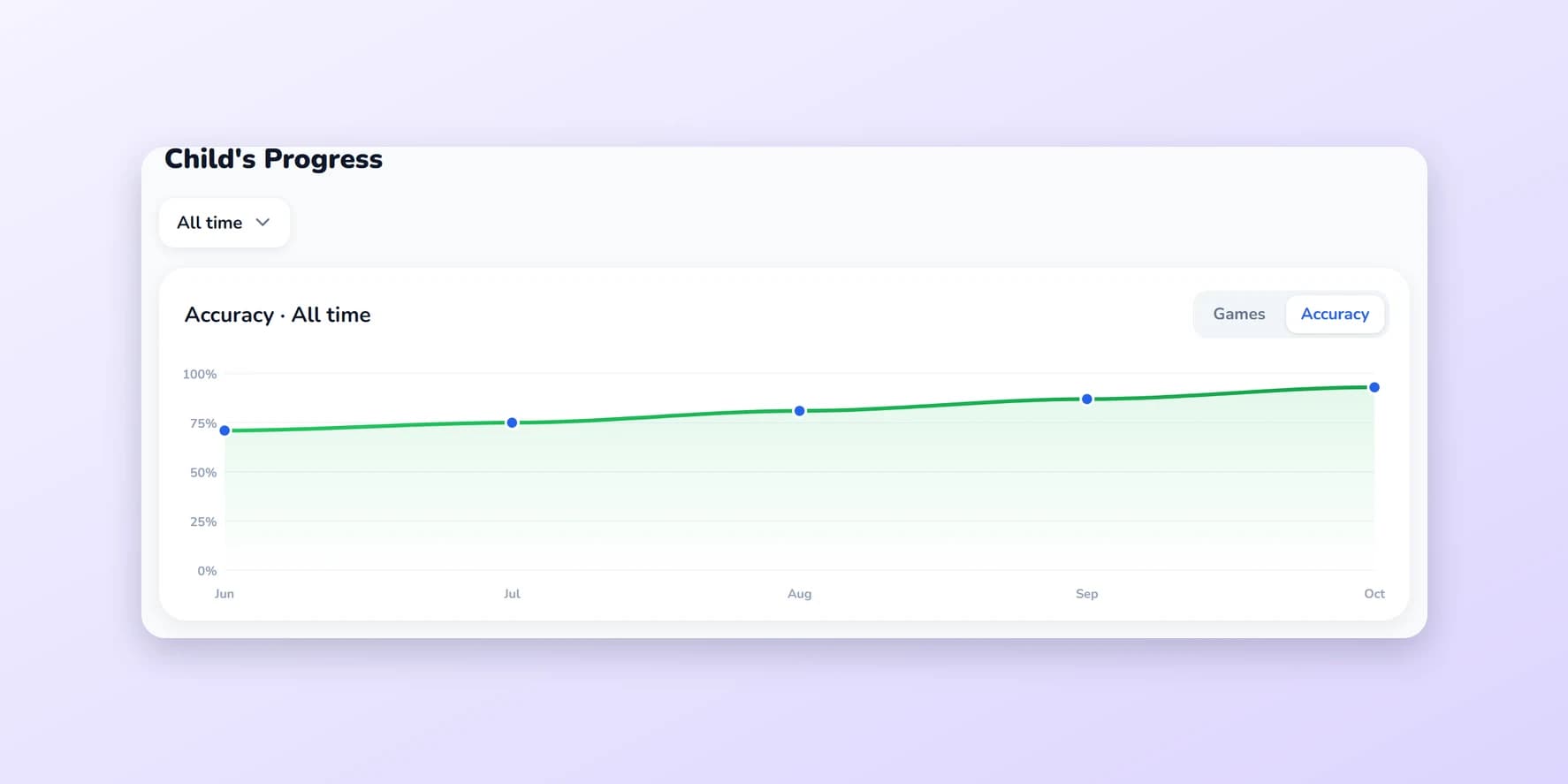
- last month accuracy was 80%; now it is 90%;
- speed was 2 seconds; now it is 1.5.
The child can see:
“I am becoming better than I was before.”
Competition can then remain an additional motivational tool rather than the only measure of success.
Should parents stay in the classroom?
Usually there is no need for a parent to attend every lesson. The child and teacher need to develop their own working relationship.
But parents should still understand:
- what is being learned;
- how the child is progressing;
- whether problems are appearing;
- how home practice is going.
Parents do not need to correct every movement. But they should not be completely disconnected from the process either.
A good teacher communicates clearly with parents
Communication should be specific. Not just:
“Everything is fine.”
For example:
“The child understands the topic, but accuracy drops when the speed increases.”
Or:
“The physical abacus is stable, but mental calculation needs more practice.”
Or:
“An older topic has started producing errors, so we will reinforce it this week.”
Now the parent understands what is actually happening.
Parents should not become a second teacher
This boundary matters. If a parent says at home:
“No, your teacher explained it incorrectly. Do it this way instead,”
the child suddenly has two teachers using different systems. Confusion can appear very quickly.
Parents should mainly support:
- regular practice;
- routine;
- general progress.
Technical methodology should remain with the teacher — see how parents can support a child without becoming a second teacher.
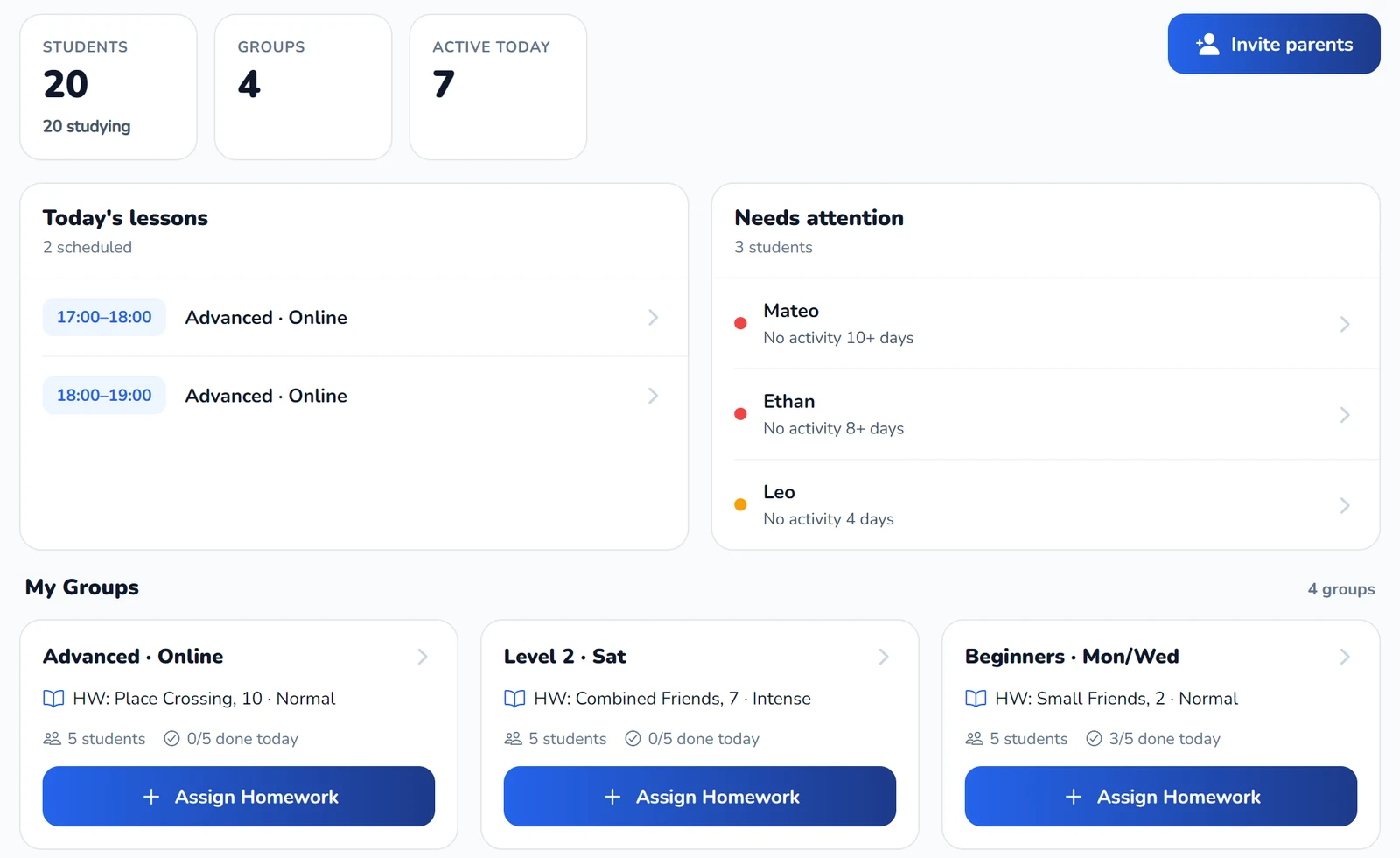
How digital tools can help teachers
When a teacher works with only a few children, much of the information can be remembered.
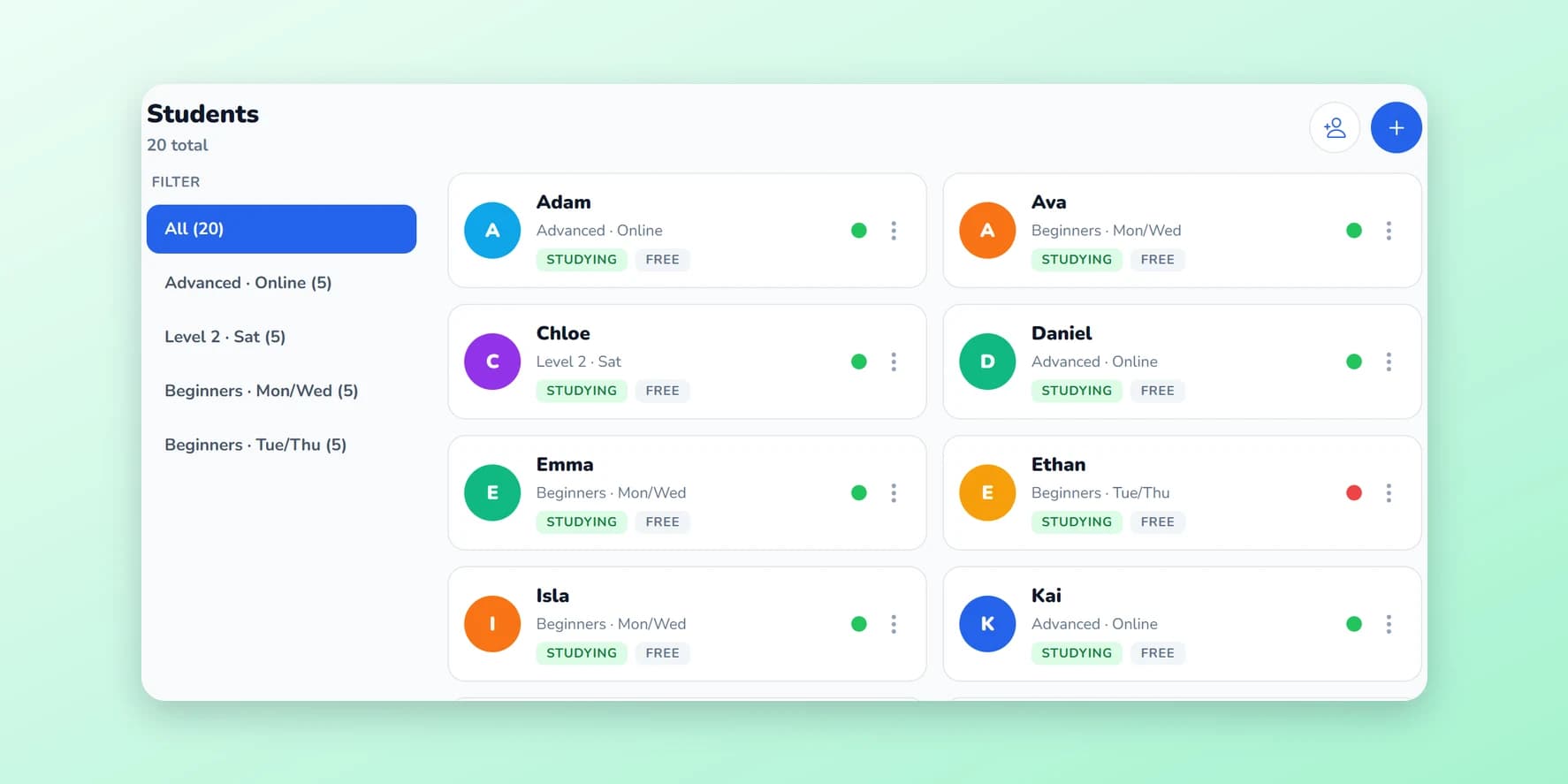
When there are 30 students, 50 or 100, that becomes much harder. The teacher needs to know:
- who is working on which topic;
- whose accuracy has dropped;
- who stopped practising;
- who is struggling with speed;
- where an old weakness has returned.
Amavit helps teachers see learning results and trends instead of relying only on memory.
A good teacher uses data without becoming controlled by it
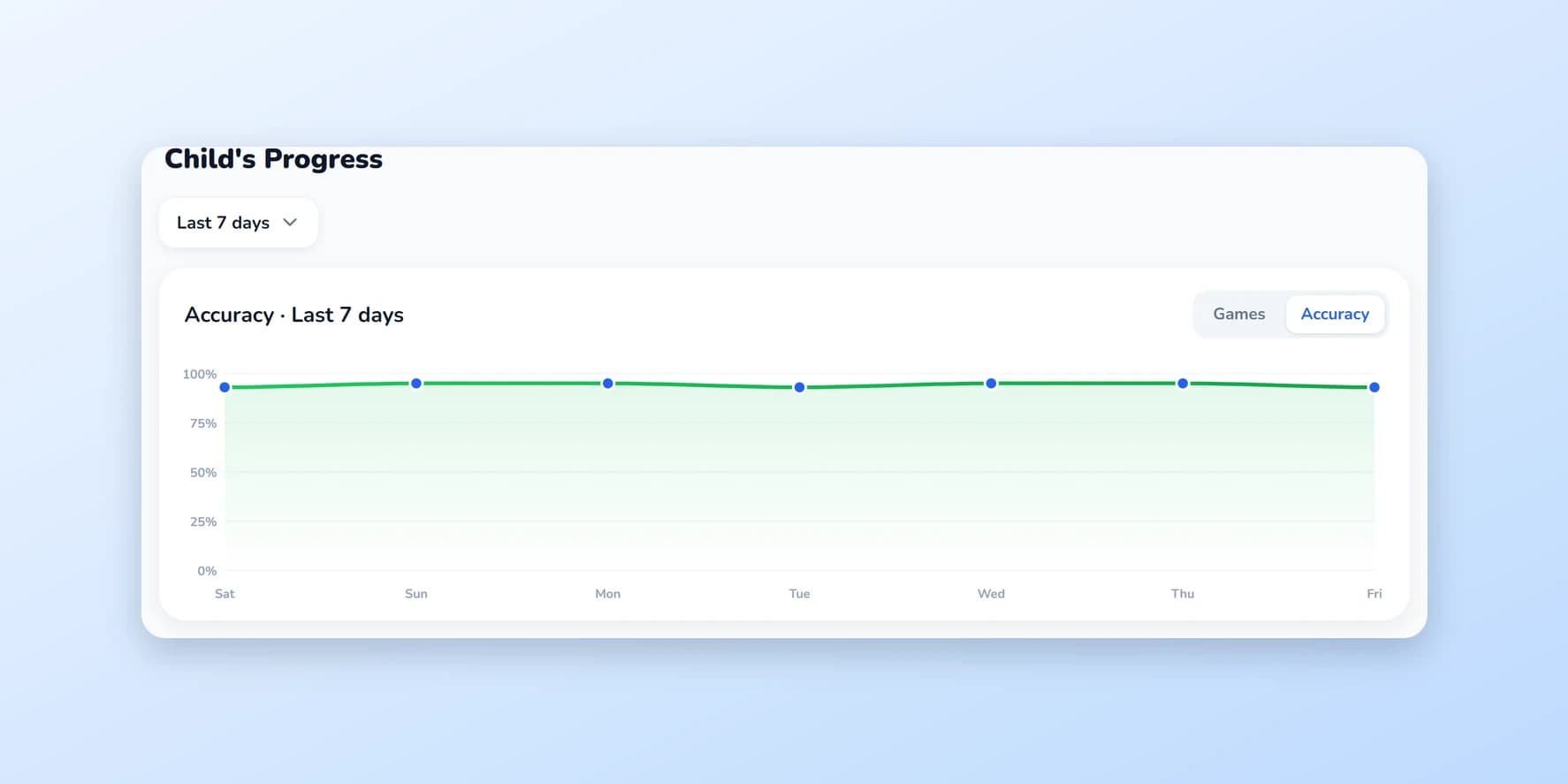
This is equally important. If a dashboard shows 82% accuracy, that is not a complete diagnosis.
The teacher still needs to ask why.
- Perhaps the child tried a higher speed for the first time.
- Perhaps the topic is new.
- Perhaps they were tired.
- Perhaps the same problem has appeared for a week.
Data helps the teacher ask better questions. The teacher still makes the educational decision.
What should parents ask before enrolling?
Parents do not need to conduct a twenty-question interview. But it is useful to understand a few things:
- How is the program structured?
- How often is a new topic introduced?
- How much home practice is expected?
- How does the teacher know when the child is ready to progress?
- How are mistakes tracked?
- What happens if a child falls behind the group?
- When does mental calculation begin?
- How are the physical abacus and workbook used?
If the teacher can explain these things calmly and logically, that is a good sign.
Do not choose a teacher only by the number of certificates
Certificates and professional education can matter. But they do not automatically guarantee good teaching.
A teacher can have many certificates and still struggle to explain clearly. Another may have strong methodology, excellent practical experience and a very good connection with children.
Qualifications are one factor. Not the only factor.
Do not choose only by brand either
A strong brand can provide:
- curriculum;
- materials;
- teacher training;
- methodology;
- quality standards.
All of that can be valuable. But in the end, the child does not study with a logo. They study with a particular person.
Even within the same network, two teachers can create very different learning experiences.
Trial lessons are useful
Do not expect extraordinary achievement during the first lesson. Instead, observe:
- Does the teacher connect with the child?
- Do they listen?
- Do they explain clearly?
- Do they pay attention to technique?
- How do they respond to mistakes?
- Does the child become interested?
A trial lesson may also include an impressive demonstration or an early mental-calculation exercise. That can be excellent for motivation.
But parents should understand what it is: a demonstration of possibility, not proof that the skill has already been formed.
One exciting trial lesson does not guarantee long-term quality
Trial lessons are often designed to be especially engaging. There is nothing wrong with that.
Real learning, however, will also include:
- repetition;
- home practice;
- difficult topics;
- mistakes;
- periods when effort is required.
So parents should ask not only:
“Did my child have fun?”
but also:
“Can this teacher systematically develop the child's technique over the next year or two?”
That is a much more important question — and it connects directly to how long children should study mental arithmetic.
A good school should be able to explain the learning path
Parents do not need to understand every Friend formula or advanced algorithm. But the overall structure should be clear:
- what happens first;
- what comes next;
- where the program is going;
- which advanced levels exist.
If the program feels like:
“Today we will calculate something and then see what happens,”
that is not a strong structure. There should be a learning path.
The learning path should still be flexible
Structure does not mean rigidity. There can be one curriculum. But a particular child may need:
- more repetitions;
- a different speed;
- additional practice;
- a temporary return to an older topic.
A strong program combines a clear route with the ability to adjust.
The real test appears after several months
A beautiful beginning is useful. But the real measure of teaching quality appears later.
After several months:
- Does the child still want to attend?
- Do they understand what they are doing?
- Are they becoming more independent?
- Is accuracy improving?
- Is speed improving?
- Is mental calculation developing?
- Are older skills still stable?
If yes, the program is doing its job.
If the child stays at the same level for months, ask why
Sometimes parents think:
“Maybe we just need to wait.”
Sometimes that is true. But if for several months:
- complexity does not increase;
- speed does not change;
- no new skills appear;
- the child keeps doing the same tasks,
it is reasonable to ask why. Possible reasons include:
- insufficient home practice;
- a weak earlier topic;
- an unsuitable learning format;
- a group that is too large;
- poor progress monitoring.
A good teacher should be able to explain the situation.
The strongest model is teacher + child + platform + parent
A good learning system has clear roles.
The teacher explains, chooses methodology, establishes technique and sets the appropriate level.
The child practises, repeats and develops the skill.
The platform provides different practice formats, records results and shows trends.
The parent supports regularity, monitors general progress and contacts the teacher when something changes.
Each participant has a different role. No one needs to replace anyone else.
What kind of mental arithmetic teacher does a child really need?
Not someone who promises:
“Your child will become a genius in three months.”
And not someone who only shows photos of champions.
A child needs a teacher who can:
- build the foundation;
- establish correct technique;
- explain clearly;
- identify the real source of errors;
- assign appropriate practice;
- increase difficulty at the right time;
- maintain motivation;
- guide the child through a long learning process.
Because in mental arithmetic, the impressive result is not the first wow effect.
The impressive result is what happens when correct technique has been repeated so many times that it becomes fast, stable and automatic.
The main conclusion
When choosing a mental arithmetic program, do not look only at brand, price, classroom appearance, certificates, promises or competition photos.
The most important question is:
How will this particular teacher work with this particular child?
A strong teacher:
- puts technique before speed;
- understands that a trial-lesson wow effect is not the same as mastery;
- looks beyond the final answer;
- finds the cause of mistakes;
- adjusts difficulty;
- tracks development;
- communicates with both the child and the parent.
And modern tools such as Amavit provide one additional advantage: the teacher can see not only what happens during the weekly lesson, but also what happens between lessons.
Over a long learning program, that can become one of the most important elements of quality control.
Frequently asked questions
What makes a good mental arithmetic teacher?
A good teacher prioritises technique, understands the learning sequence, identifies the causes of errors, adjusts practice and communicates clearly with both the child and the parent.
Is fast calculation on a trial lesson a sign of strong mental arithmetic skills?
Not necessarily. A teacher can demonstrate simple mental calculation very early to motivate a child, but stable mental-abacus skill requires correct technique and extensive practice.
What is more important in mental arithmetic: technique or speed?
Technique comes first. Sustainable speed is built on correct movements, accuracy and automaticity.
Should parents choose a mental arithmetic teacher by certificates?
Qualifications can be useful, but parents should also evaluate teaching ability, technique control, communication and long-term student progress.
How can parents know if a teacher is making progress with their child?
Look at changes in accuracy, speed, independence, mental calculation, increasing difficulty and the stability of older topics over time.
Should parents correct abacus technique at home?
Parents should support regular practice, but methodological and technical corrections are best coordinated with the teacher to avoid giving the child conflicting instructions.
Free for teachers