How to Know When a Child Is Ready for the Next Topic in Mental Arithmetic
In a well-structured mental arithmetic program, a child usually does not spend months on a single topic.
In many schools, lessons take place once a week and last around one to one and a half hours. During each lesson, the teacher introduces a new topic. The child then practises at home during the week. At the next lesson, the class can normally move on to the next rule.
This is a completely realistic pace.
With regular home practice, one new topic per week can be a normal pace in mental arithmetic. The key is not perfect performance, but enough understanding, accuracy and automaticity for the next topic to be added without weakening the previous one.
If a child practises regularly at home, one week is often enough to:
- understand the new rule;
- repeat it many times;
- reinforce the correct movements;
- begin to automate the skill;
- mix the new topic with previously learned material.
So the key question is not:
“How many weeks should a child stay on one topic?”
The better question is:
“Has the child actually consolidated the new skill during this week?”
One new topic per week can be a normal learning pace
Consider a typical weekly cycle.
During the lesson, the child learns a new topic. The teacher:
- explains the rule;
- demonstrates the movement;
- checks whether the mechanics are understood;
- assigns home practice.
The child then has several days before the next lesson. With regular practice, there is enough time to complete a significant number of repetitions.
At the next lesson, the teacher can:
- quickly review the previous topic;
- check how stable it has become;
- move on to the next one.
This is how many mental arithmetic programs are structured.
Home practice is the key between lessons
A weekly lesson by itself is not enough. Even if it lasts an hour or ninety minutes.
Most automaticity develops between lessons. The child needs repetition — see how much practice a child needs each day.
It is not enough to perform the movement correctly once. The same pattern needs to appear dozens or hundreds of times in different examples.
A typical weekly cycle therefore looks like this:
- Lesson new topic
- Days 1–2 focused practice
- Days 3–4 different formats
- Days 5–6 mixed topics
- Progress review
- Next lesson new topic
Problems can be corrected within the same week.
If the child practises consistently, this pace is realistic. If little or no practice happens between lessons, the same week may no longer be enough.
Understanding the rule is only the first stage
Suppose the child is learning a new Small Friend.
The teacher explains it. The child understands. At a slow speed, the calculation is correct.
That is a good start.
But if the child still thinks every time:
“Here I need +5 −2,”
the skill is not yet automatic.
During the following days of home practice, that conscious process should gradually become much faster. The child sees the situation and almost immediately performs the correct action.
That is exactly why regular practice between lessons matters.
During one week, a new skill passes through several stages
With consistent practice, the progression may look like this:
- “I understand how this works.”
- “I can do it correctly if I do not rush.”
- “I hardly need to think about the formula anymore.”
- “I can recognise this rule even when it is mixed with other topics.”
That is already a strong result for one learning cycle.
The topic does not need to be absolutely perfect. But it needs to be stable enough for the next topic to be added on top.
A correct answer does not always show the full picture
Workbooks are very useful for consolidation.
The child completes a page. The answers are correct. The teacher can see that the homework was done. In many cases, that is perfectly sufficient.
But sometimes a correct answer can hide a weakness. The child may:
- calculate too slowly;
- use a different method;
- count individual steps instead of applying the intended technique;
- understand the result but not the movement;
- repeat one pattern mechanically without recognising it in mixed exercises.
Sometimes a child simply wants to finish the homework and finds another way to get the answer.
That means:
“The answer is correct”
and “The skill has become automatic”
are not always the same thing.
The same topic should be checked in different formats
If a child always practises in only one format, they gradually learn the format itself.
For example, if an entire workbook page contains Small Friends, the child already knows:
“Every example on this page uses the same type of rule.”
There is less need to recognise the situation independently.
That is why a well-consolidated skill should eventually appear in different formats. For example:
- on the physical abacus;
- in standard written examples;
- with flashcards;
- on screen;
- through audio exercises;
- in mental calculation;
- mixed with older topics.
The child should not merely learn how to complete one particular exercise. They should learn to recognise and apply the rule in different conditions.
This is where Amavit can broaden practice
A workbook remains an important learning tool. It is useful for:
- introducing a new topic;
- establishing mechanics;
- structured repetition;
- calm, sequential work.
But a digital platform can present the same skill from several different angles.
For example, in Amavit the teacher can use:
- flashcards;
- numbers presented on screen;
- audio-based exercises;
- mental calculation;
- different speeds;
- different chain lengths;
- mixed-topic training.
- Workbook
- Flashcards
- Screen
- Audio
- Mental calculation
One topic — several ways to test the skill.
The child is not simply repeating the same format twenty times. The same topic appears in different conditions.
That helps the teacher see whether the skill has actually become stable.
Different formats also reduce boredom
This matters because mental arithmetic requires a large number of repetitions.
If the entire week looks like page 24, page 25, page 26 and another similar column of examples, even useful practice can begin to feel repetitive.
Changing the format makes the training more engaging. For example:
- a workbook;
- then flashcards;
- then an audio exercise;
- then numbers on screen;
- then a short mental-calculation session.
The total number of repetitions remains high. But the child experiences them as different activities rather than one endless task.
Audio practice creates a different type of challenge
A child may perform extremely well when numbers are visible. But accuracy may suddenly drop when the same type of task is presented by audio.
That is useful information. It shows that the skill is stable in one format but still needs work in another.
The same thing can happen when moving:
- from a physical abacus to mental calculation;
- from slow to faster presentation;
- from isolated topics to mixed practice.
Different formats reveal different parts of the skill.
The most important test is mixed-topic practice
If the child spends an entire training session on one new topic, after a while they already know:
“The same rule applies everywhere.”
That is much easier.
The real test begins when the exercise includes:
- Simple;
- an older topic;
- the new topic;
- another previously learned rule.
Now no one tells the child in advance which rule to use. The child has to identify it independently.
That is where it becomes clear whether the topic has truly been integrated.
With regular home practice, this can be checked within one week
There is usually no need to wait a month.
If the child practises several times between lessons, useful information appears within just a few days. For example:
- the first two days contain many mistakes;
- by day three accuracy begins to improve;
- by day five the child works confidently;
- by the end of the week the new topic works well in mixed exercises.
Excellent. The child can move forward.
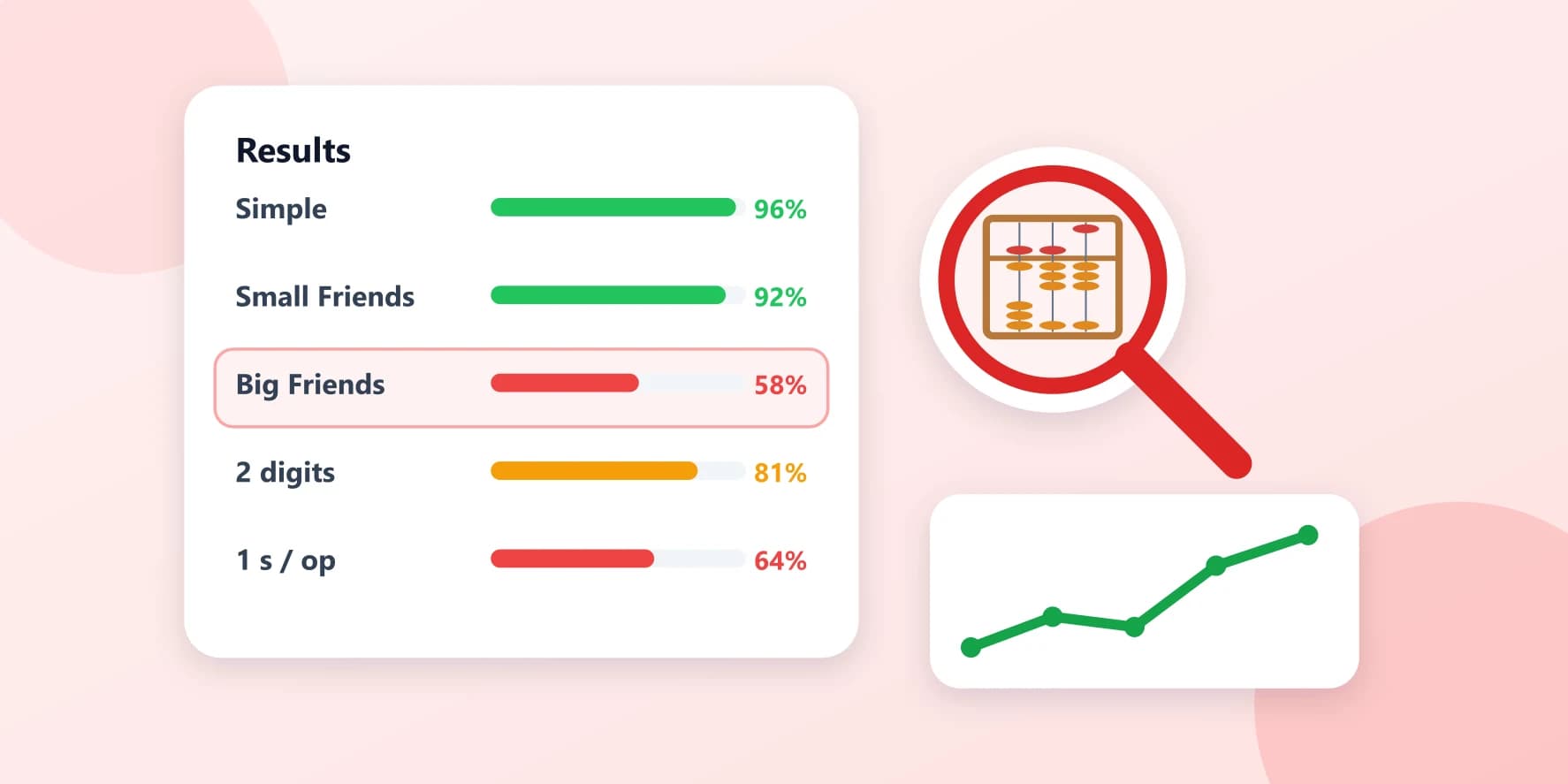
A digital system allows the teacher to see not only the final result at the end of the week, but the development of the skill throughout the week.
A problem can also become visible within three days
This is one of the strongest advantages of learning analytics.
Suppose a new topic has been assigned. Three days pass. The data shows:
- accuracy is not improving;
- the same errors keep repeating;
- speed remains unusually low;
- the child regularly abandons the training;
- the new topic is disrupting older ones;
- one particular format produces much worse results.
There is no need to wait a month. There may not even be a reason to wait until the problem becomes obvious during the next major stage.
The parent or teacher can already see:
something is not working correctly.
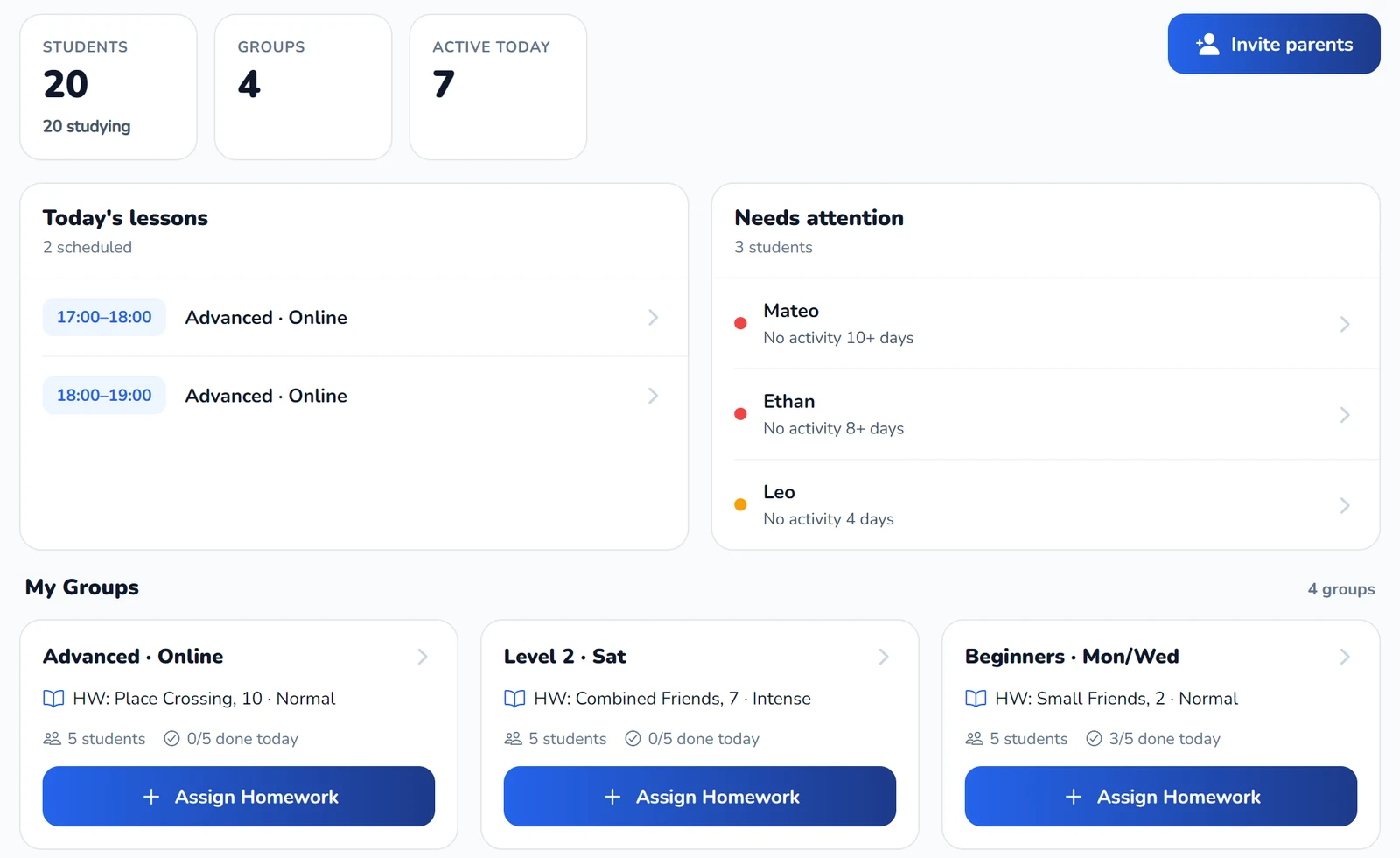
And the practice can be adjusted quickly — the same approach we describe in why children keep making the same mistakes.
The earlier the correction, the easier it usually is
If a problem is noticed after several days, the required correction may be small. For example:
- give slightly more practice on the new topic;
- reduce speed;
- add flashcards;
- return briefly to the physical abacus;
- add more audio practice;
- shorten the chain;
- delay mixed-topic practice slightly.
This is a minor adjustment. The child can continue progressing with the group.
That is very different from discovering the same weakness three months later.
Teacher and parent can see the same learning trend
This is another major advantage of a digital system.
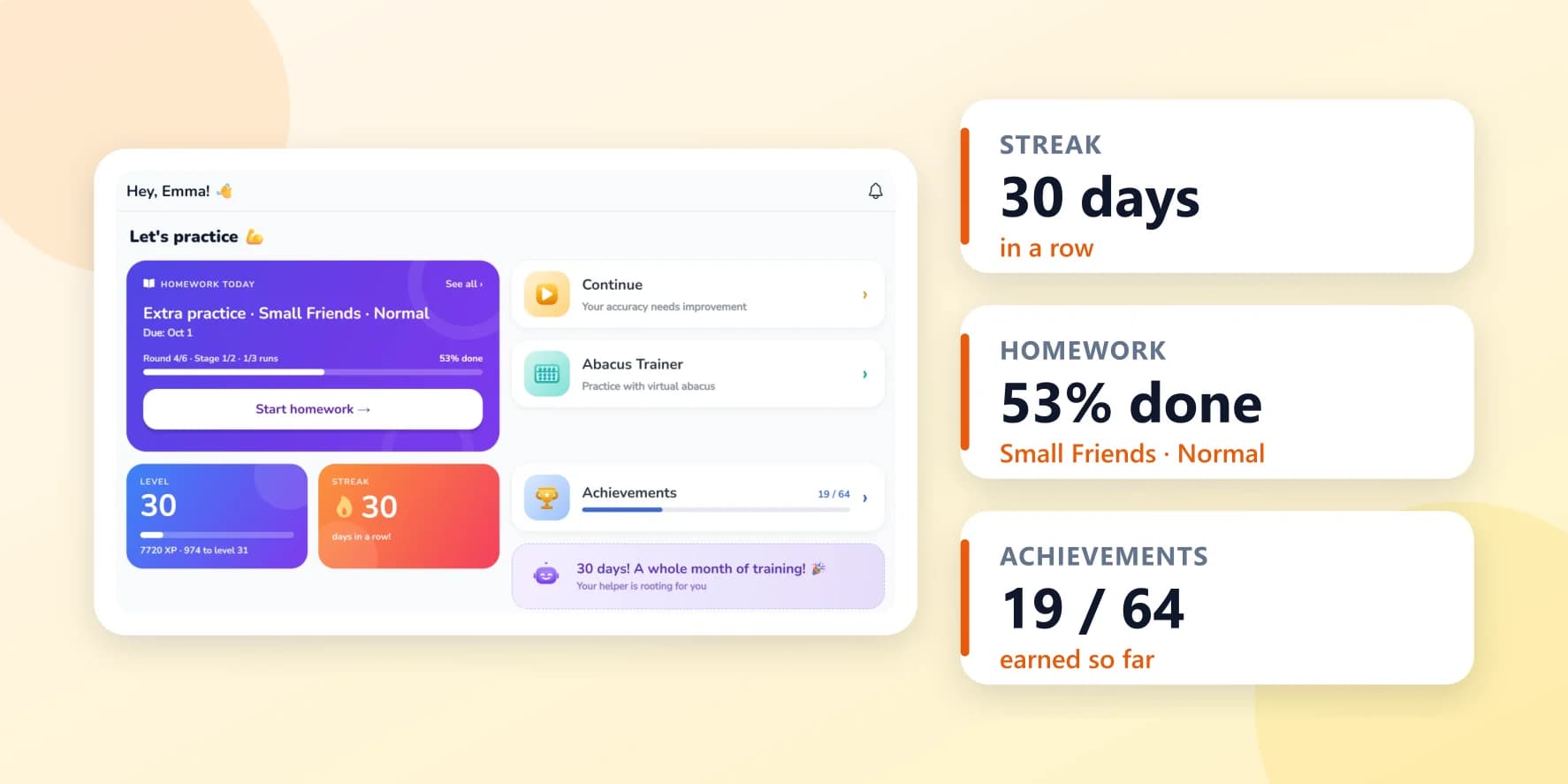
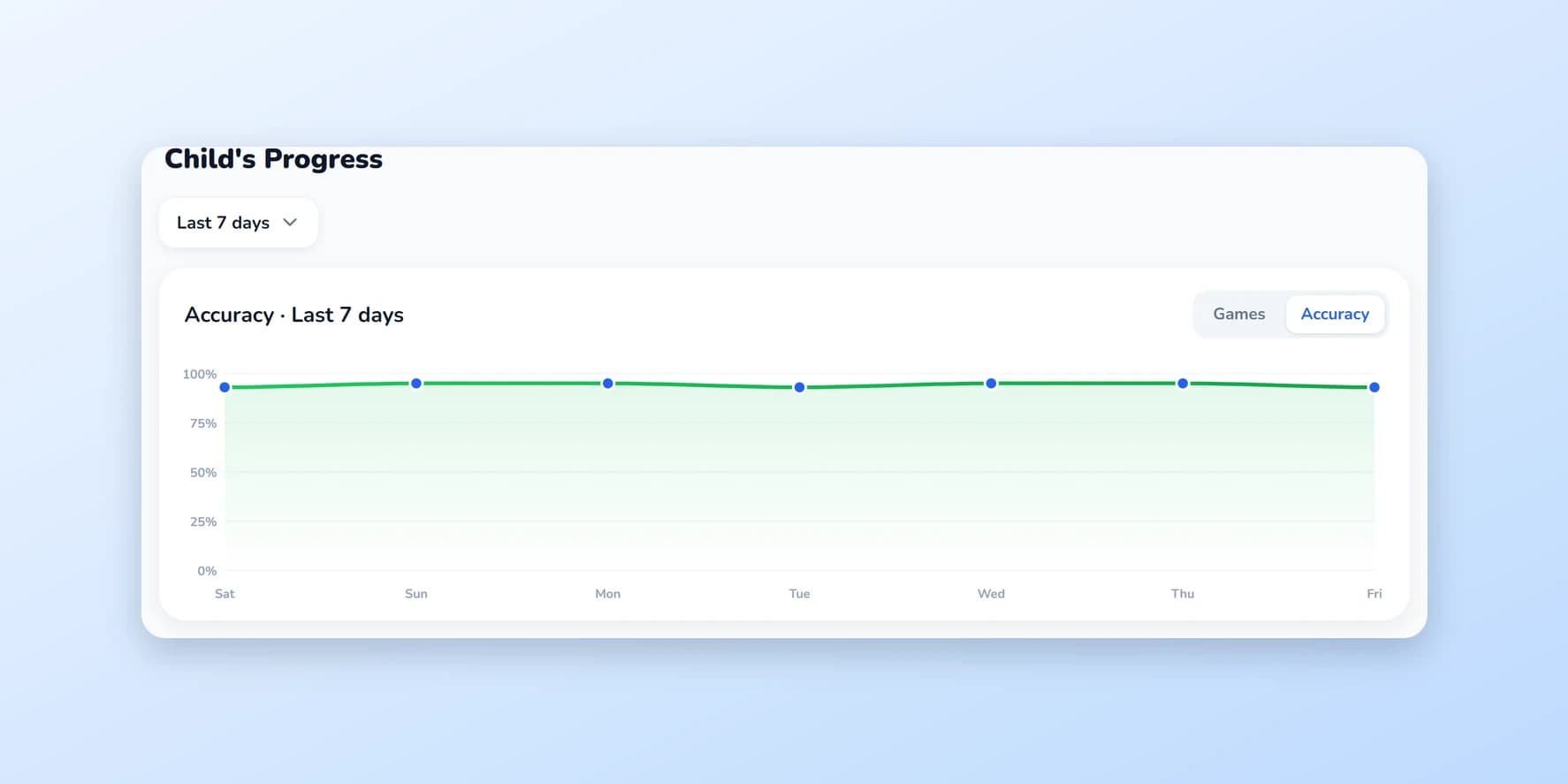
The teacher sees the student's results. The parent sees the progress of their own child.
If the parent notices:
- a sudden drop in accuracy;
- reduced practice;
- stalled speed;
- weaker homework performance,
they can contact the teacher. Not to change the teaching method themselves. Simply to say:
“Could you please take a look? Something seems to have changed during the last few days.”
The teacher then investigates the cause.
Sometimes the parent can notice the problem before the teacher
That is normal.
A teacher may work with 30 students, 50 or even more. They monitor the whole group and individual progress. But the parent watches only one child.
If the system provides clear progress data, the parent becomes another early-warning point — see how parents can support a child without becoming a second teacher.
The process becomes:
- the child practises;
- the platform collects data;
- the parent sees the trend;
- the teacher makes the methodological decision.
This does not mean the curriculum should constantly slow down
Quite the opposite.
With normal home practice, most children can progress at approximately one new topic per week.
The purpose of analytics is not to search for reasons to stop the student. Its purpose is to confirm that the normal pace is working.
- If everything looks good: move forward.
- If a small weakness appears: correct it quickly. Then move forward again.
Digital monitoring should help maintain a healthy pace, not unnecessarily slow it down.
Different children may need different amounts of practice during the same week
- One child understands the topic very quickly. The standard homework is enough.
- Another needs more repetition.
- A third performs well on the physical abacus but is weaker in mental calculation.
- A fourth is accurate but slow — and needs speed to develop gradually.
The entire group may still move to the next topic the following week.
The difference is that individual children receive slightly different additional practice during the week.
This is much more practical than creating a completely separate curriculum for every student.
Adaptive practice works inside a common curriculum
There can still be one shared learning route. For example: this week — one topic; next week — another.
But within that common route, the platform can adjust repetition:
- a weak topic can appear more often;
- a well-mastered topic can appear less frequently;
- an older topic can return occasionally for maintenance.
This preserves both:
the pace of the group
and individual correction.
An old topic should not disappear after Friday
If a child finishes a topic this week, that does not mean:
“We will never see this rule again.”
A new topic appears next week. But the previous one continues to return. A month later, it may still appear. Just less frequently.
That is how older skills are maintained and gradually combined into one larger system.
This also means that a topic does not need to become absolutely perfect within seven days. It will continue to strengthen later.
When does a child really need more time?
Sometimes one week is not enough. That is normal too.
The teacher should pay attention if, by the end of the weekly cycle, the child:
- still does not understand the basic principle;
- systematically uses incorrect movements;
- repeats the same errors;
- cannot use the topic without prompting;
- completely loses the rule when it is mixed with older material.
In that situation, the program should be adjusted.
But this is an exception to the normal learning cycle, not something that needs to happen with every topic.
A child does not need 100% perfection before moving forward
There is another extreme. Teachers can become so afraid of errors that a child spends far too long on one topic.
That is not necessary either. The skill will continue to strengthen after the class moves forward. Older topics will keep returning in mixed practice.
So the weekly goal is not:
“Never make another mistake in this topic.”
The goal is:
“Understand and consolidate the topic well enough that the next one can be added without destabilising the previous skill.”
- Understand
- Practise
- Automate
- Mix
- Move forward
The goal is stable progress, not absolute perfection.
How Amavit helps maintain a weekly learning pace
The role of Amavit here is very practical.
It is not designed to stretch the curriculum. Quite the opposite — it helps the teacher maintain a normal pace with more confidence.
During the week, the teacher can see:
- how often the child practised;
- how much work was completed;
- where mistakes occurred;
- how accuracy changed;
- how speed changed;
- how the new topic is progressing;
- what is happening to older topics;
- which format is stronger or weaker.
By the next lesson, the teacher has far more information than simply:
“The homework page was completed.”
A good weekly learning cycle becomes transparent
A strong weekly structure can look like this:
- lesson — new topic;
- first days — focused practice;
- middle of the week — repetition in different formats;
- later — mixed practice with older topics;
- end of the week — review of progress;
- next lesson — next topic.
If a problem appears, it can be corrected inside the same cycle. Not six months later. Within a few days.
The main principle
A child does not need to spend months waiting before moving to every new topic.
With good teaching and regular home practice, one new topic per week can be a normal and realistic pace.
But this pace works best when the teacher can see what is happening between lessons.
- The workbook helps consolidate mechanics.
- Different training formats test the skill from several angles.
- Digital analytics helps detect small deviations early.
So the right question is not:
“Are we allowed to move on yet?”
The better question is:
“Does this week show that the child has learned the topic well enough for the next level to be added?”
If yes — move forward. If not — adjust the practice slightly and prevent a small weakness from becoming a large gap.
That is one of the main advantages of a modern learning system:
a healthy learning pace can be maintained without losing individual quality control.
Frequently asked questions
Can children learn one new mental arithmetic topic every week?
Yes. With regular home practice and good teaching, one new topic per week can be a realistic pace for many programs.
Does a child need 100% accuracy before moving to the next topic?
No. The topic should be stable enough to support the next level, but it will continue to strengthen through later mixed practice.
How can a teacher tell whether a topic is really learned?
Look at understanding, correct technique, accuracy, speed, performance in mixed exercises and stability across several practice sessions.
Why should the same topic be practised in different formats?
Because a child may perform well in one predictable format but still struggle when the rule appears in audio, mental or mixed-topic exercises.
How quickly can a learning problem be detected?
With regular digital practice, meaningful patterns can sometimes become visible within several days rather than only after weeks or months.
Free for teachers