Why Academies May Want to Include Premium Digital Access for Every Student
An education academy can use a digital learning platform in two different ways.
The first model is simple. The academy connects Amavit and uses branding, management tools, groups, teachers, students and digital practice. Families then decide individually whether they want Premium. If they do, they purchase it themselves.
Technically, this model works. But from the academy's brand perspective, there is an important question. The parent is already paying the academy for education. Then they are told:
“If you want full digital access, you also need to pay another company separately.”
That can create a reasonable reaction: “Why am I paying the academy and then being asked to pay someone else as well?”
This is why academies that want to build a strong, consistent brand may prefer a second model: include Premium access for all students directly in the academy programme. The parent then deals primarily with the academy. The digital platform becomes part of the academy's own educational product.
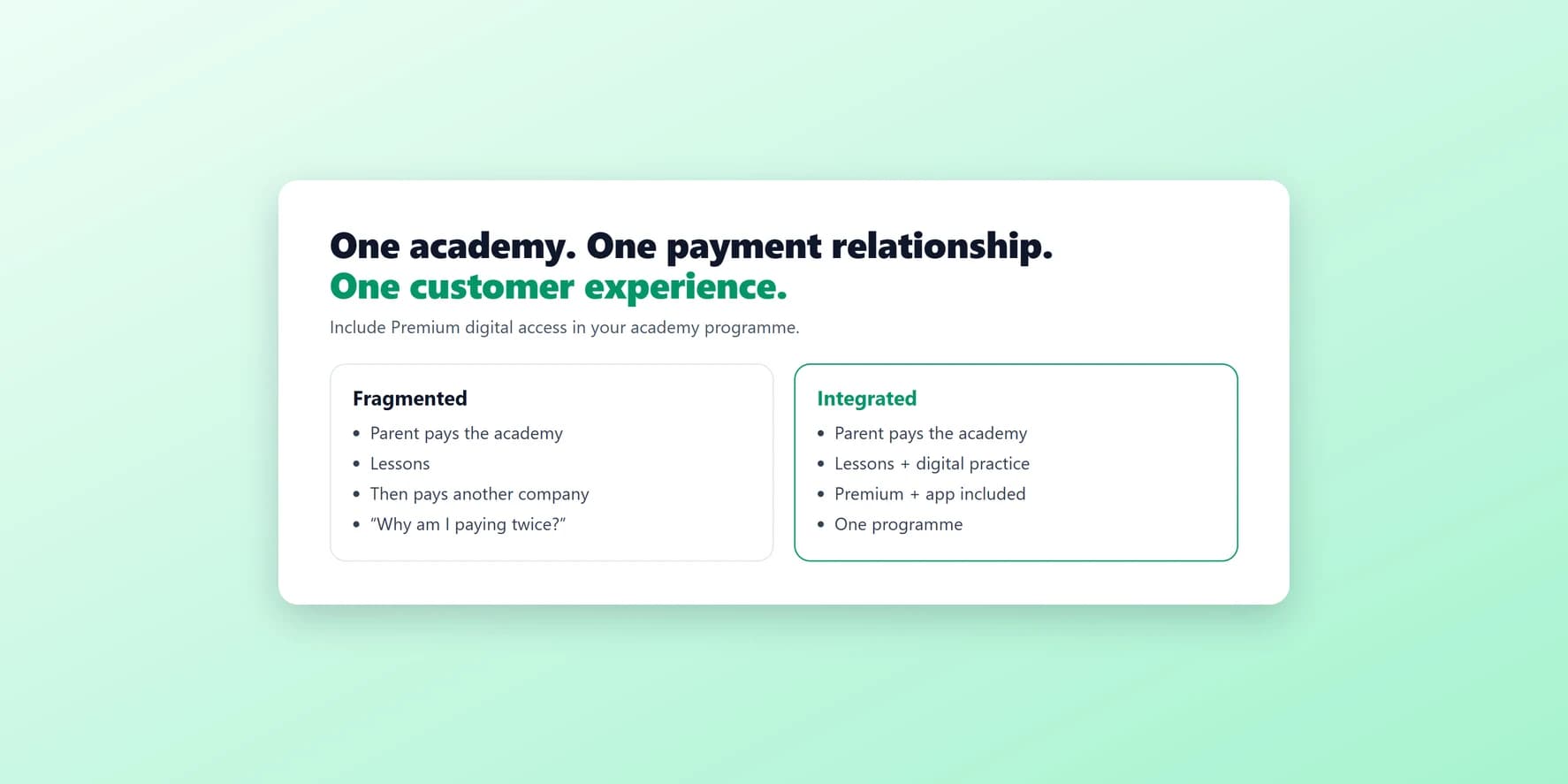
When parents pay an academy for education and are then asked to purchase a separate digital subscription from another provider, the customer experience can become fragmented. An academy can instead include digital access in tuition, keep one payment relationship with the family and provide the platform as part of its own educational programme.
Fragmented customer journey
Parent → pays academy → lessons → then pays another company → Premium platform
“Why am I paying twice?”
Integrated academy experience
Parent → pays academy → lessons + digital practice + Premium + app → one programme
One academy. One payment relationship.
One academy. One payment relationship. One customer experience.
Parents should buy the academy programme — not assemble it piece by piece
Consider two different customer journeys.
Model 1: Premium is purchased separately
The parent pays the academy for lessons. The child receives access to the digital platform. Then the family discovers that some additional functionality requires a separate Amavit Premium payment.
The parent now has to understand what Amavit Premium is, decide whether it is necessary, make another purchasing decision and pay another organisation. Even if the additional cost is relatively small, the customer journey becomes more complicated.
Model 2: Premium is included by the academy
The parent pays the academy. And that is all.
The programme already includes teacher-led lessons, home practice, digital training, Premium activities, mobile access, games and progress tools. For the family, this is one product. One provider. One commercial relationship. One clear point of responsibility.
That is a much stronger customer experience.
This is not only about convenience
It is also about the academy's reputation. If a school tells parents “We provide a modern digital learning environment,” but then asks them to pay an external company separately to unlock the full experience, some parents may perceive the programme as incomplete, fragmented, dependent on another provider or more expensive than expected.
The issue may not even be the amount of money. The issue is how the academy's product is perceived. That makes academy-sponsored Premium more than a billing decision. It becomes a decision about brand ownership and customer experience.
Who owns the product in the parent's mind?
Parents generally do not think about who developed the platform, who maintains the app or which company provides the technology infrastructure. They purchased education from the academy. They expect the academy to take responsibility for the overall experience.
The more of that experience remains under one commercial relationship, the stronger and clearer the academy's product becomes.
One brand, one customer relationship
In the cleanest model, the parent deals with the academy. They choose the academy, pay the academy, receive the educational service from the academy, communicate with the academy and use the digital tools included in the academy programme.
Amavit remains the technology partner behind the platform. But the parent does not need to become a separate paying customer of another education company.
Option A — two separate relationships
Parent ↔ Academy
Parent ↔ Technology provider
Option B — one relationship
Parent ↔ Academy ↔ Technology provider
The academy remains the customer's primary relationship.
This is the commercial side of the same idea behind a branded platform: a white-label learning platform answers who owns the visual customer experience, while academy-sponsored Premium answers who owns the commercial relationship.
Explore academy-sponsored Premium. Offer full digital access as part of your own academy programme. Amavit for academies.
Separate payment can break the customer journey
Imagine the parent's experience. They discover the academy through its website. They speak with its manager. They join its programme. They pay tuition. Their child studies with the academy's teacher. Then they hear:
“Now go to another service and pay separately for Premium.”
The customer journey suddenly splits. There is now another company, another payment, another subscription, another decision and possibly another support relationship. And the parent may reasonably ask: “Is this actually part of the academy or not?”
A strong academy brand usually benefits from minimising these breaks in the experience.
Academy-sponsored Premium keeps the relationship with the academy
If Premium is already included in tuition, the experience changes. The parent pays the academy. The academy organises the digital access. The child simply receives it.
For the family, Amavit becomes part of the academy's technology infrastructure rather than a separate product they need to purchase.
This can be especially important for smaller academies
Large education brands may have multiple partnerships, products and external services. Parents may already expect a more complex ecosystem.
A smaller academy is often different. Families may choose it because they trust the owner, the teachers, the methodology and the academy's reputation. The relationship is often more personal. That makes additional third-party payments potentially more noticeable.
Reputation is built through small details
Parents evaluate an academy not only by lesson quality. They also notice: Is the pricing clear? Are there additional charges? Who is responsible for the digital platform? Who receives the payment? Who should they contact when something goes wrong?
If the entire experience is organised through the academy, the service feels more complete. Separate third-party payments can create unnecessary questions about what is and is not included in the academy programme.
Why this matters for your academy brand
Avoid the feeling of “We already paid — why are we paying again?”
This is an important psychological point. Even when Premium is genuinely optional, parents may still think: “We already pay for the programme. Why does the full experience require another payment?”
The problem may not be price sensitivity. It may be the feeling that the original package was incomplete.
Decide clearly what is included in the academy product
There are two transparent models.
Family-paid Premium
- Standard academy platform
- Premium optional
- Family buys separately
Academy-sponsored Premium
- Academy provides access
- Premium available to all participating students
- Cost can be incorporated into tuition
- One customer relationship
Volume-based academy terms available.
Option 1: family-paid Premium. The academy clearly explains that standard digital practice is included and Premium is an optional upgrade purchased separately by the family. This can work well if it is communicated clearly from the beginning.
Option 2: academy-sponsored Premium. The academy says: “Full digital access is included in our programme.” The academy then provides Premium centrally.
Both models can work. But the second model creates a more integrated customer experience.
For a strong academy brand, the second model can be more powerful
The academy can say:
You pay us once. Everything your child needs for our programme is already included.
That is a strong proposition. It tells the parent that the academy controls the product, the academy takes responsibility for the experience, and there are fewer external purchasing decisions.
The academy is not selling Amavit
This distinction is important. The academy is selling its own educational programme. Amavit is the technology layer supporting that programme.
From the parent's perspective, there is no requirement for Premium to feel like a separate purchase. This is much closer to the academy uses professional software than to the parent buys another education product.
The academy is not selling Amavit. It is selling its own educational programme.
Think of other business technology
Customers are not normally asked to pay separately for a company's CRM, its booking system, its internal software or its operational tools. Those technologies are already part of the service. An academy can think about its digital learning platform in the same way.
Premium can become part of the academy's cost of delivery
The academy can treat digital access similarly to workbooks, learning materials, software, classroom infrastructure and teacher training. It becomes part of the cost of delivering the programme. The academy then decides how that cost is reflected in tuition.
The cost can be built into tuition
For example, an academy may previously have offered 8 lessons per month. The updated programme could include 8 lessons, home practice, a digital trainer, Premium access, mobile access and progress tools. The academy may price the complete package accordingly.
But the parent still sees one clear price. That creates a cleaner commercial experience.
Not
- Lesson
- App subscription
- Premium subscription
- Another payment
But: Academy Programme
- Lessons
- Workbooks
- Home practice
- Digital trainer
- Premium activities
- Mobile access
- Progress tools
One product instead of several separate purchases.
One payment is simpler than several
The fewer financial touchpoints a customer has, the simpler the relationship becomes. The parent pays the academy. The academy manages its own technology costs internally.
The parent does not need to pay the platform separately, manage another subscription, understand another billing system or contact another organisation about access. If the academy also wants tuition itself to move online, see how academies can add online payments without building their own payment system.
Who should the parent contact when something goes wrong?
This is another reputation issue. If the parent pays Amavit directly, they may not know: Should I contact the academy? Should I contact Amavit? Who is responsible?
When Premium is included by the academy, the logic becomes simpler: “I am the academy's customer.” The academy becomes the primary point of contact. If necessary, the academy can then work with its technology partner behind the scenes.
One clear point of contact builds trust
Parents generally want to know who is responsible. They do not want to navigate the academy for lessons, Amavit for the platform, another company for payments and someone else for the app.
Internally, an academy may work with many technology providers. The customer does not need to experience that complexity.
Academy-sponsored Premium also makes teaching simpler
There is also an operational advantage. If every student has the same full access, the teacher knows that any Premium practice activity is available to everyone.
There is no need to check whether a particular family purchased Premium, whether the subscription expired, or why one child can access an activity and another cannot.
This matters for homework
Suppose a teacher wants to use a particular Premium activity as part of home practice. If only some students have access, the teacher needs an alternative for everyone else. If Premium is included academy-wide, the same digital homework can be used consistently across the group.
Equal access creates a predictable academy product
Every student can receive the same minimum digital package — for example, teacher-led lessons, workbooks, a digital trainer, Premium activities, mobile access and progress tools. The academy can confidently explain this package to every new family.
It also strengthens the academy's marketing
Compare these two messages:
“You can optionally purchase additional Amavit features.”
versus:
“Full digital practice is included in our programme.”
The second message is much stronger. It turns technology into part of the academy's competitive positioning.
Parents care about the benefit — not who wrote the software
The parent wants to understand what the child receives: more home practice, greater variety, games, motivation, progress tracking and mobile access. They usually do not care about software licences, technical architecture or subscription mechanics.
The benefit should be part of the academy's programme.
Academy-wide Premium makes the platform less visible as a separate purchase
This is one of the key advantages. The technology remains. The Amavit brand remains. But the parent's commercial relationship remains primarily with the academy. That is a powerful model for a school that wants to own the complete educational experience.
Branding makes this even stronger
The effect becomes stronger when the academy also uses its logo, website login, academy groups, academy teachers and a customised environment. Then Premium access for every student becomes a natural part of the same branded experience.
For the family, the platform increasingly feels like the academy's digital environment — see one platform for academy owners, managers, teachers and students.
The mobile app still remains Amavit
This should be communicated transparently. The mobile application remains under the Amavit name. But if the academy already provides Premium, the parent does not need to separately purchase access from Amavit.
This creates an important distinction: the technology brand may be visible; the commercial relationship remains with the academy.
The technology brand can be visible. The commercial relationship can still belong to the academy.
The academy does not need to hide Amavit
The goal is not to pretend Amavit does not exist. The goal is to avoid forcing parents to become separate paying customers of another organisation.
The academy can say openly: “Our digital learning environment is powered by Amavit.” But everything required for the programme is already included. This is a professional technology-partner model.
Transparency can actually strengthen trust
The academy does not need to pretend it developed a complex platform internally. It uses a professional technology partner. But it still takes responsibility for the complete customer package. That is a normal model across many industries — and the same logic as using an existing platform instead of building your own.
Volume pricing can make the model more economical
When an academy provides Premium for a larger number of students, commercial terms can be different from individual retail subscriptions. That is what makes academy-wide access more practical.
50, 200 or 500 students are very different from one parent buying one subscription. The relationship becomes a B2B agreement between Amavit and the academy.
Academy pricing can be agreed separately
There does not need to be one public price for every academy. Commercial terms can depend on student volume, market, currency, academy setup, additional services and specific commercial conditions. This is why academy-wide Premium pricing is better handled through direct discussion.
Discuss academy pricing. Academy-wide Premium terms can be based on student volume and setup. Talk to us about your academy.
An academy can start with a pilot
There is no need to move the entire student base immediately. An academy can begin with one branch, several groups or a limited number of students. Then evaluate how actively children use the platform, how teachers integrate it into learning, how parents respond and what value the digital layer creates.
Then expand if the model works
If the pilot is successful, the academy can add more students, include digital access in tuition, update its programme positioning and make the platform part of the academy standard. This creates a controlled rollout.
The pilot should still be communicated through the academy brand
Parents should not feel: “Our children are testing some unrelated external product.” A stronger message is: “We are introducing a new digital practice environment as part of our academy programme.” The academy remains at the centre of the relationship.
Different programmes can use different models
For example:
| Programme | Digital access |
|---|---|
| Standard programme | Standard digital access |
| Advanced programme | Full Premium included |
| Competition programme | Full Premium included |
Or the academy may choose a much simpler model: Premium included for every student. The academy controls its own product structure.
But the cleanest brand experience is often full inclusion
For an academy that wants maximum consistency — one price, one company, one customer relationship, one support entry point — academy-sponsored Premium can be the strongest option.
This is more than a feature
That is why academy-sponsored Premium should not be viewed simply as “a discount on subscriptions.” It is much more strategic. It affects who owns the customer relationship, who receives the payment, who takes responsibility for the service, how the programme is positioned and how the academy's brand is perceived.
Technology can stay in the background
| The academy focuses on | Amavit focuses on |
|---|---|
| Brand | Technology |
| Teaching | The platform |
| Parents | Practice tools |
| Students | The mobile app |
| The programme | Updates and technical infrastructure |
Each side does what it does best — the same division of responsibility described in launching an academy platform without hiring developers.
Everyone benefits
Parent. Pays one organisation. Understands what is included. Does not manage another subscription. Knows who to contact.
Student. Receives full digital access. Does not encounter unnecessary feature restrictions. Uses one consistent learning environment.
Teacher. Knows the same digital tools are available to every student. Can build a consistent homework and practice process.
Academy. Owns the customer relationship. Strengthens its brand. Creates a stronger educational package. Avoids sending customers elsewhere to make additional purchases.
Premium supports practice, repetition and engagement between lessons. It does not replace the teacher: teaching, technique correction and diagnosis remain the teacher's job.
The main conclusion
Academy-sponsored Premium is not simply about paying for students' subscriptions. It is about who owns the customer relationship.
If the parent pays the academy, then separately pays Amavit, and communicates with both the academy and Amavit, the digital product begins to feel like an external service.
But if the parent pays only the academy, Premium is already included, the digital platform is built into the programme and the academy remains the primary point of contact, then the entire experience strengthens the school's brand.
That is why, for academies that care about reputation and a consistent customer experience, providing full Premium access to all students can be much stronger than asking families to purchase separate subscriptions. Amavit remains the technology partner. For the parent and student, the digital platform becomes part of the academy itself.
One academy. One payment relationship. One customer experience. Create one complete academy experience — request academy access.
Frequently asked questions
Why would an academy pay for Premium instead of asking parents to buy it?
Including Premium can create a simpler customer experience: the parent pays the academy once and receives the complete digital package as part of the programme.
Can parents still purchase Premium themselves?
Yes. Family-paid Premium remains one possible model.
Can Premium be included in academy tuition?
Yes. The academy can incorporate digital access into its own programme and pricing structure.
Does the parent still see the Amavit brand?
The mobile application remains Amavit, and the technology provider does not need to be hidden. The difference is that Premium can already be included in the academy programme rather than purchased separately by the parent.
Does the academy get its own separate mobile app?
No. The application remains Amavit, while the internal academy experience can be customised.
Can every student receive the same Premium access?
Yes. Academy-sponsored Premium can provide consistent access for participating students.
Are academy prices the same as individual Premium prices?
Academy-wide access can use separate commercial terms based on student volume and the agreed setup.
Can an academy test the model before connecting every student?
Yes. A pilot can begin with selected groups or students before a wider rollout.
Does Premium replace the teacher?
No. It supports practice, repetition and engagement between lessons. Teaching, technique correction and diagnosis remain teacher responsibilities.
Who supports the parent if Premium is included by the academy?
The academy can remain the family's primary point of contact and work with Amavit as its technology partner where technical assistance is required.