Small Friends on the Abacus: How Friends of 5 Work in Addition and Subtraction
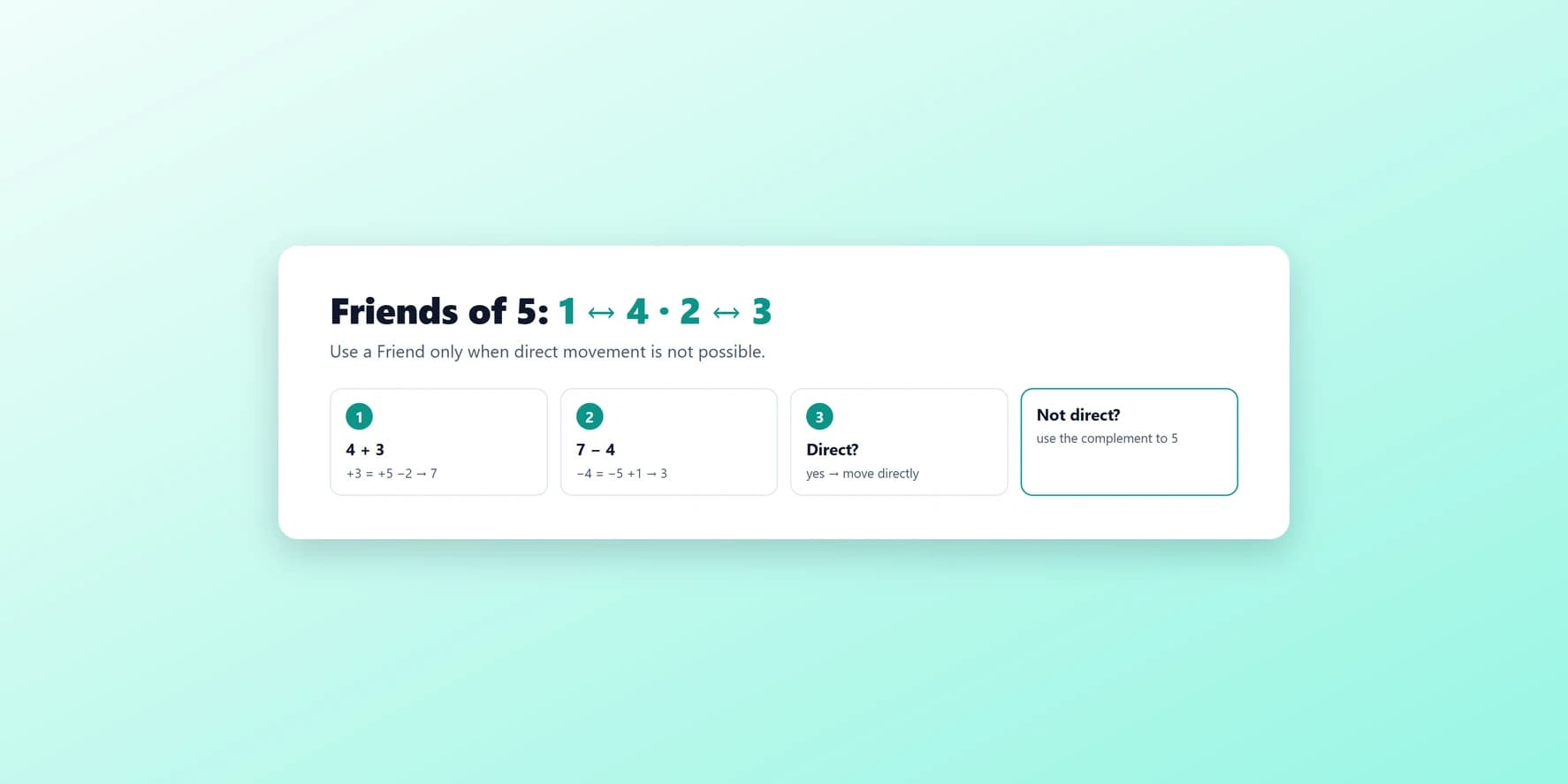
At some point, every child learning the abacus reaches a situation where direct movement is no longer enough. For example: 4 + 3.
At first, the task sounds simple. Just add 3. But on the abacus, four lower beads are already active. There is nowhere to add three more lower beads directly. So the child needs a different way to represent the number.
This is where Small Friends, also called Friends of 5, begin to matter. If you are new to the abacus itself, start with what an abacus is and how it works.
Small Friends, or Friends of 5, are number pairs that make 5: 1 and 4, and 2 and 3. They are used on the abacus when an addition or subtraction cannot be completed directly with the available lower beads.
What are Small Friends?
Small Friends are number pairs that make 5. The key pairs are:
They can also be written as:
1 = 5 − 4 · 2 = 5 − 3 · 3 = 5 − 2 · 4 = 5 − 1
Different schools may use slightly different terminology: Small Friends, Friends of 5, complements to 5. The name can vary. The number relationship does not.
Addition example
4 + 3 → +3 = +5 −2 → 7
Subtraction example
7 − 4 → −4 = −5 +1 → 3
Use a Friend only when direct movement is not possible.
This article is a detailed guide to Friends of 5 only. For an overview of both systems, see Small Friends and Big Friends in mental arithmetic.
Why 5 becomes the reference point
The importance of 5 becomes obvious as soon as a child reaches the limit of direct movement. With smaller values, the available lower beads are often enough. But once an operation cannot be completed using the current lower-bead position, the child needs another way to express the number.
This is where the upper bead, with a value of 5, becomes the reference point. From that moment, the child starts seeing 1, 2, 3 and 4 in two ways: as individual numbers, and as distances from 5.
That is the key idea behind Small Friends.
A simple addition example
Take 4 + 3. The abacus already shows 4. Adding three lower beads directly is impossible. So 3 is represented as 5 − 2. The child performs +5 −2. The result is 7.
The important point is not the formula by itself. It is the fact that the child has found another valid way to represent 3.
What the child should understand
The child should not simply memorise +3 = +5 −2. They should understand the logic:
- I cannot add 3 directly.
- I can add 5.
- But 5 is two more than I need.
- So I remove 2.
Once this relationship makes sense, the formula stops feeling like a trick.
Small Friends in addition
The basic addition relationships are:
| Add | Movement |
|---|---|
| +1 | +5 −4 |
| +2 | +5 −3 |
| +3 | +5 −2 |
| +4 | +5 −1 |
But these formulas are not used automatically every time one of those numbers appears. If the number can be added directly, direct movement is usually the better choice. For example, in 1 + 2 there is no reason to use +5 −3 if 2 can simply be added. For the wider picture of addition on the abacus, see how to add on an abacus.
Recognising when a Friend is needed
This is one of the most important skills in this topic. The child needs to ask, even if only mentally: can I complete this movement directly?
YES
Use direct movement.
NO
Use the complement to 5.
Do I need a Small Friend? Check the bead position first.
This decision-making skill is just as important as remembering the complement itself.
A common mistake: using Friends too often
Sometimes a child learns a new formula and becomes eager to apply it everywhere. That usually means the formula has been learned before the situation has been understood. The better sequence is:
- look at the bead position;
- decide whether direct movement is possible;
- only then choose the Friend if needed.
The rule should solve a real movement problem. It should not create unnecessary complexity.
Small Friends in subtraction
The same number relationships appear in subtraction. Take 7 − 4. The abacus shows 7. There are not four lower beads available to remove directly. So 4 is again understood through 5: 4 = 5 − 1. The subtraction becomes −4 = −5 +1. The child removes 5 and adds 1 back. The result is 3.
The full set of subtraction relationships: −1 = −5 +4, −2 = −5 +3, −3 = −5 +2, −4 = −5 +1. For subtraction more broadly, see how to subtract on an abacus.
Why subtraction often feels less intuitive
The child hears: “Subtract 4.” But part of the movement involves adding 1. For a beginner, this can feel contradictory.
That is why I would not teach only “minus four equals minus five plus one.” Instead, the child should see why 4 cannot be removed directly, why 5 is removed and why 1 must then return. The logic has to remain visible.
Meaning first, automatic movement later
At first, the child may need to think through the operation step by step. That is normal. Later, the goal is for the situation to be recognised quickly: the child sees the bead position and understands which movement is needed. That is where automaticity begins.
A formula is only a bridge
The final goal is not to create a child who can recite +2 = +5 −3. The goal is to build a connection between the number, the current bead position, the correct rule and the correct movement. The formula helps build that connection. Practice makes it stable.
Why technique becomes more important here
Small Friends require more coordination than direct movement. The child may need to control the upper bead, move lower beads, change direction and coordinate the movement cleanly. That is why the teacher should still observe the movement itself. A correct final answer does not always mean the technique was correct — the finger technique checklist helps with that review.
The coordinated two-finger movement
In some Friends of 5 combinations, the thumb and index finger work together as part of one coordinated action. Some schools use the image of a “crab” to help children remember this movement. The name is secondary. What matters is that the fingers work together cleanly and consistently. If the basic finger roles are still new, see how to use an abacus step by step.
Why I would not teach all Small Friends at once
Imagine the child has just understood one relationship. Then, in the same lesson, they receive three more addition rules, four subtraction versions, long chains and higher speed. That is too much information at once. A better approach is usually: one topic; simple examples; short chains; stable accuracy; then the next topic.
In what order should Small Friends be taught?
There is no single mandatory sequence. One methodology may use 1 → 2 → 3 → 4. Another may use 4 → 3 → 2 → 1. Both can work. The real question is not which sequence is universally correct. The real question is whether the sequence is consistent with the teacher's curriculum.
Why different schools use different sequences
There can be several reasons. Some schools prefer moving from smaller values to larger ones. Others prefer combinations that are easier to demonstrate first. Some connect Small Friends to the future order of Big Friends. Others build the sequence around their own workbooks or lesson structure. These are methodological choices.
Teachers should not have to rebuild their programme around software
If a teacher has successfully used 4 → 3 → 2 → 1 for years, there is no strong reason to force 1 → 2 → 3 → 4 just because a digital platform was built that way. Technology should fit the methodology. Not replace it.
How Amavit supports different sequences
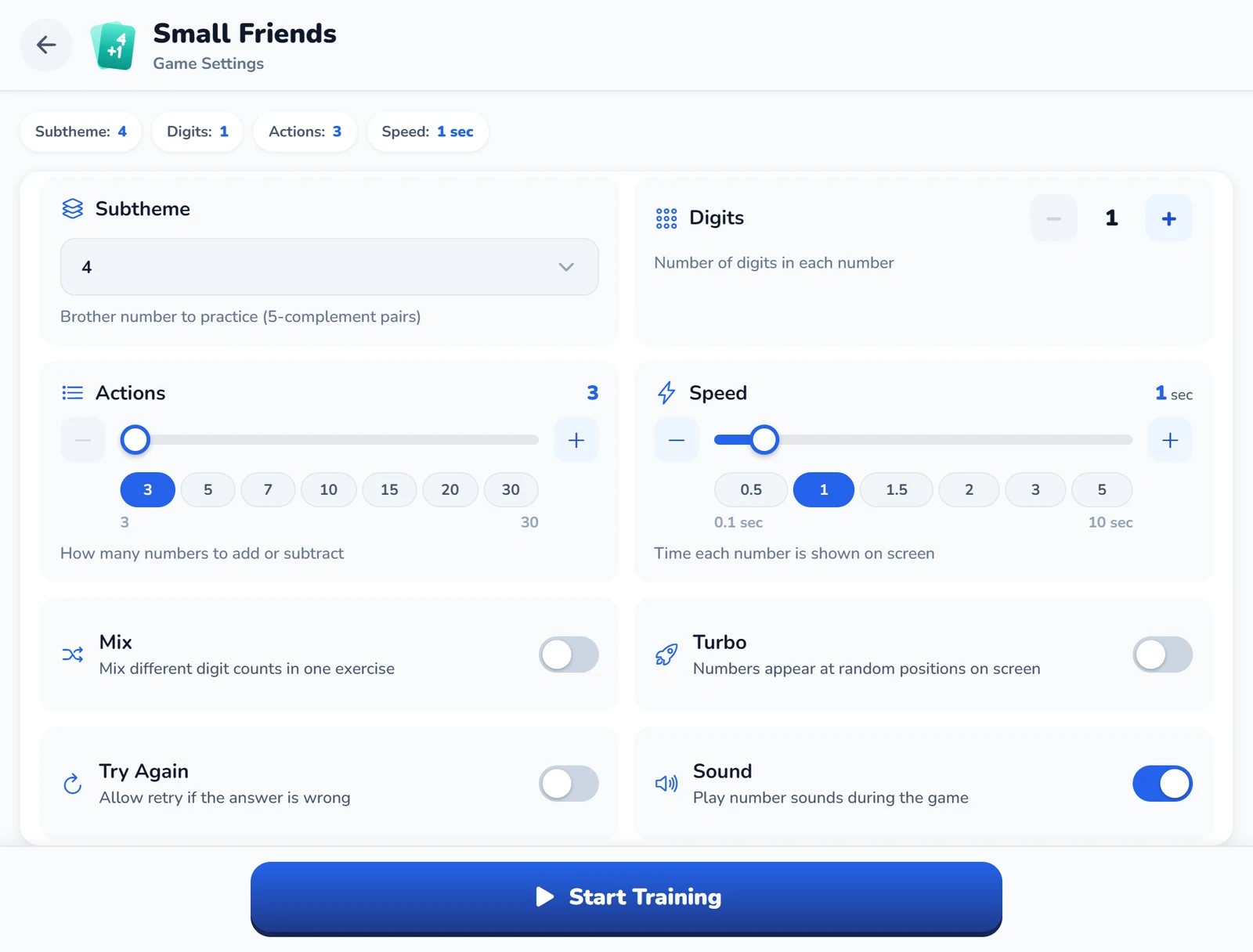
In Amavit, each Small Friend — 1, 2, 3 or 4 — is a separate topic. A teacher chooses which one to assign and when, so the order stays the teacher's: 1 → 2 → 3 → 4, or 4 → 3 → 2 → 1. Digital practice supports an established curriculum instead of forcing a new one — the same idea as using Amavit as a practice trainer alongside your own programme.
How do you know a Friend is really learned?
Not from one correct answer. I would look for several signs. The child:
That is a much better measure of stability.
Recognition is a separate skill
A child can know +3 = +5 −2 but still struggle to recognise when this rule should be used. That is why “knowing the formula” and “knowing the topic” are not the same thing. Recognition has to be trained too.
Why a child can know the Friends and still make mistakes
There are many possible causes. The child may confuse the formula, use a Friend when direct movement is possible, move the wrong beads, lose the starting value, rush, mix up addition and subtraction, or make errors only inside longer chains. Each of these requires a different response — see how to work with mistakes and weak topics.
More repetition is not always the answer
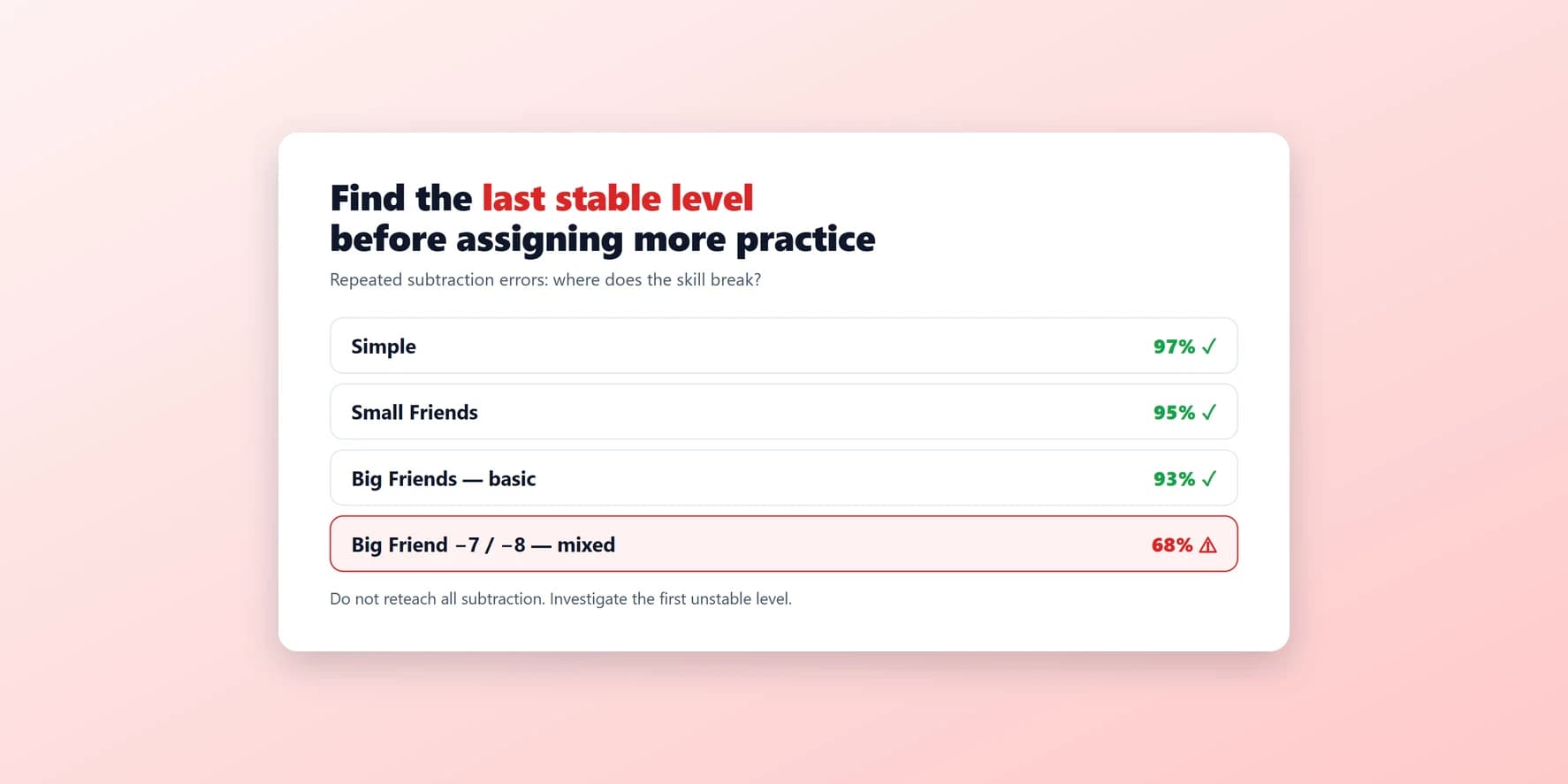
If the child is repeating the same incorrect movement, simply adding another 100 examples can make the problem worse. The wrong pattern may become more stable. First, identify the cause. Then increase the practice.
Sometimes one example is more useful than a long chain
Suppose the child keeps failing inside a longer sequence. Remove the speed, the long chain and the extra topics. Keep one simple example using the same Friend.
If the child still makes the mistake, the problem is likely in the rule or movement. If the single example is easy, but the long chain creates errors, the problem is somewhere else.
Change one parameter at a time
This is a useful way to diagnose difficulty. Move gradually:
- Single example
- Short chain
- Longer chain
- Slightly higher speed
Then observe where accuracy begins to fall. That makes the weak point much easier to identify.
Why speed should come later
After a few correct examples, it is tempting to increase the pace. But if the movement is not stable yet, speed usually creates extra mistakes. I would first aim for clean and repeatable movement. Then increase speed — the same principle as in mental arithmetic speed training.
How to practise Small Friends at home
Once the teacher has already explained the topic, home practice can be short. It does not need to be 30 or 40 minutes. A useful beginner format can be: 5–10 minutes; one topic; a calm pace; regular repetition. Consistency matters more than one very long session — see how much practice per day.
Workbooks still have a role
A workbook can be useful for calm practice, physical abacus work, staying on one topic and homework without another screen. There is no need to remove workbooks simply because digital practice is available.
Where digital practice helps most
Its biggest advantage is controlled repetition. A digital trainer can generate fresh examples, check answers, change speed, change chain length and focus on a specific Friend. This becomes especially useful after the movement has already been taught correctly.
How Amavit fits into existing methodology
A teacher does not need to change the order of Small Friends to use the platform. The academy can keep its own sequence and use Amavit for additional structured practice. That is especially useful for schools that already have their own curriculum, their own lesson plans and their own workbooks. The technology adds practice without replacing the methodology.
When should Small Friends be mixed?
Not immediately. First, the child should recognise each relationship confidently on its own. Then mixed practice becomes valuable. For example, one short practice set may include +2, −4, +3, −1. Now the child has to identify the correct relationship each time. That is a different level of skill.
Focused practice and mixed practice do different jobs
Focused practice
+3, +3, +3, +3
Goal: build the movement.
Mixed practice
+2, −4, +3, −1
Goal: recognise and choose the right Friend.
If the child receives 20 examples using only one Friend, they can concentrate on building the movement. When several Friends appear together, the child needs to recognise the situation and choose the rule. Both are useful. They simply serve different purposes — more on this in mixed practice in mental arithmetic.
When should mental practice begin?
Once the physical movement is stable enough. The child should be able to picture the number, the bead position, the movement and the final value. Then the same relationships can gradually move into mental abacus practice — see physical vs mental abacus.
- Understand the relationship
- Learn the movement
- Focused practice
- Mixed practice
- Increase speed
- Mental practice
How Small Friends become automatic.
The physical abacus still remains useful
If repeated mistakes begin to appear in mental practice, returning to the physical abacus can reveal the problem very quickly. Sometimes the child believes the issue is mental calculation. But the real weakness is still in the physical movement or recognition of the Friend.
Small Friends are an important transition
Before Small Friends, much of the child's work is direct. See a number. Add beads. Remove beads. With Friends of 5, the child begins to see numbers more flexibly. For example, 3 is not only 3. It can also be understood as 5 − 2. This is a major step in the logic of abacus calculation.
Small Friends prepare the child for Big Friends
Once the child understands “I cannot complete this movement directly, so I use a nearby reference value,” the next stage becomes easier to understand. With Small Friends, the reference value is 5. With Big Friends, it becomes 10. The basic idea is already familiar.
What I would avoid
I would not:
- teach every Friend in one lesson;
- push speed immediately after explanation;
- use long chains too early;
- try to fix technique only with more examples;
- mix several methodologies without a clear reason;
- remove the physical abacus after the first signs of success.
What good progress looks like
The child recognises the situation faster, chooses the wrong Friend less often, stops verbally reciting the formula, moves more cleanly, works confidently in short chains, keeps accuracy at a slightly higher pace and begins using Small Friends in mental practice. These are meaningful signs of progress.
The main idea
Small Friends are not simply four formulas. They are the first major step from direct bead movement toward flexible number relationships. The child begins to understand: if an action cannot be completed directly, the number can be represented through 5.
At first, the child thinks through the rule. Then they recognise the relationship. Then the movement becomes familiar. That is why I would not rush speed. First: understand; recognise; perform correctly; repeat; then accelerate.
And the sequence of Small Friends may differ from one methodology to another. The goal is not to make every teacher follow the same order. The goal is to support good practice within the methodology the teacher already uses.
Frequently asked questions
What are Small Friends on the abacus?
Small Friends are number pairs that make 5. On the abacus they are used when an addition or subtraction cannot be completed directly with the available lower beads, so the number is represented through the upper bead (5) instead.
Why are Small Friends also called Friends of 5?
Because each pair adds up to 5, and the upper bead with a value of 5 becomes the reference point. Some schools also call them complements to 5. The name varies; the number relationship does not.
What are the Small Friend pairs?
There are two pairs: 1 and 4, and 2 and 3. They can also be written as 1 = 5 − 4, 2 = 5 − 3, 3 = 5 − 2 and 4 = 5 − 1.
When should a child use a Small Friend?
Only when the movement cannot be completed directly. If the number can simply be added or removed with the available lower beads, direct movement is the better choice.
How are Friends of 5 used in addition?
The child adds the upper bead and removes the complement: +1 = +5 −4, +2 = +5 −3, +3 = +5 −2, +4 = +5 −1. For example, 4 + 3 becomes +5 −2, and the result is 7.
How are Friends of 5 used in subtraction?
The child removes the upper bead and adds the complement back: −1 = −5 +4, −2 = −5 +3, −3 = −5 +2, −4 = −5 +1. For example, 7 − 4 becomes −5 +1, and the result is 3.
In what order should Small Friends be taught?
There is no single mandatory sequence. Some methodologies use 1 → 2 → 3 → 4, others 4 → 3 → 2 → 1. What matters is that the order is consistent with the teacher's curriculum and that each Friend is stable before the next one is added.
Why does a child know the formula but still make mistakes?
Knowing the formula and recognising when to use it are different skills. Mistakes can also come from moving the wrong beads, losing the starting value, rushing, mixing up addition and subtraction, or errors that appear only inside longer chains.
When should Small Friends be practised mentally?
Once the physical movement is stable and the child can picture the number, the bead position, the movement and the final value. If mistakes appear in mental practice, returning to the physical abacus usually shows the cause quickly.
Keep your Small Friends sequence
Teach 1 → 4 or 4 → 1. Amavit supports the methodology you already use.
Explore Amavit for TeachersFree for teachers