How to Maintain Mental Arithmetic Skills After Finishing an Abacus Course
When a child finishes a mental arithmetic course, parents often have a simple question: What should happen next? Should the child continue taking lessons? Stop completely? Practise occasionally?
If a child already knows how to use the abacus, understands the main techniques, can calculate mentally and has developed good speed, there is not always a reason to continue full lessons at the same intensity.
But there is another risk. A skill that is no longer used can gradually lose speed, automaticity, confidence and stability. So after finishing a course, the best solution is often neither “keep studying indefinitely” nor “the course is finished, so we never practise again.” There is a third option:
move from learning mode to maintenance mode.
After finishing a mental arithmetic course, children do not necessarily need to continue full lessons. Short regular maintenance practice can help preserve accuracy, mental calculation, automaticity and speed with much less time than active learning requires.
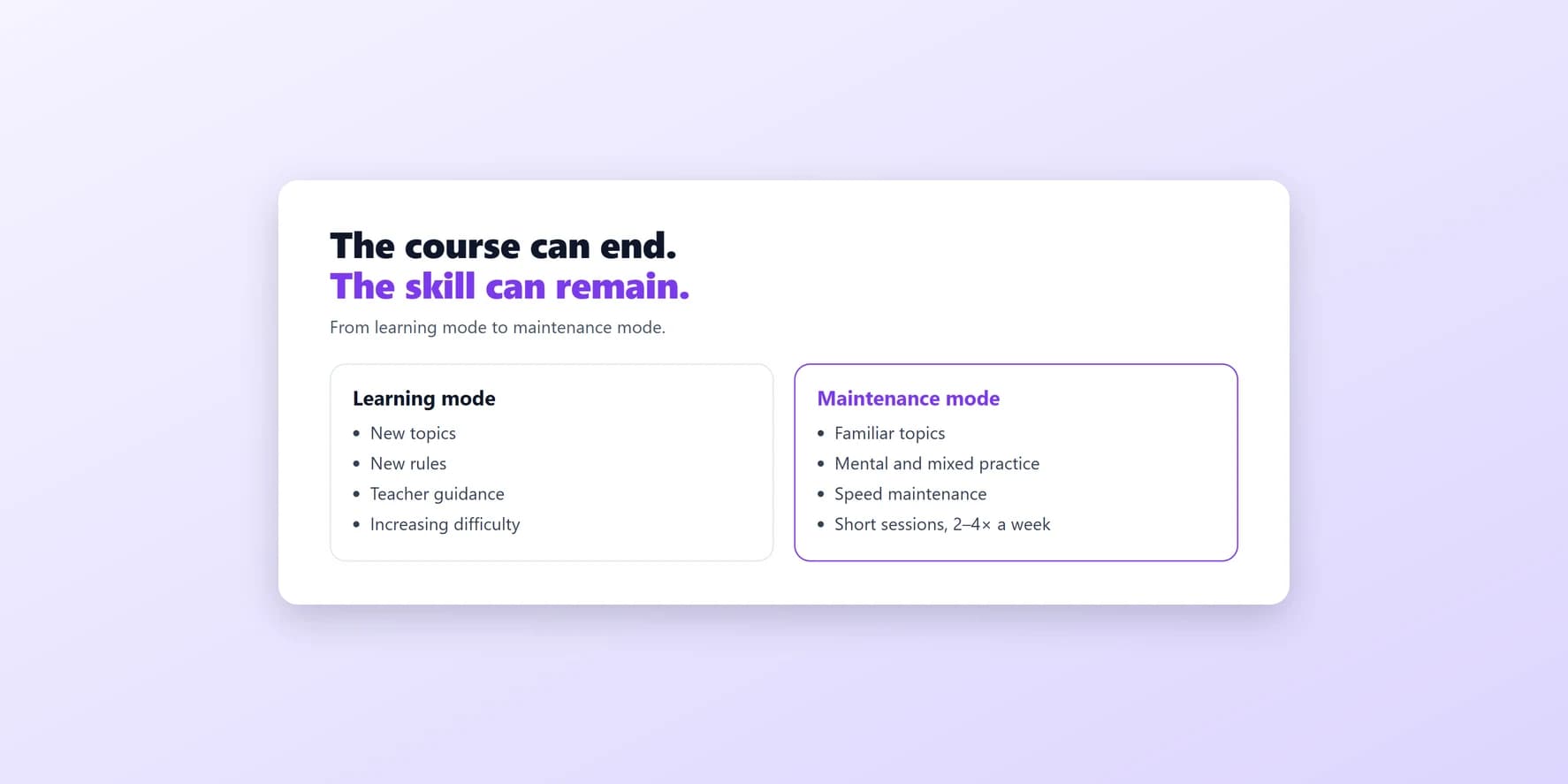
Learning mode
New topics · new rules · teacher guidance · increasing difficulty
Maintenance mode
Familiar topics · mental practice · mixed practice · speed maintenance · short sessions
The course can end. The skill can remain.
After the course, the goal changes
During active learning, the child is usually working on new topics, new rules, higher difficulty, mental calculation and greater speed. After the main course has been completed, the goal becomes different: preserve what the child has already learned. That requires much less work than learning everything from the beginning.
The skill does not disappear immediately
If a child stops practising today, they will not forget everything tomorrow. Or next week. But after months without using the skill, parents may notice slower calculation, rules taking longer to recall, a less stable mental image, more difficulty with longer chains and less confidence. This is normal.
Mental arithmetic is similar to other learned skills
The same principle applies to many skills. If someone stops speaking a foreign language, playing a musical instrument or training in a sport, the skill does not disappear completely. But performance gradually becomes less sharp.
Mental arithmetic can behave in the same way. The child does not suddenly “forget everything.” What usually weakens first is speed, automaticity and stability.
After the course, the child may need practice — not more lessons
This distinction is important. Learning mode means new topics, new algorithms, new difficulty. Maintenance mode means keeping familiar skills active.
The child does not need to learn a new topic every month forever. They can simply review familiar topics, maintain speed, do mental exercises, return occasionally to the physical abacus and revisit older weak areas when necessary.
How often should a child practise after finishing the course?
There is no universal schedule. But maintenance usually does not require the same intensity as active learning. A practical example might be 10–15 minutes, 2–4 times per week. Some children may need less. A child who wants to maintain competition-level performance may need more.
The most important principle is: maintenance practice should be light enough to continue for a long time.
Short and regular is better than rare and exhausting
For example, 10 minutes three times per week is often easier to maintain than one hour every two weeks. Why? Because the skill is activated regularly. The child does not need to spend the beginning of every session simply remembering how everything works — the same logic as in how often children should practise.
There is usually no need to start again from the beginning
Parents sometimes think:
“The course is finished. Maybe we should review everything from lesson one.”
Usually that is unnecessary. If the child has retained the skill, start from their current level, familiar mixed practice and a comfortable speed. If one area begins producing repeated errors, return temporarily to that specific topic.
Maintenance should include different types of practice
If a child always performs exactly the same exercise, some parts of the skill may receive very little stimulation. It is useful to alternate occasionally between physical abacus, mental calculation, speed practice, mixed examples, short chains, longer chains and game-based activities.
Different formats help keep different parts of the skill active — see why mental arithmetic needs more than one type of practice.
Do not put the physical abacus away forever
Even if the child is already strong in mental calculation. The physical abacus can still be useful when accuracy starts falling, an old rule becomes unstable, the mental image becomes less clear or finger technique needs to be refreshed.
The physical abacus remains an excellent recalibration tool — see physical vs mental abacus.
But most maintenance can be digital
After completing a course, families often do not want to restart weekly lessons, large homework assignments, workbook checking or manual exercise preparation. That is exactly where a digital trainer becomes especially useful.
The child already knows how to calculate. Now the main need is: practice.
Parents do not need to become mental arithmetic teachers
This is important. Parents do not need to remember which Friend should be used, which algorithm is correct, which topic should come next or how to create hundreds of examples.
Their role can be much simpler: help maintain a routine; give the child time to practise; occasionally check that practice is actually happening.
What can the child do independently?
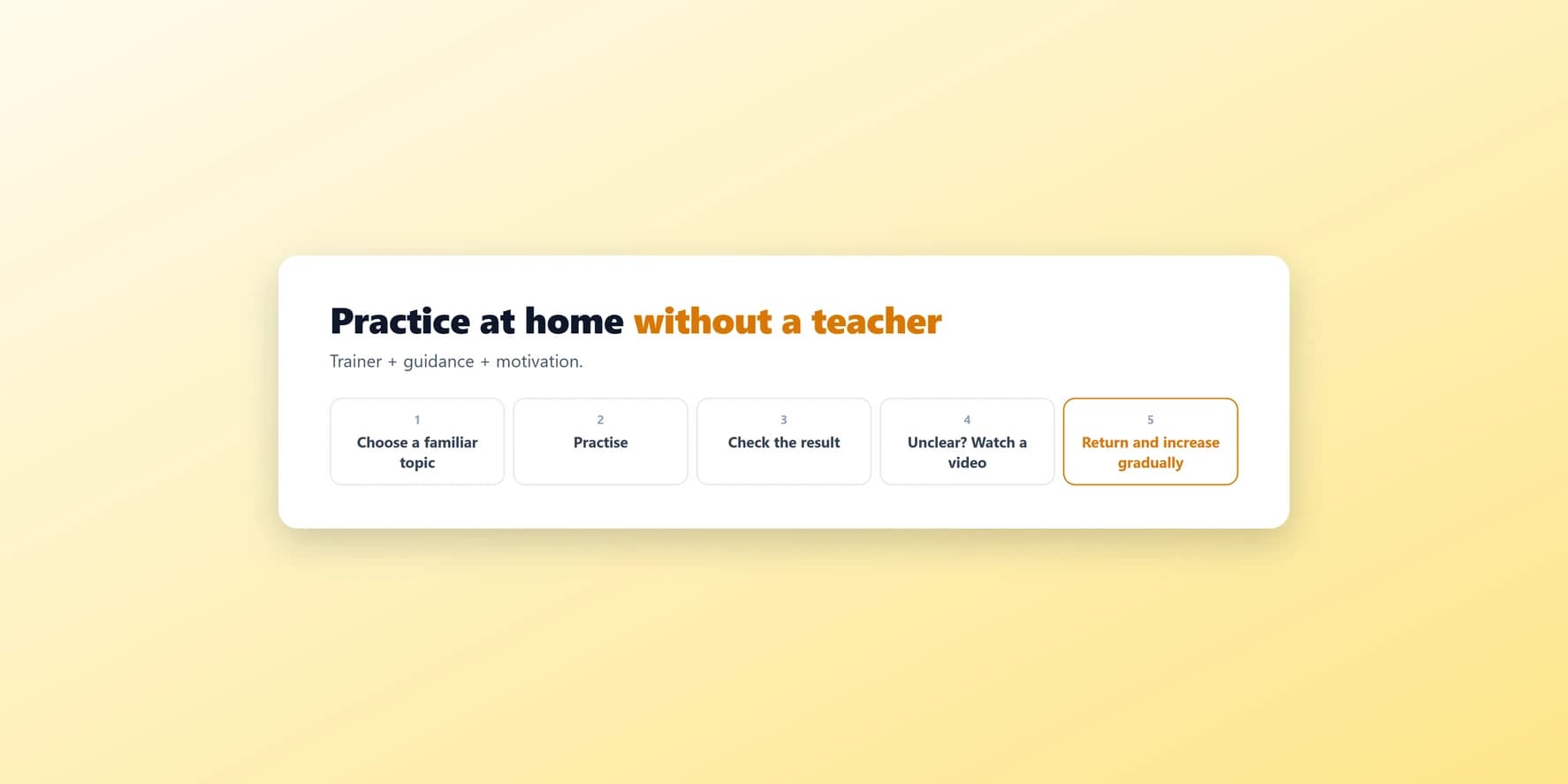
If the child is already sufficiently independent, they can simply open the trainer, choose a familiar topic, complete a short practice session, check the result and finish. The whole session may take only a few minutes. There is no need to recreate a full learning programme — see how a child can practise at home without a teacher.
Amavit can be used simply as a maintenance trainer
After completing a course, the child does not need to join another group, find another teacher or restart the curriculum. Amavit can simply be used to maintain the existing skill. The basic logic is:
choose a topic → practise → keep the skill active.
Practice can adapt to the child
This is particularly useful in maintenance mode. The child does not need to decide every time what needs more repetition, what is already strong and where difficulty can increase.
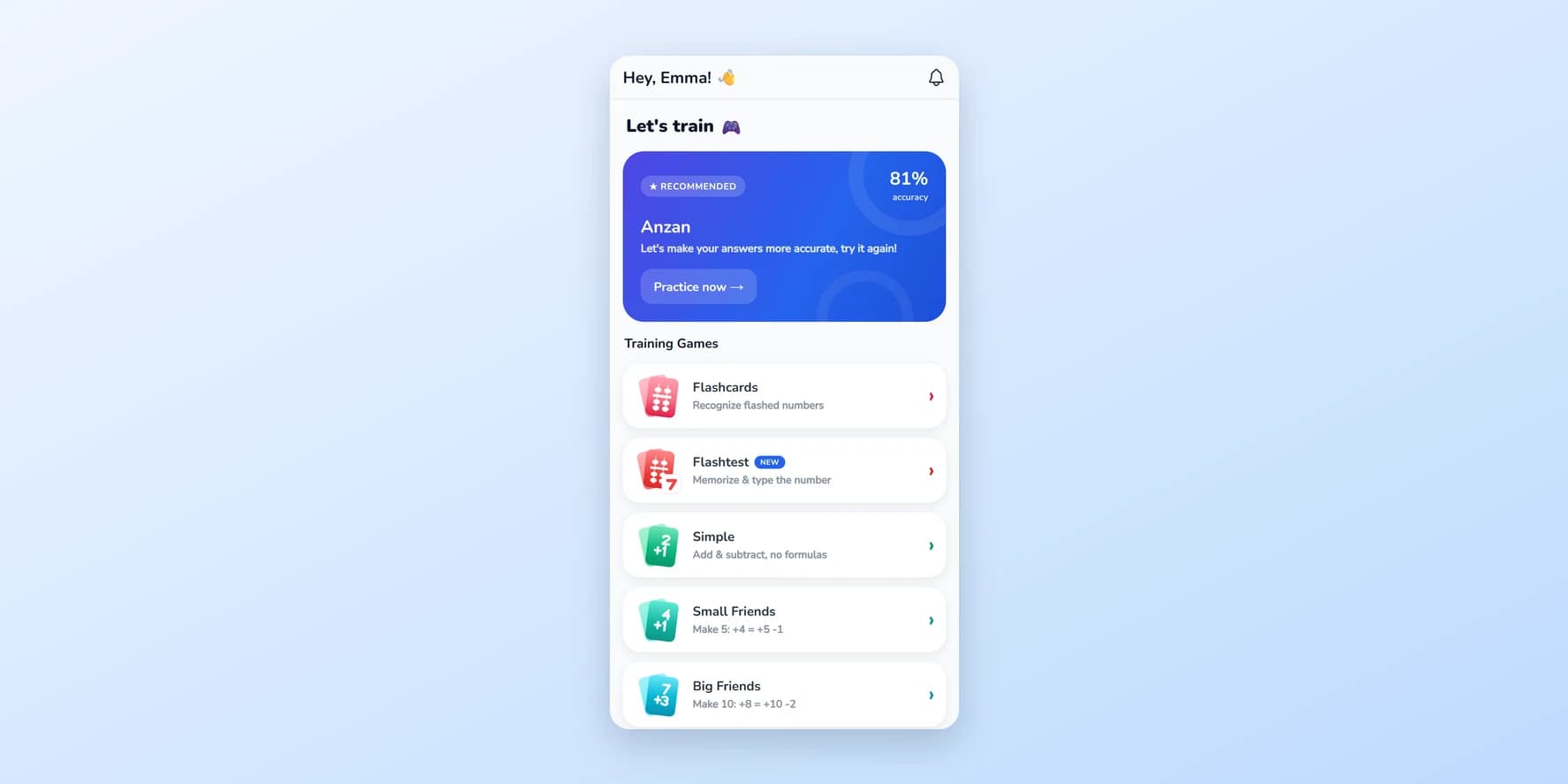
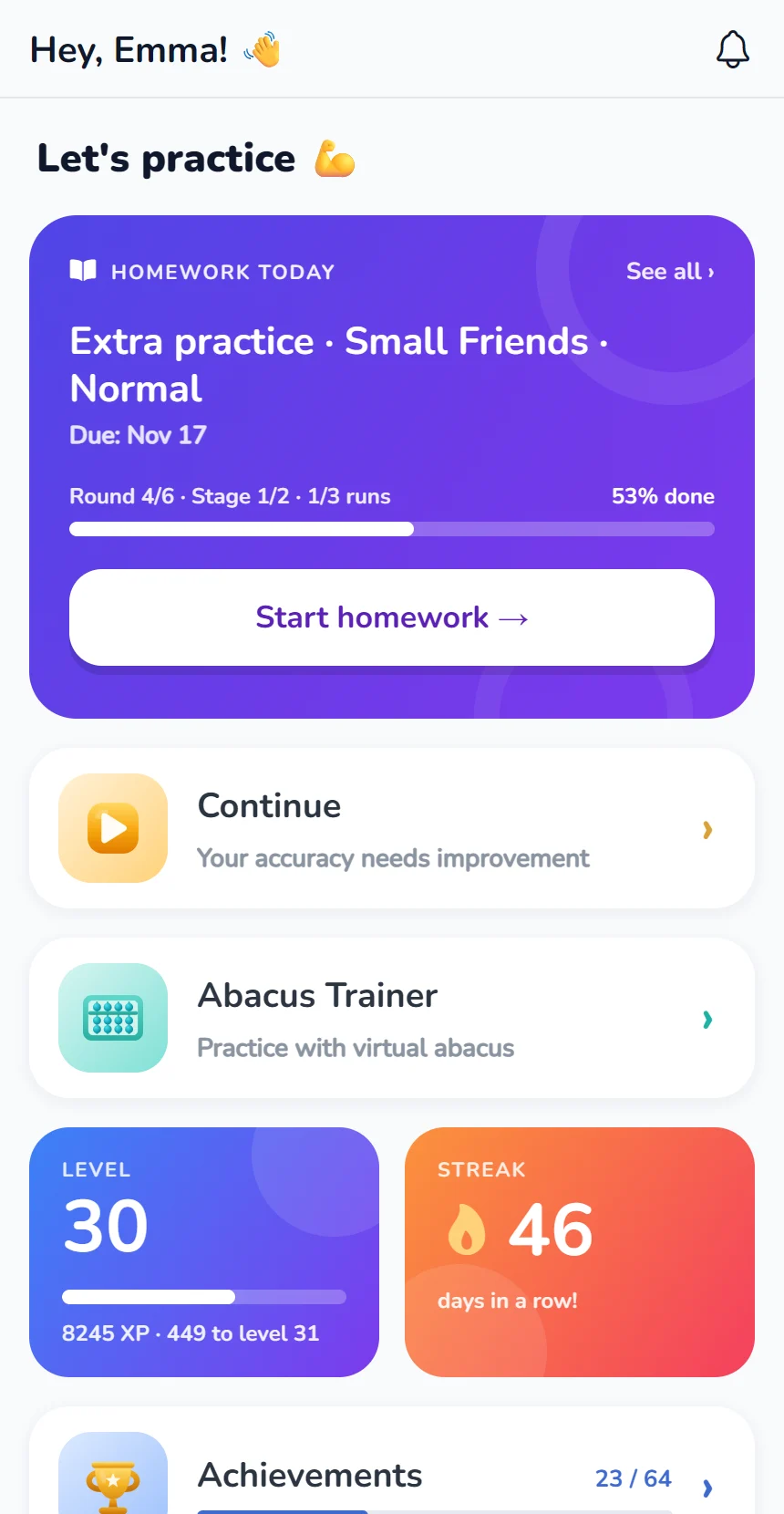
When practice responds to performance, weaker elements can receive more attention. Well-consolidated material can remain in the practice without occupying most of the session. In Amavit, the Continue card suggests the game where the child’s accuracy is lowest, and Auto difficulty adjusts speed and the number of operations to the child’s results.
This makes maintenance more targeted
Imagine that a child remembers almost everything well. But one particular topic has become weaker. On a random workbook page, that skill may appear only a few times. In adaptive digital practice, the weaker area can be identified and reinforced more efficiently.
Parents should monitor regularity — not every individual error
There is usually no need to ask “How many mistakes did you make in exercise three?” More useful questions are: Did you practise this week? Are you practising regularly? Has your speed dropped significantly? Is one particular topic becoming difficult again? That is often enough.
Tell the child: “You are maintaining your form”
This can make a psychological difference. The child has already completed the main course. So instead of saying “You still have to keep studying,” say:
“You already know this. Now you are just keeping the skill in good shape.”
That feels very different. The child understands: the main learning work has already been done. Now the goal is simply to preserve the result.
Think of it as a mental arithmetic gym
This is a useful way to explain maintenance. You already have the skill. You do not need to learn it again every time. You simply return occasionally to exercise it, keep it active and check your form. Just as someone who has already learned a sport still trains to stay in shape.
Three possible maintenance levels
| Light | Standard | Advanced |
|---|---|---|
| 2 sessions per week | 3–4 sessions per week | For children who want to retain a high performance level |
| 5–10 minutes | 10–15 minutes | More speed work; longer chains |
| Familiar mixed practice | Mixed practice + mental calculation + some speed work | Competition-style practice |
Examples only — every child is different.
Maximum speed does not need to be maintained at all costs
After the main course ends, the goal may change. If the child is not preparing for competitions, there may be no reason to constantly maintain peak speed. It may be more useful to preserve accuracy, confidence, mental calculation and a positive relationship with the skill.
Occasional challenges can keep practice interesting
Every few weeks, the child might try an old personal record, a faster speed, a longer chain or a competition-style exercise. Not because it is mandatory. But because it is satisfying to discover:
“I can still do this.”
Competitions can also support maintenance
For children who enjoy competition, occasional participation can create a new goal. There is no need to restart a full course. The child can simply increase practice for a short period, participate, see the result and compare it with a previous performance. This can bring motivation back.
But competition is not necessary for everyone
Some children enjoy rankings and challenges. Others do not. Their motivation may come from a personal record, a streak, games, visible progress or the simple satisfaction of retaining the skill. Maintenance should fit the child.
Premium can make long-term practice more varied
Once a child is mostly repeating familiar material, boredom can become one of the main risks. Additional game-based activities can help change the format, add challenge, maintain motivation and make repeated practice feel less monotonous. This is one reason Premium can be particularly useful for long-term independent practice.
Maintenance does not need to look the same all year
The schedule can change. For example: normal weeks — standard maintenance; holidays — lighter maintenance; before competition — increased practice; after a long break — short recovery period. That is completely normal. Maintenance should be flexible.
What if the child takes a long break?
There is no need to panic. And there is no reason to immediately return to maximum speed. A better approach is: start with familiar material; check accuracy; reduce difficulty slightly if necessary; complete several short sessions. Much of the previous performance may return surprisingly quickly.
If errors appear, find the last stable level
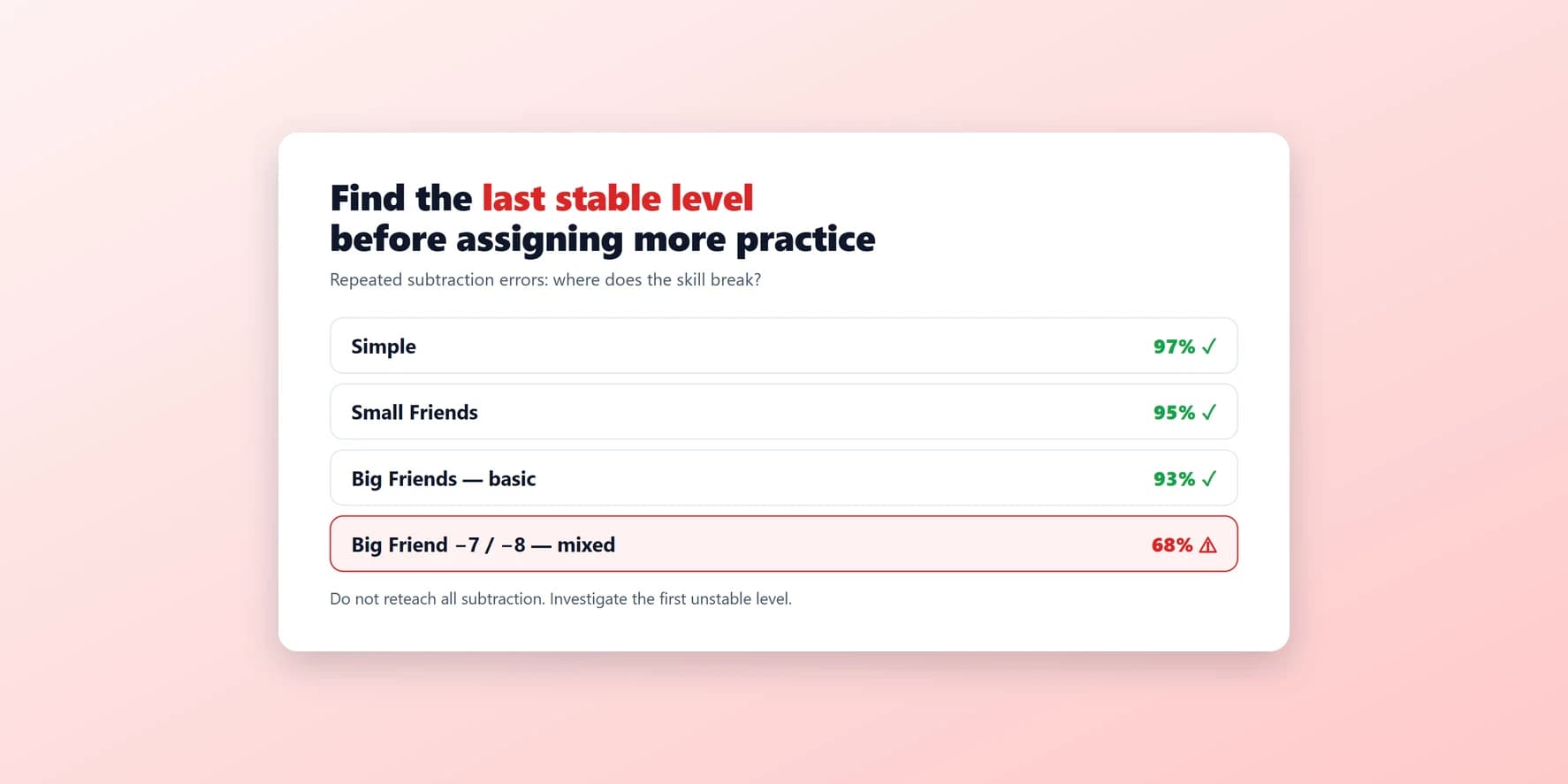
Suppose the child begins making many mistakes in advanced mixed practice. Do not immediately assign even more advanced mixed practice. Instead: step back; find the level that is still stable; restart from there; move forward gradually.
This is usually more effective — the method described in the diagnostic checklist for repeated subtraction errors.
Parents can support practice without creating pressure
A parent can remind occasionally, encourage regularity, support a streak, suggest a short practice session and recognise consistency. They do not need to stand beside the child, check every answer or criticise missed sessions. The long-term goal is for the child to take increasing ownership of the habit.
The app can help keep practice visible
After finishing a formal course, practice is particularly easy to forget. There may be no scheduled lesson, no teacher reminder and no homework deadline. This is where visible reminders become useful: they bring the skill back into the child's attention.
In Amavit, the streak and the Continue card wait on the child’s home screen, and the parent’s home screen shows whether the child has practised today.
The child does not need to remember everything alone
Children already have school, sports, friends and other activities. A visible streak can be enough to restart the habit: “Play today to keep it!”
Parents do not need to become the daily reminder system
This can reduce one of the most repetitive family conversations: “You still haven't practised.” When the application keeps the habit visible, the parent can remain a supporter rather than becoming a daily supervisor.
How can you tell whether maintenance is working?
Occasionally check accuracy, speed, older topics and mental calculation. Not every day. Perhaps every few weeks. If the key skills remain reasonably stable, the maintenance plan is working. The parent’s progress screen in Amavit shows accuracy and average time per answer over the chosen period.
A small drop in speed is not a disaster
After intensive training ends, maximum speed may decline slightly. That is normal. The more important questions are: Does the child still understand the rules? Is accuracy stable? Is mental calculation still working? Can speed be restored when needed? Maintenance should not become a permanent race for peak performance.
Protect the result the child has already built
A child may have studied mental arithmetic for one year, two years or longer. During that time, they may have completed thousands of repetitions and developed technique, automaticity, mental imagery and speed.
It makes little sense to lose all of that simply because the formal course has ended. The good news is that preserving a skill usually requires much less work than building it.
Maintaining is easier than rebuilding
Building the skill
Months / years · many repetitions · new techniques · teacher support
Maintaining the skill
Short sessions · familiar material · independent practice · occasional correction
Maintaining a skill usually takes much less effort than building it.
That creates a very favourable equation: small ongoing effort → preservation of a large previous investment.
A simple weekly maintenance example
- Monday — 10 minutes of mixed practice.
- Wednesday — 10 minutes of mental calculation.
- Saturday — 10–15 minutes of speed practice or a game.
That can be enough for some children. There is no need to practise for an hour every day.
Can a child maintain the skill completely without a teacher?
For a child who has already completed training and has a stable foundation, often yes. If there are no new complex algorithms to learn, finger technique is already established and the child knows how to practise independently, a digital trainer can handle a large part of maintenance practice — see online abacus practice with an adaptive trainer.
If a serious repeated problem appears, a teacher can always be involved again.
A teacher may be needed only occasionally
This creates another useful model. Most of the time: independent maintenance practice. If a problem appears: one consultation; diagnosis; correction; then back to independent practice.
There is no need to continue paying for and attending full lessons indefinitely just to maintain an already established skill.
The main conclusion
Finishing a mental arithmetic course does not mean a child needs to continue full lessons forever. But completely abandoning the skill is not always the best choice either. For many children, the best solution is somewhere in between:
move from learning mode to maintenance mode.
That means no constant new topics, no large homework assignments, no return to a full lesson schedule — just a few short practice sessions each week. This can help preserve accuracy, speed, mental calculation, automaticity and confidence.
And Amavit can be used in the simplest possible way: not as a school; not as another course; but as a trainer that helps keep the skill in shape.
The child already knows how to calculate. Now the goal is much simpler: do not lose what has already been learned.
Frequently asked questions
Does my child need to continue mental arithmetic lessons after finishing the course?
Not necessarily. If the child has already developed a stable foundation, lighter maintenance practice may be enough.
Will my child forget mental arithmetic after stopping lessons?
The skill does not disappear immediately, but speed, automaticity and mental stability can gradually decline if it is not used for a long time.
How often should a child practise after finishing an abacus course?
There is no universal schedule. For many children, a few short sessions per week can be a practical maintenance routine.
Does maintenance practice require a teacher?
Not always. Children with stable technique and existing knowledge can often maintain familiar skills independently.
Should a child still use a physical abacus?
Sometimes. Physical practice can help restore technique, accuracy or an unstable mental image.
Should children maintain their maximum calculation speed?
Not necessarily. The priority can shift from peak performance to preserving accuracy, automaticity and mental calculation.
Can an online trainer help maintain abacus skills?
Yes. An online trainer can provide regular practice, mental exercises, speed work and immediate checking without requiring the child to restart a course.
What if the child has not practised for several months?
Start with familiar topics at a comfortable speed, confirm accuracy and gradually increase difficulty.
Finished the course? Keep the skill active.
A child who already knows mental arithmetic can use Amavit independently for familiar-topic practice, mental calculation and speed maintenance — without restarting a full course.
Start Practising