Why Mental Arithmetic Needs More Than One Type of Practice — and How Different Training Formats Work Together
When parents first discover mental arithmetic, the learning process may look quite simple. There is an abacus. There is a workbook. The child solves examples. It seems reasonable to think:
“What else is needed? The main thing is simply to practise more.”
But as the skill develops, it becomes clear that one type of exercise cannot fully train or reveal everything the child needs.
A workbook does one job particularly well. A physical abacus does another. Flashcards serve another purpose. Screen-based exercises add something different. Audio training creates another kind of challenge. Mental calculation develops yet another layer.
A strong mental arithmetic program gradually combines these formats. Not simply to entertain the child. But because different types of practice develop and test different parts of the same skill.
Mental arithmetic is best trained through several complementary formats. Physical abacus develops technique, workbooks build structured repetition, flashcards train visual recognition, screen exercises control speed, audio removes visual support, mental practice develops the internal abacus image, and mixed exercises train rule selection.
| One skill — different training formats | |
|---|---|
| Physical abacus | Technique |
| Workbook | Repetition & consolidation |
| Flashcards | Visual recognition |
| Screen | Speed control |
| Audio | Listening + mental representation |
| Mental practice | Internal abacus image |
| Mixed practice | Rule selection |
| Together | Stable mental arithmetic skill |
Different exercises are not different versions of the same task. They train different parts of the same skill.
Everything begins with the physical abacus
At the beginning, the physical abacus is the foundation. The child needs to understand:
- how the abacus is structured;
- what each rod represents;
- how place value works;
- which fingers should move the beads;
- how to perform Simple operations;
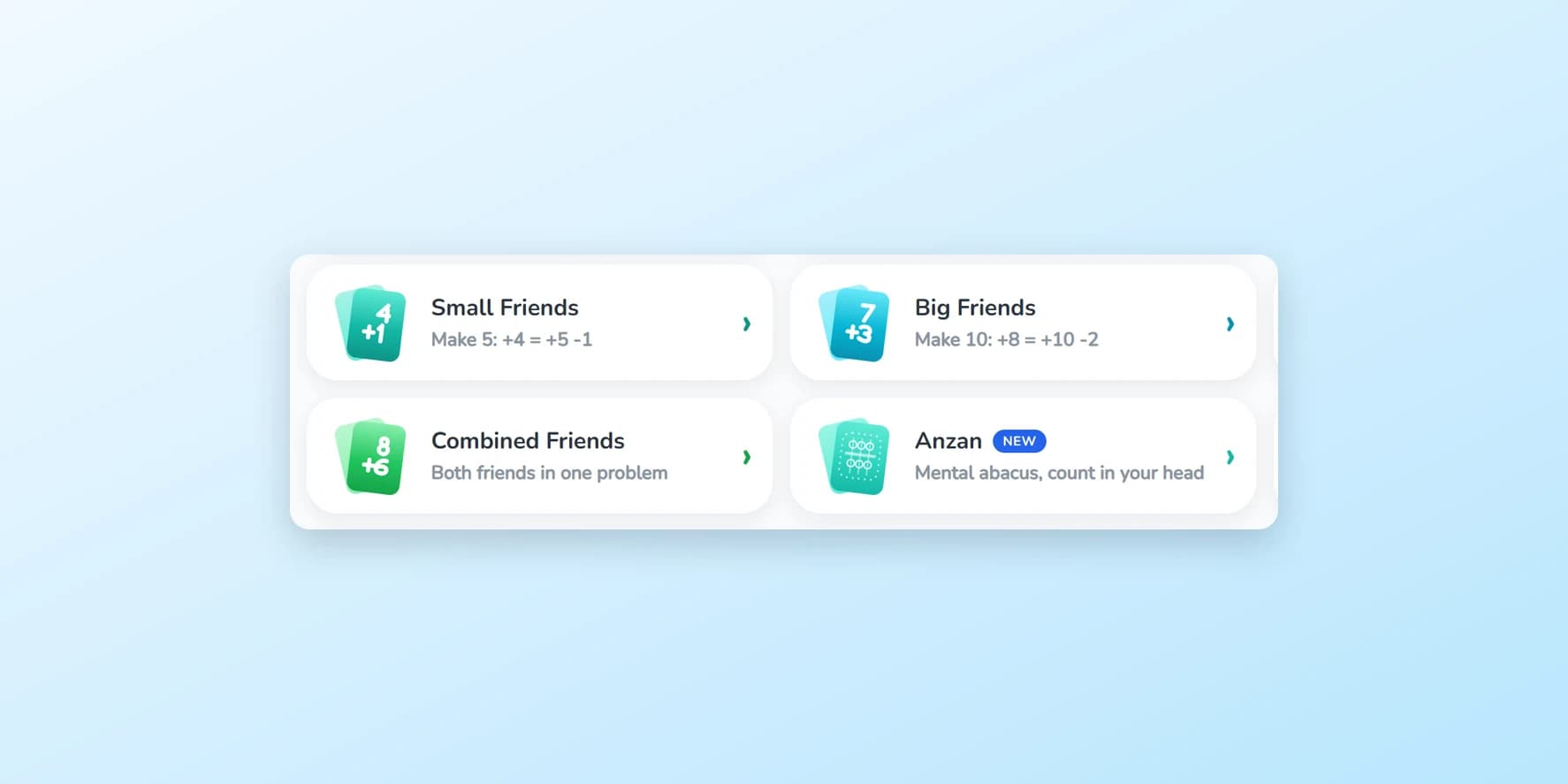
- Small Friends; Big Friends;
- and different transitions.
At this stage, a screen cannot fully replace a real abacus. The child needs to physically perform the movement. See the result. Repeat it. And gradually build correct technique.
The physical abacus answers an important question: Is the child performing the action correctly?
Imagine that the child gives the correct answer. That is useful. But the teacher also needs to know:
- How was the answer produced?
- Were the thumb and index finger used correctly?
- Were there unnecessary movements?
- Did the child compensate for an incorrect action?
On a physical abacus, technique is visible. That is why the physical abacus remains an important tool even after mental calculation begins to develop — see why physical abacus practice should never disappear completely.
The workbook builds volume and discipline
The workbook is also extremely valuable. It allows the child to:
- complete many examples calmly;
- see the structure of the task;
- work at their own pace;
- record answers;
- repeat a topic as many times as necessary.
Workbooks are especially useful for building basic mechanics and creating enough repetitions for a new skill to become stable. This part of learning should not simply be removed and replaced by a phone or tablet.
But a workbook does not show everything
A workbook has natural limitations. The child controls the pace. They can stop. Think. Go back. Recalculate. Sometimes they may even reach the correct answer using a different method from the one being trained.
So a correct written answer does not always mean:
“The skill is automatic.”
The workbook provides an important part of the picture. But not the whole picture.
Flashcards teach children to recognise numbers as visual patterns
With flashcards, the task changes. The child no longer has unlimited time to inspect every bead. They see a configuration and need to recognise it quickly. One card. Then another. Then another. Gradually, display time becomes shorter.
And the child moves from “I am examining individual beads” to “I recognise the configuration.”
This is an important bridge between the physical abacus and the mental abacus.
Why flashcards are especially useful early in training
For mental calculation, the child needs to create an internal representation of a number quickly. If they have to reconstruct that image slowly from individual elements every time, high-speed calculation will be difficult.
Flashcards help develop rapid recognition of familiar abacus configurations — one of the building blocks of automaticity. The child gradually learns not simply to count beads but to see the number.
Screen-based practice adds precise speed control
Later, another challenge appears. The child understands the topic. They know how to perform it. Now the question becomes:
At what speed does the skill remain stable?
A teacher can show examples manually at slower speeds. That works well. But try maintaining perfectly consistent intervals of 2 seconds; 1.5 seconds; 0.8 seconds; 0.3 seconds.
A person cannot reliably maintain exactly the same timing for long. A digital system can.
Speed becomes measurable
This changes the quality of feedback. Instead of saying:
“The child seems to calculate quickly,”
the teacher can see something like:
- 2 seconds — 96%;
- 1.5 seconds — 94%;
- 1 second — 82%.
Now there is a clearer boundary. The skill exists. But its current stable speed is approximately here. And the next training step can be selected more precisely — the way speed develops from 3 seconds to 0.1 seconds per operation.
Screen practice removes unlimited thinking time
In a workbook, a child can spend five seconds on one action. Or ten. And still write the correct answer.
On the screen, the next number appears automatically. The child needs to process the previous one before the next arrives. This reveals whether the rule is genuinely becoming automatic or whether the child can only remember and apply it slowly.
Mental calculation is another level of the skill
Once the physical image is sufficiently developed, the child begins to work without the real abacus. Now the operations happen internally. The child needs to:
- see or hear a number;
- represent it;
- change the position of the mental abacus;
- hold the new state;
- receive the next number.
This creates a different challenge from solving examples in a workbook.
A child can therefore be strong physically and weaker mentally
That is completely normal. Physically, the child may understand the rule, move the beads correctly and show high accuracy. Mentally, they may still lose the image, struggle to update it quickly and make mistakes in longer chains.
This does not necessarily mean:
“The child does not know the topic.”
It may simply mean that the mental version of the skill is still developing.
Audio practice tests another pathway
Now the child does not see the number at all. They hear it. They need to immediately:
- recognise the number;
- create the internal representation;
- apply the operation;
- update the mental abacus.
The visual cue has disappeared. That creates a different kind of task.
A child can perform very well visually and less well by audio
That is also normal. One child may have a stronger visual pathway. Another may respond very well to auditory input. A child may calculate accurately from a screen but become less stable when numbers are spoken. Or the opposite may happen.
If only one training format is used, this difference may remain hidden.
Audio does not replace visual practice
And visual practice does not replace audio. They solve different problems.
Visual training is especially suitable for very high speeds. Audio has a physical limit: the number has to be spoken. With two-digit or larger numbers, this becomes increasingly important.
So at extremely short intervals, visual presentation naturally becomes more practical. But audio remains valuable at speeds where spoken input can still be delivered clearly.
Different formats help identify the real weak point
Imagine these results:
- Workbook — 98%.
- Physical abacus — 97%.
- Flashcards — 96%.
- Screen at 2 seconds — 95%.
- Screen at 1 second — 72%.
- Audio — 90%.
What does this suggest? The child understands the topic, has good technique, recognises the visual pattern, can calculate mentally — but loses stability at higher visual speed.
There may be no need to reteach the topic. The next task may simply be to develop speed.
Now imagine another child
- Workbook — 97%.
- Physical abacus — 78%.
- Mental practice — 65%.
This is a different situation. Possible causes may include:
- incorrect technique;
- a weak topic;
- an unstable Friend rule;
- the child reaching correct workbook answers through a slower alternative method.
In this case, increasing speed would probably be premature. The foundation needs attention first — the kind of hidden gap described in why children keep making the same mistakes.
This is the value of multimodal practice
Different formats do more than make training more varied. They provide the teacher with different diagnostic windows.
One reveals mechanics. Another reveals visual recognition. Another reveals speed. Another tests auditory processing. Another tests the mental image. Together, they create a much more complete picture.
| Same accuracy — different information | |
|---|---|
| Workbook 95% | Can solve with time |
| Screen 95% at 2 sec | Skill stable at controlled speed |
| Audio 95% | Skill works without visual cue |
| Mixed 95% | Rule selection stable |
The same percentage means different things in different formats — see how to measure a child’s progress.
Variety also reduces monotony
There is another practical reason. Mental arithmetic requires a large number of repetitions. That is unavoidable.
But it is difficult for a child to spend two years doing only page 24; page 25; page 26; page 27. Even if those pages are useful.
Different formats allow the child to repeat the same underlying skill while changing the experience of practice.
The same topic can be trained in different ways
For example:
- Today physical abacus
- Tomorrow workbook
- Next flashcards
- Then screen practice
- Then audio
- Then mental mixed training
The topic may remain the same. But the task feels different. That helps reduce monotony without removing the repetition that skill development requires. Short sessions can be varied in the same way across the week — see how much practice a child needs each day and how often to practise.
But training should not become a collection of entertainment
There is an important boundary here. Formats should not change simply because:
“The child is bored — give them a game.”
Each format should have a methodological purpose. The goal is not merely to entertain. The goal is to train or test a particular component of the skill.
A game can therefore be educationally useful. Or it can simply be attractive animation with little methodological value.
Every activity should answer one question: What exactly are we training?
For example:
- Physical abacus — technique and mechanics.
- Workbook — volume, consolidation and written practice.
- Flashcards — rapid recognition of visual configurations.
- Screen practice — speed and stability under controlled timing.
- Audio — processing without visual support.
- Mental practice — maintaining and updating the internal abacus image.
- Mixed exercises — selecting the correct rule among many possibilities (see why mixed practice matters).
When each tool has a clear role, the entire program becomes logical.
Not every format is needed in equal amounts
At the beginning, physical abacus work may dominate almost completely. Flashcards are introduced gradually. Mental work appears in small portions.
Later, the mental component becomes larger. Screen-based practice becomes more important. Audio can be added when the child is ready.
At advanced levels, physical abacus work remains useful but may represent a smaller share of total training. So the balance changes as the child develops.
| Beginner | Intermediate | Advanced |
|---|---|---|
| More physical abacus | Physical + mental | Mostly mental practice |
| More workbook | More screen practice | Higher speed, longer chains |
| Some flashcards | Mixed topics | Mixed topics |
| Small amount of mental practice | Audio added | Audio / visual challenges · regular return to physical abacus |
How the balance changes over time — a direction, not fixed percentages.
A strong program should evolve with the learner
A five-year-old beginner and an advanced Anzan student should not follow exactly the same lesson structure. Their tasks are different.
A beginner needs to develop hand technique, understand basic mechanics and build the first visual representations.
An advanced student may be maintaining a multi-digit mental image, working at higher speed, training longer chains and mixing many rules.
The training formats should support the child’s current stage.
Workbooks are especially important at the beginning
Early training requires a great deal of controlled physical practice. The child cannot and should not replace all of that with screen exercises. It would be a mistake to say:
“Why use a workbook? Let’s put everything into an app.”
That would remove an important part of the learning process.
But at advanced levels, a workbook alone is not enough
The opposite problem also exists. A child may spend two years doing only paper exercises. They may become very strong in written work. But high-speed mental calculation requires different demands. The child needs to:
- work under time limits;
- lose the ability to pause indefinitely;
- process a visual stream;
- work from audio;
- maintain a mental image.
This is where digital tools become increasingly valuable — the shift we describe in abacus worksheets vs digital practice.
Paper and technology should not compete
This is one of the central principles. Not workbook or platform. But workbook + platform. Not physical abacus or mental practice. But physical + mental.
Each tool should do what it is best at.
The goal is not workbook or technology. The goal is workbook plus technology, used for the right purpose.
An app alone is not a complete teaching system either
It is possible to create an excellent-looking game. Beautiful buttons. Animations. Points. Levels.
But if the child has not developed correct hand technique, does not understand Friends, cannot work properly with a physical abacus and has not received methodological instruction, the app itself cannot build the entire foundation.
The teacher remains central to the learning process.
The platform should strengthen the teacher, not replace the teacher
The teacher
Explains · builds technique · understands the child · decides what needs to be trained · adjusts the learning path
The platform
Generates targeted practice · controls speed precisely · provides multiple formats · collects results · shows progress
The roles are different and complementary.
The platform should strengthen the teacher, not replace the teacher.
How this works in Amavit
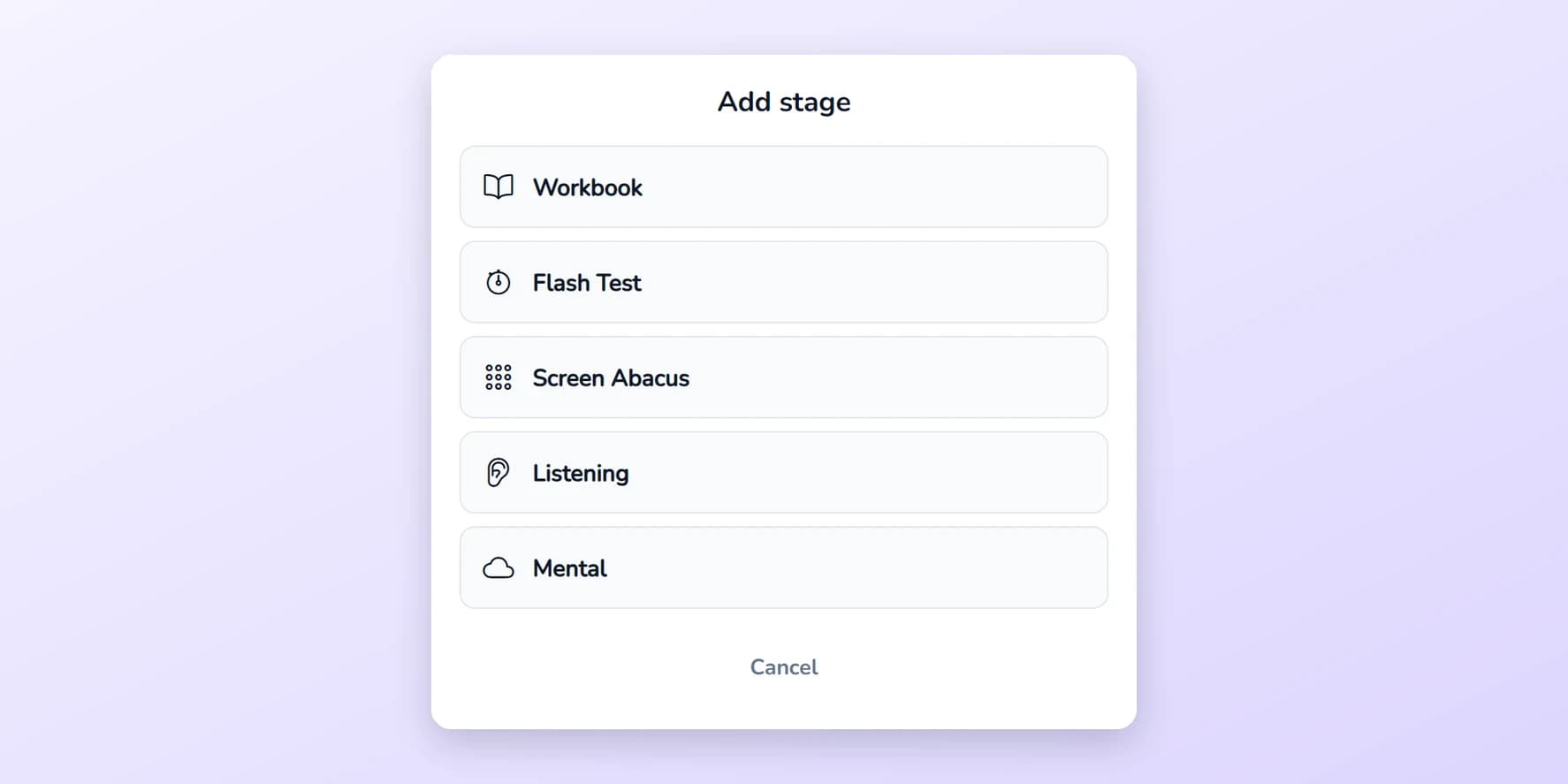
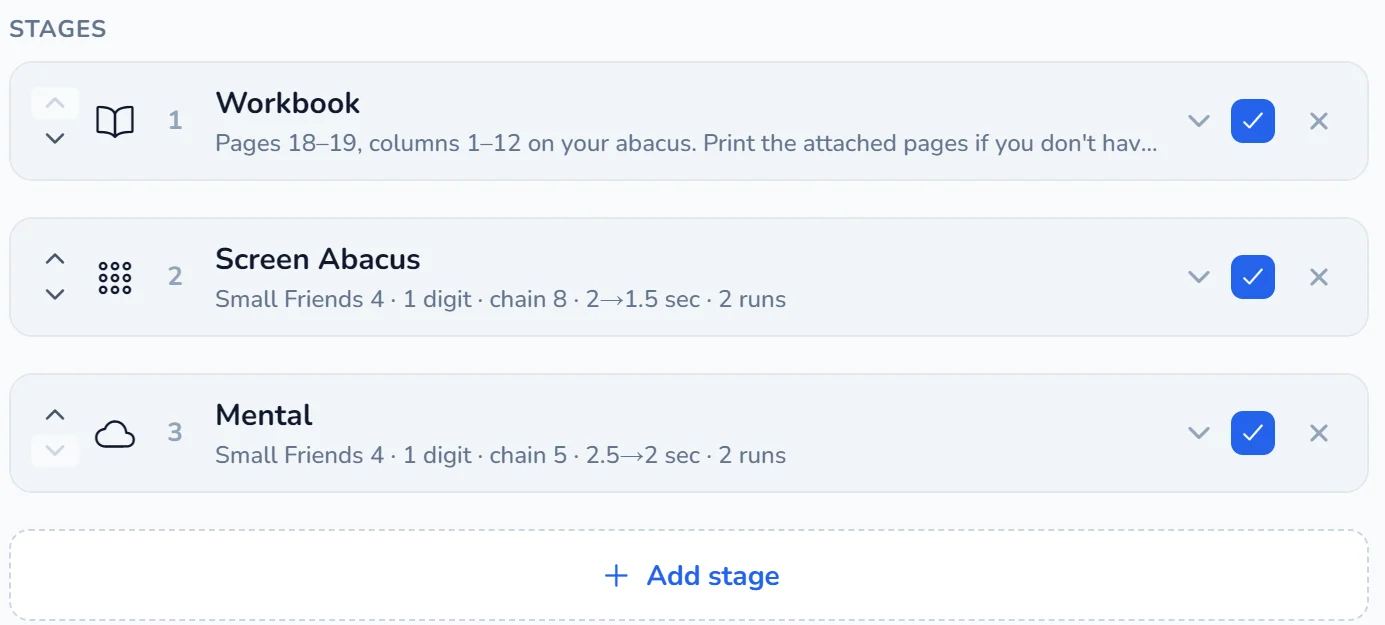
The idea behind Amavit is to bring different types of practice together around one methodology. A homework assignment is built from stages, and each stage is one format:
- Workbook — written exercises from the child’s book; the teacher can attach the pages;
- Flash Test — abacus cards shown for a set time;
- Screen Abacus — numbers appear on screen while the child calculates on their own abacus;
- Listening — numbers are also read aloud;
- Mental — no abacus, the child counts in their head.
For each stage, the teacher sets the game and topic, the operations, digit length, chain length, a speed range and how many successful runs are needed before the next stage opens. A Mix option adds earlier rules to the topic.
The platform is therefore not designed to replace traditional learning. It is designed to extend what teachers can do with it.
Technology is most useful when it expands the teacher’s toolkit — not when it tries to replace the teacher.
This is especially important for homework
During a lesson, the teacher can personally use several training formats. But at home, children have traditionally often been left with only a workbook. The teacher might say:
“Complete pages 15–18.”
But what actually happened at home? Did the child work slowly? Rush? Use the correct method? Recalculate? Make repeated errors?
The teacher might not know until the next lesson.
Digital homework provides feedback
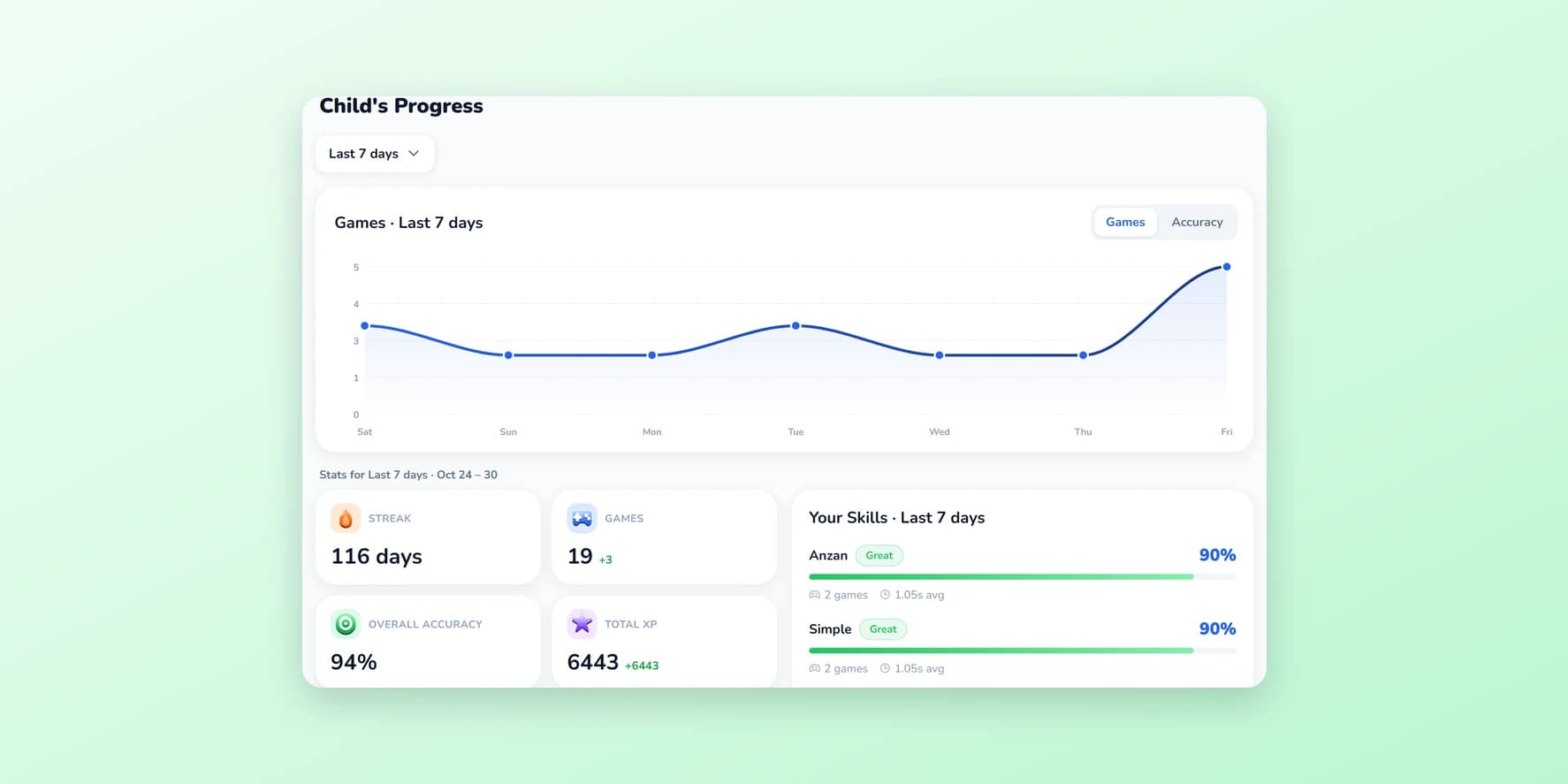
With digital practice, the teacher can see additional information such as speed, accuracy, number of exercises, homework completion, repeated mistakes and progress over time.
So the next lesson does not need to begin without context. The teacher already has a clearer picture of what happened during the week.
The physical workbook still remains important
This is a key principle. Digital homework should not automatically eliminate workbook practice. A workbook creates:
- a different mechanical experience;
- a different pace;
- a different type of concentration;
- a close connection with the physical abacus;
- an important stage of skill development.
A strong system therefore uses the tools together.
A mature skill should work under different conditions
This is a useful way to evaluate stability. If the child can use the topic on the physical abacus, in the workbook, with flashcards, on screen, mentally and inside mixed exercises, we can be much more confident that the skill is truly stable.
If it works only in one predictable format, it may need deeper testing.
Sport provides a useful analogy
A football player does not practise only shooting. Training also includes technique, passing, speed, physical conditioning, game situations and matches. Real performance requires all of these pieces to work together.
Mental arithmetic is similar. Different exercises develop different components of the overall skill.
Music works in the same way
A musician does not practise only complete pieces. There may also be scales, technical exercises, sight-reading, isolated difficult passages and full performances.
Each format has a different purpose. Together, they build the complete skill.
So the key question is not “Which format is best?”
There is no single best exercise. It makes little sense to say:
“Flashcards are better than workbooks.”
Or:
“Audio is better than physical abacus.”
They perform different functions. The more important question is:
Does the program have the right balance for the child’s current stage?
The program should choose the tool — not the other way around
A strong methodology asks: What is the child learning now? What is already stable? What needs more repetition? What needs to be tested? What needs more speed?
Then it selects the appropriate training format. That is much stronger than simply using whichever exercise looks most modern or entertaining.
The main conclusion
In mental arithmetic, it is not enough simply to solve many examples. It also matters how the child solves them and which part of the skill the current exercise is designed to train.
- Physical abacus develops technique.
- Workbooks provide structured repetition.
- Flashcards develop rapid visual recognition.
- Screen practice gives precise control over speed.
- Audio removes visual support.
- Mental practice develops the internal abacus image.
- Mixed exercises train automatic rule selection.
When these formats work together, they are no longer a collection of separate activities. They become one learning system.
So the strongest mental arithmetic program is not built around the question:
“Should we use a workbook or an app?”
It is built around a better question:
“How should different tools be combined so the child develops a stable and flexible skill?”
And this is where technology becomes genuinely useful: it does not replace the teacher, the physical abacus or the workbook — it helps connect them into one manageable learning system.
Frequently asked questions
Why does mental arithmetic use different types of exercises?
Because different formats train different parts of the skill, such as technique, visual recognition, speed, auditory processing and mental representation.
Can an app replace the physical abacus?
No. The physical abacus remains especially important for learning correct technique and new algorithms. Digital tools complement rather than replace it.
Are workbooks still useful in mental arithmetic?
Yes. Workbooks are valuable for structured repetition, technique and consolidation, particularly during the early stages.
What are flashcards used for in mental arithmetic?
Flashcards help children recognise familiar abacus configurations quickly instead of processing individual beads one by one.
Why use screen-based mental arithmetic exercises?
A digital screen can present numbers at precise and repeatable time intervals, making speed measurable and easier to train systematically.
Why use audio mental arithmetic exercises?
Audio exercises require children to process numbers without visual support and build or update the mental abacus from spoken input.
Is one training format enough?
Usually not for a complete long-term program. A skill that works across several formats is generally more robust than one that works only under one predictable condition.
Free for teachers