How Often Should a Child Practise Mental Arithmetic — and Why One Lesson a Week Is Not Enough
Many parents treat mental arithmetic like any other extracurricular activity. The child attends one lesson per week. Studies for an hour or ninety minutes. Goes home. Then returns the following week.
It seems like that should be enough. But mental arithmetic works differently.
One good weekly lesson may explain a new topic very well. But by itself, it rarely creates a stable skill.
Because between “I understand it” and “I can do it automatically” there is regular practice.
That is why the important question is not only how many lessons the child attends each week but also:
What happens between those lessons?
For many children, one main mental arithmetic lesson per week can be enough if it is supported by short, regular practice between lessons. The goal is not to attend as many teacher-led lessons as possible, but to return to the skill often enough for new rules to become automatic.
One main lesson per week can work very well
Let’s start with something important. One main lesson per week is a perfectly normal model. Many mental arithmetic schools use exactly this structure.
Once a week, the child meets the teacher for around 60–90 minutes. During the lesson, the teacher may:
- review previous material;
- correct technique;
- introduce a new topic;
- explain a new rule;
- let the child practise under supervision;
- assign home practice.
If the child practises regularly between lessons, this structure can work extremely well.
The problem begins when nothing happens between lessons
Imagine this. On Monday, the child learns a new topic. They understand it. They perform several examples correctly. Then they do not return to it for six days.
A week later, the teacher opens the same topic again. Part of the lesson is now spent simply trying to remember:
“How did we do this?”
The teacher is no longer building the next level. They are repeatedly restoring what should have been consolidated during the week. That slows the entire program.
A lesson creates understanding — practice creates skill
This is probably the simplest way to explain the process.
The lesson creates understanding. Regular practice creates automaticity.
A teacher may explain a Small Friend rule in a few minutes. The child understands it. But if they need to use that rule quickly, without consciously remembering every step, repetition is necessary. A lot of repetition.
And it is very difficult to fit enough high-quality repetition into one weekly lesson alone.
- Teacher lesson understanding
- Regular home practice repetition
- Time + consistency automatic skill
Regular short practice is often better than one long homework session
Some families follow this pattern: nothing happens during the week; then on Sunday evening the child sits down for an hour and completes all the homework.
Technically, the homework is done. But from a skill-development perspective, this is usually not the best structure.
For many children, it is more effective to practise 10–15 minutes several times per week — or almost every day — than to do one very long session once every seven days. The reason is simple. The child keeps returning to the skill.
Option A
1 × 60 minutes, once per week
Option B
5 × 10–15 minutes, across the week
For automaticity, frequent high-quality practice is often more useful than one large block. This is a practical principle, not a universal formula.
The brain needs repeated contact with the same pattern
When a child learns a new rule or movement, it is still unstable. Today, they remember it clearly. Several days later, less clearly. Then they practise again. And gradually the path becomes more familiar.
At first, the child thinks “What should I do now?” Later: “I know this.” Eventually: “I just do it.”
That is the transition toward automaticity. And it requires time and repetition.
How much home practice is usually enough?
There is no single number for every child. Age is different. Level is different. Speed is different. But in practice, some useful guidelines can be:
- for beginners: around 7–10 minutes per day;
- for children already practising regularly: around 15–20 minutes;
- for advanced students or serious competition preparation: 30–40 minutes, if the child handles that load well.
These are not strict standards. The quality and regularity of practice matter more than the exact number of minutes. We cover the minutes in more detail in how much mental arithmetic practice a child needs each day — this article is about how to spread practice across the week.
Ten good minutes can be more useful than forty poor ones
Imagine a child practising for 40 minutes. For the final 25 minutes, they are tired, distracted, making mistakes, working unwillingly and simply waiting for it to end.
The total duration is large. But the quality of practice is already low. Sometimes 10–15 minutes of focused work produces more value. Especially for younger children.
Practice length should match the child’s age
Forty minutes of independent home practice means something very different for a five-year-old than for a ten-year-old.
Younger children usually benefit from practice that is short, clear, regular and focused on one understandable goal. For example: one topic today; a short flashcard block; a few mental examples; finished.
Practice should not always end only when the child is completely exhausted.
Regular does not mean long every day
When we say “practise regularly,” we do not mean one hour every day. That can create the opposite problem.
Regularity means frequent return, manageable volume and a stable routine. For example, five or six short practice sessions per week may be much more useful than one very long session.
A rest day is completely normal
Children are not machines. They also have school, sport, music, other classes, family and friends. Mental arithmetic should not become a daily burden that pushes everything else out.
A child may have five normal practice days, one light day and one full rest day. That can be completely reasonable.
The important thing is that the skill does not disappear from the child’s life for the entire week.
Does a child need extra home practice on lesson day?
Not necessarily. If the child has already spent 60–90 minutes with the teacher, there may be no need for another large session at home.
Sometimes a short review is enough. Perhaps a few flashcards. Or home practice can simply begin the next day. Especially with younger children.
The day after the lesson is particularly useful
What is important is returning to the new topic relatively quickly. For example, the next day. The material is still fresh. The child repeats the new rule, the new movement, the new combination.
That is far better than opening the homework for the first time five days later.
A good week can work like a cycle
- Day 1 — lesson with the teacher introduce the new topic
- Day 2 — short review reinforce fresh material
- Day 3 — practice more repetitions
- Day 4 — mix the new topic with older ones
- Day 5 — step up slightly increase speed or difficulty
- Day 6 — check short review or control practice
- Day 7 — rest or the next lesson
The exact schedule can vary. The principle is regular return to the skill.
This is not a mandatory schedule. It simply shows the logic of a good weekly rhythm.
Practice does not need to look the same every day
This is where boredom often begins. If the child receives another page of nearly identical exercises every day, even useful practice can quickly become tiring.
The same topic can be trained in different ways: workbook, physical abacus, flashcards, screen-based exercises, audio, mental calculation, mixed exercises.
The learning goal stays the same. The format changes.
Different formats make frequent practice easier to sustain
This matters especially in a long program. If a child needs thousands of repetitions, it is unrealistic to rely only on willpower. Practice needs to be organised in a way that does not feel like endless repetition of the same task.
Today: workbook. Tomorrow: flashcards. Then: audio. Then: mental calculation. The underlying skill is still being trained. But the experience feels different.
Accuracy comes before speed
Imagine the child learns a new topic on Monday. On Tuesday, there is no need to chase a record immediately. The main goal should be: perform the rule correctly.
Then gradually: repeat; stabilise; automate; increase speed.
By the next lesson, the child should not simply “remember what was explained.” They should be able to use the topic with reasonable confidence.
This is how one new topic per week becomes realistic
When home practice works properly, one new topic per week can be a very reasonable pace. The teacher explains the topic. The child practises throughout the week. At the next lesson, the teacher checks:
- Is the technique correct?
- Is accuracy acceptable?
- Is the topic stable enough?
If yes — move forward. This is what allows a program to progress consistently — see how to know when a child is ready for the next topic.
If the child does not practise between lessons, the group begins to move ahead
This is one of the most common problems. The group learns the topic, practises and returns a week later ready to move forward.
One child barely practised. For that child, the topic is still not automatic. But the group is already moving on. Now the next topic is built on top of a weak previous one. After several weeks, the gap becomes larger.
Later, the problem may look like “The child doesn’t understand”
But the original cause may have been completely different. The child did understand. There simply were not enough repetitions. Then old rules remained unstable; new rules were added; the workload increased; mistakes appeared.
Parents may begin to think:
“Maybe mental arithmetic is not right for my child.”
When sometimes the real problem is simply inconsistency.
Home practice should not become a family conflict
There needs to be balance. If every evening parents say:
“Sit down! Do your homework! You skipped it again!”
and ten minutes of practice becomes forty minutes of arguing, something is wrong.
A clear routine often works better. For example: after school; after a snack; 10–15 minutes; finished. The fewer negotiations required every day, the easier it is to build a habit.
A small habit is better than constant negotiation
It is similar to brushing teeth. Families do not normally hold a daily discussion:
“Do you feel like brushing your teeth today?”
It is simply part of the routine. Mental arithmetic can also become a small, normal part of the day. Not punishment. Not a major event. Just a short training block.
The parent’s role is to support consistency — not to teach
Parents do not need to know every Friend rule. They do not need to correct finger movement, explain methodology or solve examples together with the child. That is the teacher’s role.
The parent’s role is much simpler:
- help establish a routine;
- remind when needed;
- check whether practice is being completed;
- notice when the child starts skipping repeatedly;
- contact the teacher if something changes.
More on this in how parents can support a child without becoming a second teacher.
If the child constantly refuses home practice, look for the reason
The answer is not always “The child is lazy.” Perhaps:
- the assignment is too long;
- too difficult;
- too easy;
- too repetitive;
- the topic was not understood;
- the practice time is inconvenient;
- the parent-child interaction around homework has become stressful;
- the child has no clear goal.
Before increasing pressure, it is better to understand what is causing the resistance.
Sometimes the answer is less homework
This may sound counterintuitive. The child is not practising enough. So the instinct is:
“Give more homework so they catch up.”
But if the real problem is overload, increasing volume makes things worse. Sometimes it is better to choose 15 minutes of high-quality practice instead of 40 minutes of conflict. Then gradually increase the load later.
Sometimes the real problem is simply too little practice
There are also children who practise three minutes, twice a week. And parents wonder why speed barely changes.
In that situation, the answer is more straightforward. Automaticity requires enough repetition. High performance cannot be built on very rare exposure.
Minutes alone are not enough
Two children may both practise for 15 minutes. The first works attentively, trains the required topic and rarely gets distracted. The second switches screens, stops, returns and makes careless mistakes.
Technically, both practised for 15 minutes. In reality, these are very different sessions.
That is why teachers benefit from seeing more than time. They should also look at the number of completed tasks, accuracy, speed, topics and consistency.
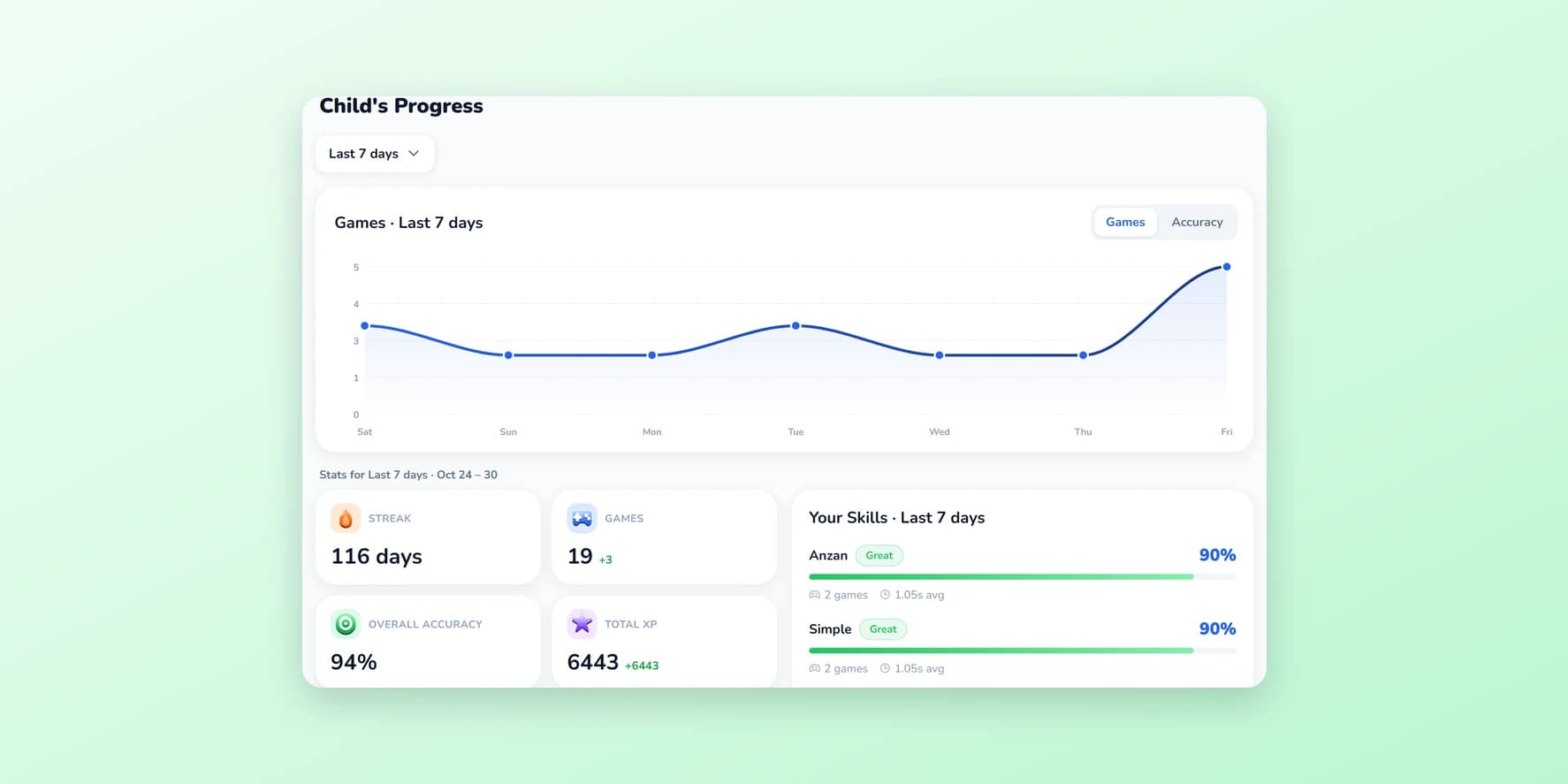
A streak can make regularity visible
For a child, the phrase “You need to practise regularly” is very abstract. A streak of 7 days, 14 days or 30 days is much easier to understand.
The child can see continuity. They may not want to break it. This can become a useful motivational mechanism — one of the tools that help keep children motivated. But only when the streak is connected to real practice.
A streak should not be awarded just for opening the app
The child should actually do something meaningful. For example: complete a training session; finish the minimum target; perform real practice.
Then the streak represents “I am practising consistently.” Not “I opened the app every day.”
How Amavit helps teachers see consistency
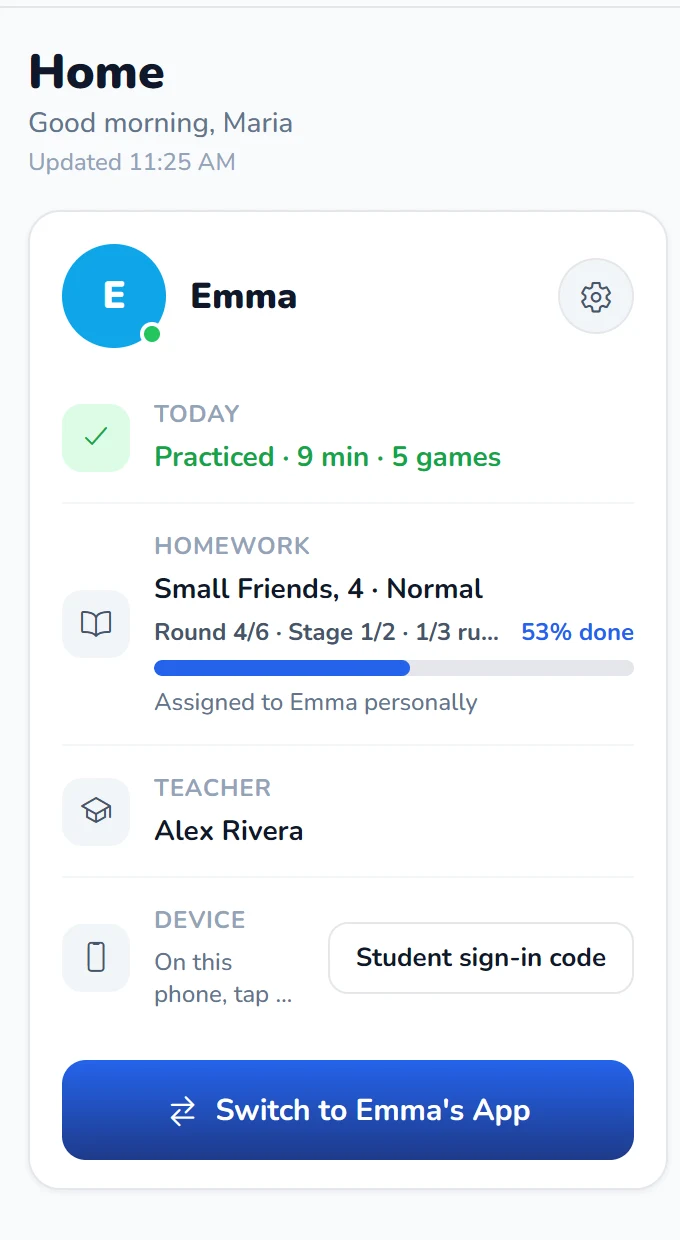
The teacher is not physically present at the child’s home every day. They cannot automatically know whether the child practised. Especially when the teacher works with 30 students, 50 or more.
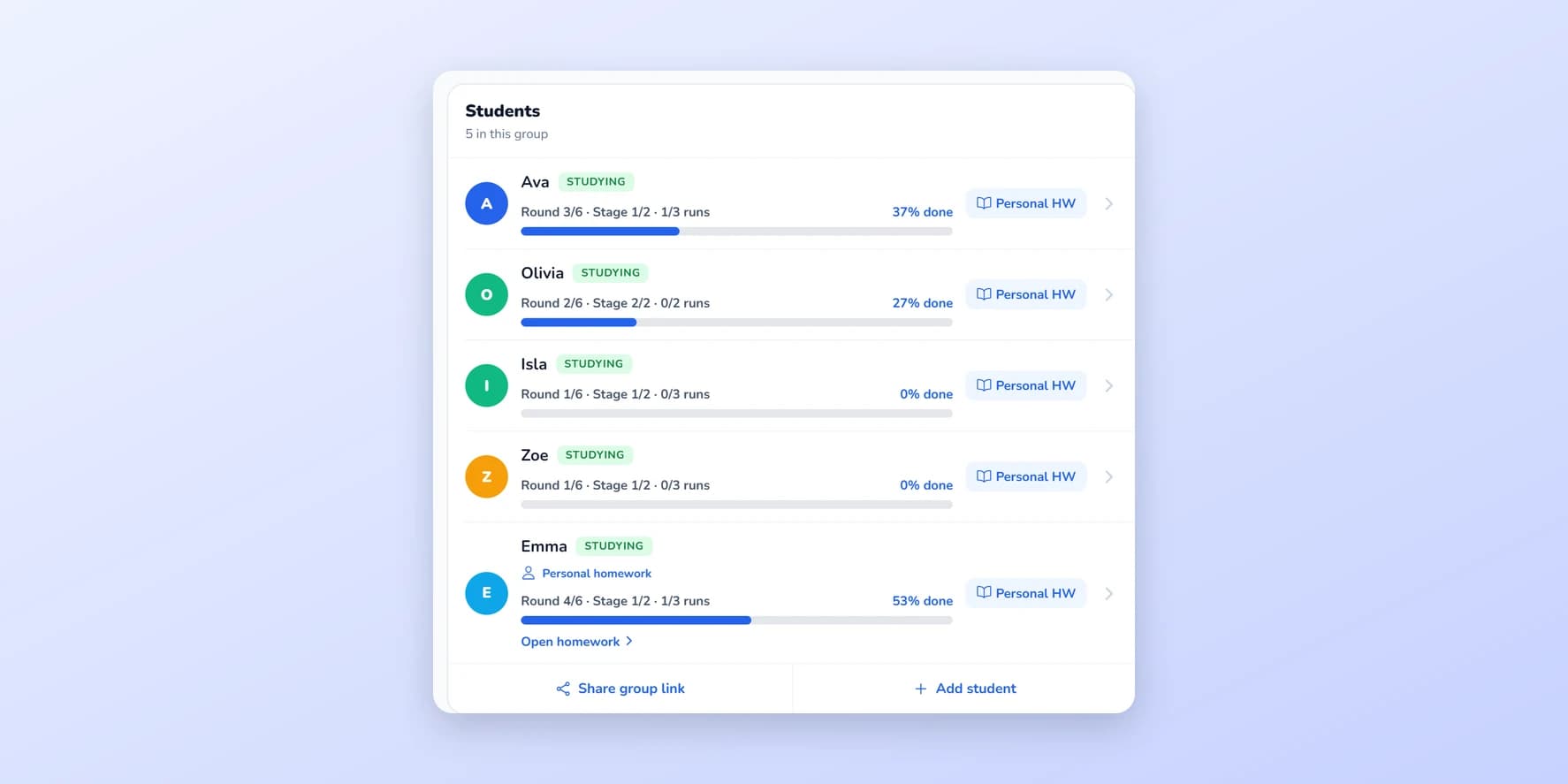
Amavit can help teachers see:
- whether homework was completed;
- how much practice was done;
- practice volume;
- accuracy;
- speed;
- how regularly the child returned to training.
So at the next lesson, the teacher has a clearer picture of what happened during the week.
This helps distinguish a teaching problem from a practice problem
Imagine the child returns to class and makes many mistakes.
Scenario one: they practised regularly all week, but the same error remained. The teacher should investigate the topic or technique.
Scenario two: the child barely practised. That is a different situation.
Without data, these two causes can easily look the same.
Parents can also notice problems earlier
There is no need to wait until the end of the month. If a child has not practised for three days, starts abandoning exercises or suddenly shows much lower accuracy, the parent can notice fairly quickly.
Then they can contact the teacher. The earlier a problem is identified, the easier it usually is to correct.
Can a child have two teacher-led lessons per week?
Of course. That model can work too. For example, two shorter lessons per week. For some children, this is very effective. The material is distributed more frequently. The teacher can check technique more often.
But even two lessons do not necessarily replace all home practice. If the goal is automaticity, it is still useful to return to the skill between lessons.
What about three lessons per week?
That can also work. Especially for intensive programs, competition preparation, individual training and shorter lesson formats — see group or individual mental arithmetic lessons.
But more teacher-led lessons do not automatically produce proportionally better results. You still need to consider age, total workload, other activities, motivation and cost. Mental arithmetic should not crowd out the rest of the child’s life.
For most children, the system matters more than the lesson count
A child can have one strong lesson per week + regular home practice and achieve excellent results.
Another child can have three lessons per week + almost no independent practice and remain heavily dependent on the teacher.
The first model may build a more independent skill.
One strong weekly lesson plus consistent home practice can be more effective than several lessons with no practice in between.
Children should gradually learn to practise without the teacher
This is another important part of development. At first, the parent reminds and the teacher controls everything.
Later, the child begins to understand: I have a short practice session; I complete it; I see the result; I move forward.
That develops more than mental arithmetic. It also develops learning independence.
What if the child misses a few days?
Nothing terrible. Illness. Travel. A difficult school week. Life happens.
There is no need to respond to three missed days with “Now you need to complete all three days at once.” It is usually better to return calmly to the routine.
Consistency matters over the long term. Not perfect compliance every single calendar day.
A streak should never become an obsession
If the child is sick, losing a streak is not a disaster. If the family goes on holiday, the same applies.
A motivational tool should support the family. It should not control the family. The real goal is to maintain a long-term practice habit — and mental arithmetic is a long-term program.
What can a healthy weekly routine look like?
For many regular programs, the basic logic may look like:
- one main lesson per week;
- short practice between lessons;
- several training days;
- one or two lighter days;
- early return to the new topic;
- continued review of older skills.
Not necessarily the same activity every day. But frequent enough that the child does not restart almost from zero each week.
The main conclusion
A child does not need to see a mental arithmetic teacher every day. For many programs, one main lesson per week can be completely sufficient. But only if there is regular practice between lessons.
The teacher explains, builds technique, checks, corrects and introduces new material.
Short home practice reinforces, repeats, automates and prepares the child for the next stage.
So the most useful question is not:
“How many lessons per week are necessary?”
It is:
“How often does the child really return to the skill?”
Because one lesson can teach a new rule. But regular practice is what turns that rule into a real skill.
One lesson teaches the topic. The week between lessons builds the skill.
Frequently asked questions
Is one mental arithmetic lesson per week enough?
For many children, yes — if the lesson is supported by regular practice between lessons.
How many days per week should children practise mental arithmetic?
There is no single universal number, but several short sessions spread across the week are often more useful than one large homework session.
How long should mental arithmetic home practice take?
A practical guideline may range from around 7–10 minutes for beginners to 15–20 minutes for regular learners, with longer sessions for advanced students when appropriate.
Should children practise mental arithmetic every day?
Not necessarily. Regularity matters more than perfect daily practice, and rest days can be completely appropriate.
Is it better to practise for one hour once a week or 10–15 minutes several times?
For building automaticity, shorter and more frequent high-quality practice is often the stronger approach.
Do two or three teacher-led lessons per week remove the need for home practice?
Not necessarily. Regular independent repetition can still be important for automaticity.
What if a child misses several days of practice?
There is usually no need to compensate with one huge session. It is better to return calmly to the normal routine.
Free for teachers