How to Teach a Mixed-Ability Abacus Group Without Splitting the Class
Almost every mental arithmetic group eventually becomes a mixed-ability group. Even when all students begin at approximately the same level. Children simply do not develop at exactly the same pace.
One child understands a new topic quickly. Another needs more repetitions. A third is accurate but slow. A fourth is very fast but makes mistakes. A fifth missed two weeks of lessons. A sixth practises every day at home.
After several months, they are still one group. But their actual learning needs are no longer identical. That is normal.
The problem does not begin when children become different. The problem begins when the teacher continues treating them as if they were all the same.
A mixed-ability abacus group does not always need to be split. Teachers can keep one shared curriculum while adapting speed, volume, digit length, chain length and homework intensity for individual students. Digital practice makes this easier because stronger students can work independently while the teacher supports those who need more explanation.
A mixed-ability group is not a bad group
Teachers sometimes see differences inside a class — or a mixed-level batch — and think:
“I must have formed this group incorrectly.”
Not necessarily. Even a very well-matched group will gradually spread out. Progress depends on many factors: regularity; age; previous experience; concentration; learning speed; home practice; motivation.
The goal is therefore not to keep every student at exactly the same level. The goal is: keep a shared learning path while giving each child an appropriate level of practice.
The key distinction: shared lesson, adapted practice
This is the basic principle. During the lesson, the whole group can learn the same topic. For example: Big Friends. The teacher explains the rule to everyone. Demonstrates the technique. Practises it together.
But different children may then need different amounts or types of practice. One student may need more basic examples. Another: higher speed. A third: mixed practice. A fourth: additional revision of an older topic.
So: the lesson can be shared while the practice is partially individualised.
One shared curriculum. Different levels of practice.
A digital platform makes this much easier during the lesson
Without digital tools, a teacher often has only two options. Either everyone does the same task. Or the teacher manually prepares different exercises for different students.
With an application, there is another option. The group can stay together while students work at different levels of difficulty.
For example, imagine that the strongest students have already understood today's topic. There is no need for them to sit and wait while the teacher explains the same rule again. They can receive independent work: workbook exercises; additional problems; more advanced practice.
Meanwhile, the teacher can spend more direct time with the middle and weaker students.
Strong students can work independently while the teacher supports others
For example: the strongest children already understand Big Friend +7. The teacher gives them specific workbook pages or a more advanced digital exercise. They continue working independently.
At the same time, the teacher works with the students who need more support. The teacher can:
- slow down the examples;
- show the technique again;
- display exercises on the screen;
- use practice games;
- repeat the rule;
- work through mistakes together.
The whole group remains active. The strongest students are not waiting. The weaker students receive more teacher attention.
| What happens during a mixed-ability lesson | |
|---|---|
| Strong students | Workbook / advanced app practice |
| Teacher | Works with standard and support students |
| Support students | Slower screen practice, games, guided examples |
| Then | The group returns to the shared lesson |
This is better than making the whole class wait
One common problem in mixed groups is that the teacher adjusts the entire lesson to the slowest learner. Then stronger children become bored.
The opposite problem is also common: the teacher moves at the speed of the strongest students. Then weaker children stop understanding.
A better solution is to create temporary parallel practice inside one shared lesson. The class remains together. But not every child must perform exactly the same task during every minute.
Do not turn one group into six individual lessons
There is still an important boundary. If every student follows a completely independent curriculum, the group eventually stops functioning as a group.
The teacher begins explaining one topic to one child, another topic to another, a third topic to someone else. Everyone else waits. That quickly becomes inefficient.
Individualisation works best when the class keeps a common learning framework and the teacher changes only the parameters that need to differ.
What can be individualised?
The topic can remain the same. The difficulty does not have to.
One topic can have several difficulty levels
Imagine the whole group is learning Big Friend +8. One student receives slow one-digit practice with short chains. Another: normal-speed practice. A stronger student: higher speed, longer chains or mixed digits.
The skill being trained remains the same. Only the load changes. That makes it much easier to keep the group together.
| One group — three practice levels · Shared topic: Big Friend +8 | ||
|---|---|---|
| Support | Standard | Advanced |
| Lower speed | Normal speed | Higher speed |
| Shorter chain | Standard volume | Longer chain |
| More repetition | Mixed digits | |
Same lesson. Same curriculum. Different practice.
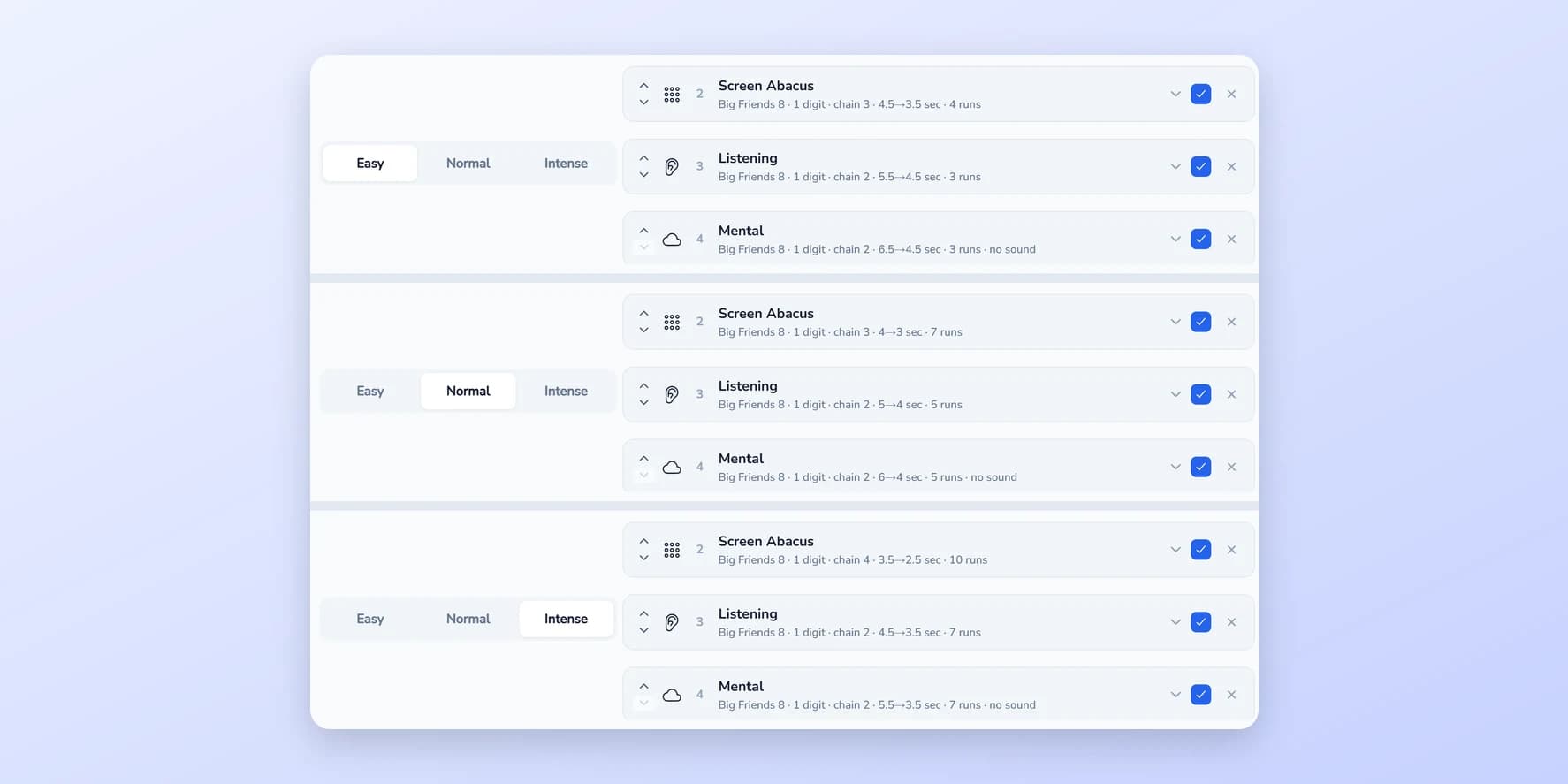
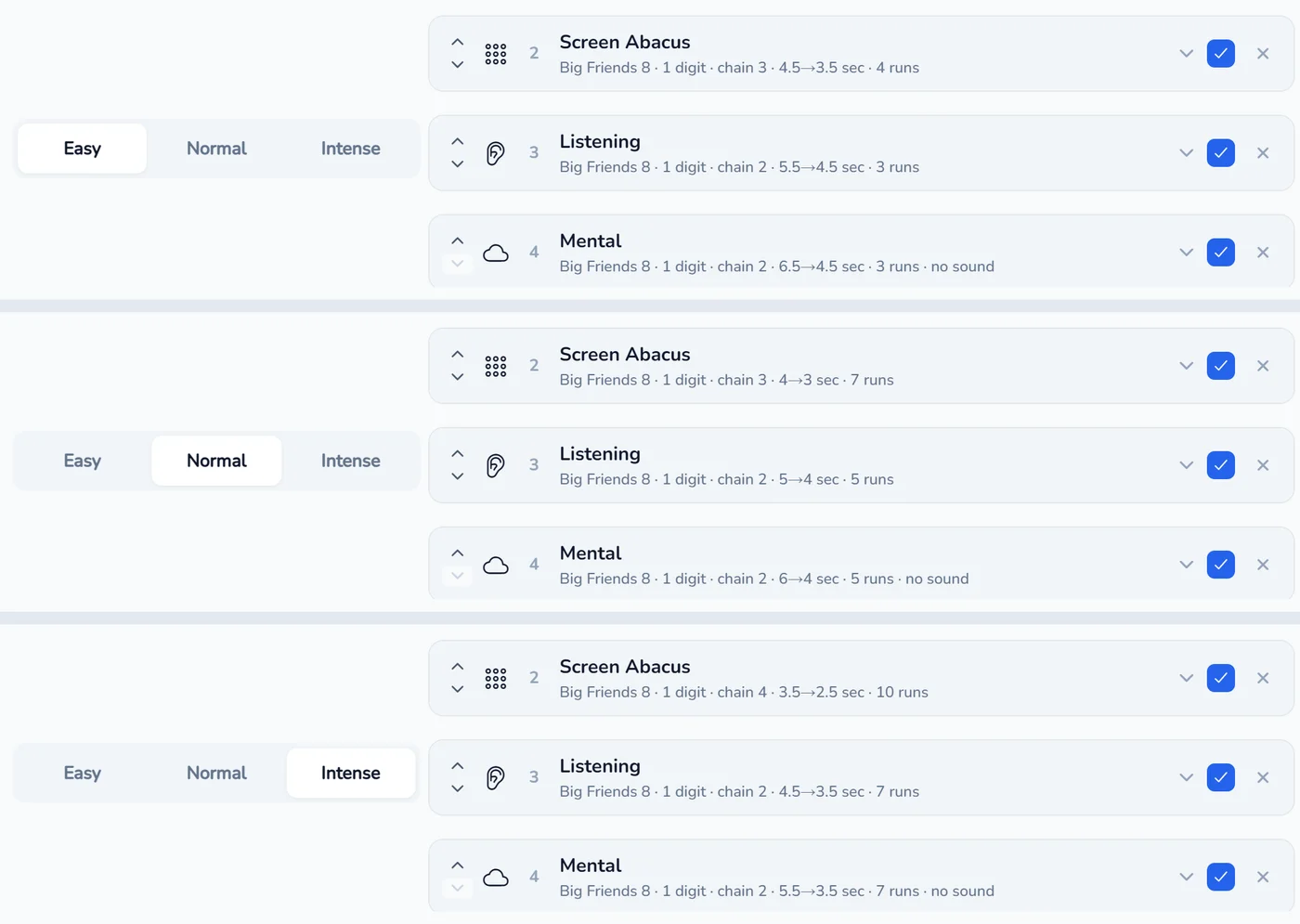
In Amavit, every homework has a Difficulty switch — Easy, Normal and Intense — on top of the same topic. Easy gives fewer rounds, half a second more per number and fewer successful runs before the next stage opens. Intense gives more rounds, half a second less per number, more runs and a slightly longer chain on the screen stage. After that, the teacher can still change any stage by hand.
The same principle can be used for homework
This is where a platform becomes particularly useful. The group can receive one common homework structure. But the actual settings can differ according to the child's level. In Amavit, different homework templates and practice levels can be used for this purpose. For example:
- Support / easier practice — for a student who needs more time and a lower difficulty.
- Standard practice — for a student progressing normally with the group.
- Advanced / intensive practice — for a stronger student who needs greater speed or difficulty.
So the teacher does not need to create an entirely separate homework program from scratch for every child.
One homework assignment can have different difficulty settings
Imagine the whole class is practising the same topic. For one child: lower speed; shorter chain; more basic repetition. For another: standard settings. For a stronger child: higher speed; longer chain; harder parameters.
Educationally, the group continues moving together. Operationally, each child receives a more suitable workload. This is a major advantage.
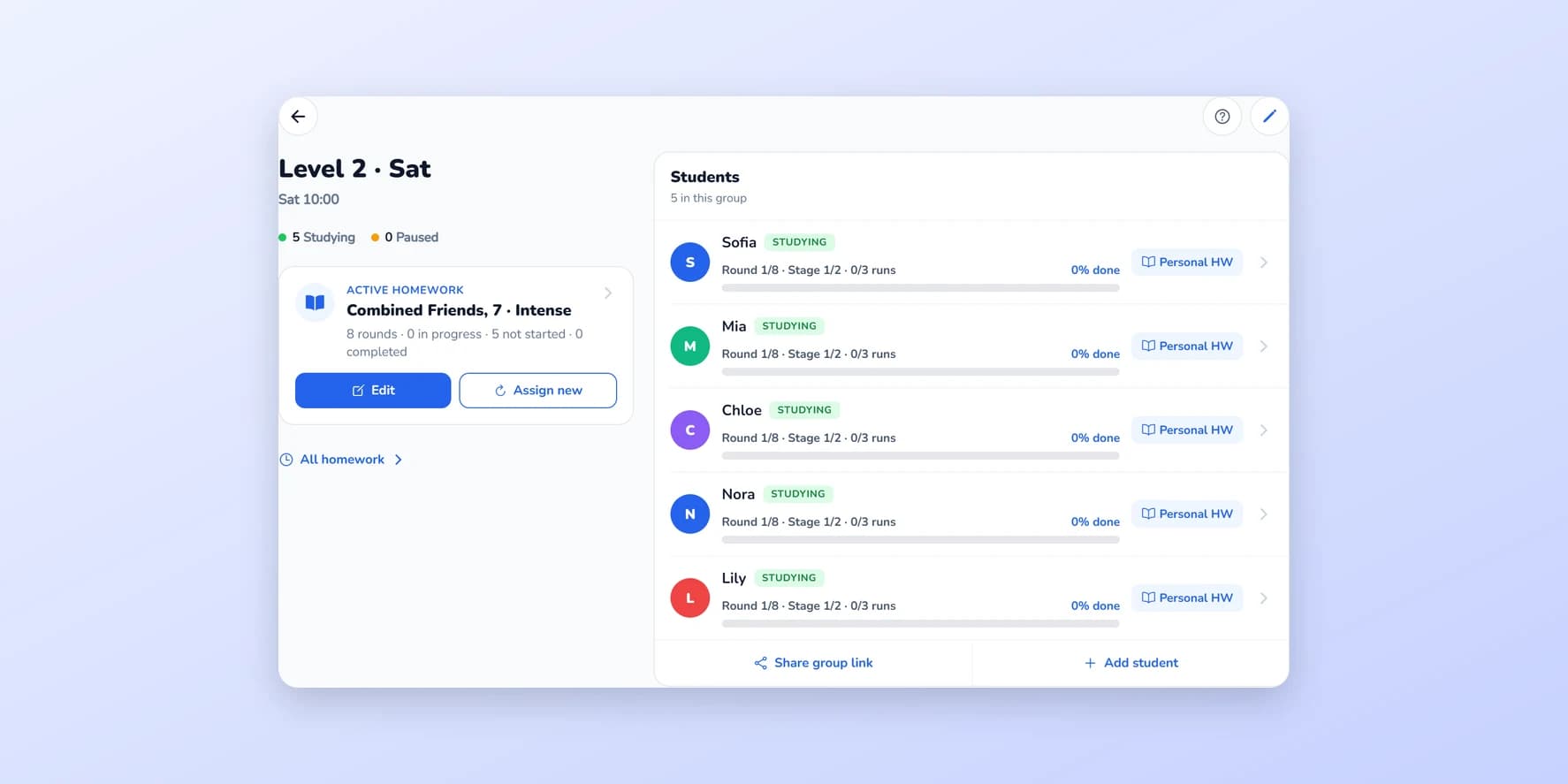
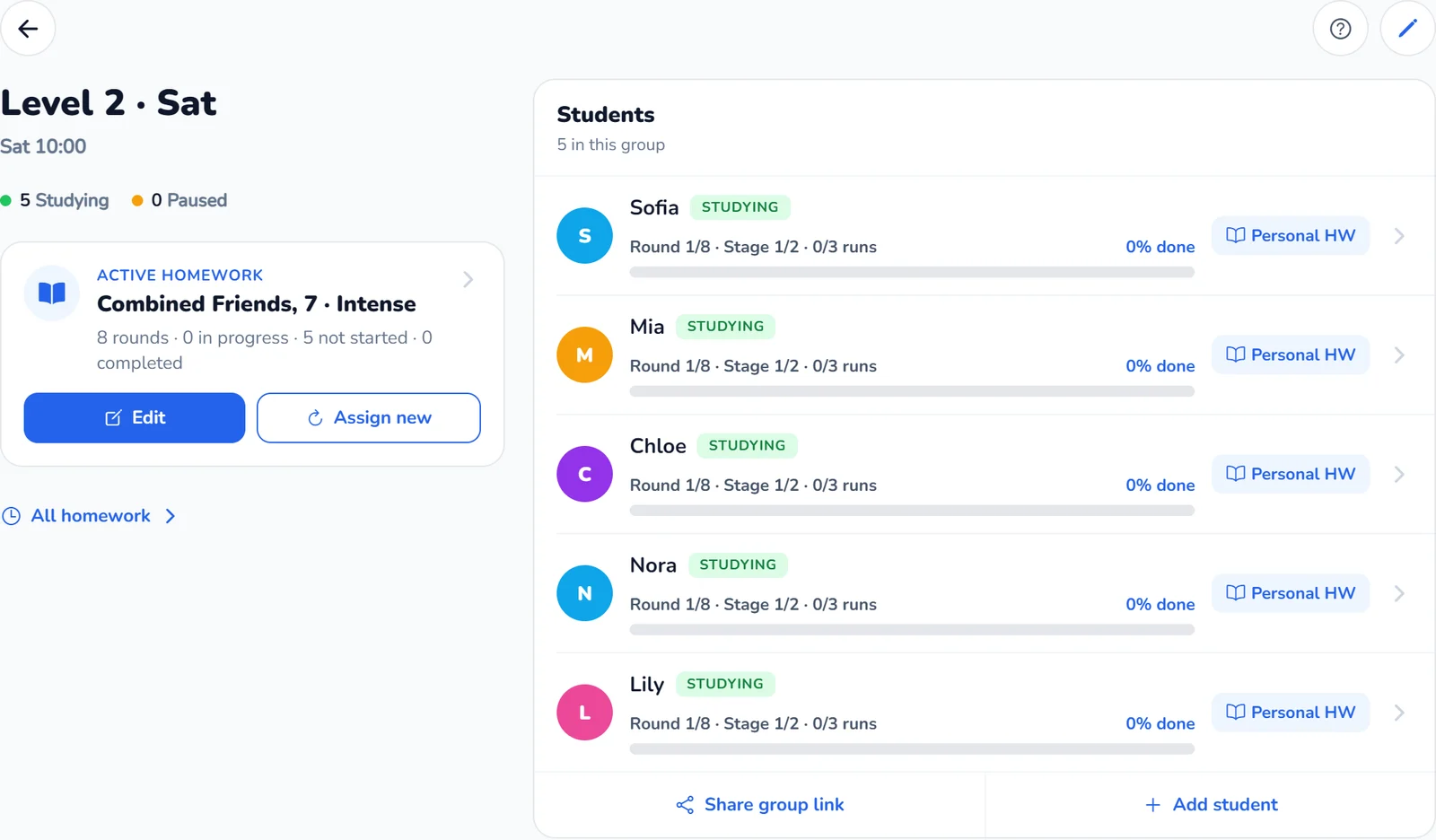
In practice, the group receives the shared homework, and a student who needs a different level gets personal homework on the same topic. That student sees their own version instead of the group one; the rest of the group keeps theirs.
Personalisation does not have to increase teacher work
This distinction is important. Without a system, personalisation often means more administration. The teacher has to create separate files, send separate messages, remember separate settings and track different assignments manually.
Eventually, individualisation becomes so time-consuming that the teacher stops doing it.
A platform can change this equation. If the homework already has structured templates and adjustable levels, the teacher can personalise difficulty without creating a completely new workflow for every student.
Personalisation should not multiply teacher work.
Without structured differentiation
Student A → separate homework · Student B → separate homework · Student C → separate homework · Student D → separate homework · messages + files + checking
With Amavit
Shared topic → Easy / Normal / Intense → individual parameters where needed
More personalisation. Less administration.
Technology can help keep groups together longer
Without flexible practice, teachers may be forced to split groups earlier. For example: strong students move to another class; weaker students remain behind; new schedules need to be created; parents need to change lesson times; the teacher receives additional groups to manage.
But sometimes the children do not actually need completely different curricula. They only need different practice intensity. If the teacher can adjust speed, volume, chain length, digit length and difficulty, the students may continue learning together for much longer.
Keeping the group together has real advantages
A stable group gives children familiar classmates, a familiar teacher, social connection, healthy comparison, shared progress and motivation.
Splitting the group every time students differ slightly can destroy some of these benefits — the trade-off we discuss in group vs individual lessons. Therefore, separation should not be the first response to mixed ability. First ask:
Can the difference be managed through adapted practice?
Very often, it can.
Do not split the group just because the practice needs to be different.
A weaker student does not always need a different group
Suppose the whole class has started Big Friends. One child understands the new topic but still makes mistakes with Small Friends. The easiest solution might seem to be:
“Move the child back.”
But this may not be necessary. The student can stay with the group. Their practice can temporarily include more Small Friends revision, lower speed, shorter chains and additional guided exercises. Meanwhile, they continue participating in the same class.
Within several weeks, the gap may close.
A strong student also needs individualisation
Teacher attention naturally goes to students who are struggling. But strong students can lose motivation too. If everything is easy, slow and predictable, they may become bored. They begin talking, losing concentration, doing exercises carelessly.
This is not always a behaviour problem. Sometimes the task simply requires too little effort.
Strong students do not always need the next topic earlier
It can be tempting to move the strongest child several topics ahead. But this can create a new problem. After a few months, one student is following an entirely different curriculum from the rest of the class.
Instead, the current topic can often be made more challenging through higher speed, more digits, longer chains, mixed practice, mental calculation and competition-style tasks.
Not always: a new topic. Sometimes: greater complexity inside the same topic.
Accuracy and speed create different needs
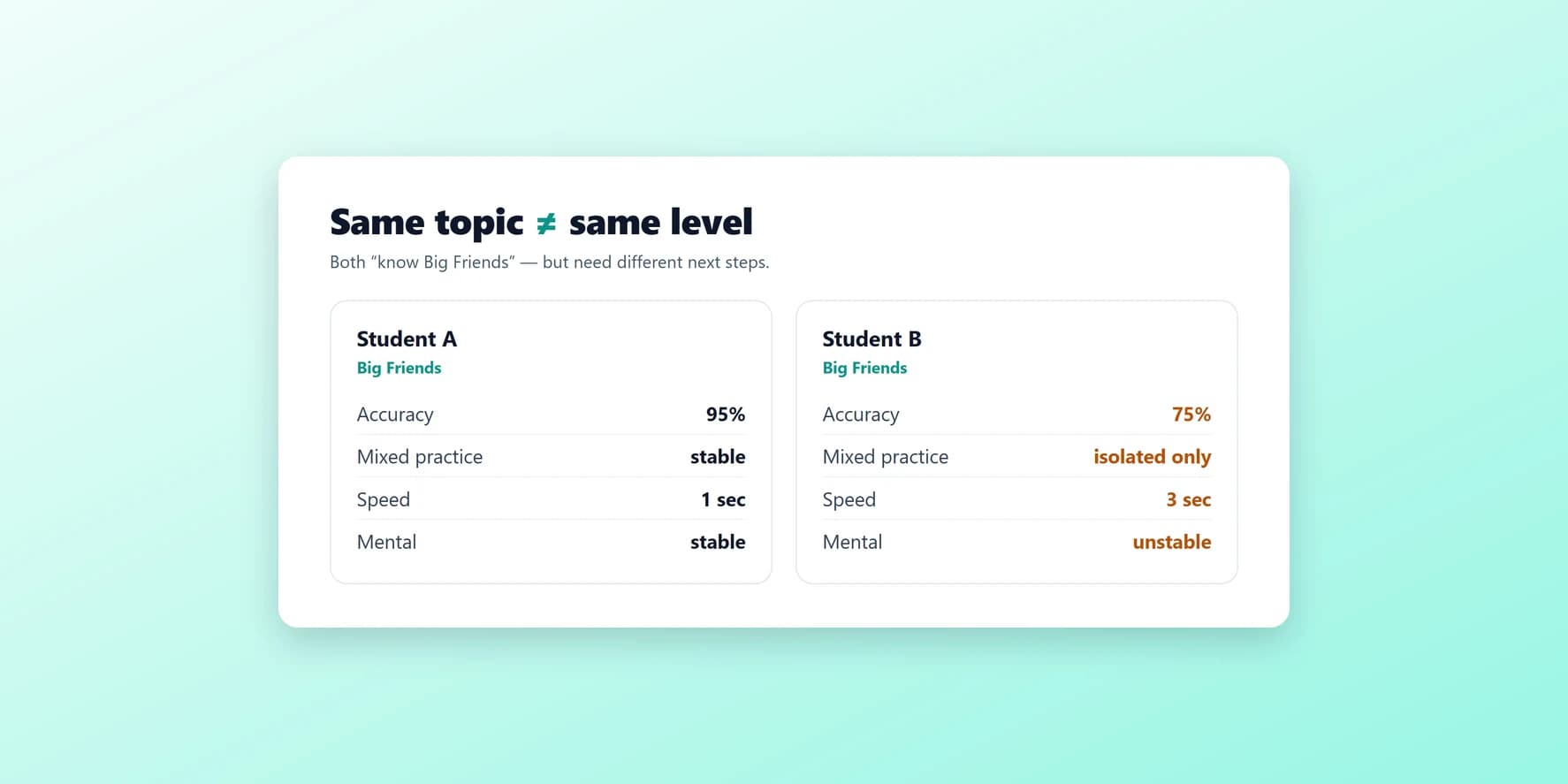
Imagine two students.
Student A
95% accuracy · but relatively slow
Student B
75% accuracy · but very fast
Who is stronger? There is no useful answer based on one number. They simply need different next steps. Student A may gradually increase speed. Student B may need to slow down and restore accuracy.
Giving both exactly the same practice is not necessarily efficient.
Digit length is another adjustment
The whole group may be studying the same rule. But Student A works with one-digit numbers. Student B is stable with two digits. Student C can work with mixed one- and two-digit numbers.
Same topic. Different difficulty. That is a normal mixed-ability classroom.
Chain length can also be adjusted
You do not have to change the topic. One student can solve 5 operations. Another 8. Another 12.
This gives stronger children more challenge without breaking the shared curriculum.
Homework is one of the best places for individualisation
During the lesson, the teacher needs to preserve the group structure. Homework allows much stronger adaptation. For example, everyone is learning Big Friend +7. At home:
- Student A receives basic reinforcement.
- Student B receives the standard homework template.
- Student C receives higher-speed practice.
- Student D receives more old-topic revision plus part of the new topic.
At the next lesson, the children return to the same shared curriculum. Homework itself can be organised the same way — see moving abacus homework beyond WhatsApp.
Amavit homework templates can support different levels
If homework needs to be personalised manually every time, teacher workload grows quickly. That is why predefined levels are useful. For example, the teacher can use:
- a lighter / support version;
- a standard version;
- an advanced / intensive version.
The underlying topic can remain the same. The system changes the practice parameters. This gives the teacher a practical way to differentiate homework without building completely separate assignments.
The teacher still makes the decision
The platform does not decide that a child is “weak” or “strong.” The teacher decides:
- which level is appropriate;
- when to increase speed;
- when to reduce difficulty;
- when more repetition is needed;
- when the student is ready for harder practice.
Technology provides flexible tools. Methodological decisions remain human.
Different homework does not mean different value
Sometimes teachers worry:
“If parents see different assignments, will they think one child is weaker?”
The right explanation is simple: different children need different practice. This is not an intelligence ranking. It is training design.
Two children can be in the same class and work on the same topic while needing different amounts of repetition or difficulty. That is completely normal.
Individual progress should remain the main reference point
Children naturally see who is faster, who wins, who finishes first. Some external comparison can be motivating. But the main everyday reference should remain: the child's own previous performance.
Last week: 80%. This week: 90%. That is meaningful progress — and progress is not always linear.
Comparison with others is secondary
Seeing stronger classmates can give a child a target. But if success becomes only “I must be better than someone else,” many children eventually lose motivation.
A better balance is: other students provide context; personal improvement provides the main goal.
When is the difference too large?
Sometimes adapted practice is no longer enough. For example: some children are still learning Small Friends; others are working on advanced Big Friends; some are only beginning mental work; others are already working at high speed.
At that point, the teacher should ask:
“Does this group still have one shared learning path?”
If the answer is no, splitting the group may be appropriate.
Different results alone are not a reason to split
Different speeds are normal. Different accuracy is normal. Different homework intensity is normal.
The problem becomes serious when the teacher is effectively teaching two completely different lessons at the same time. If half the group needs one topic and the other half needs a completely different topic, separation may make sense.
Missed lessons often create temporary mixed ability
A child gets sick. Misses two weeks. Returns. The class has moved forward. This does not necessarily mean permanent reassignment.
The teacher can temporarily use catch-up exercises, more old-topic homework, slower digital practice and additional individual support. If the foundation was strong, the child may quickly rejoin the group.
Do not try to catch up everything in one lesson
If a child missed three topics, teaching all three in one session usually creates too much information, too little repetition and weak automaticity.
It is usually better to restore the skill gradually, preserve correct technique and increase speed later.
A new topic can temporarily increase the gap
Before a new topic, the group may look relatively uniform. After the new topic, some understand immediately; others make mistakes.
That does not mean the group must be reorganised immediately. New skills often create temporary instability. Give the children time, repetition and home practice. Then evaluate whether the difference remains.
Look for the reason behind the difference
Three students may all show 70%. But one does not understand the rule; one understands it but works too fast; one simply did almost no home practice. These students do not need the same solution.
Mixed-ability teaching is not only about identifying who is behind. It is about understanding why.
The cause of the error matters more than the error alone
Possible causes include incorrect technique, an unclear rule, too few repetitions, excessive speed, chains that are too long, an old weak topic and irregular practice. Different causes require different interventions — see why children keep making the same mistakes.
Analytics become more valuable as the class grows
With five students, a teacher can remember a great deal. With thirty or fifty, that becomes harder. Data can help identify who is practising, where accuracy is falling, which topic remains weak, what speed is being used and how results are changing.
This does not replace the teacher. It helps the teacher decide: who needs attention today?
Manage by exceptions
This is one of the most practical principles for mixed-ability groups. Do not deeply analyse every child every day. First identify who is progressing normally. Then focus on exceptions. For example:
- accuracy suddenly dropped;
- practice stopped;
- one topic is repeatedly weak;
- speed is too low;
- or everything is consistently at 100% and clearly too easy.
These are the students who need an additional teacher decision.
A result that is too easy is also a signal
Teachers naturally notice 60%, 70%, repeated errors. But a child who produces 100%, very quickly, for several weeks may also need attention. The current practice may simply be too easy.
The teacher's task is not only to repair weaknesses. It is also to notice when a child is ready for a greater challenge.
Mixed ability can even be useful
Children see different speeds, different strengths, different levels. A stronger child may become a positive reference point. A student who was previously behind may catch up over time.
This creates social dynamics, motivation and a visible sense of progression. Different levels are not automatically harmful if the teacher manages comparison appropriately.
But a child should not feel permanently last
If one student is consistently the slowest, making the most errors, unable to finish and unable to understand new topics — and this continues for a long time, the group may begin to damage motivation.
Then consider adjusting the workload, additional individual support, temporarily reducing difficulty or moving to another group. Keeping a child in the same group at any cost is not the goal.
Strong students should not spend the lesson waiting either
If one child finishes everything in five minutes, then waits ten more — and this happens every lesson, their workload needs to change too.
A mixed-ability group works when each child regularly receives work that requires genuine effort.
Build a range of difficulty around the same skill
For example, Big Friend +8:
- Level 1 — one digit; slower speed; short chain.
- Level 2 — standard speed; standard homework.
- Level 3 — mixed digits; higher speed; longer chain.
The teacher does not need three completely different lessons. The practice parameters change around the same skill.
Workbooks and digital practice complement each other
A workbook is fixed. The exercises printed on the page do not change. That is useful for technique, structure and repetition.
A digital platform is more flexible when the teacher needs to adjust speed, digit length, chain length, topic frequency and difficulty. That is why paper practice and digital practice work well together.
Not everything needs to be personalised
Sometimes the whole group genuinely needs the same exercise. If everyone has just learned the same new topic, is at approximately the same stage and needs basic reinforcement, use the same practice.
Personalisation is useful where it improves learning. Not simply because the word “personalisation” sounds modern.
Personalisation should not become administrative overload
If a teacher has to manually configure ten parameters for every child every week, the system is not helping. A practical model is: common base; a small number of difficulty levels; simple adjustments; focus on exceptions.
For example, three homework levels may often be enough — support, standard, advanced — while the whole group continues following the same curriculum.
How to explain a mixed-ability group to parents
A parent may ask:
“Why is another child faster?”
Or:
“Why does my child have different homework?”
A simple professional explanation is:
Children in the group follow the same learning program, but they do not all need the same amount or difficulty of practice. The teacher can therefore adjust homework and practice settings so each child continues progressing while remaining with the group.
That is normal teaching.
Do not promise identical progress
Even with the same age, the same teacher and the same number of lessons, children will progress differently.
The teacher's goal is not: make everyone identical. It is: help every child continue progressing inside a shared learning structure.
How Amavit supports a mixed-ability group
Amavit allows teachers to keep one group, one shared topic and one shared learning path while adapting practice for individual students.
During class, stronger students can receive independent workbook or application-based work while the teacher spends more time practising with students who need support. Digital exercises can also be shown more slowly on screen, repeated, or used through practice activities and games while the teacher works through difficult points with the group.
At home, the same principle continues. Teachers can use different homework templates and practice intensity levels so students remain on the same topic but receive different settings. One child may receive slower, easier practice. Another: standard practice. Another: faster or more intensive practice.
The children still move through the curriculum together.
This can reduce the need to split groups
This is one of the most practical advantages of having a flexible platform. Without it, differences inside a class often create more manual work. The teacher either creates separate exercises by hand or splits students into additional groups. Both options increase workload.
With structured differentiated practice, the teacher can often keep the group together longer. Amavit can reduce the need to split groups when students share the same curriculum but require different practice levels. The application handles more of the variation in the assignments. The teacher maintains one common learning direction.
Flexible individual practice can help academies keep groups together for longer instead of creating a new class every time student levels begin to differ.
Individualisation without multiplying teacher work
This is the ideal balance. The goal is not one completely separate curriculum for every child. The goal is: one shared curriculum with appropriately different practice.
That allows the teacher to preserve the group, the schedule, the social environment and the common lesson without forcing every child into identical difficulty.
And because templates and practice levels already exist, the teacher does not need to manually rebuild every homework assignment. If you manage several classes, use a clear group structure before adding more levels of differentiation — see managing several abacus groups.
This also increases teacher capacity
If each difference between students creates another message, worksheet, group, manual assignment and manual check, teacher capacity quickly reaches its limit.
When the platform absorbs part of that repetitive work, the teacher can manage more students without administrative workload increasing at the same rate. The extra capacity can be used either to support existing students better or teach more students.
The purpose is not to maximise student numbers at any cost. The purpose is to stop consuming teacher time on routine work that can be structured by the platform.
The teacher's time should be used where it has the highest value
Technology can organise groups, templates, practice delivery, difficulty settings, results and history.
But only the teacher can observe technique, explain a difficult rule, understand why a child is struggling, motivate, correct and decide what should happen next. That is where teacher time should go.
When should the group finally be split?
Consider splitting when:
- students are learning fundamentally different topics;
- strong students are constantly waiting;
- weaker students are constantly unable to follow;
- the teacher is effectively teaching two lessons at once;
- different practice settings can no longer compensate for the gap;
- motivation begins to suffer.
At that point, another group may genuinely be better. A new student joining from another school also deserves a proper starting point — see abacus placement assessment.
But splitting should not be the first tool
Before reorganising the class, try adjusting speed, volume, chain length, digit length, homework intensity, targeted revision and independent classwork. If that is enough, the children can continue learning together.
- Difference appears
- Adjust speed
- Adjust volume
- Adjust chain length
- Adjust homework level
- Target weak topics
- Still two different lessons?
Split the practice before you split the group. Yes → consider splitting. No → keep the group together.
A simple mixed-ability group routine
After the lesson, ask four questions:
- What is the shared topic of the group?
- Who is progressing within the normal range?
- Who clearly needs additional support?
- Who is finding the current work too easy?
Then do not rebuild everything. Adjust the practice only for groups 3 and 4. This keeps personalisation manageable.
The main conclusion
A mixed-ability group is not an exception. It is the natural state of almost every class that stays together long enough. Children progress at different speeds. The teacher does not need to constantly force them back to exactly the same level.
The goal is: keep a shared learning path while adapting practice where necessary.
The lesson can remain shared. The topic can remain shared. The group can remain together. But speed, volume, digit length, chain length, revision and homework intensity can differ.
A flexible digital platform makes this much easier. It allows stronger students to keep working while the teacher supports those who need more explanation. It allows homework to have support, standard and advanced versions without creating completely separate programs. And it can help the teacher keep students together longer without multiplying administrative work.
A good mixed-ability group is not a group where every child is identical. It is a group where every child continues moving forward while the teacher still maintains control of one shared learning program.
Frequently asked questions
Should an abacus class be split when students progress at different speeds?
Not always. If students can still follow the same topic, differences can often be managed through speed, volume, chain length, digit length and homework difficulty.
How can strong and weak students work in the same abacus lesson?
Stronger students can work independently on workbook or more advanced digital exercises while the teacher spends more time guiding students who need additional explanation.
Can students in one group receive different homework?
Yes. They can follow the same topic but receive support, standard or advanced practice settings according to their current needs.
Does individualised homework create more work for the teacher?
It can if everything is created manually. Structured templates and adjustable digital practice can make differentiation much faster.
When should an abacus group actually be split?
When students no longer share a meaningful curriculum and the teacher is effectively teaching two different lessons at the same time, splitting may become appropriate.
Can digital practice help keep an abacus group together?
Yes, when students share the same topic but require different levels of difficulty. Individual parameters can allow them to continue progressing within one class.
Should every student receive personalised homework?
No. If the group is progressing similarly, common homework can be appropriate. Personalisation is most useful when a specific student needs more support or challenge.
Free for teachers