How to Measure a Child’s Progress in Mental Arithmetic — Speed Is Only One Part of the Picture
When parents look at mental arithmetic training, the most visible indicator is usually speed.
The child used to calculate slowly. Then they became faster. After some time, numbers may appear on the screen almost instantly.
That can be impressive. But if progress is measured only by speed, it is very easy to get the wrong picture.
Mental arithmetic progress should not be measured by speed alone. A more complete picture includes technique, accuracy, speed, digit length, chain length, mental calculation, retention of older topics and practice consistency over time.
In mental arithmetic, meaningful progress usually involves several factors at once:
Compare the child with their own previous performance, not only with other students.
Only together do these factors show how the child is really developing.
The first indicator is correct technique
Before looking at speed, the teacher should look at how the child calculates.
- Are the fingers moving correctly?
- Are there unnecessary movements?
- Are Small Friends and Big Friends being performed properly?
- Is the child compensating for a technical mistake with another action?
If technique is weak, high speed can actually hide the problem. The child may look fast. But later, when complexity increases, progress can hit a ceiling.
So at the beginning of the program: technique matters more than speed — one of the things to look for when choosing a good mental arithmetic teacher.
The second indicator is accuracy
Imagine two children. The first calculates very quickly but has 70% accuracy. The second is slightly slower but maintains 95%.
Who is in the stronger position? Very often, the second child. Because speed built on constant mistakes is not a stable skill.
In mental arithmetic, the sequence should usually be:
first correct → then stable → then fast.
But 100% accuracy alone does not tell the whole story
Suppose a child gets 100%. Excellent. But under what conditions?
- Was it five easy examples — or 200 examples?
- One topic — or mixed topics?
- One-digit numbers — or three-digit numbers?
- At 5 seconds — or at 0.8 seconds?
So the number 100% without context tells us very little.
The same accuracy can represent completely different levels
| Child A | Child B | |
|---|---|---|
| Accuracy | 95% | 95% |
| Speed | 3 seconds | 1 second |
| Digit length | one-digit numbers | three-digit numbers |
| Chain length | 5 operations | 15 operations |
One accuracy score — two very different levels. Context changes the meaning of the result.
The percentage is the same. The difficulty is not.
That is why progress needs to be measured across several dimensions.
Speed still matters
This does not mean speed is unimportant. It is one of the key parameters in mental arithmetic — see how speed develops from 3 seconds to 0.1 seconds per operation.
But speed should grow on top of a stable skill. For example: first the child works confidently at 3 seconds; then at 2; then 1.5; then 1 second.
If accuracy remains high while speed increases, that is real progress.
If speed increases while accuracy drops from 95% to 60%, that is a very different signal.
Speed and accuracy should be viewed together
This is one of the most useful principles. Do not ask only:
“How fast is the child calculating?”
Ask at the same time:
“How accurately are they calculating?”
For example:
- speed increases and accuracy stays stable — good progress;
- speed increases, accuracy drops slightly, then recovers — normal adaptation;
- speed increases, but accuracy remains low for several weeks — the difficulty may have increased too quickly.
Digit length is another major indicator
Calculating 7 + 4 − 3 is not the same as working with 347 + 526 − 184.
The more digits involved, the more information the child has to process. So moving from one-digit numbers to two-digit, three-digit and four-digit numbers is a separate type of progress.
Sometimes a child’s speed barely changes for several months. Parents may think:
“Nothing is improving.”
But during that time, the child may have progressed from one-digit to three-digit work. That is a major step.
Chain length is also a separate metric
Compare 5 + 3 − 2 with a chain of 15 or 20 operations.
In the second case, the child must maintain the mental image for much longer without losing the current state.
So if the child previously handled 5 operations and now handles 15 at the same speed and accuracy, that is clear progress. Even if the speed itself has not changed.
This is why parents sometimes think progress has stopped
During the first months, growth is easy to see. The child could not use an abacus — then learned. Could not calculate mentally — then started. Speed improved quickly.
Later, development becomes less obvious. Because more than one parameter is changing.
One period may focus on digit length. Another on chain length. Then a new topic is introduced. Later, the child maintains the same accuracy at a higher speed.
If parents look only at the stopwatch, much of the development becomes invisible.
A new topic also increases difficulty
Imagine that last month the child worked only with Simple. Now Small Friends are included.
Speed may temporarily decrease. That is normal. The child now has a more complex calculation task. Once the new skill becomes automatic, speed can rise again.
The same pattern may later appear with Big Friends, mixed topics, Anzan, multiplication and division.
So a temporary drop in speed after a new topic does not necessarily mean regression.
Sometimes a step back is part of moving forward
This is a normal training pattern. The child was calculating very quickly. A new level of complexity was introduced. They became temporarily slower. Then the new skill became automatic.
Speed returned — but now at a higher level of difficulty.
That is why progress should not be judged from one lesson. The trend matters more.
Look at the week, the month and the longer trend
One bad day proves very little. The child may have been tired, slept badly, been distracted, tested a new speed or started a new topic.
It is much more useful to look at:
- what changed over a week;
- how this compares with last month;
- what the child could do several months ago.
The trend shows the real direction — the same logic as deciding when a child is ready for the next topic.
Progress also means keeping old topics strong
There is another important indicator:
Does the child retain what was already learned?
A program can keep moving forward and adding new topics. But if older skills begin to collapse, the quality of progress is weaker — this is often where the same mistakes keep coming back.
Strong development looks like this: new topics are added, and older topics continue to work. For example, the child has learned Big Friends, but Small Friends remain automatic.
That is a strong foundation.
Mental calculation should be evaluated separately from the physical abacus
A child may perform extremely well on the physical abacus. But the mental abacus may develop more slowly. That is normal. These are related but not identical levels of skill.
It can therefore be useful to observe separately:
- physical accuracy;
- mental accuracy;
- physical speed;
- mental speed.
If physical technique is already strong but mental calculation is weaker, the teacher knows where additional practice is needed.
Visual and audio performance can also differ
A child may process numbers very well when they are shown visually. But accuracy may fall when the same task is presented through audio.
That does not mean “The child cannot do it.” It means that one format is currently weaker.
The opposite can also happen. Some children perform very well through audio but struggle more with high-speed visual presentation.
Different formats give the teacher a more complete picture.
Practice consistency is another important part of progress
Progress is not only about what the child can do once. It also matters how regularly they practise.
For example, one child does a huge amount in one day and then nothing for a week. Another practises 10–15 minutes almost every day.
For mental arithmetic, the second pattern is often more useful — see how much practice a child needs each day. Automaticity develops through regular return to the skill.
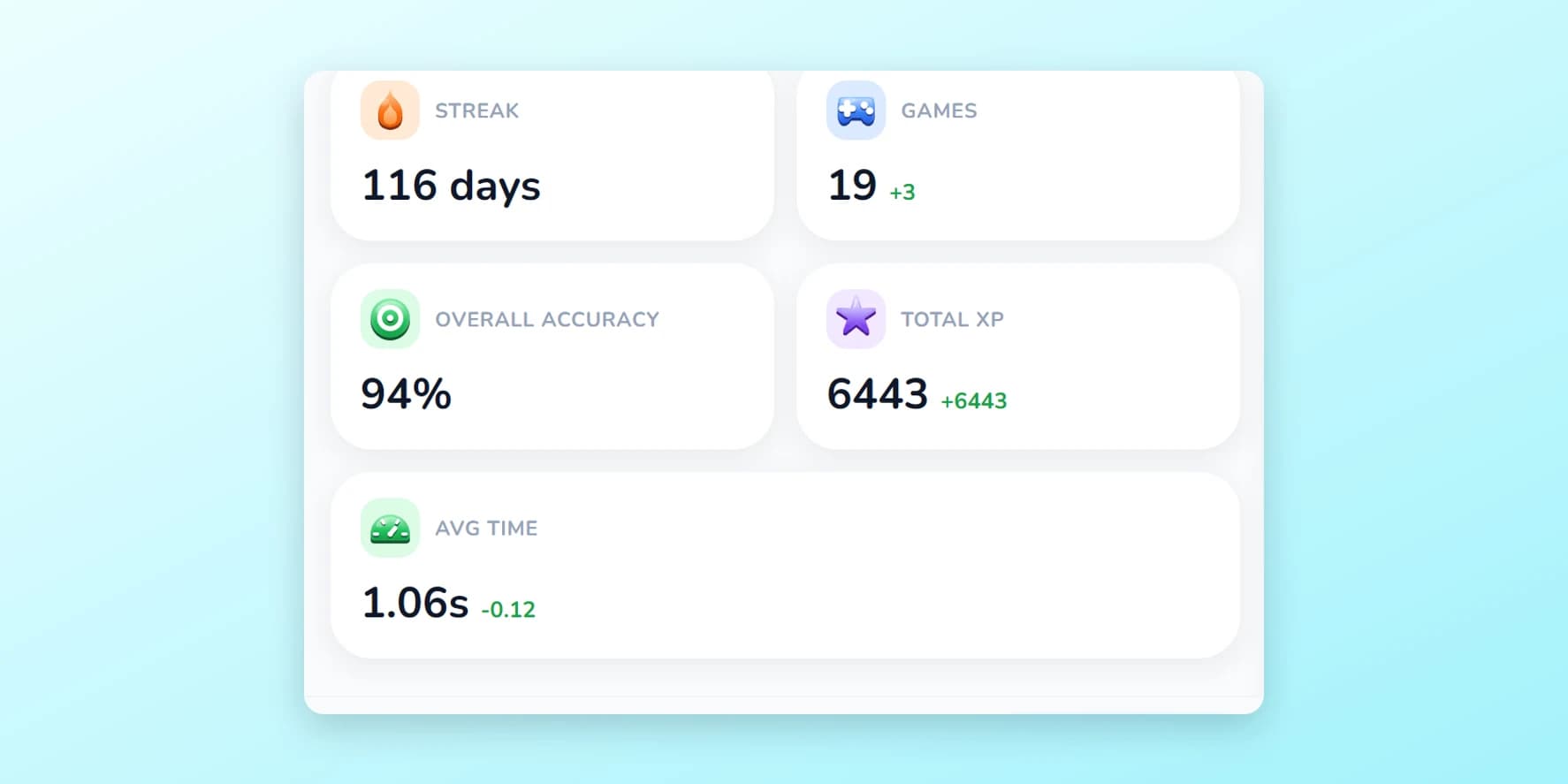
That is why a streak is more than just a game element
A streak measures one important thing: consistency.
Of course, a long streak by itself does not prove a high skill level. A child can practise every day and still practise badly.
But together with accuracy, speed, difficulty and practice volume, it becomes a useful indicator.
Practice volume should not be viewed alone either
A child completed 1,000 examples. That sounds impressive.
But what kind of examples? Were they solved correctly? At what speed? Was the same mistake being repeated?
Sometimes 200 high-quality repetitions are more valuable than 1,000 mechanical ones. So: more is not always better.
Personal records can show development very clearly
It is useful to compare the child not only with the group, but also with their own previous performance.
One month ago: 2-second speed · 88% accuracy · chain length 5 · one-digit numbers
Today: 1.5-second speed · 93% accuracy · chain length 10 · two-digit numbers
That is clear progress. The child can see:
“I really am stronger than I was before.”
And parents can understand the development much more easily than from a ranking alone.
Comparisons with other children should be used carefully
Children differ in age, experience, practice frequency, learning pace and temperament.
If someone simply says “Another child calculates faster,” that explains almost nothing. The other child may have been training a year longer.
So rankings and competition can be useful for motivation. But they should not become the main measure of development.
The fairest comparison is often the child versus their past self
This principle is especially useful for parents. Instead of asking:
“Why is my child not first?”
ask:
“What can my child do better today than a month ago?”
Then progress becomes visible in speed, accuracy, digit length, chain length, new topics, mental calculation and independence.
That is a much more meaningful picture.
Teacher feedback should be more specific than “Everything is fine”
That phrase may be reassuring. But parents benefit more from understanding why it is fine. For example:
- accuracy improved;
- speed increased;
- the child moved to a higher digit length;
- chain length increased;
- an older weak topic recovered.
Specific feedback makes progress easier to understand.
But data does not replace the teacher either
There is an opposite mistake. A parent sees a graph and thinks:
“Now I understand the methodology myself.”
Not necessarily. Data shows what happened. The teacher needs to understand why it happened.
For example, accuracy dropped. Why? A new topic? Too much speed? A longer chain? Fatigue? An older weak skill?
The number itself does not explain the cause.
How Amavit helps show progress as a complete picture
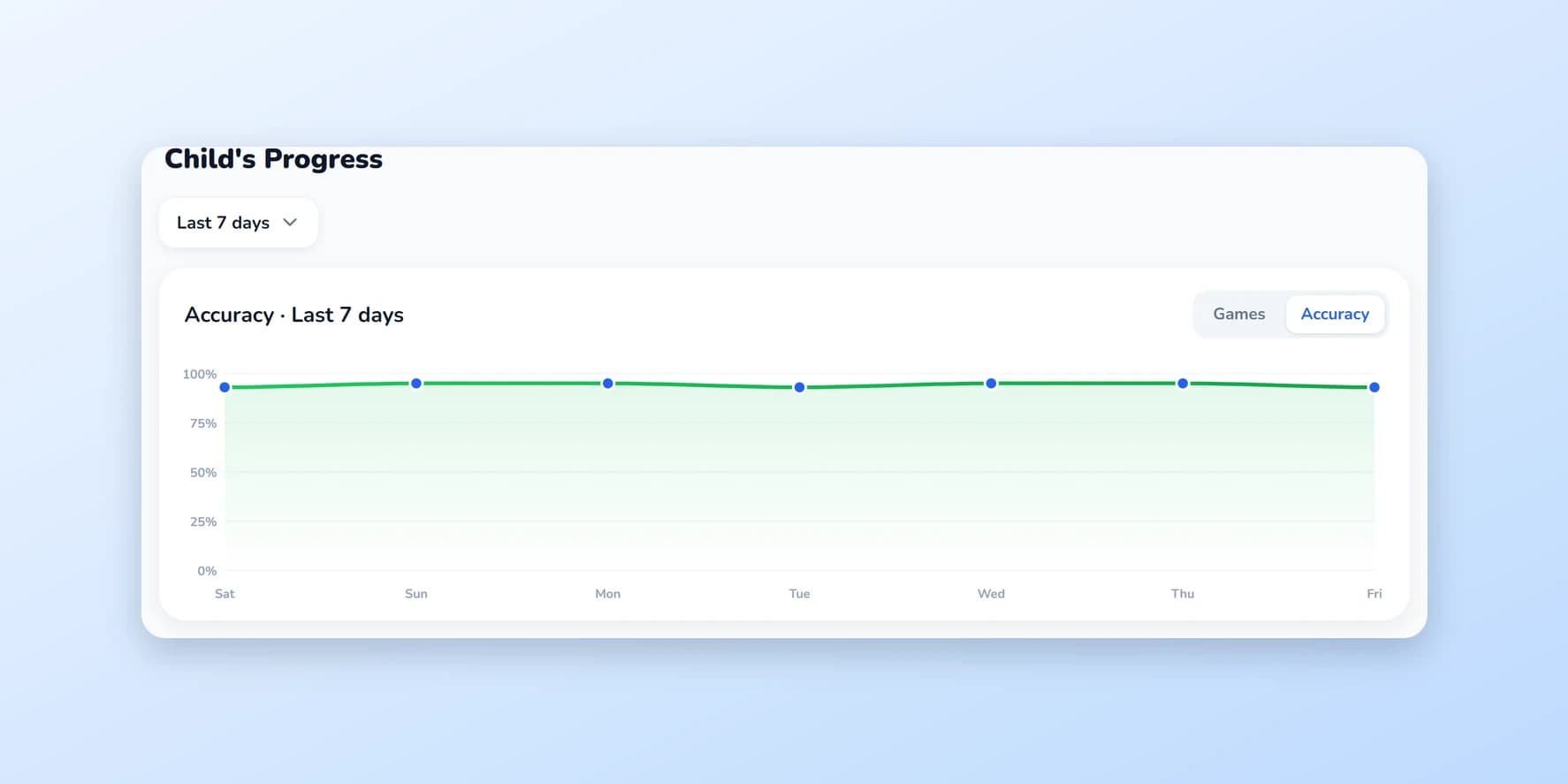
One of the goals of Amavit is to bring several indicators together in one system. Teachers and parents can see more than correct / incorrect. They can follow trends in:
- practice consistency;
- number of completed tasks;
- accuracy;
- speed;
- homework;
- weekly results;
- changes compared with previous periods.
For the teacher, this supports diagnosis. For the parent, it provides a clearer picture of development.
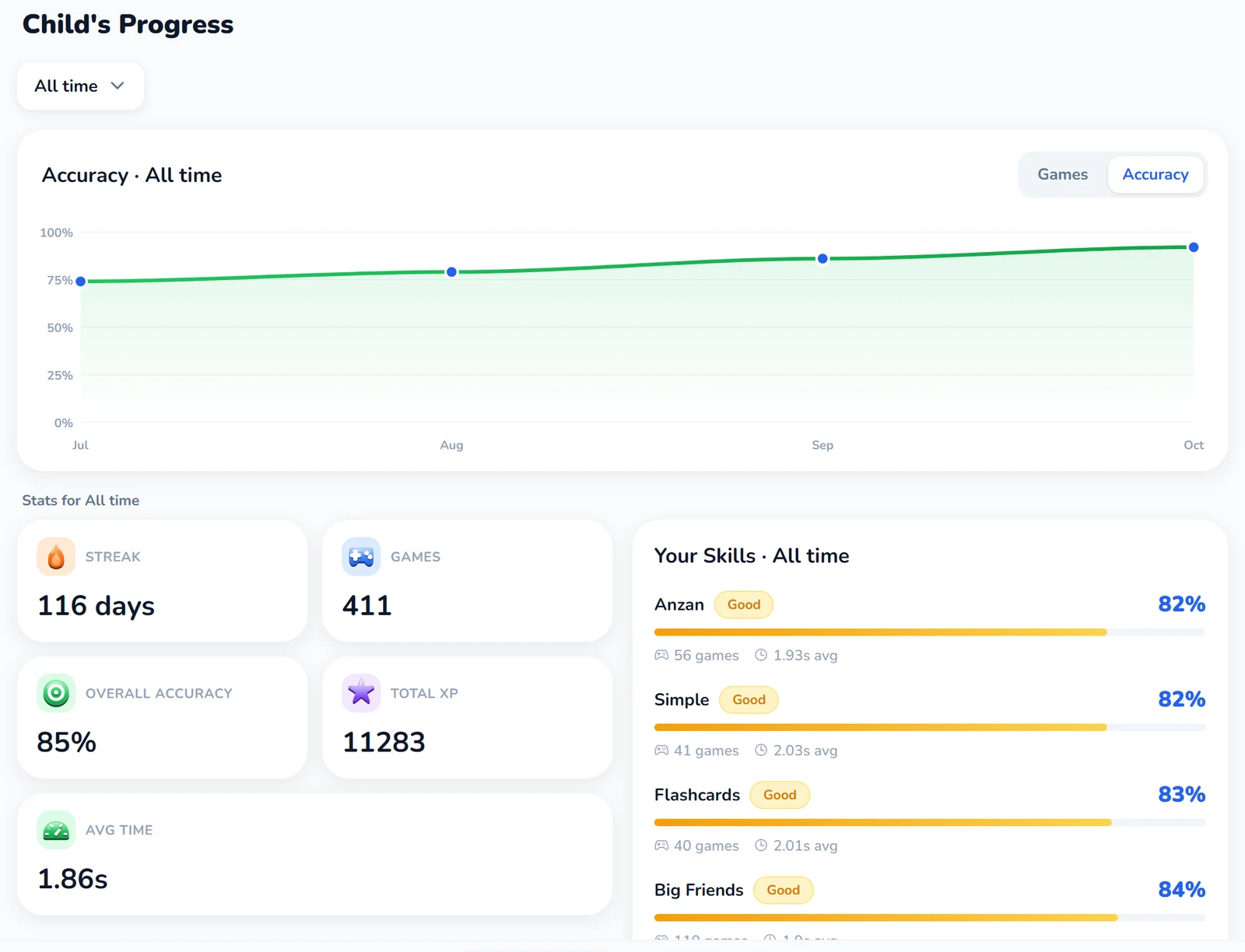
Week-to-week and month-to-month comparisons are especially useful
A single day can be random. A trend is much more informative. For example:
- accuracy has increased for four weeks, speed is gradually improving, practice volume is stable — good;
- speed is rising, but accuracy keeps falling every week — that is a signal;
- the child practises regularly, but one topic has not improved for a month — that topic deserves attention.
Good analytics should lead to action
The purpose of statistics is not to create attractive graphs. It should help answer:
What should we do next?
For example:
- everything is stable → increase difficulty;
- accuracy is high → test a higher speed;
- speed is good but accuracy is weak → slow down slightly;
- one topic is weak → increase its frequency;
- an older topic has declined → bring it back into practice.
That is when data becomes a real teaching tool.
Parents do not need to analyse ten charts every day
This is important too. Parents do not need to become analysts. It is enough to occasionally check:
- Is the child practising regularly?
- Is accuracy stable?
- Is there an overall upward trend?
- Has anything suddenly deteriorated?
If something looks unusual, contact the teacher. The teacher should make the methodological decision — see how parents can support a child without becoming a second teacher.
Real progress can look different at different times
Sometimes the child becomes faster. Sometimes they keep the same speed but work with larger numbers. Sometimes chain length increases. Sometimes they move from physical abacus to mental calculation. Sometimes the number of errors decreases. Sometimes an older weak topic finally becomes automatic.
All of these are forms of progress.
There is no single “main number”
There is no universal number that can say:
“The child has improved by 30%.”
Mental arithmetic is a multi-dimensional skill. The most useful indicators include technique, accuracy, speed, digit length, chain length, topic complexity, mental calculation, stability of older skills and practice consistency.
What should happen over time
If the program is working well, over the longer term we would expect to see:
- more stable technique;
- high accuracy;
- gradually increasing speed;
- larger digit lengths;
- longer chains;
- new topics;
- a stronger mental abacus;
- retention of older skills;
- greater independence.
Not everything has to improve at the same time. Sometimes one parameter develops for several weeks. Then another.
The biggest mistake is expecting linear progress
Learning rarely looks like: better today, better tomorrow, even better the next day. Usually it looks more like this:
- Growth
- Plateau
- New topic
- Temporary drop
- Adaptation
- New growth
Healthy progress is not linear. A small temporary drop is not always a problem.
That is normal. What matters is that the overall level gradually rises over time.
The main conclusion
A child’s progress in mental arithmetic cannot be measured only by speed. And it cannot be measured only by accuracy. You need to look at the whole system.
- Technique shows the quality of the foundation.
- Accuracy shows stability.
- Speed shows automaticity.
- Digit length and chain length show increasing complexity.
- Mental calculation shows development of the internal image.
- Consistency shows the quality of the training process.
And progress over time answers the most important question: Is the child moving forward?
So one of the best questions a parent can ask is not:
“Why is my child not calculating at 0.5 seconds yet?”
but:
“What can my child do better today than a month ago?”
If the number of answers to that question keeps increasing, the learning process is working.
Frequently asked questions
Is speed the most important measure in mental arithmetic?
No. Speed matters, but it should be evaluated together with technique, accuracy, digit length, chain length and task complexity.
What is a good accuracy rate in mental arithmetic?
There is no single percentage that tells the whole story. Accuracy should be interpreted together with speed, difficulty, volume and the stability of the result across several sessions.
Why can a child become slower after learning a new topic?
A new topic increases cognitive and technical difficulty. Temporary slowing can be normal while the new skill becomes automatic.
Should parents compare their child with other students?
Competition can be motivating, but the most meaningful comparison is usually the child’s own progress over time.
How often should parents check mental arithmetic progress?
Parents usually do not need to monitor daily details. Weekly and monthly trends are often more useful than one isolated result.
What should a teacher do if speed increases but accuracy falls?
The teacher should identify whether the difficulty increased too quickly and may need to reduce speed, reinforce technique or strengthen a weak topic.
Free for teachers. Parent access included.