Can Parents Teach Mental Arithmetic at Home Without a Teacher?
Today, finding mental arithmetic materials is easy. Parents can buy an abacus. Download worksheets. Watch lessons on YouTube. Print flashcards. Install an app. Use an online training platform.
So a natural question appears:
“Do we really need a teacher? Can I teach my child mental arithmetic at home myself?”
The answer is: yes, it is possible.
In fact, some parents complete mental arithmetic teacher training specifically so they can learn the methodology properly and teach their own children. For some families, this can become an excellent learning model and even a meaningful activity that parents and children enjoy together.
But there is an important distinction: knowing how to calculate and knowing how to teach a child to calculate are not the same skill. And that difference becomes increasingly important as the program becomes more advanced.
Yes, parents can teach mental arithmetic at home, especially if they learn the methodology properly. Some parents even complete teacher training and successfully teach their own children. However, calculating and teaching are different skills: strong home learning requires correct technique, structured progression, time, patience and the ability to diagnose mistakes.
Parents can absolutely introduce a child to the abacus at home
There is nothing wrong with beginning independently. A parent can show:
- how the abacus works;
- where ones and tens are;
- how beads move;
- how simple numbers are represented;
- how basic addition and subtraction work.
For many families, this can be a wonderful first introduction. It can answer an important question:
“Does my child enjoy this?”
Not every first experience needs to begin with a long course or expensive commitment. Sometimes it is perfectly reasonable to buy an abacus, play with it, try several exercises and see how the child responds — and whether mental arithmetic suits this particular child.
The first rules often look surprisingly simple
This can create confidence very quickly. A parent watches several lessons and thinks:
“I understand this. I can teach it.”
And at the beginning, that may be true. Simple movements are not mysterious. Many basic mental arithmetic rules can be learned from books, videos, teacher manuals, courses and digital materials.
The main challenge usually appears later. It is not simply “Do I know the rule?” It is:
“Can I see whether the child is learning and applying it correctly?”
A correct answer does not always mean correct technique
Imagine a child solves 3 + 2 = 5. The answer is correct. Everything seems fine.
But an experienced teacher is not looking only at the final number. They may also look at:
- which finger the child used;
- how the beads were moved;
- whether the hand position is correct;
- whether there were unnecessary movements;
- whether the intended rule was used;
- whether the child recalculated in another way.
A parent without methodological training may not notice these details.
Incorrect technique can still produce correct answers for a long time
This is why technical mistakes can remain hidden. At slow speed, a child may compensate. They can pause, recalculate, correct themselves or use a longer method. The final answer is still right.
The problem becomes visible later when the program introduces higher speed, Small Friends, Big Friends, mixed topics, multi-digit numbers and mental calculation. Then weak technique begins to limit progress.
Correct technique is easier to build than to rebuild
This is true for many complex skills. If a child has used an incorrect movement hundreds or thousands of times, that movement becomes familiar. Later, the teacher may need to stop the old habit, introduce the correct movement, repeat it many times and rebuild automaticity.
That is harder than establishing the correct technique from the beginning. This is one reason why the early stages matter so much.
But parents can learn the methodology properly
There is another side to the story. Some parents do not simply watch several videos. They complete a proper mental arithmetic teacher-training course. They learn:
- physical abacus technique;
- Small Friends;
- Big Friends;
- topic progression;
- mental calculation;
- how to correct common mistakes;
- how to structure practice;
- when to increase difficulty.
Then they work with their own children. In that situation, the parent is no longer simply “helping with homework.” They have invested time in learning how the methodology actually works.
And this can be a very strong model.
Learning together can become a powerful family activity
There is a special advantage when a parent learns mental arithmetic too. The child sees that the adult is also using the abacus, practising, making mistakes, improving and trying to increase speed.
Now the atmosphere can change from:
“You need to do your homework”
to:
“We are learning something together.”
For some families, that is extremely motivating.
When parents and children learn together, practice can become a shared family experience rather than another homework obligation.
Shared learning can strengthen the parent-child relationship
A common learning activity can create shared goals, shared challenges, small victories, conversation, playful competition and mutual encouragement.
The parent is not simply the person checking whether homework has been completed. They become part of the experience. That can create a very positive atmosphere around learning.
Children can also learn something important from watching an adult learn
Adults make mistakes too. They forget rules. They need repetition. They sometimes need to slow down. Then they improve. A child who sees this receives a useful message:
Mistakes are part of learning.
And:
Skills grow through practice.
That lesson can be valuable far beyond mental arithmetic — and adults can learn mental arithmetic too.
But being able to calculate is one skill. Being able to teach is another.
This is probably the most important distinction. A parent may become excellent at mental arithmetic personally.
But then the child does not understand something. The parent explains it. The child still does not understand. The parent explains the same thing again. Then again. Eventually:
“But this is so simple!”
For the adult, perhaps it is. For the child, it is not. Teaching requires the ability to change the explanation.
Being able to calculate is one skill. Being able to teach a child to calculate is another.
Teaching is a skill that also needs to be learned
A good teacher needs to know how to:
- explain;
- observe;
- ask questions;
- identify the source of an error;
- avoid giving the answer too quickly;
- change the explanation when necessary;
- decide when to repeat;
- decide when to progress;
- maintain motivation.
These abilities do not appear automatically simply because someone understands the subject. Academic knowledge and teaching ability are related — but they are not identical.
Knowing mental arithmetic
Understand the rule · calculate correctly · practise personally
Teaching mental arithmetic
Explain the rule · observe technique · diagnose mistakes · adjust difficulty · know when to progress · maintain motivation
Teaching is a skill of its own.
Not every parent naturally enjoys teaching
And that is completely normal. Some parents have patience, methodological thinking, good communication with children and a genuine interest in teaching. Others may be excellent professionals in completely different areas but find teaching their own child extremely difficult.
Neither makes someone a better or worse parent. Teaching is simply a separate competence.
Time is another major factor
Even if a parent is perfectly capable of teaching, they need enough time. A proper home program may require the parent to learn the methodology, prepare lessons, observe technique, check progress, understand the next topic and manage regular practice.
And parents already have work, business, other children, school logistics, household responsibilities and their own activities.
For one family, this becomes an enjoyable shared project. For another, it becomes an additional obligation that creates stress. Both situations are normal.
Parents do not need to become teachers to support their children well
This is important. Good parenting does not mean personally teaching every subject. A parent does not need to become a mathematics teacher, a swimming coach, a piano instructor or a mental arithmetic specialist.
Sometimes one of the best things a parent can do is:
- find a good teacher;
- provide the necessary tools;
- create a regular routine;
- support the child emotionally.
That is already a major contribution — the role we describe in how parents can support a child without becoming a second teacher. This article is about a different case: a parent who deliberately learns the methodology and takes on the teaching role.
Parents and teachers naturally have different psychological roles
There is another practical difficulty. A mother or father is not simply another teacher in the child’s life. The relationship contains everything: home, comfort, rules, emotions, family conflicts, love, daily routines.
A teacher can say:
“Try again.”
The child calmly repeats the exercise. A parent says exactly the same thing. The child replies:
“I don’t want to!”
The words are identical. The relationship is not.
This does not mean parents cannot teach their own children
Many do it successfully. But the role transition needs to work for that particular family. A parent may sometimes need to communicate clearly:
“Now we are doing our lesson.”
And after the lesson:
“Now the lesson is finished.”
Otherwise teaching can begin to enter every part of family life. Breakfast becomes a quiz. Driving becomes practice. Dinner becomes correction. The child may eventually feel that learning never ends.
Shared learning should strengthen the relationship, not consume it
That is the goal. If parent-led learning creates curiosity, shared enjoyment, communication and progress — excellent.
If every session turns into arguments, pressure, constant correction and frustration, the family may benefit from separating the roles again. A professional teacher can sometimes protect the parent-child relationship simply by taking the teaching responsibility away from the parent.
Independent practice and independent teaching are not the same thing
This distinction is also very important. A child should gradually learn to practise independently. That is a valuable skill.
But this does not mean the child should also be responsible for designing their own educational program. A teacher or trained parent decides:
- which topic comes next;
- what needs more repetition;
- when to increase speed;
- when to increase digit length;
- when to introduce mixed practice;
- when to move from physical to mental work.
The child then completes the assigned practice increasingly independently.
Independent practice and independent teaching are not the same thing.
Exercises are not the same as a curriculum
The internet contains almost unlimited mental arithmetic exercises. But quantity does not answer the main question:
Which exercise does this particular child need today?
Imagine that the weak topic is Big Friend +8. Giving the child another 200 random examples may not solve the problem. A better sequence might be:
- slow correct repetitions;
- then mixed exercises;
- then higher speed;
- then a return to broader practice.
Methodology is not just about having exercises. It is about choosing the correct sequence.
A strong methodology is largely about order
A structured program answers questions such as:
- What comes first?
- What comes next?
- When should mental calculation begin?
- When should digit length increase?
- When should topics be mixed?
- When is the child ready for Anzan?
- When should multiplication and division be introduced?
Without a consistent structure, a family can collect many good exercises but still lack a coherent learning path.
Mixing different teaching systems can create confusion
Different mental arithmetic schools may use different topic sequences, terminology, finger techniques, ways of introducing mental calculation, multiplication algorithms, division algorithms and advanced methods.
That is not necessarily a problem. Different methodologies can work. But randomly combining several systems can confuse a beginner.
If one video teaches one movement, another shows a different sequence and an app uses another convention, the child may no longer know which system to follow.
Early simplicity can create a false impression
At the very beginning, the parent may think:
“This is easy. Why would we need a teacher?”
And for the first topics, that may seem reasonable. But later the program can include:
At that point, the challenge is no longer simply calculating the answer. It is managing the learning process.
Diagnosing mistakes is one of the hardest parts
Imagine a child gives a wrong answer. Why? There are many possibilities. Perhaps the child:
- does not know the rule;
- used the wrong movement;
- forgot an older topic;
- worked too quickly;
- lost the mental image;
- made an error on one place value;
- could not maintain the chain length.
The final wrong answer tells us very little about the cause. An experienced teacher tries to identify the cause behind the error — see why children keep making the same mistakes.
Mental calculation makes diagnosis even harder
On a physical abacus, at least the hands and beads are visible. During mental calculation, the child may simply give an incorrect final answer. The adult sees: wrong answer.
But what happened internally? Was the error on the second number? The fifth? Did the child lose the tens? Use the wrong Friend? Lose the mental image completely?
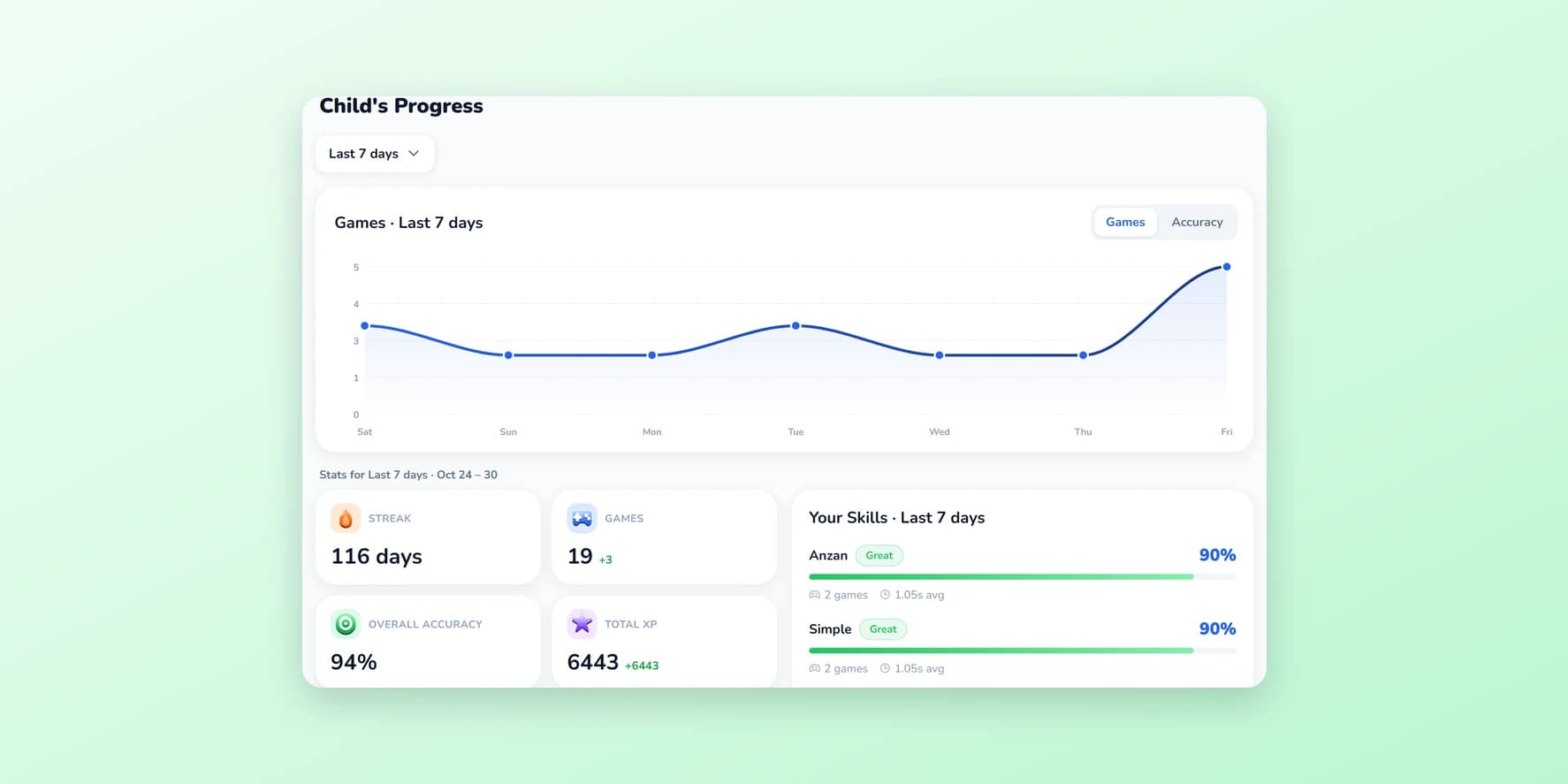
This is where methodology and progress data become increasingly useful.
Can a child learn mental arithmetic only from an app?
An app can be extremely useful. It can generate exercises, control speed, show flashcards, provide audio, record results and support consistency.
But an app does not automatically see everything. Especially at the beginning. It may know correct and incorrect. But it may not know:
- whether finger technique was correct;
- whether the intended method was used;
- why the error happened;
- whether the child is methodologically ready for the next topic.
So an app is usually strongest as a learning and practice tool, not necessarily as a complete replacement for instruction.
Different practice formats also train different parts of the skill — see why mental arithmetic needs more than one type of practice.
Technology can take over more practice without taking over the entire educational role
This distinction matters. A platform can automate many things that previously required manual teacher work. It can generate homework, control timing, repeat weak topics, collect statistics and show progress.
That allows children to practise more independently. But someone still needs to make the higher-level methodological decisions. That can be a professional teacher or a properly trained parent.
Platform
Generate practice · control speed · track results · repeat topics · collect analytics
Teacher / trained parent
Choose the learning path · correct technique · diagnose causes · decide when to progress · understand the child
What about AI?
AI will almost certainly become increasingly useful in education. It can help analyse errors, speed, practice frequency, weak topics and progress patterns. Over time, systems may become better at analysing technique as well.
But teaching a child includes more than deciding which example comes next. It also involves motivation, personality, fatigue, confidence, fear of mistakes, communication and family expectations.
Technology can increasingly support these decisions. But education remains broader than exercise generation.
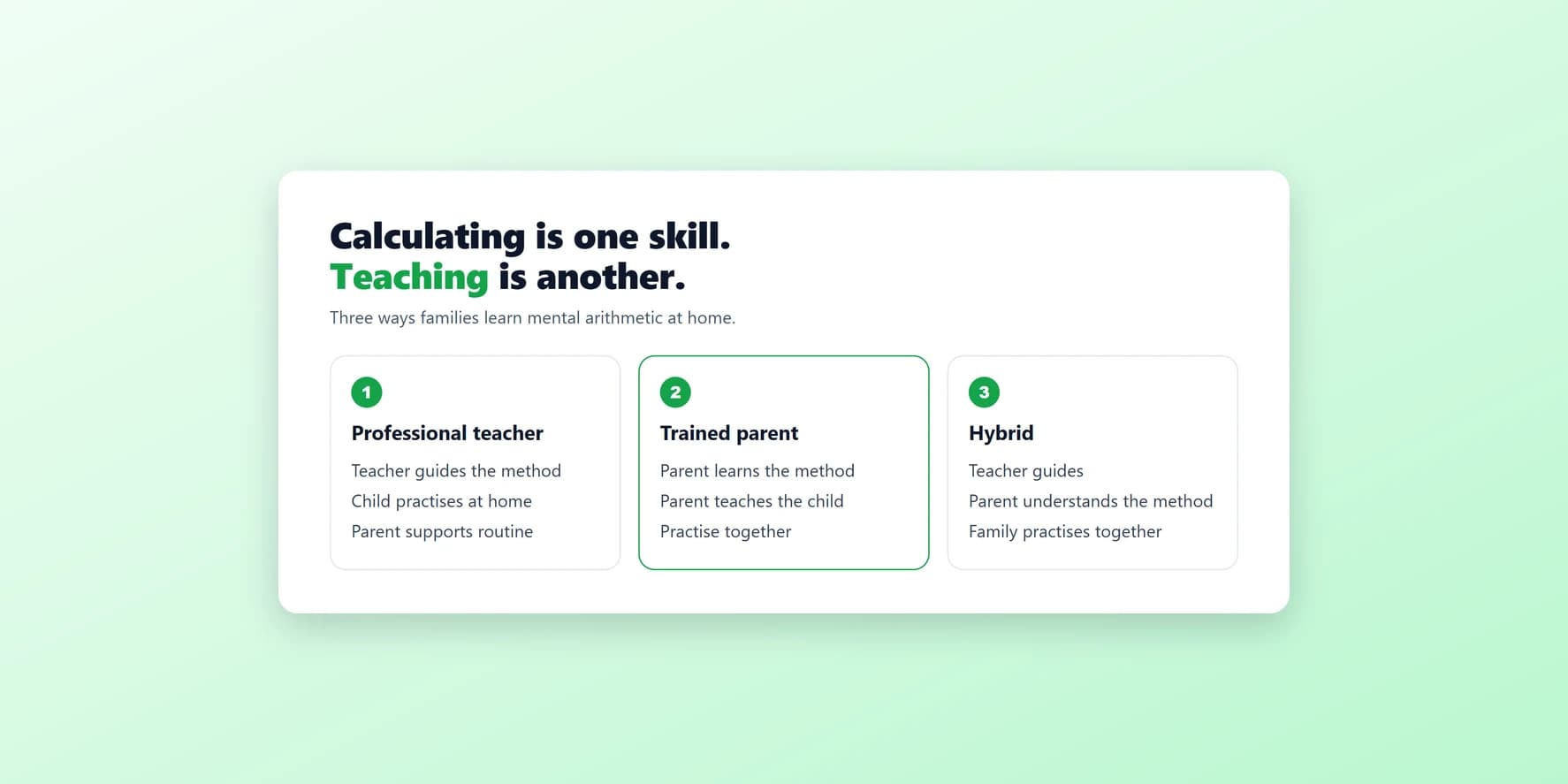
There are three perfectly reasonable family models
There is no need to present one model as correct for everyone.
| Professional teacher | Trained parent | Hybrid |
|---|---|---|
| Teacher guides methodology | Parent learns methodology | Professional teacher guides |
| Child practises independently | Parent teaches child | Parent understands the method |
| Parent supports routine | Parent and child practise together | Family can practise together |
All three models can work when methodology and family dynamics are right.
Model 1: Professional teacher + independent home practice. The teacher controls methodology. The child practises between lessons. The parent supports consistency. This is probably the most common model.
Model 2: A trained parent teaches their own child. The parent completes proper methodological training and takes responsibility for teaching. This can be an excellent option when the parent has the time, interest, teaching ability and healthy learning relationship with the child.
Model 3: A shared or hybrid model. The child studies with a professional teacher. The parent also learns mental arithmetic, understands the methodology and occasionally practises together with the child without taking over the entire teaching role. For some families, this creates an excellent balance.
The hybrid family model can be particularly interesting
Imagine that the child has a teacher who manages progression and technique. At the same time, the parent understands the methodology and can:
- practise with the child;
- join a flashcard challenge;
- try mental exercises;
- compare personal progress;
- celebrate achievements.
The parent is involved. But the professional responsibility remains with the teacher. That can provide many of the relationship benefits of shared learning without forcing the parent to manage the whole curriculum.
A parent who teaches needs to protect the parent-child relationship
If a parent becomes the teacher, it is useful to keep boundaries. During the lesson: teach. After the lesson: return to being the parent.
Do not correct every mistake throughout the entire day. Do not make every car journey into a lesson. Do not turn every dinner conversation into progress analysis.
The relationship is more important than any one educational program.
When parent-led mental arithmetic can work especially well
It can be an excellent option when the parent:
- wants to learn the methodology properly;
- has enough time;
- enjoys teaching;
- can remain patient;
- can observe technique;
- can follow a structured curriculum;
- can separate teaching from everyday family life.
In those circumstances, learning together can be genuinely rewarding.
When a professional teacher may be the better choice
A teacher may be preferable when:
- the parent has very limited time;
- teaching repeatedly creates conflict;
- the parent does not want to study the methodology;
- technical mistakes are difficult to identify;
- the child behaves very differently with a parent;
- the program has reached an advanced level.
There is nothing wrong with choosing professional help.
YouTube can still be extremely useful
Videos can demonstrate a movement, a rule, an example or a training idea. Even professional teachers use educational videos.
But video has one major limitation: it cannot watch the child back. It cannot see what was misunderstood or adjust immediately. Educational content and teaching are related. But they are not the same thing.
A strong learning model may look very simple
For example: once a week, the child works with a teacher. The teacher introduces the new topic, checks technique, reviews older material and plans the next stage.
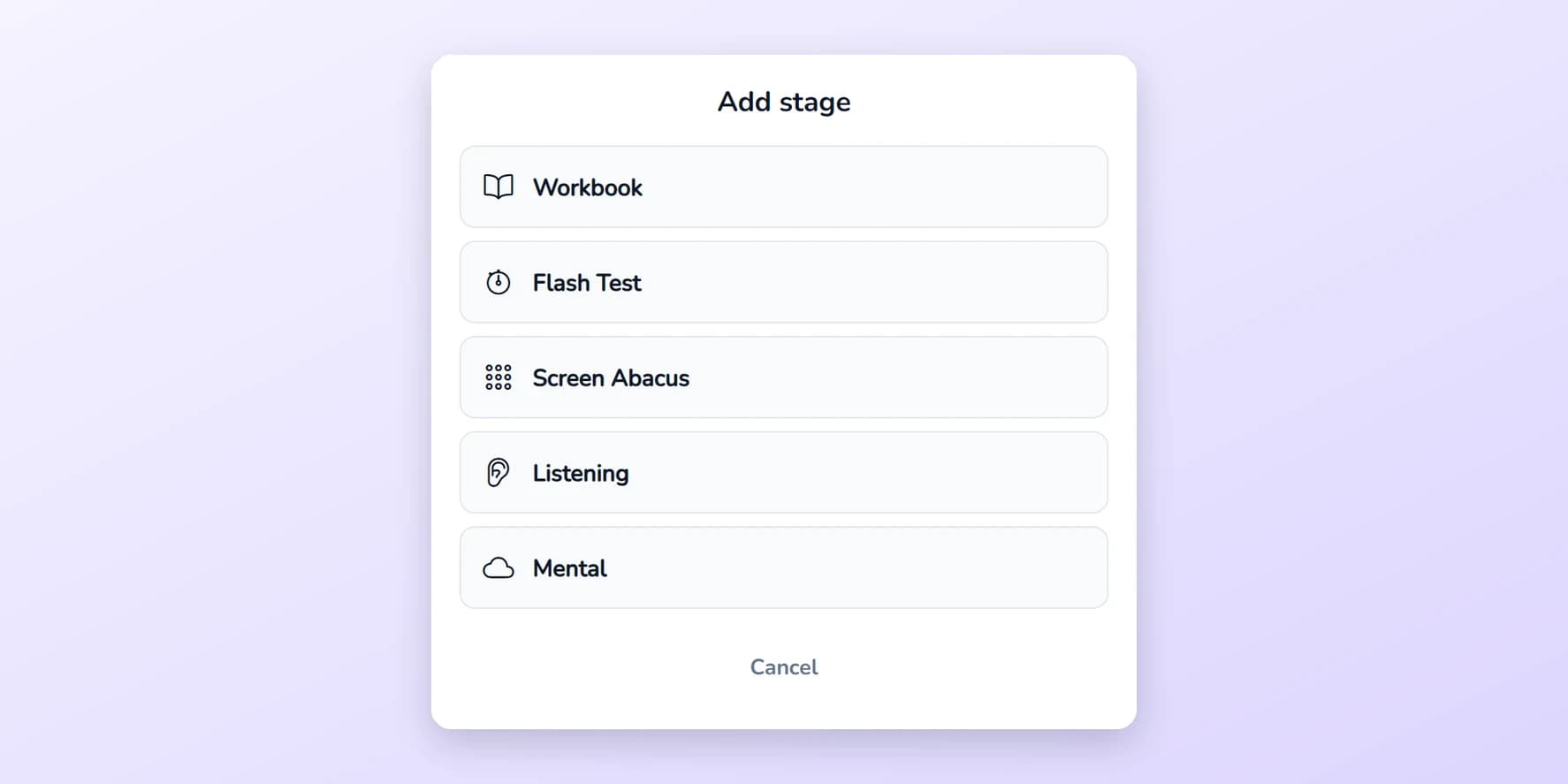
Between lessons, the child independently uses the workbook, physical abacus, flashcards, screen exercises and mental practice — a few short sessions across the week. The parent mainly supports regularity.
At the next lesson, the teacher reviews progress and adjusts the program. This allows the child to become increasingly independent without losing methodological guidance.
A good teacher should not make a child dependent on the teacher
Quite the opposite. The long-term goal should be for the child to understand tasks, practise independently, take responsibility for regular work and see their own results.
The teacher guides the learning trajectory. But the child gradually takes more responsibility for practice.
It is similar to sport
An athlete does not train only while the coach is standing beside them. Much of the practice can be completed independently. But the coach builds technique, creates the program, identifies mistakes, adjusts workload and prepares the athlete for the next level.
Mental arithmetic is similar.
Music provides another useful comparison
A student may meet a music teacher once or twice a week. But practise at home much more frequently. Nobody expects the teacher to sit next to the child for every scale. Yet building strong technique with no guidance at all can be much more difficult.
The lesson guides. Home practice builds the skill.
Teachers are particularly valuable at transition points
For example:
- starting Small Friends;
- starting Big Friends;
- moving into mental calculation;
- increasing digit length;
- beginning Anzan;
- introducing multiplication;
- introducing division.
At each of these stages, the nature of the challenge changes. An experienced teacher — or a properly trained parent — can judge whether the foundation is ready for the next step.
Moving forward too early can create hidden problems
A parent may see the child complete a new rule correctly ten times and think:
“Great. Next topic.”
But an experienced teacher may notice that speed is still unstable, finger technique is inconsistent, mixed practice falls apart, or the previous topic is weak.
The child may technically understand the rule but still not be ready to build the next layer on top of it.
Staying too long on one topic can also be a mistake
The opposite can happen. The parent wants:
“100% perfect performance before we move forward.”
The child spends weeks doing nearly the same thing. Boredom appears. Progress slows.
A strong methodology finds the balance between enough repetition and continued progression. Older skills can then remain active through mixed practice instead of blocking all new learning.
How a platform can help families
Digital tools can be particularly useful for the independent practice part. Once a teacher or trained parent has set the topic, speed, digit length, chain length and practice volume, the child can complete much of that training independently.
The system can record the results. This reduces the amount of manual supervision required.
How this works in Amavit
Amavit is not built around the idea:
“Teachers are no longer necessary.”
The opposite. The methodology remains controlled by the teacher — or by a trained adult who understands the learning process. Amavit helps organise the practice. The teacher can:
- select topics;
- set training parameters;
- assign homework;
- review results;
- adjust the next stage.
The child gains more independence without losing structure.
Technology can automate practice. Methodology still determines what should be practised and when.
This becomes especially important when a teacher has many students
Imagine a teacher with 30, 50 or 100 learners. They cannot personally sit beside every child during every home practice session.
But they can set the correct task, collect data, identify problems and intervene where attention is actually needed. That makes independent home practice much more manageable.
So should parents try mental arithmetic at home?
Absolutely, if they want to. Buy an abacus. Explore it together. Try simple exercises. See whether the child enjoys the experience.
And if the family wants to continue seriously, there are several good paths:
- work with a professional teacher;
- complete proper parent/teacher training and teach the child yourself;
- or combine professional teaching with shared family practice.
The important thing is not who has the title “teacher”. The important thing is whether the child receives correct technique, a structured progression, regular practice, appropriate feedback and a healthy relationship with learning.
The main conclusion
Yes, parents can teach mental arithmetic at home. And in some families, it can work extremely well.
A parent who properly learns the methodology may become a strong teacher for their own child. Learning together can also create shared interests, positive communication, mutual motivation and a very healthy learning atmosphere at home.
But this model requires more than good intentions. It requires time, methodological knowledge, teaching ability, patience and the ability to maintain a healthy parent-child relationship.
Because: being able to calculate is one skill. Being able to teach a child to calculate is another.
Not every parent has the time or desire to become a teacher. And they do not need to. For many families, the strongest system remains:
teacher + independent child practice + supportive parent.
For others:
trained parent + child learning together.
And for some:
professional teacher + parent who understands and sometimes joins the learning process.
There is no single correct model. The best model is the one that gives the child correct methodology, regular practice, growing independence and a positive relationship with learning.
Frequently asked questions
Can I teach my child mental arithmetic myself?
Yes. Parents can teach their own children, especially if they properly learn the methodology and technique first.
Do parents need mental arithmetic teacher training?
It is not necessary for simply introducing a child to an abacus, but structured teacher training becomes much more valuable if the parent wants to deliver a complete long-term program.
Can children learn mental arithmetic only from YouTube?
Videos can be useful for demonstrations and explanations, but they cannot observe the child, correct technique or diagnose the cause of mistakes.
Can an app replace a mental arithmetic teacher?
Apps and platforms can automate large parts of practice, but technique, progression and error diagnosis may still require a knowledgeable teacher or trained parent.
Is it good for parents and children to learn mental arithmetic together?
It can be an excellent shared activity when both enjoy it. Learning together can create common goals, motivation and a positive family learning environment.
What if teaching my child causes arguments?
Separating the parent and teacher roles may be healthier. A professional teacher can manage methodology while the parent focuses on encouragement and regularity.
Can a parent be as effective as a professional teacher?
Yes, if the parent has appropriate methodological knowledge, teaching ability, time and a productive learning relationship with the child. Being the parent alone does not automatically make teaching better or worse.