How to Add on an Abacus: From Simple Movements to Friends of 5 and Friends of 10
Addition is usually the first real arithmetic operation a child begins to perform on an abacus. At first, everything looks very simple. There is 1. Add another 1. The result is 2. Then 2 + 1 = 3. Then 3 + 1 = 4. And it can feel as if everything will continue in the same way.
But quite soon, the child reaches an example where there are simply not enough available beads to add the number directly. For example, 3 + 4. Three lower beads are already active. Only one lower bead remains available. So adding another four directly is impossible.
This is the point where addition stops being only direct bead movement and starts requiring number relationships.
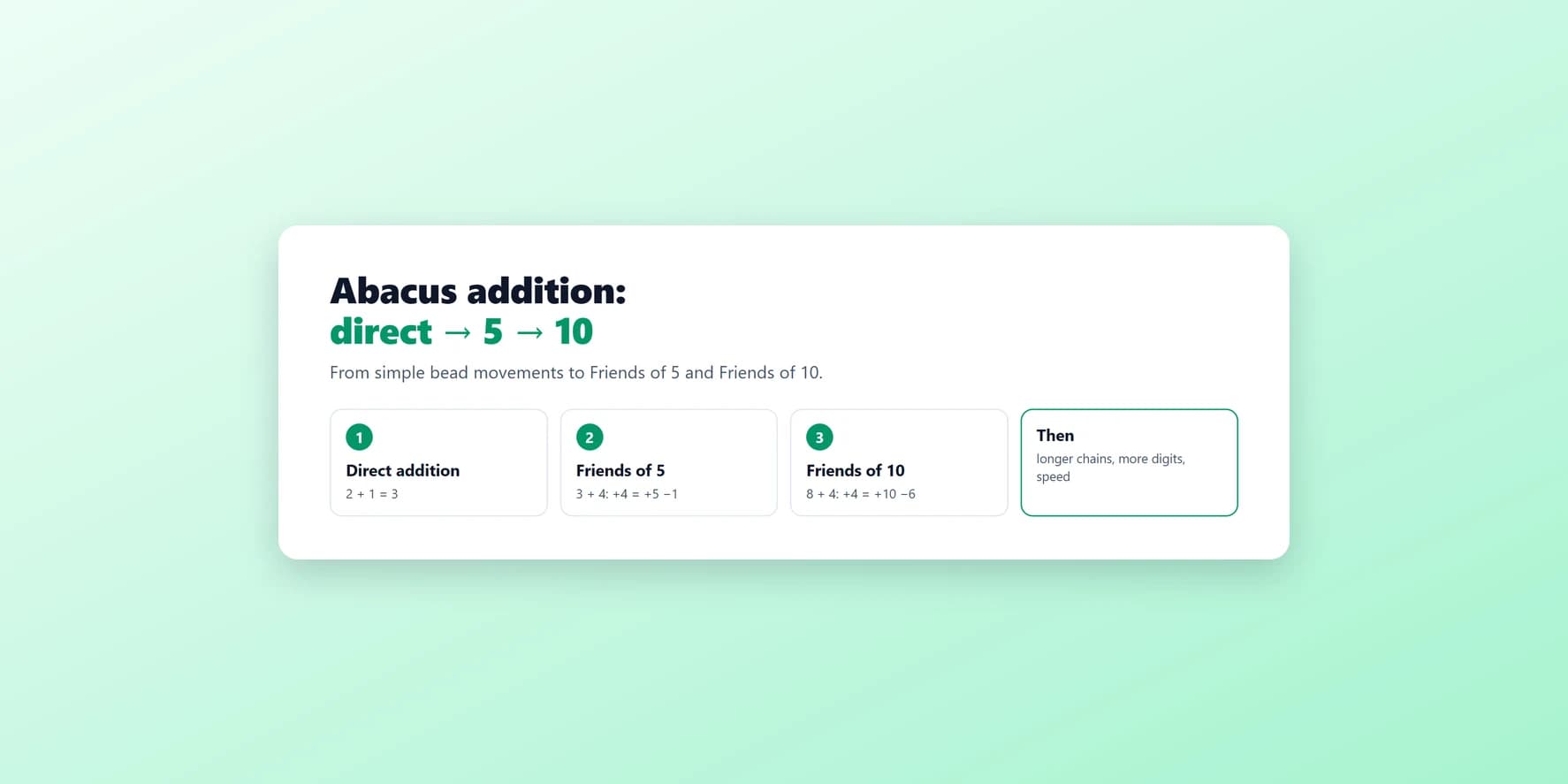
Abacus addition begins with direct bead movement. When a number cannot be added directly, children use complements to 5 and 10 — commonly called Friends of 5 and Friends of 10 — to complete the operation efficiently.
- Direct addition — 2 + 1 = 3
- Friends of 5 — 3 + 4: +4 = +5 −1
- Friends of 10 — 8 + 4: +4 = +10 −6
Three stages of abacus addition.
First, the child needs to understand the number itself
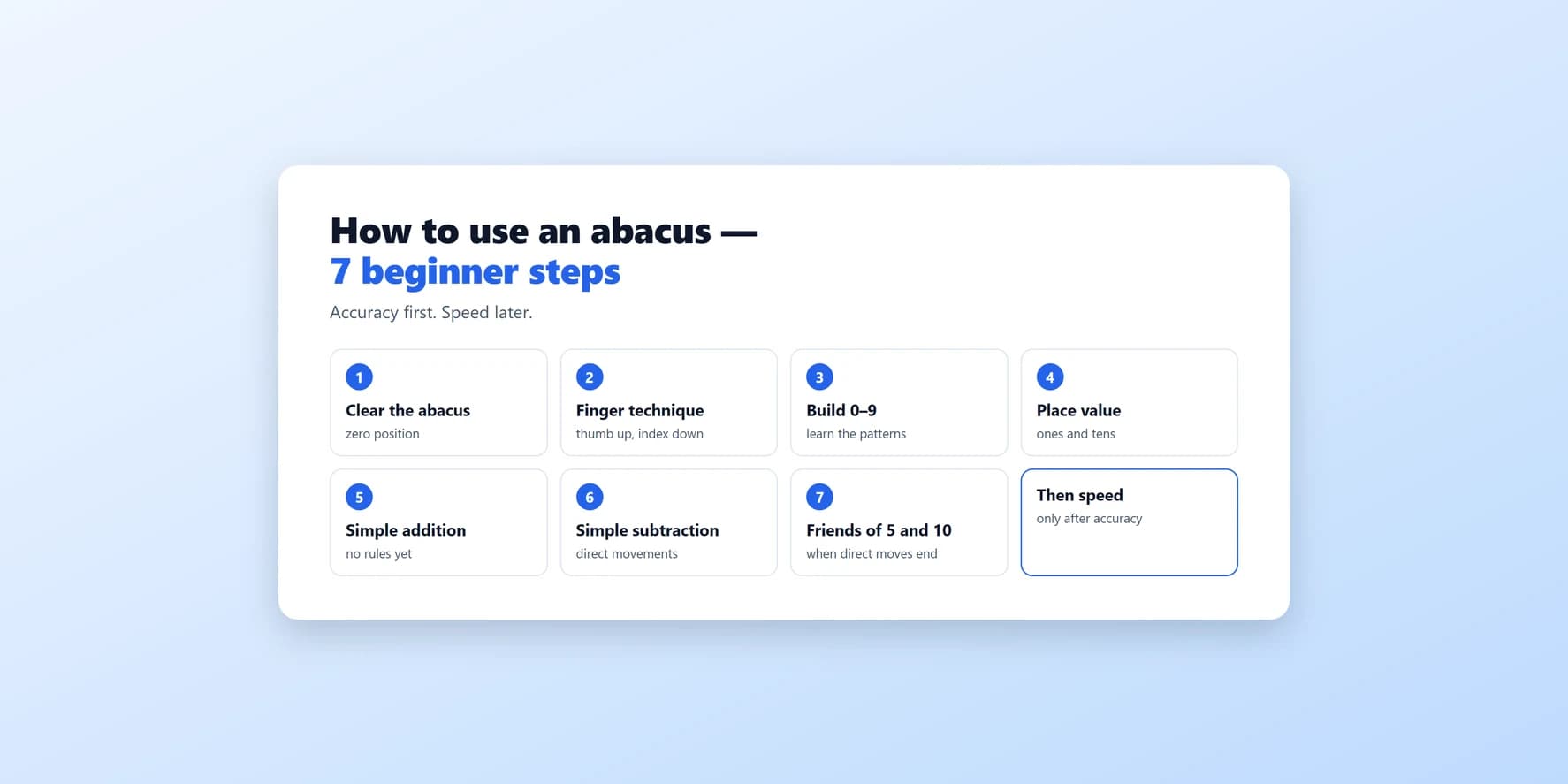
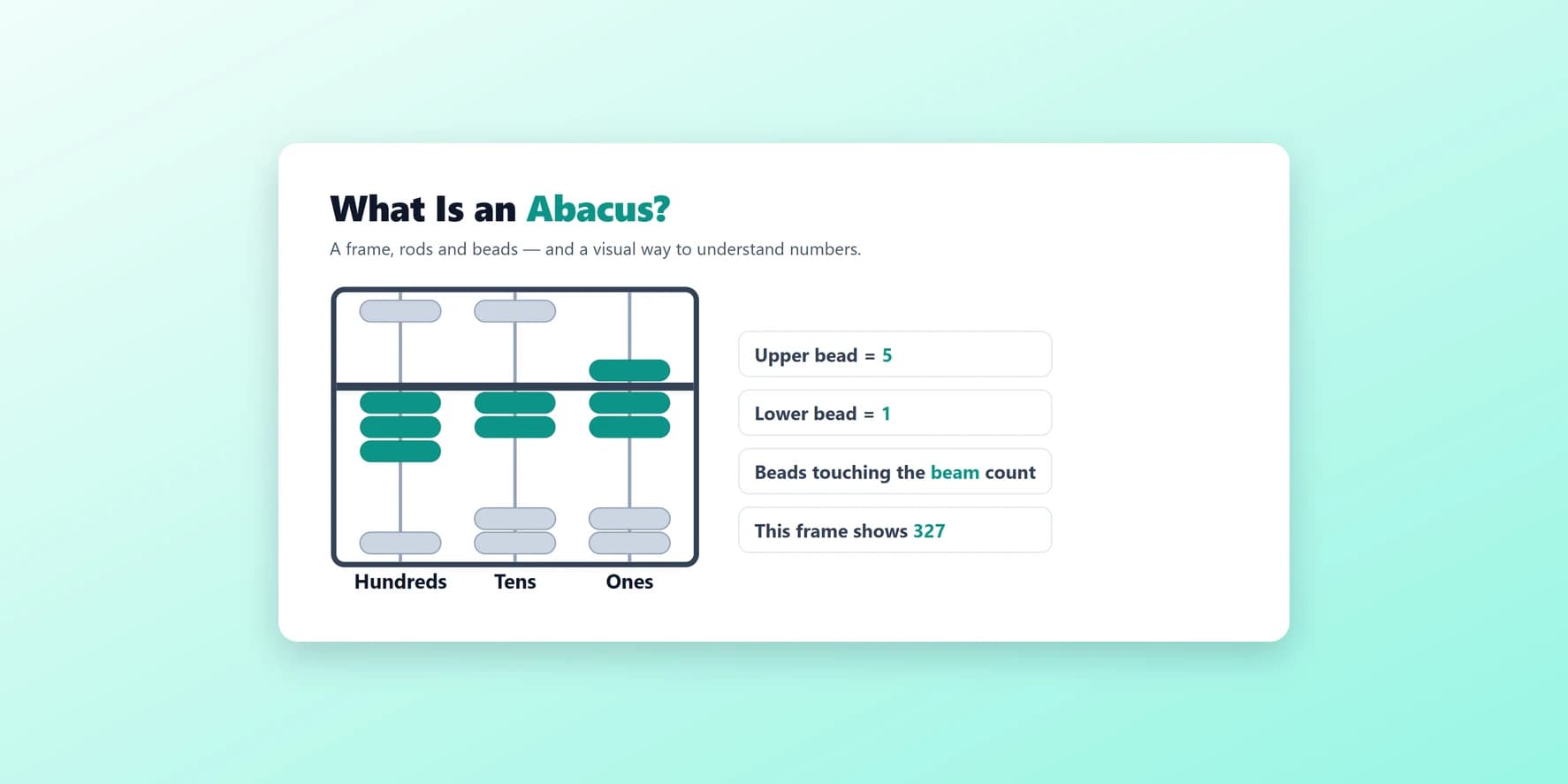
I would not start addition until the child can confidently represent numbers from 0 to 9. They should recognise 1, 2, 3, 4, 5, 6, 7, 8 and 9 without having to think for too long. If you are new to the tool itself, start with what an abacus is and how it works.
If the child still counts every bead one by one each time, addition quickly becomes too demanding. The number itself first needs to become a familiar visual pattern.
The first stage: direct addition
The earliest examples can be solved by simply adding beads.
For example, 1 + 2. The child sets 1. Then adds two lower beads. The result is 3.
Or 5 + 2. First, the child sets 5. Then adds two lower beads. The result is 7.
At this stage, no special rule is needed. The child simply performs a direct movement. The basic finger work and bead positions are covered step by step in how to use an abacus.
Why this stage should not be skipped
It can be tempting to move quickly into formulas. But if the child does not feel comfortable with direct addition, later rules can feel like arbitrary substitutions rather than something logical.
First, the child should understand the simple idea: add something — the value increases; remove something — the value decreases. Only then do more complex transformations make sense.
What happens when direct addition is no longer possible?
Take 3 + 4. Three lower beads are already active. Only one remains available. But we need to add four. So the operation cannot be completed directly. The child has to use a different relationship.
The number 4 can be represented as 5 − 1. So:
+4 = +5 −1
Instead of trying to add four separate lower beads, the child adds 5 and removes 1. The result is 7.
This is the first point where the child begins to use complements rather than only direct movement.
This is where Friends of 5 appear
Small Friends, also called Friends of 5, are complements to 5. The basic relationships are 1 and 4 and 2 and 3.
In addition, they are used when the required number cannot be added directly with the available lower beads. For example, 4 + 2 can be solved using +2 = +5 −3.
At first, the child consciously remembers the relationship. Later, the movement becomes familiar enough to happen almost automatically. The goal is not to memorise formulas forever. The goal is to recognise the number relationship quickly and perform the movement correctly.
The formula is only a temporary step
This is important. The child should not spend years thinking: “Plus two means plus five minus three.”
The formula explains the logic. Practice turns that logic into a familiar movement. That is where speed eventually comes from — see automaticity in mental arithmetic.
Why speed should not come first
If the child is still thinking Which rule do I need? What should I add? What should I remove? then it is too early to push for speed.
Speed should come after stability. Otherwise, the child may begin to guess movements. And later, those habits can be difficult to correct.
What changes when the calculation crosses 10?
The next stage appears when addition moves across 10. For example, 8 + 4. Now the child needs to involve the next place value.
The number 4 can be represented as 10 − 6. So:
+4 = +10 −6
The child adds one ten and removes 6 from the units. The result is 12. This is where Friends of 10 become important.
Friends of 10
Big Friends, also called Friends of 10, are complements to 10. The basic pairs are:
These relationships help the child handle addition that crosses from one place-value rod to the next.
For a detailed explanation of how Small Friends and Big Friends work, it is better to study them as a separate topic rather than trying to learn every formula inside one addition lesson. Learn more: What Are Small Friends and Big Friends in Mental Arithmetic?
Why Friends of 10 often feel more difficult
Because the child needs to control several things at once: the current rod; the next place value; the complement; the current result; the movement sequence.
That is why these combinations should normally be introduced only after the basic addition movements are stable.
Do not teach every combination at once
A common mistake is to introduce too many new rules at the same time. The child learns one complement, then suddenly receives all the others. The rules begin to mix together.
A better approach is usually:
- One topic
- Simple examples
- Short chains
- Stable accuracy
- Then the next topic
Different schools may use different sequences
One academy may teach Small Friends 1 → 2 → 3 → 4. Another: 4 → 3 → 2 → 1. The same is true for Big Friends. One methodology may move 1 → 2 → 3 → … → 9. Another: 9 → 8 → 7 → … → 1.
The mathematics does not change. The teaching sequence does. And that can be completely valid.
Why this matters in a digital platform
If a teacher has used one sequence successfully for years, software should not force them into another sequence. The digital tool should support the teacher’s methodology. Not rewrite it.
In Amavit, each Small Friend (1–4) and each Big Friend is a separate topic that the teacher selects individually. The order in which they are assigned is up to the teacher, so an academy can keep its own programme instead of rebuilding it around the platform — see how teachers use Amavit as a practice trainer.
How do you know a child has really learned an addition topic?
Not from one correct example. I would look at several things. The child:
- chooses the correct rule;
- performs the movement without confusion;
- does not pause for too long;
- does not repeat the same error again and again;
- can complete several examples in a row;
- keeps accuracy when the pace increases slightly.
Only then does the topic begin to look stable. More on this in when a child is ready for the next topic.
What if the child knows the rule but still makes mistakes?
This happens often. The child may explain the rule correctly but still perform the operation incorrectly. That means the problem may not be knowledge. It may be technique, coordination, visual recognition, attention or speed that is too high.
At this stage, the teacher should still check the actual movement pattern, because a correct verbal explanation does not always mean the physical technique is correct. The finger technique checklist helps to see what exactly goes wrong.
- Wrong rule?
- Wrong movement?
- Too much speed?
- Lost place value?
- Attention problem?
Fix the cause before adding more practice.
Sometimes the best solution is simply to slow down
If errors appear after the speed increases, I would first return to the previous pace. Then check: Is the movement still clean? Have unnecessary movements appeared? Is the child skipping part of the operation?
Very often, slowing down reveals the real problem immediately. The same diagnostic logic is described for subtraction in how to find the exact cause of repeated abacus subtraction errors.
Addition is better practised in short chains
Not only as separate examples such as 3 + 4 = ?, but also in chains like 2 + 1 + 3 − 1 + 2. Or, after learning a specific rule, in short chains where that rule appears several times.
This teaches the child to hold the current value instead of starting from zero after every operation.
Increase chain length gradually
If a child can comfortably complete a chain of three operations, that does not mean they should immediately move to twenty. A better progression may be 3 operations, then 5, then 7. Then observe when accuracy begins to fall.
Change only one difficulty parameter at a time
This is especially useful in abacus training. If the child has just learned a new rule, I would not simultaneously increase speed, increase digit length and make the chain longer.
First, the new topic should become stable. Then change one variable.
- Direct addition
- Friends of 5
- Friends of 10
- Longer chains
- More digits
- Higher speed
- Mental addition
Addition progression — one step at a time.
How physical addition connects to mental addition
On the physical abacus, the child first sees and performs the real movement. Then the movement becomes visually familiar. Later, the child can begin to imagine that same movement without the physical tool.
This is how physical addition gradually becomes the basis for mental addition — see physical vs mental abacus.
When repeated errors appear, return to the physical abacus
If the same addition mistake keeps happening, returning to the physical abacus is often the fastest way to see where the process breaks down. The teacher can observe:
- where the child hesitates;
- which movement is incorrect;
- whether the place value is being lost;
- whether the wrong complement is being chosen.
This is much more useful than simply giving the child more examples at a higher speed.
Where workbooks are useful
A workbook works well for calm practice, physical abacus work, repetition of familiar rules and homework. It also has one obvious advantage: the child can practise without another screen.
But a workbook cannot automatically adjust difficulty or react to repeated errors.
Where digital practice is useful
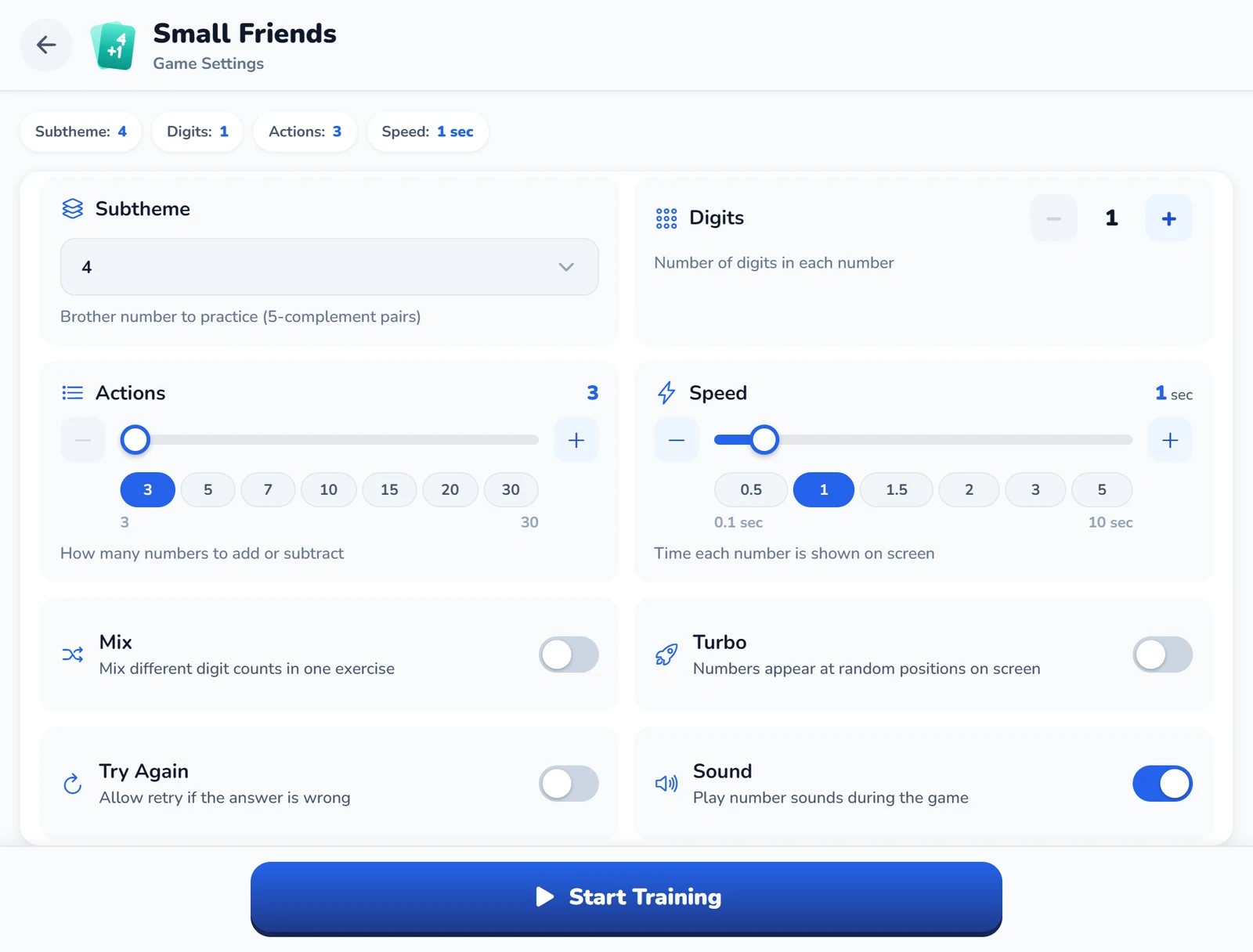
A digital trainer is especially useful when the child needs a lot of repetition. It can:
The teacher does not need to manually create hundreds of examples.
But digital practice cannot fully correct technique
This is important. The software can see a correct answer, an incorrect answer, speed and performance history. But it may not always know whether the physical movement itself was correct.
That is why new technique still needs teacher supervision.
A good learning workflow looks like this
The teacher explains the new addition topic, shows the correct movement and checks the first examples. Then the child practises independently, repeats the topic and builds volume. After that, the teacher reviews what worked, where mistakes appeared and whether the child is ready to move on.
This is a useful division of roles
The teacher focuses on
Explanation · technique · diagnosis
The platform focuses on
Repetition · practice · checking · regularity
They solve different parts of the same learning process.
How Amavit helps with addition practice
In Amavit, the teacher can choose the required topic and use the platform for further consolidation. Practice can vary by topic, speed, chain length, digit length and training volume.
With Auto difficulty on, the game adjusts speed and the number of operations to the child's results. The child's Recommended card points to the game where their accuracy is lowest, so a weaker area comes back more often. Already familiar topics can stay in homework instead of disappearing completely — more in online abacus practice with an adaptive trainer.
Why this matters especially in addition
Addition quickly becomes more than one single topic. First there is direct addition. Then Friends of 5. Then Friends of 10. Then more digits. Then longer chains. Then higher speed.
If every child receives exactly the same practice, one child may be bored while another is overwhelmed.
Stronger and weaker students should not always receive identical practice
If one child is already stable, the next step may be to increase speed, increase chain length or add more digits. For another child who is still making errors, it may be better to keep shorter chains, lower speed and more repetition of the current rule.
That is more useful than moving everyone forward at exactly the same pace — see how to teach a mixed-ability abacus group.
When should speed increase?
When the child understands the topic, performs the movement correctly, solves consistently, makes few errors and keeps the technique when the pace increases slightly. Then speed can grow gradually.
When should mental addition begin?
Once the child understands the physical movement well enough. Then simple visualisation can begin. For example: first complete an example on the physical abacus; then try a similar example mentally.
Mental addition should grow from a clear physical image.
What I would avoid
I would not:
- teach every formula at once;
- start with speed;
- remove the physical abacus too early;
- mix several methodologies;
- increase every difficulty parameter at the same time;
- compare the child with the fastest student in the group.
These things usually create more problems than they solve.
What good progress in addition really looks like
Progress does not always mean: “Today the child solved 30 examples per minute, tomorrow it must be 35.” Progress can also mean the child:
- thinks less about the rule;
- makes fewer mistakes;
- moves more cleanly;
- holds longer chains;
- does not freeze when crossing 5;
- works more confidently across 10;
- can increase speed slightly without losing accuracy.
That is progress too.
The main idea
Addition on the abacus begins very simply. Add a bead. Get a new number. But gradually, the child moves from direct actions into a structured system of number relationships. First around 5. Then around 10. And eventually, what once required a conscious rule becomes a familiar movement.
That is why speed should not be rushed. First, the child needs to understand, move correctly, repeat, stabilise. Speed comes later.
That is how a strong foundation for mental addition is built.
Frequently asked questions
How does addition work on an abacus?
Children begin with direct bead movements and later use complements to 5 and 10 when direct addition is not possible.
What are Friends of 5 in abacus addition?
They are number relationships that use complements to 5, such as 1 and 4 or 2 and 3.
What are Friends of 10?
They are complements to 10, including 1 and 9, 2 and 8, 3 and 7, 4 and 6, and 5 and 5.
When should a child learn Friends of 5?
After direct addition and basic bead movements are already stable.
When should Friends of 10 be introduced?
When the child is ready to work across 10 and between neighbouring place-value rods.
Should children memorise abacus addition formulas?
The formulas help explain the logic, but the long-term goal is stable, automatic movement.
Should speed be trained immediately?
No. Accuracy and correct movement should become stable first.
What should I do if my child keeps making the same addition error?
Slow down and return to the physical abacus to identify whether the problem is the rule, movement, place value or excessive speed.
Can digital practice help with abacus addition?
Yes. It is useful for repetition, automatic checking, speed control and targeted practice of specific topics.
Can digital practice replace a teacher?
No. Teachers are still important for new techniques, movement correction and diagnosing repeated errors.
Teach addition in your own sequence
Choose the topics and progression that match your methodology. Let Amavit support the practice.
Explore Amavit for TeachersFree for teachers