Why Mental Arithmetic Topics Should Be Mixed — and Why Practising One Rule for Too Long Is Not Enough
When a child learns a new mental arithmetic topic, it makes sense to begin with similar exercises.
For example, today the child is learning a specific Small Friend. The teacher explains the rule. The child completes a few examples. Then a few more. Then perhaps twenty more.
After some time, accuracy becomes very high. Parents may think:
“Excellent. The topic is mastered.”
But there is an important limitation. If the child already knows that the next 30 examples all require the same rule, they no longer need to decide:
Which rule should I use now?
They are mainly repeating one known pattern. This is useful at the beginning. But it is not the full skill.
A much more important test begins when the child does not know in advance which rule will appear next.
That is why mental arithmetic training should gradually move from isolated practice to mixed practice.
A new mental arithmetic topic should first be practised separately so the child can understand the rule and build correct technique. Once the topic becomes stable, it should gradually be mixed with previously learned material. This trains not only rule execution, but also the ability to recognise which rule is needed in real time.
A new topic should first be isolated
When a child meets a new rule for the first time, there is no reason to mix it immediately with everything they already know. First, the child needs to understand:
- what is happening;
- which movement is required;
- which fingers to use;
- why this particular rule applies.
At this stage, repetitive examples are useful. The child can focus on one new mechanism without unnecessary distractions. For example:
“Today we are practising this specific transition.”
That reduces cognitive load and helps establish correct technique.
But isolated practice quickly becomes predictable
Imagine that the child receives 50 exercises based on the same topic. After the first few, they already know:
“I understand. The same rule applies again.”
The task becomes easier. The child still practises execution. But they are no longer practising one of the most important parts of real calculation: choosing the correct rule from several possible ones.
Real calculation does not announce the next rule
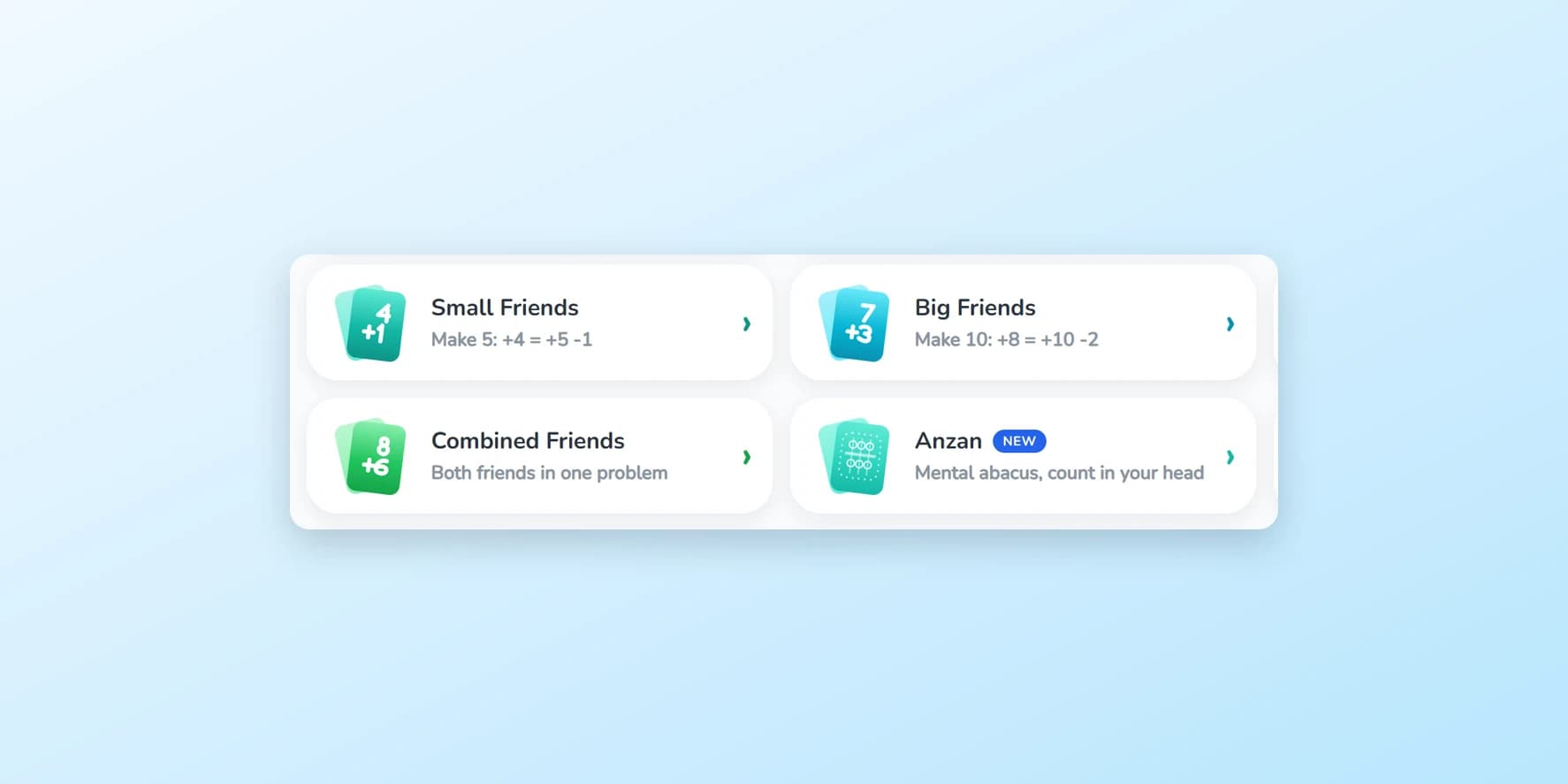
In actual mental arithmetic, topics do not arrive in perfect blocks. One operation may be Simple. The next may require a Small Friend. Then a Big Friend. Then another simple action.
With multi-digit numbers, several different rules may even appear within the same number.
The child therefore needs more than knowledge of each individual rule. They need to be able to recognise the situation and select the correct rule quickly.
These are two different skills
The first skill is performing a known rule correctly.
The second is identifying which rule is needed and immediately performing it.
A child can be very strong at the first while still developing the second. Mixed exercises reveal this difference.
Knowing how to use a rule is one skill. Knowing when to use it is another.
A simple example
Imagine that a child has spent the whole week practising +4. They know exactly which combination to use. After enough repetition, the movement becomes fast and confident. Excellent.
Then the teacher mixes +1, −2, +4, −3, +2 and different Friends. Suddenly, mistakes appear.
Does that mean the child never learned +4? Not necessarily. The movement itself may already be excellent.
What is not yet fully automatic is recognising when +4 is the correct rule among several alternatives. That is the next stage.
Automaticity is not only fast execution
This is an important extension of the idea of automaticity. A child needs to automate two things:
- recognition of the situation;
- execution of the correct action.
If the hand movement is automatic but the child needs two seconds to decide which rule applies, high-speed calculation is still impossible.
Mixed practice develops the selection stage.
The more rules a child knows, the more important mixed practice becomes
At the beginning, the choice is small. There are only a few basic actions. Then Small Friends appear. Then Big Friends. More combinations are added.
Eventually, the child needs to distinguish between many familiar patterns. With two- and three-digit numbers, the challenge becomes even greater.
Different rules can appear inside one number
Imagine a three-digit operation. At the hundreds place, the movement may be simple. At the tens place, a Small Friend may be required. At the ones place, a Big Friend.
So even within a single operation, the child cannot think:
“This is a Small Friends exercise.”
They need to switch between familiar patterns quickly. This is one reason mixed practice is direct preparation for real multi-digit mental calculation.
New knowledge should inherit everything learned before
This is one of the most important principles. A new topic should not replace previous topics. It should join them.
The child learns one rule. Then another. Then another. Each new topic becomes part of an increasingly large system of knowledge. So the learning process is not:
Topic A → finished · Topic B → finished · Topic C → finished
It is closer to:
- Stage 1 A
- Stage 2 A + B
- Stage 3 A + B + C
- Stage 4 A + B + C + D
Every new topic inherits the topics learned before it.
With every new stage, the child has a larger set of possible tools and must increasingly select the right one automatically.
That is how separate rules gradually become one integrated calculation system.
New knowledge should not replace old knowledge. It should join it.
When should a new topic be mixed?
Not immediately. First, the child should:
- understand the rule;
- perform it with correct technique;
- complete enough clean repetitions;
- show reasonable accuracy.
Then the new topic should gradually be mixed with older material. A useful progression is:
new topic alone → repetition → mix with one familiar topic → broader mixed practice
The child should not be thrown immediately into twenty different rules.
- Learn new rule
- Isolated practice
- Correct technique
- Mix with familiar topics
- Broader mixed practice
- Automatic rule selection
Each new topic should become part of the existing system — not remain a separate island.
Mixing should also be gradual
Imagine the child has just learned a new Small Friend. First, it can be mixed with Simple. Then another familiar topic can be added. Then several. Later, the child can work in a much broader mixed mode.
This keeps the challenge manageable while gradually increasing the need for rule selection.
Why mixing too early creates problems
If the child is still unsure how the new movement works, which Friend is required and which fingers to use — and ten older rules are immediately added — errors multiply.
Then it becomes difficult to diagnose the cause. Did the child:
- fail to understand the new topic?
- choose the wrong old rule?
- perform the movement incorrectly?
So first: build clean technique. Then: train selection between alternatives.
But keeping a topic isolated for too long is also a mistake
There is an opposite problem. The child practises one topic for two weeks. Accuracy reaches 98–100%. Everyone is satisfied.
Then the same topic appears inside mixed exercises — and accuracy collapses.
That usually means the training environment was too predictable. The child learned to perform the rule. But not to recognise when that rule is needed.
A strong teacher gradually removes clues from the exercise structure
At first, the exercise effectively tells the child: “Use this rule.”
Later: “One of these two rules may be needed.”
Eventually: “Any previously learned rule may appear.”
This is a natural progression. The stronger the child becomes, the less information the structure of the exercise should give away.
It is similar to learning a language
Imagine learning twenty words from one category. For example: apple; banana; orange; pear. If every flashcard is a fruit, the child already has a major clue.
But real language begins when those words appear inside many different sentences alongside hundreds of other words. The learner needs not only to remember the word. They need to recognise and use it in context.
Mental arithmetic develops in a similar way.
Sport works the same way
A football player can practise one particular shot 100 times. That is useful. But during a match, nobody announces:
“Exercise number three is coming now. Please use this particular shot.”
The player needs to see the situation, choose the action and perform it. Training gradually needs to resemble the real situation. Mixed practice plays a similar role in mental arithmetic.
Why children can perform perfectly at home but make mistakes in class
This is very common. At home, the child completes a workbook page dedicated to one topic. The result is excellent. Then the teacher gives mixed examples in class. Suddenly, mistakes appear. Parents are surprised:
“But everything was correct at home.”
Both results can be accurate. The tasks were testing different levels of skill.
The workbook page tested: Can the child execute this specific rule?
The mixed exercise tested: Can the child identify this rule among several others?
A workbook can sometimes create an overly optimistic picture
Workbooks are extremely valuable. Especially for learning technique, initial repetition and consolidating a new rule.
But if pages are organised by topic, the page itself gives the child an extra clue. The student already knows:
“This page is about Big Friend +7.”
Real mixed calculation does not provide that clue. That is why workbook practice should eventually be complemented by mixed practice.
This is not a weakness of workbooks
The tools should not be placed in competition with each other. The workbook performs its function very well. It provides structure, repetition, written practice and sequential training.
Mixed digital practice performs a different function. The strongest system can use both.
| Isolated practice | Mixed practice |
|---|---|
| Topic already known | Topic unknown in advance |
| Lower decision load | Rule must be identified |
| Excellent for learning technique | Closer to real calculation |
| Good for first repetitions | Tests true automaticity |
Flashcards can also move from isolated to mixed
At first, the child learns specific configurations. Later, the flashcards can appear in random or mixed order. Now the child no longer knows what will come next. They need to recognise each image rapidly.
The same principle applies to calculation rules. Predictability gradually decreases.
Mixed audio practice adds another layer
In visual training, the child can see the number. In audio practice, they hear it and need to immediately recognise it, create the mental image, select the action and update the current state.
If the topics are also mixed, there is even less contextual help. That can make mixed audio practice a strong test of a stable mental skill. But only when the child is ready for it.
Mixed practice is important long before advanced Anzan
In mature Anzan, the child is not told:
“Now we are practising Small Friends.”
Numbers simply appear. Everything previously learned may be required. At speed.
So if the child has spent months working only in isolated thematic blocks, the transition to advanced Anzan becomes much harder. Mixed practice should begin well before very high speeds.
Mixed exercises reveal real weak topics
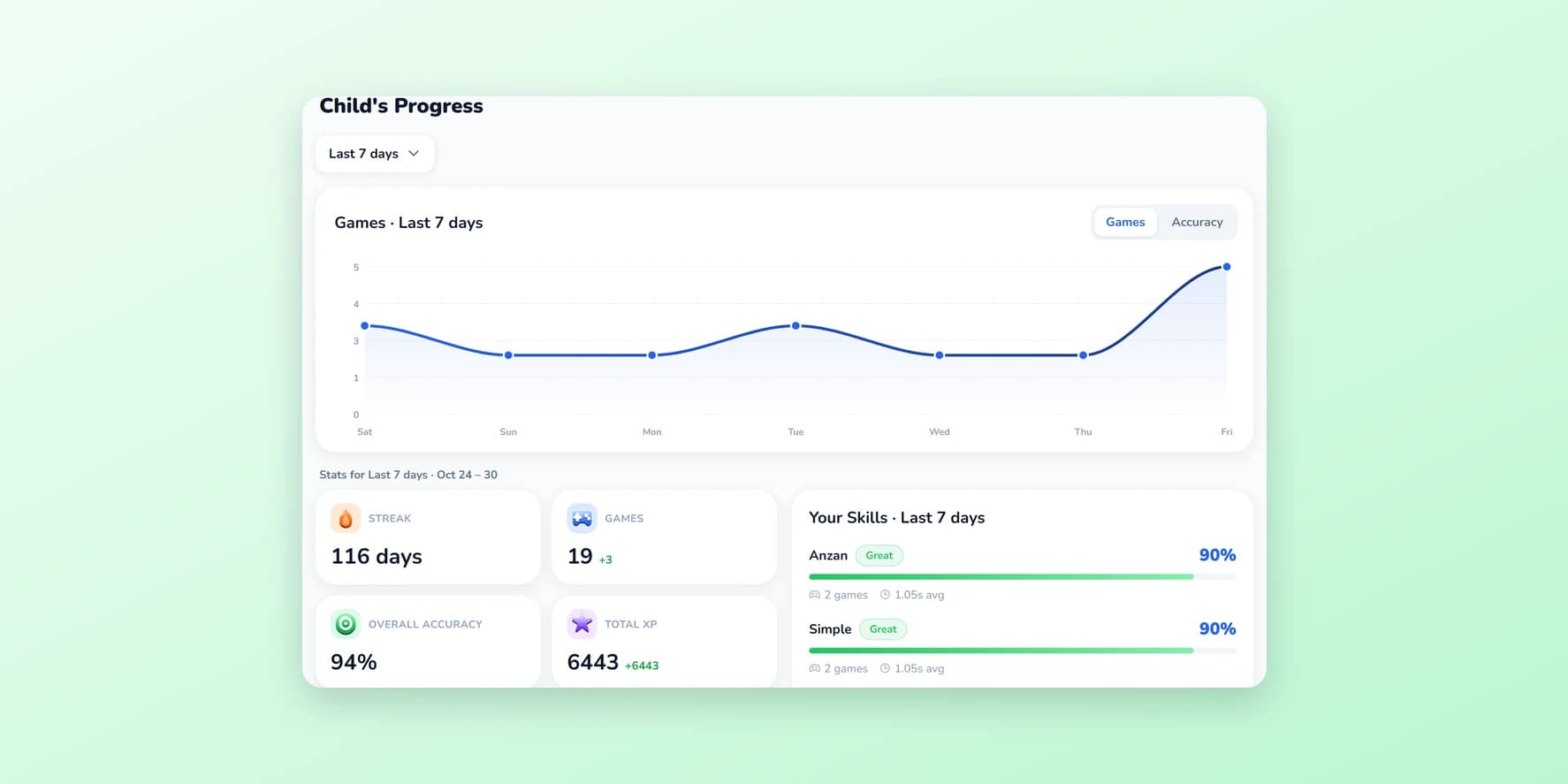
This is another major advantage. Suppose isolated results show:
- Small Friends — 95%;
- Big Friends — 94%;
- Simple — 99%.
Everything looks excellent. Then mixed-mode accuracy falls to 78%.
The teacher examines the errors and discovers something interesting: the child repeatedly confuses two similar situations. The isolated topic drills did not reveal that weakness — the kind of hidden weak spot we describe in why children keep making the same mistakes.
Mixed mode is therefore a diagnostic tool
It is not only training. It helps the teacher see:
- what is truly automatic;
- what works only when the topic is already known;
- which combinations are confused;
- which older rules break down at speed.
This is valuable methodological information.
Mixed results need to be interpreted correctly
If a child learned a new topic yesterday and mixed accuracy is lower today, there is no reason to panic. That is normal. Mixed practice is objectively harder.
The child needs to recognise the situation, choose the rule and execute it correctly. Accuracy can initially fall. Then improve with repetition.
Sometimes lower accuracy after mixing is actually a sign of progress
It may sound strange. But imagine:
- isolated topic — 98%;
- first mixed session — 82%;
- after more practice — 91%;
- a week later — 95%.
The final 95% is much stronger than the original 98%. Why?
Because it was achieved in an environment where the child had to identify the correct rule rather than simply repeat a predictable one.
Percentages are meaningless without context
This connects directly with how progress should be evaluated.
98% on one isolated familiar topic and 93% with mixed rules, higher speed and three-digit numbers are completely different results. The second may represent a much stronger skill.
So teachers need to see not only the percentage. They also need to know under what conditions it was achieved.
Old topics should keep returning
Mixed practice has another important function: it prevents older knowledge from disappearing.
The child learned a topic six months ago. If it never appears again, the skill may gradually weaken. If older material continues to appear periodically in mixed exercises, it remains active. The principle becomes:
learn → consolidate → continue using
rather than:
learn → close the topic → forget it.
But old topics do not need equal frequency
Not every rule needs to appear equally often. A new weak topic can have a high frequency. An older stable topic can appear less often. But it does not need to disappear entirely. For example:
- new topic — high weight;
- recent topic — medium weight;
- old stable topic — low weight.
If the old topic starts producing errors again, its weight increases. This becomes adaptive practice.
This is where a digital platform becomes especially useful
In a workbook, the examples are fixed in advance. A teacher can manually create mixed homework. But if they teach 20, 50 or 100 students, building a different mix for each student becomes very time-consuming.
A digital system can make that far more practical.
How Amavit can support mixed practice
In Amavit, the teacher can control:
- which topics are included;
- which topic appears more frequently;
- which older topics should remain active;
- speed;
- digit length;
- chain length;
- training volume.
For example: a new weak topic — 50%; several older topics — the remaining 50%. Later, the new topic becomes stronger. Its share decreases.
The training gradually becomes broader and closer to real mixed calculation.
Mixed practice should be adaptive, not simply random
This distinction matters. Random practice can mean: anything appears in any order.
But methodically useful mixed practice should consider:
- what the child already knows;
- what they are currently learning;
- what is becoming weaker;
- where mistakes appear.
Mixed practice should not be chaos. It should be controlled.
Mixed practice should be adaptive, not chaotic. The goal is not random exercises. The goal is automatic selection of the correct skill.
Mixed performance can help determine readiness for the next topic
Suppose a child performs the new topic perfectly in isolation but becomes completely lost once it is mixed with older rules. That may mean a little more consolidation is needed.
There is no need to demand perfect 100% performance. But ideally, the new skill should begin to survive outside its own isolated block — one of the signs that a child is ready for the next topic.
Then it is becoming part of the child’s overall calculation system.
This becomes even more important in a long program
After one year, the child may know many rules. After two years, even more.
If every topic remains isolated, the child ends up with many small skills that do not interact well. The real goal is different: to build one integrated calculation system.
Mixed practice connects the individual topics — and regular practice across the week (see how often children should practise) keeps them all active.
Eventually, the child stops thinking in topic names
This is an important advanced result. A beginner may think:
“This is a Small Friend.”
“This is a Big Friend.”
A strong student at high speed should no longer need to repeat those labels internally. They see the situation and act.
Separate rules gradually merge into one automatic calculation system. That is the point.
The main conclusion
A new mental arithmetic topic should first be learned in isolation. The child needs to:
- understand the rule;
- develop correct technique;
- complete enough repetitions;
- achieve good accuracy.
But after that, the topic should not remain isolated for long. It needs to be gradually mixed with everything the child already knows. Because a real skill is not:
“I can perform the rule when someone tells me which rule to use.”
A real skill is:
“I can recognise the situation, select the correct rule and perform it accurately among many other possibilities.”
So the progression should look like:
learn in isolation → consolidate → mix → automate selection → increase speed and complexity
And as this process repeats with every new topic, dozens of separate rules gradually become one stable mental arithmetic system.
Learn separately. Use together.
Frequently asked questions
Should a new mental arithmetic topic be mixed immediately with older topics?
Usually not. It is better to first establish understanding, correct technique and reasonable accuracy before gradually introducing mixed practice.
Why can a child solve one topic perfectly but make mistakes when topics are mixed?
Because isolated practice tests execution of a known rule, while mixed practice also requires the child to identify which rule should be used.
What is mixed practice in mental arithmetic?
Mixed practice combines several previously learned rules or topics so the child does not know in advance which one will be required next.
Why is mixed practice important for Anzan?
In Anzan, numbers arrive without announcing which rule is needed. Previously learned topics therefore need to work together automatically.
Are workbooks bad for mixed practice?
No. Workbooks are excellent for technique and structured repetition. Mixed exercises simply provide an additional type of training that tests rule selection in a less predictable environment.
Should old topics continue to appear after they are mastered?
Yes. Older topics can appear less frequently, but periodic repetition helps keep them active and reveals when a previously strong skill begins to weaken.
Is random practice the same as adaptive mixed practice?
No. Random practice simply mixes tasks. Adaptive mixed practice gives more attention to new or weak skills while continuing to maintain older ones.
Free for teachers