Why a Child May Suddenly Calculate More Slowly — and Why It Does Not Always Mean They Are Getting Worse
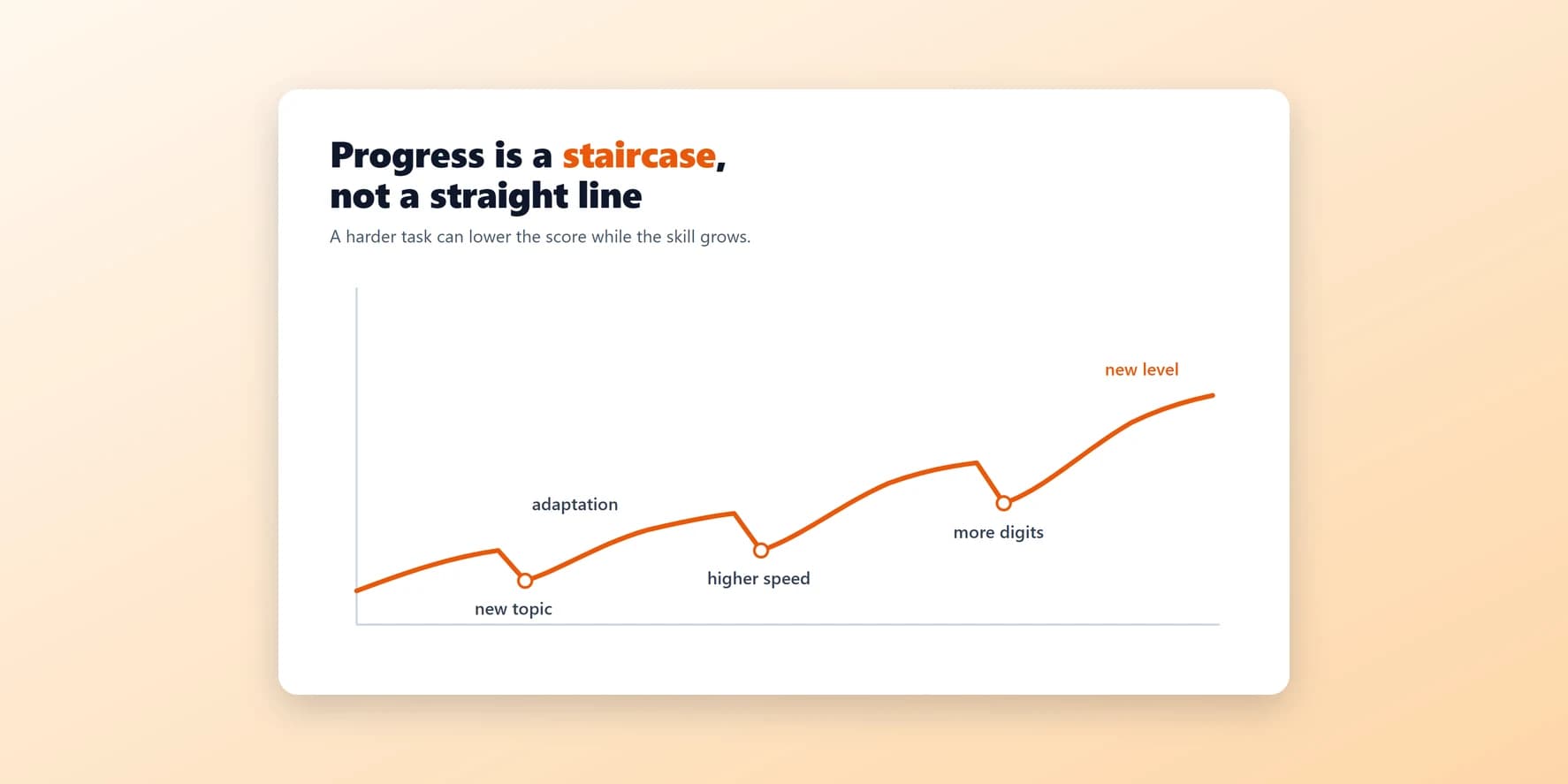
Parents often expect progress in mental arithmetic to look like this: faster; then faster again; more accurate; then more difficult. In other words, they expect the line to keep moving upward.
Real learning rarely works that way.
A child may calculate a familiar topic confidently. Then the teacher introduces something new. Suddenly:
- speed drops;
- more mistakes appear;
- the child starts hesitating;
- sometimes even older skills temporarily become less stable.
Parents naturally ask:
“What happened? They were doing better last week.”
But very often, this is not regression. It is a normal part of learning. The child has stopped working only with an already familiar skill and is now trying to integrate something new into the system.
A temporary drop in speed or accuracy does not always mean a child is getting worse at mental arithmetic. Performance often falls when a new topic, higher speed, longer chain, larger digit length or mental calculation is introduced. The important question is not only whether the score changed, but whether the task became more difficult.
New material almost always increases the difficulty
Imagine a child who has become confident with Simple operations. They no longer need much conscious thought. They recognise the situation and act. Accuracy is high. Speed is good.
Then Small Friends are introduced. Now the task changes. The child needs to:
- recognise the situation;
- understand that a simple movement is not enough;
- remember the new Friend rule;
- select the correct combination;
- perform the movement correctly.
Of course this initially takes more time.
The child did not become weaker — the task became harder
This is one of the most important principles when evaluating progress.
Suppose a child calculated an old topic at one second per operation. Now they are learning a new topic at two seconds. It would be wrong to conclude:
“The child has become twice as slow.”
These are different tasks. It is like saying that someone runs one kilometre quickly but completes five kilometres more slowly, so their physical condition must have become worse. The workload changed.
Mental arithmetic works in the same way.
The child did not necessarily become weaker. The task may have become harder.
Speed should always be evaluated together with difficulty
A single number tells us very little. For example: 95% accuracy at one second. Is that good? Possibly. But first we need to know:
- one-digit or three-digit numbers?
- one topic or mixed topics?
- a short chain or a long chain?
- physical or mental calculation?
- visual or audio?
Only then does the result have meaningful context.
The same applies when a new topic is introduced
A child may have 95% accuracy on familiar topics and 75–80% on a newly introduced topic. At the beginning, that can be completely normal.
The teacher’s task is to gradually bring the new skill closer to the stability of the older ones. Then mix it with previous material. Then gradually increase speed again.
Progress therefore does not look like one straight line. It often looks more like a staircase.
Learning often follows the pattern: growth, disruption, adaptation, new growth
For example: the child learns a topic, becomes faster and reaches good accuracy. Then a new topic appears. Performance temporarily drops. The child adapts. Then reaches a higher level.
Later, another topic is introduced. Another temporary drop may appear. This is a normal learning cycle:
- Stability the current level is comfortable
- New difficulty a topic, speed or digit length is added
- Temporary drop speed or accuracy falls
- Adaptation the new skill becomes familiar
- New stability a higher level than before
- Next difficulty and the cycle repeats
Progress is often a series of adaptation cycles, not a straight line.
A short-term drop can sometimes be evidence of progress
This sounds paradoxical. Imagine: last week — 98%. Today — 90%. At first glance, today looks worse.
But perhaps last week’s 98% was achieved with one familiar topic, one-digit numbers and 2-second intervals. And today’s 90% was achieved with mixed topics, two-digit numbers and 1.5-second intervals.
Which result represents the stronger skill? Very possibly the second one. The percentage is lower. The task is significantly harder.
A lower score on a harder task can represent more progress than a perfect score on an easy one.
Parents can easily be misled by percentages
100% looks excellent. 80% looks worrying. But percentages without context tell us very little.
100% on a task that has become too easy may simply mean that the child is ready for greater difficulty. 85% on a new and much harder level may represent perfectly normal development.
A good teacher therefore does not evaluate only the score. They evaluate the trend and the conditions behind it — the same principle we describe in how to measure a child’s progress in mental arithmetic.
What changed since the previous result?
Before judging a decline, ask:
- Was a new topic introduced?
- Did the speed change?
- Did digit length increase?
- Did the chain become longer?
- Were mixed topics introduced?
- Did the child move from physical to mental calculation?
- Was audio practice added?
Only then can we understand what the result actually means.
Sometimes speed should deliberately be reduced
This is important. A strong teacher is not always trying to make the child calculate faster. Sometimes the correct methodological decision is the opposite.
For example, a child may perform familiar material at one second. A new topic begins. The teacher temporarily returns to 2 seconds, 2.5 seconds or even slower.
Why? Because the immediate goal is not to break a speed record. The goal is to build the new skill correctly.
Accuracy comes before speed
If the child is still thinking through a new rule, excessive speed can create the wrong learning environment. They may begin to:
- rush;
- guess;
- skip actions;
- make unnecessary mistakes;
- become nervous;
- or reinforce incorrect technique.
It is often better to reduce the speed temporarily. Give the child enough time to see, understand and perform the action correctly. Then gradually increase speed again — the way speed develops in mental arithmetic in the long run.
Slowing down is not going backwards
Children sometimes worry about this too. They may say:
“But I used to calculate faster.”
A useful response is:
“Yes. But the old task was easier. Now you are learning something more difficult. When the new skill becomes familiar, your speed will increase again.”
That changes the psychology completely. The child no longer feels that they have become worse. They understand that they have moved to the next level.
Almost every complex skill develops this way
A musician learns a simple piece and plays it quickly. Then they receive a harder one. At first, they play it slowly. That does not mean they became a worse musician.
A football player learns a new technical movement. First slowly. Then faster. A new driver initially needs conscious attention for almost every action. Later, many actions become automatic.
Mental arithmetic follows the same general principle.
This is especially visible when moving from physical to mental calculation
A child may already calculate very confidently on the physical abacus. They can see the beads, control the movements and maintain good accuracy.
Then mental calculation begins. Suddenly, speed decreases. That is completely understandable. Now the child must perform similar operations without a physical reference. They need to:
- create the image;
- maintain it;
- change it;
- avoid losing it between numbers.
The task has become much more demanding.
Mental calculation may temporarily lag behind physical calculation
That is normal. A child can already be learning a newer topic physically while practising an earlier, more stable topic mentally. For example:
- physical practice may already include +4 / −4;
- mental practice may still focus on +3 / −3.
This can be a perfectly reasonable progression. Physical and mental development do not need to move at exactly the same speed.
Sometimes parents ask: “Why are we going backwards?”
For example, the child can already complete difficult mental exercises. Then the teacher gives them a physical abacus again or lowers the speed. A parent may think:
“Why are we returning to something they already learned?”
There may be a very good reason. The teacher is diagnosing the skill. They need to understand: is the error in the rule? In the technique? In the mental image? In the speed? In the chain length?
Returning temporarily to a simpler condition can help identify the real cause.
This is diagnosis, not regression
Suppose a child starts making mistakes mentally. The teacher reduces the speed. The mistakes disappear. That suggests the topic itself may be understood, but the current speed is too high.
Now return to the physical abacus. If the same error still appears, the problem may instead be in technique or understanding of the rule.
Changing the conditions helps answer an important question:
Where exactly is the skill breaking down?
Sometimes even older topics become temporarily less stable
This can happen too. Why? Because the child is integrating new knowledge into an existing system.
Previously, they might have been choosing between ten familiar patterns. Now there are eleven. Then twelve. Then twenty. The decision system becomes more complex.
As a result, mixed practice may temporarily produce mistakes even on older material. With correct practice, this usually stabilises.
New knowledge is inherited by the whole system
A new topic does not live separately from everything learned before. Suppose the child already knows A + B + C. Now topic D is introduced. The system becomes:
A + B + C + D.
The child must now select correctly from a larger set of possible responses. Then topic E appears. The system grows again.
This is why temporary reductions in speed after introducing new material are completely logical.
One bad day tells us very little
A child may sleep badly, be tired after school, have a difficult day, be distracted or have just started a new topic. Performance may fall.
If everything returns to normal shortly afterwards, there may be no problem at all. What matters much more is one week, two weeks, one month.
Progress should be evaluated as a trend
For example:
- Week 1 — new topic, 76%.
- Week 2 — 84%.
- Week 3 — 91%.
- Week 4 — 94%, with a higher speed.
That is clear progress. Even if individual days looked like 88%; 79%; 93%; 85%.
Daily fluctuations are normal. The overall direction matters more.
When should a decline actually concern us?
Of course, not every deterioration should be explained away by saying:
“It is just a harder level.”
Sometimes there really is a problem. For example:
- accuracy continues falling for several weeks;
- the child begins making mistakes even on old simple material;
- technique deteriorates;
- incorrect movements become common;
- random answers increase sharply;
- the child no longer understands the topic;
- home practice has almost disappeared.
Those are signals worth investigating.
| Often normal | Investigate |
|---|---|
| New topic | Decline continues for weeks |
| Higher speed | Old easy topics also deteriorate |
| More digits | Technique becomes incorrect |
| Longer chain | Practice has stopped |
| Mixed practice | Random guessing increases |
| Physical → Mental | Child no longer understands the rule |
The important question is not “Did the result fall?”
The better question is:
“Why did it fall?”
If we increased speed, digit length, chain length, topic complexity or introduced mental calculation, a temporary decline may be completely understandable.
If nothing changed but results keep deteriorating, that is different.
There are several very different reasons for lower performance
Broadly, they can be separated into three categories.
1. Normal increase in difficulty. A new topic, greater speed, more digits, longer chains or transition to mental work.
2. A methodological problem. The rule was not understood, technique is incorrect, or an older topic was not sufficiently consolidated — often the source of the same mistakes repeating.
3. A consistency or child-state problem. Insufficient practice, fatigue, excessive workload or loss of motivation. Here it helps to look at how often the child actually practises during the week.
These situations should not be treated as if they were the same.
Sometimes too many parameters are increased at once
Imagine introducing a new topic, a faster speed, two-digit numbers and a longer chain at the same time. Then everyone is surprised:
“Why did accuracy collapse?”
A more controlled approach is usually better. Introduce the new topic. Stabilise it. Then adjust speed. Then perhaps increase digit length.
The exact order can vary depending on the methodology and child, but changing everything simultaneously makes the result much harder to interpret.
Changing one parameter at a time makes diagnosis easier
Suppose accuracy was 95%. We only increased the speed. It falls to 82%. The likely cause is fairly clear.
But if we simultaneously increase speed, add a new topic, increase digit length and increase chain length — and performance drops, we no longer know which change created the problem.
Controlled progression gives the teacher much better information. It also helps judge when a child is ready for the next topic.
Progress is not only about speed
A month may pass with almost no change in seconds per operation. But perhaps the child:
- used to calculate one-digit numbers and now handles two-digit numbers;
- used to manage chain 5 and now handles chain 10;
- used to work with one topic and now works in mixed mode;
- used to calculate physically and now works mentally.
That can represent enormous progress. It simply happened along another dimension.
Mental arithmetic has many dimensions of difficulty
Difficulty can increase through:
That means progress is multidimensional. It cannot be reduced to one number on a stopwatch.
A good teacher may deliberately hold speed steady
Because something else currently matters more: technique; accuracy; mental image; integration of a new topic. A new speed record can wait.
This is especially important when parents ask:
“Why is another child already calculating at 0.5 seconds?”
Because speed alone does not define level.
Two children at the same speed may be at completely different levels
Child A
0.8 seconds · one-digit numbers · chain 5 · one topic
Child B
0.8 seconds · three-digit numbers · chain 10 · mixed topics
The speed number is identical. The difficulty is not. That is why comparing children only by speed can be misleading.
Compare the child primarily with their own previous performance
What could the child do three months ago? What can they do now? Which topics have been added? How has accuracy changed? Has digit length increased? Can they hold a longer chain? Are they now working mentally?
These comparisons are far more informative.
Competitions provide a different kind of reference point
Occasionally, it can also be valuable for a child to see how they perform relative to other learners. Competitions can provide that external reference.
But everyday learning progress is still best assessed primarily against the child’s own previous level. Children develop at different rates.
How Amavit can show the real picture
If we look only at correct and incorrect, we have very little context. But if the result stays connected to the task — topic, speed, digit length, chain length, practice volume — and to accuracy over time, the picture becomes much clearer.
In Amavit, every homework stage keeps its conditions: game and topic, digits, chain length and speed range. The teacher sees each student’s progress through those stages, and the child’s progress screen shows accuracy over time — so a lower number can be read together with the task that produced it.
We can see that the child did not necessarily become weaker. The task may simply have become harder.
For example
One month ago
1 digit · 2 sec · chain 5 · one familiar topic
96%
Today
2 digits · 1.5 sec · chain 8 · mixed topics
89%
The percentage fell. The skill level increased.
If we look only at 96% → 89%, it appears worse. If we look at the complete task, the child has made a major step forward.
That is why progress analytics should preserve the context behind the result.
A result without context is only a number.
Parents need to see trends too
Otherwise every temporary decline creates unnecessary stress:
“What happened?”
“Why are there more mistakes?”
“Is the teacher doing something wrong?”
Sometimes there really is a problem. But sometimes the explanation is much simpler: the child is struggling because the program has just become more difficult.
This matters for the child’s motivation
Imagine that every time a new topic begins, adults say:
“You used to do better.”
The child receives a strange message. They are attempting something harder — and being told that they have become worse. A better response is:
“Yes, there are more mistakes right now because this topic is harder. Let’s see how much stronger it becomes over the next two weeks.”
That teaches the child something valuable about learning itself — and helps keep them motivated.
Children should not be expected to set a record at every stage
Learning is not an endless series of personal bests. There is a time to learn, make mistakes, slow down, consolidate and speed up. Then learn again.
That is a normal cycle.
A plateau can also be normal
Sometimes performance barely changes for several weeks. The child is not faster. But they are not getting worse either.
This may be a period of consolidation. The skill is becoming more stable. Sometimes another jump follows afterwards. Not every stage of development is immediately visible in one metric.
But plateaus should still be monitored
If for months there is no increase in difficulty, no improvement in accuracy, no stronger technique, no meaningful progress — and the child is becoming bored, the program may need to change.
A temporary plateau is normal. Permanent stagnation is not the goal.
The main conclusion
In mental arithmetic, a child does not need to calculate faster every single week. Real progress often looks different.
The child learns a level. Becomes faster. Receives a new topic. Slows down. Adapts. Speeds up again. Moves to larger numbers. Performance temporarily falls again. Then grows again.
So a realistic learning cycle often looks like:
stability → greater difficulty → temporary decline → adaptation → new level
That is often how a real skill develops. So when a child’s result drops, the first question should not be:
“Why are they getting worse?”
It should be:
“What has become harder in the task?”
Very often, that one question changes the entire interpretation of the result.
See not only whether the child improved — see what became harder.
Frequently asked questions
Is it normal for a child to become slower after learning a new mental arithmetic topic?
Yes. New material usually requires more conscious processing before it becomes familiar and automatic.
Why does accuracy sometimes decrease when a child is improving?
Because the task may have become harder through higher speed, longer chains, more digits, mixed topics or mental calculation.
Should the teacher reduce speed when introducing a new topic?
Often this can be useful. Correct technique and accuracy usually need to be established before speed is increased again.
How can parents tell whether a decline is normal?
Look at what changed in the task and whether the result begins to recover over the following practice period.
When should falling results be a concern?
A sustained decline across several weeks, worsening technique, mistakes on previously easy material or disappearing practice habits deserve closer attention.
Is 90% on a harder task better than 100% on an easier task?
It can be. Accuracy should always be interpreted together with speed, digit length, chain length, topic complexity and training format.
Should children be compared mainly by speed?
No. Speed is only one dimension of progress. Accuracy, complexity, digit length, chain length, technique and physical-versus-mental performance also matter.
Free for teachers