Why Different Abacus Schools Teach Friends in Different Orders — and Why That Can Be Fine
If you compare several abacus schools, sooner or later you may notice something surprising: they do not always teach the same topics in the same order.
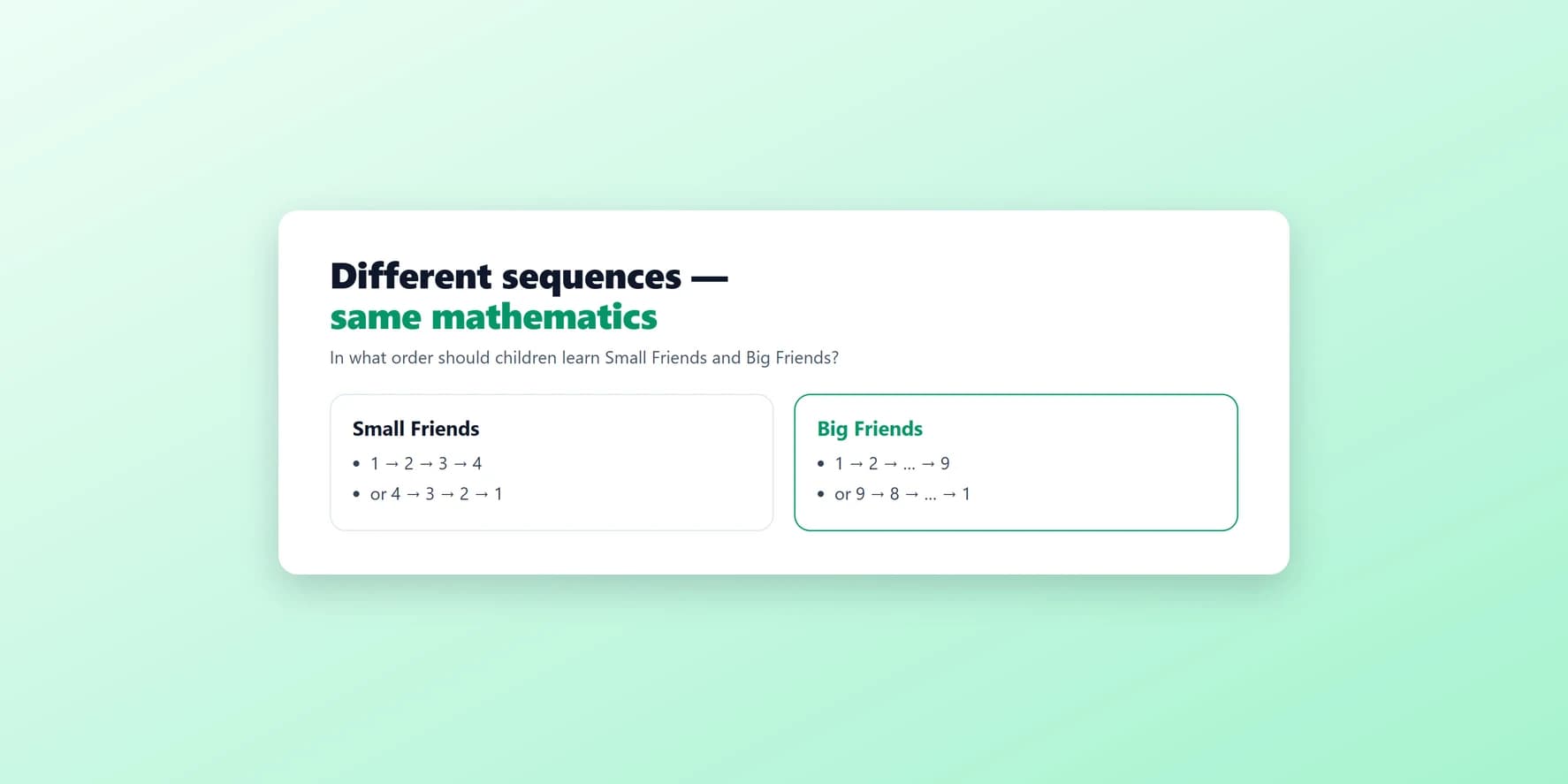
One school may introduce Small Friends as 1 → 2 → 3 → 4. Another may use 4 → 3 → 2 → 1. The same happens with Big Friends: one programme goes 1 → 9, another 9 → 1.
For parents, and sometimes for new teachers, this creates a simple question: which school is doing it correctly? The answer is not always as simple as choosing one sequence and rejecting the other. Different schools can use different learning orders and still teach the same mathematics correctly. What matters much more is whether the methodology is consistent, understandable and well structured.
Different abacus schools may teach Small Friends and Big Friends in different orders because teaching sequence is part of the methodology, not the mathematics itself. What matters most is consistency across lessons, workbooks, homework and practice — not forcing every school to use the same order.
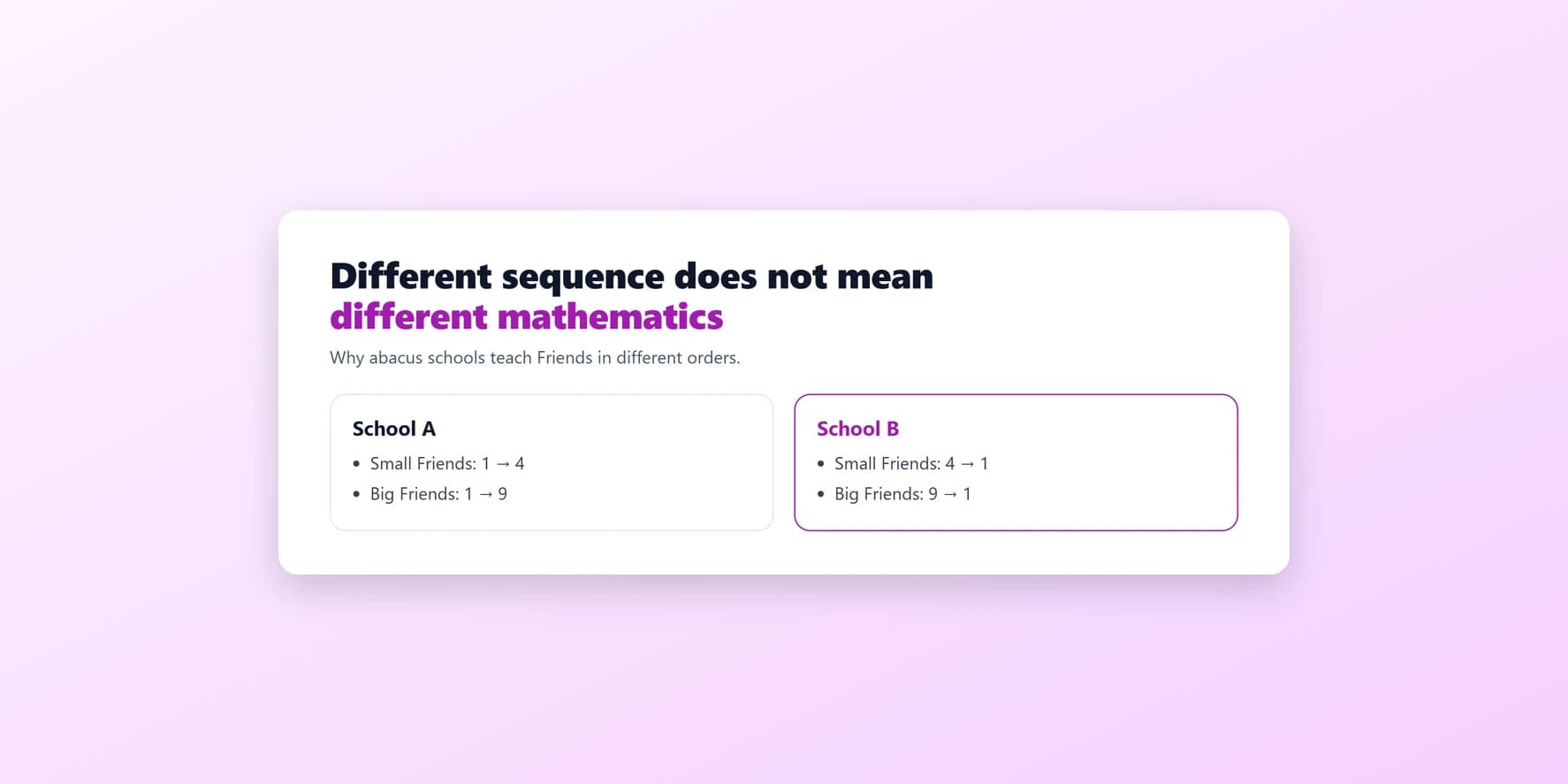
School A
- Small Friends: 1 → 4
- Big Friends: 1 → 9
School B
- Small Friends: 4 → 1
- Big Friends: 9 → 1
Different sequence. Same mathematical relationships.
If you are looking for the practical question — which order to use and how to pace it — see in what order children should learn Small Friends and Big Friends. This article is about something broader: why methodologies differ at all, and where that is normal.
Different sequence does not mean different mathematics
The first thing to separate is mathematics from teaching order.
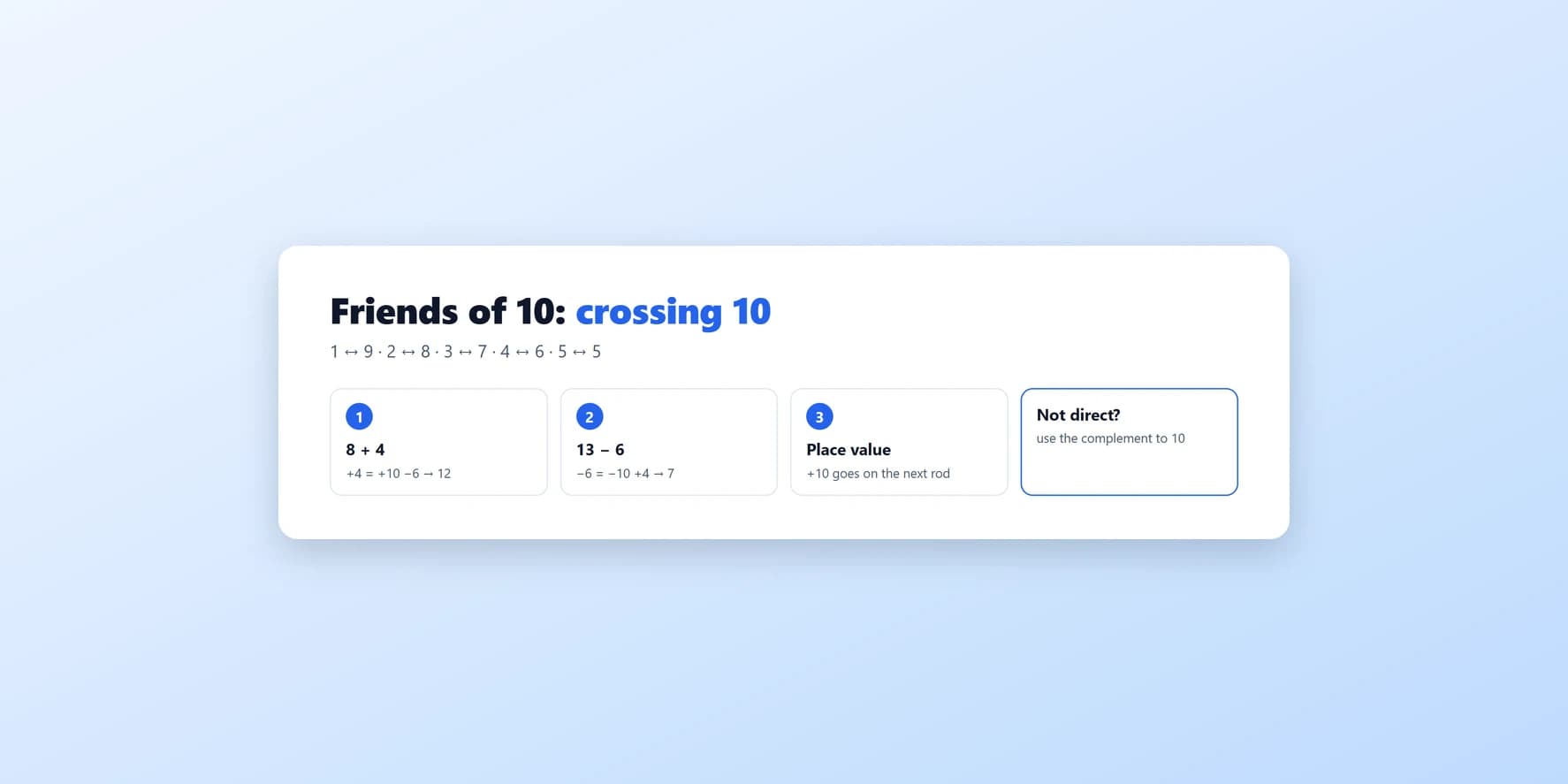
Friends of 5 remain the same number relationships regardless of the curriculum: 1 and 4 make 5; 2 and 3 make 5. Friends of 10 also remain the same: 1 and 9, 2 and 8, 3 and 7, 4 and 6, 5 and 5 make 10. (For how they work on the beads, see Small Friends and Big Friends.)
A school can change the sequence in which these relationships are introduced without changing the relationships themselves.
Different sequence does not mean different mathematics.
Why do schools use different learning orders?
There is rarely only one reason. A methodology usually develops as a complete system. The order of topics may depend on:
So when two schools use different orders, it does not necessarily mean one of them made a mistake. They may simply have built their programmes differently.
Some programmes prefer numerical progression
The most obvious sequence is 1 → 2 → 3 → 4 for Small Friends and 1 → 9 for Big Friends. It feels natural because the child moves through numbers in ascending order. It is easy for parents to understand, easy to write into a curriculum, and it creates a simple visual progression. That is one valid approach.
Other programmes start from the opposite direction
Another methodology may begin with 4 → 1, or 9 → 1 for Big Friends. Why? The teacher may consider some movements easier to demonstrate first. The workbook may already be structured that way. The school may connect one combination to the next through movement patterns. Or the curriculum may have been tested and refined around that order for years.
The direction is different. The mathematical relationships are not.
The curriculum is more than a list of topics
This is where people sometimes oversimplify methodology. A curriculum is not just “Lesson 1: +1, Lesson 2: +2, Lesson 3: +3.” A real programme also includes:
- how the rule is explained;
- which examples are used first;
- how much repetition is given;
- how subtraction is introduced;
- when mixed practice begins;
- when speed increases;
- when mental practice starts;
- how earlier topics return later.
Changing one topic in isolation may affect several other parts of the course.
Why a working sequence becomes part of a school's identity
An established academy may have used the same programme for years. Teachers were trained in that sequence. Workbooks were designed around it. Homework and internal assessments follow it. Hundreds or thousands of students may have completed the course successfully.
In that situation, changing the order is not simply “move Topic 4 before Topic 2.” It may mean changing an entire teaching system. That is why software should be very careful before forcing a school into a different sequence.
When different methodologies are perfectly fine
Different teaching orders are usually not a problem when each programme is internally consistent:
- Teacher explanation
- Workbook
- Homework
- Digital practice
- Review
- Mental practice
One learning logic across the whole programme.
The exact order may differ from another academy. But the child receives one coherent learning experience. That is what matters.
When different methodologies become a problem
The real problem is not usually that two schools disagree. The problem appears when one child is asked to follow several systems at once: the teacher teaches 4 → 1, the workbook uses 1 → 4, an app forces another order, and a parent adds random YouTube videos from yet another school.
Now the child has to constantly switch context. The mathematics may still be the same, but the learning experience becomes fragmented.
More information is not always better
Parents often want to help. If the child does not understand something immediately, they search for another explanation. That can be useful. But with abacus methodology, another explanation may use different terminology, a different topic order, a different movement explanation and different visual cues.
The parent may think: “I found a better explanation.” The child may experience: “Now I have two different systems.”
A better question for parents
Instead of asking “Which internet teacher is correct?”, I would first ask: “What methodology is my child's teacher using?” Then: “Does the additional explanation fit that methodology?”
If it does, it may help. If it introduces a completely different progression, it may create more confusion than clarity.
Different terminology can make similar methods look more different than they are
Another source of confusion is language. One school says Small Friends. Another says Friends of 5. Another says complements to 5. One teacher may use a child-friendly name for a movement; another may use a more formal mathematical term.
Before deciding that two schools teach differently, check whether they are actually describing the same relationship with different words. Very often, they are — the overview of Small Friends and Big Friends lists the common names.
What should be standard?
Even if schools use different sequences, some things should remain stable: the mathematical relationships themselves; correct use of place value; accurate movement; a logical progression from simpler to more difficult work; enough practice before increasing speed; and clear separation between a new topic and independent practice.
Different methodology does not mean anything goes.
| Can be flexible | Should stay correct |
|---|---|
| Topic sequence | Mathematical relationships |
| Practice volume | Place value |
| Terminology | Movement technique |
| Lesson rhythm | Logical progression |
| Error diagnosis |
Flexibility is not the same as lack of structure
A school can be flexible and still be highly structured. It may choose Small Friends 4 → 1 and Big Friends 9 → 1. That is a methodological choice. But if topics are introduced randomly depending on the day, that is not flexibility. That is inconsistency.
Good flexibility means the teacher can choose a coherent system. Not that there is no system.
Healthy flexibility
- Clear topic order
- Consistent terminology
- Matching workbook
- Matching homework
- Gradual progression
Methodological chaos
- Random topic jumps
- Mixed terminology
- Conflicting videos
- Software using another order
- No clear progression
Why consistency helps children
Children build patterns through repetition. When the same logic appears across the lesson, the workbook, homework and digital practice, the child does not need to constantly reinterpret the rule. That reduces unnecessary cognitive load. The child can focus on understanding, movement, accuracy and automaticity.
Sequence and pace should not be confused
Two students may follow exactly the same curriculum sequence but need different amounts of practice. Both are learning the same Friend: Student A understands it after a few repetitions, Student B needs much more time. The topic order stays the same; the pace differs.
A teacher does not need to create a completely different curriculum for every child. The methodology can remain shared, while practice is adjusted by number of repetitions, speed, chain length, digit length and how often weaker topics return. This gives the teacher consistency without forcing identical workloads — see also teaching a mixed-ability abacus group.
Why digital platforms often create conflict
Many educational tools are built around one fixed curriculum. That is understandable from a software-development perspective: it is easier to create Level 1, Level 2, Level 3, Level 4 and force every user through the same path.
But that becomes a problem when the platform enters an existing academy. The academy already has a methodology. Now the software has another one. The teacher is forced to choose.
The wrong question is: “Whose curriculum wins?”
The teacher should not have to abandon years of working methodology simply to use a digital practice tool. And the platform should not pretend that its own sequence is automatically superior.
A better model: the teacher chooses the methodology; technology supports the practice. This keeps the educational responsibility where it belongs.
Technology should support the methodology — not replace it.
How Amavit approaches this
Amavit does not impose a Friends sequence. When a teacher builds homework, each stage practises a topic the teacher selects — Small Friends for a specific number (1–4), Big Friends for a specific number — in the order the teacher adds them.
So an academy may use Small Friends 1 → 4 or 4 → 1, and Big Friends 1 → 9 or 9 → 1. The idea is simple: the teacher should not have to rebuild the curriculum around the platform — the same approach as using Amavit as a practice tool for your own curriculum.
Your methodology should remain yours
This matters particularly for experienced teachers and established schools. They may already have their own terminology, workbook, progression, teacher-training system and lesson plans. A digital tool should strengthen that system. Not quietly replace it.
What a platform should standardise — and what the teacher controls
| Technology can standardise | The teacher controls |
|---|---|
| Regular practice | When a topic is introduced |
| Assignment delivery | How it is explained |
| Answer checking | Movement technique |
| Practice volume | The curriculum sequence |
| Difficulty settings | When the child is ready to progress |
| Result tracking | How mistakes are diagnosed |
These are areas where software can provide a lot of value without dictating educational philosophy. The educational layer stays with the teacher.
Different schools can use the same platform differently
Two academies may both use Amavit. Academy A teaches Small Friends 1 → 4. Academy B teaches Small Friends 4 → 1. They can still use the same practice technology. The platform does not need to decide which academy is “right.” It needs to support each one consistently.
Why this matters internationally
Abacus education is taught in many countries. Schools have developed different curricula, terminology, teacher traditions, workbook systems and lesson structures. A platform designed for only one teaching culture can struggle when it expands internationally.
A teacher in India may not teach exactly like a teacher in another country — a different Friends order, a different lesson rhythm, different homework volume, different terminology. And that is not automatically a problem. The core mathematics can still be the same. This is why international educational software needs to distinguish between what is mathematically essential and what is methodological preference.
When should a school reconsider its sequence?
Different does not mean a methodology should never be questioned. A school should review its curriculum if there are clear signs that something is not working: many students repeatedly fail at the same transition; teachers constantly improvise around the programme; the workbook and lessons no longer match; students are overloaded; internal results show a systematic weakness.
But change should have a reason
I would not change a working curriculum simply because another school does something differently. A methodology should be changed because there is evidence of a problem, the academy has a clear improvement goal, the new structure has been thought through, teachers are retrained and materials are updated consistently.
Not because someone found a different order online.
How to compare two abacus methodologies properly
Do not compare only which Friend comes first. Look at the whole process:
- How is the rule explained?
- How is movement taught?
- How much practice follows?
- When are topics mixed?
- When does speed increase?
- How are errors corrected?
- When does mental practice begin?
- How does the teacher know the child is ready to move on?
Those questions tell you much more about methodology quality than topic order alone.
A good methodology should be explainable
A teacher should be able to answer: Why do we teach this topic now? What skill should the child already have? What comes next? How do we know the topic is stable?
If there is a logical answer, the curriculum is probably structured. If the answer is “because that is just how we always do it,” it may be worth looking more closely.
Parents do not need to become methodologists
Parents do not need to analyse every formula or curriculum decision. But they can ask useful questions: What topic is my child studying now? What should they practise at home? Should I correct technique myself? Are there videos or exercises that match your methodology?
These questions help parents support the course without accidentally creating a second one. For the very basics, how to use an abacus is a good neutral starting point.
Teachers also benefit from methodological clarity
A clear curriculum makes teaching easier. The teacher knows what to explain, what to assign, what to review, when to increase difficulty and when to return to an earlier topic. That reduces improvisation and creates a more consistent experience across groups.
Technology works best when roles are clear
The teacher handles
- Methodology
- Explanation
- Technique
- Diagnosis
The platform handles
- Structured practice
- Repetition
- Assignment delivery
- Tracking
- Difficulty settings
When those roles are clear, technology strengthens the teacher instead of competing with them.
The main idea
Different abacus schools can teach Friends in different orders. That alone does not make one methodology right and another wrong.
The important questions are: Is the methodology consistent? Does the child understand the rules? Is the movement correct? Does practice match the lesson? Does difficulty increase gradually? Are mistakes diagnosed properly? If the answer is yes, different learning sequences can work perfectly well.
The goal should not be to make every abacus teacher teach exactly the same way. The goal should be to give each teacher a clear, coherent methodology — and technology flexible enough to support it.
Your methodology. Your sequence. Amavit supports the practice. Running a school? See Amavit for academies.
Frequently asked questions
Why do abacus schools teach Friends in different orders?
Because teaching sequence is part of a methodology — shaped by workbooks, lesson structure, teacher training, movement progression and years of experience — not part of the mathematics itself.
Is there one correct abacus teaching method?
No single method is the only correct one. Different methods can work well if they keep the mathematics, place value and movement technique correct and follow a clear, consistent progression.
Can two different Friends sequences both be correct?
Yes. Small Friends 1 → 4 and 4 → 1, or Big Friends 1 → 9 and 9 → 1, introduce exactly the same number relationships in a different order.
Why is consistency important in abacus learning?
When the lesson, workbook, homework and digital practice follow the same logic, the child does not have to reinterpret the rule each time and can focus on understanding, movement, accuracy and automaticity.
Can different terminology confuse children?
It can. Small Friends, Friends of 5 and complements to 5 describe the same relationship, but switching between names and explanations can make one topic feel like several.
Should parents use videos from other abacus schools?
Only if they fit the methodology the child's teacher uses. A video with a different order or terminology can create a second, conflicting system. Ask the teacher what matches the course.
Should software control the curriculum?
No. The teacher should choose the methodology and sequence; software should support practice, assignments, checking and tracking within it.
When should an academy change its methodology?
When there is evidence of a problem — such as repeated failure at the same transition or a mismatch between lessons and workbooks — and the change is thought through, teachers are retrained and materials are updated consistently.
Your methodology. Your sequence. Amavit supports the practice.
Keep your curriculum, terminology and topic order. Use Amavit for structured practice, assignments and progress tracking around it.
Explore Amavit for TeachersFree for teachers