Big Friends on the Abacus: How Friends of 10 Work and Why Children Often Struggle
Once a child is comfortable with basic operations and Small Friends, the next major step is crossing 10. This is where Big Friends, also called Friends of 10, begin.
At this stage, the child is no longer working only within a single rod. They need to understand place value, move between ones and tens, and see numbers through their complements to 10.
For many children, this feels noticeably harder than Small Friends. Not because the formulas themselves are dramatically more difficult. But because several things need to be controlled at the same time.
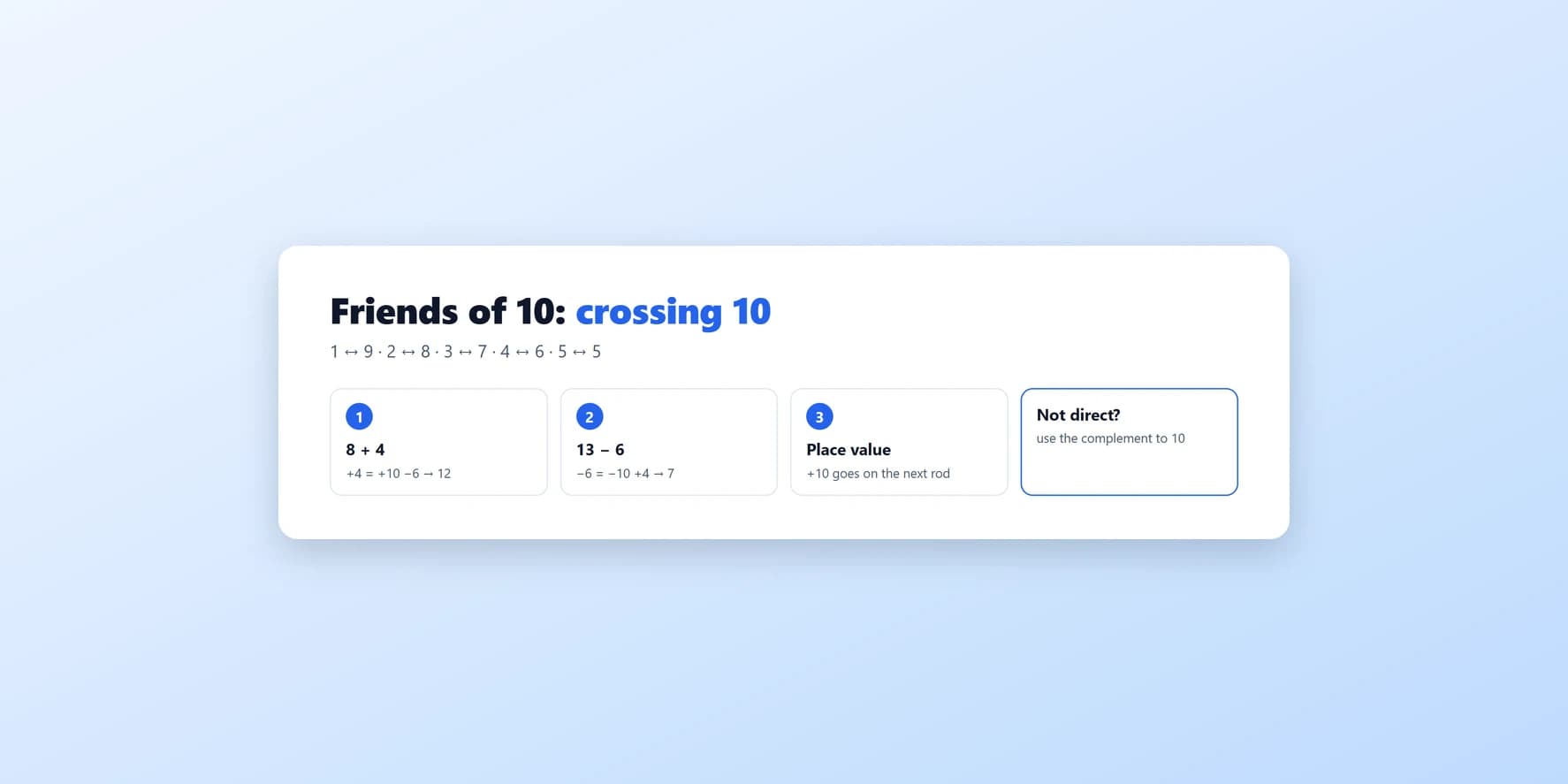
Big Friends, or Friends of 10, are number pairs that make 10: 1 and 9, 2 and 8, 3 and 7, 4 and 6, and 5 and 5. They are used when an abacus operation cannot be completed directly within the current place value and the child needs to cross 10.
What are Big Friends?
Big Friends are pairs of numbers that make 10. The basic pairs are:
They are also commonly called Friends of 10 or complements to 10. Different schools may use different terms, but the number relationships are the same.
Addition
8 + 4 → +4 = +10 −6 → 12
Subtraction
13 − 6 → −6 = −10 +4 → 7
Big Friends are used when the operation crosses 10.
This is a detailed guide to Friends of 10 and place value. For an overview of both Friends systems, see Small Friends and Big Friends in mental arithmetic; for the abacus basics, see what an abacus is and how it works.
Why 10 becomes the new reference point
Ten matters because it represents a move into the next place value. Before this stage, the child mostly works within one rod. But once an operation crosses the limit of the current place value, the neighbouring rod becomes involved. That is why 10 becomes the new reference point.
A simple addition example
Take 8 + 4. The units rod already shows 8. Adding 4 directly is not possible. So 4 can be represented as 10 − 6. The operation becomes +4 = +10 −6. The child adds one ten and removes 6 from the units. The result is 12.
- Units rod shows 8
- Add 1 ten on the next rod
- Remove 6 from the units
- Result: 12
Crossing 10 on the abacus: units rod → add / remove 10 → adjust units → final result.
What the child should understand
The goal is not simply to memorise +4 = +10 −6. The child should understand: I cannot add 4 directly. So I add 10. But 10 is six more than I need. So I remove 6.
As with Small Friends, the formula is useful because it explains the relationship.
Big Friends in addition
The main addition relationships are:
| Add | Movement | Add | Movement |
|---|---|---|---|
| +1 | +10 −9 | +6 | +10 −4 |
| +2 | +10 −8 | +7 | +10 −3 |
| +3 | +10 −7 | +8 | +10 −2 |
| +4 | +10 −6 | +9 | +10 −1 |
| +5 | +10 −5 |
But these rules should only be used when direct movement is not possible. For addition on the abacus more broadly, see how to add on an abacus.
Do I need a Big Friend?
The question is the same as with Small Friends, but now it is about place value: can the operation be completed directly in the current place value?
YES
Use direct movement.
NO
Use the complement to 10.
Big Friends in subtraction
The logic works in reverse for subtraction. Take 13 − 6. There are only 3 units. Six cannot be removed directly. So 6 can be represented as 10 − 4. That means −6 = −10 +4. The child removes one ten and adds 4 back in the units. The result is 7. See also how to subtract on an abacus.
Why subtraction across 10 often creates more errors
Because the child has to manage several things at once: remove a ten; adjust the units; keep track of the current value; avoid confusing the signs; choose the correct Friend. This is no longer a single movement within one rod. It is a coordinated operation across place values.
Big Friends are really about place value
This is one of the most important things to understand. Big Friends = complements to 10 + place value. They are not only about memorising complements to 10. They are also about ones, tens and moving between them correctly.
That is why I would not introduce Big Friends too early if the child is still unsure about place value. If ones and tens are already confusing, Friends of 10 will add too much extra load.
Make sure the foundation is ready
Before moving into Big Friends, the child should already be reasonably confident with:
If these skills are still unstable, the next stage will be much harder. The basics are covered in how to use an abacus step by step, and how to know when a child is ready for the next topic helps judge the moment.
Do not teach all nine Friends at once
This is one of the most common mistakes. A child is shown a complete table from 1 to 9 and told to learn it. The table may be memorised. But that does not mean the child knows when or how to apply each relationship.
A better approach is usually: one topic; a small set of examples; correct movement; stable accuracy; then the next topic.
In what order should Big Friends be taught?
There is no single mandatory sequence. One methodology may use 1 → 2 → 3 → … → 9. Another may use 9 → 8 → 7 → … → 1. Some schools may use a different internal order. That can be completely valid.
Why different schools use different sequences
Every academy or teacher may have their own logic: starting with combinations that are easiest to explain; starting with the rules used most often; following the order of a workbook; following a sequence that has been used successfully for years. There is no problem with that as long as the methodology is internally consistent.
What matters most is consistency
If a teacher works from 9 down to 1, but the child then watches a random lesson using a completely different order and terminology, confusion can appear. The mathematics has not changed. But the teaching structure has. That is why children usually benefit from working inside one consistent system.
Why software should support different methodologies
If an academy has used the same Big Friends sequence for years, a digital trainer should not force the entire programme to change. That is poor integration. Technology should fit into the curriculum. The curriculum should not have to fit the software.
How Amavit supports Big Friends
In Amavit, each Big Friend is a separate topic the teacher chooses, so practice follows the order that already matches the teacher's methodology — 1 → 9 or 9 → 1. This is especially useful for academies with their own established curriculum.
How do you know a Big Friend is really learned?
I would look for several signs. The child understands when the rule is needed; does not use it when direct movement is possible; moves correctly between place values; does not lose the current value; does not confuse the internal operation; can complete several examples in a row; keeps accuracy when the pace increases slightly.
A common problem: the formula is known, but the place value is lost
For example, the child may correctly remember +4 = +10 −6. But during the movement, they forget that +10 belongs on the neighbouring rod. The rule is known. The answer is still wrong. This is not a memory problem. It is a place-value and movement problem.
Another common problem: confusing the signs
This happens especially in subtraction. For example, −6 = −10 +4. The child sees “minus six” and instinctively tries to remove everything. But part of the rule includes +4. This is exactly why the relationship needs to be understood instead of recited mechanically.
Formula known — answer still wrong? Possible causes: wrong place value; sign confusion; movement error; speed too high; lost intermediate value.
Repetition without diagnosis can make things worse
If the child repeats the same incorrect movement again and again, a large number of examples can simply reinforce the mistake. Before adding more practice, first identify what exactly is going wrong. A structured approach is described in how to find the exact cause of repeated abacus subtraction errors.
Reduce the difficulty and find the breaking point
If the child struggles in a long chain, temporarily remove speed, chain length and other topics. Leave one example — for example, 8 + 4.
If the child still makes the mistake, the problem is probably in the Big Friend itself. If the single example is correct but the chain causes errors, then the problem may be attention, working memory, or holding the intermediate value.
Change one parameter at a time
A useful progression is:
- Single example
- Short chain
- Longer chain
- Slightly higher speed
- More digits
Then watch where accuracy starts to fall. That gives much more useful information than simply saying “do more practice.”
Start with focused practice
When a new Big Friend is first introduced, it can be useful to practise one topic repeatedly — for example, only +4 across 10. This helps stabilise the movement. But the child should not stay in that mode forever.
Then move to mixed practice
Once several Friends are familiar, they should be mixed. For example: +4, −7, +2, −6, +8. Now the child has to recognise which Friend is needed each time. They are no longer simply copying the same movement.
Why mixed practice matters
If a child receives 20 examples of +4 in a row, the choice becomes easy. They already know what movement is coming. But real calculation does not work that way. The next operation may require a completely different Friend. Mixed practice develops recognition and selection — see mixed practice in mental arithmetic.
How to increase speed
Only after the rule is understood, the movement is stable, place value is not being lost and accuracy is high. Then the pace can increase gradually. If errors suddenly rise after speeding up, the child is not ready yet.
How Big Friends move into mental calculation
At first, the child physically adds a ten and removes part of the units, or performs the reverse movement. Later, the same action is visualised mentally. This is why good physical technique matters. Mental calculation is being built on that internal image — see physical vs mental abacus.
Do not remove the physical abacus too early
Even when a child already calculates mentally, the physical abacus remains a useful diagnostic tool. If a repeated error appears, the same operation can be brought back to the real abacus. Very often, the exact problem becomes visible immediately.
Where workbooks are useful
A workbook works well for slower practice, reviewing a new topic, homework and physical abacus work. It is particularly useful when the child needs to repeat one new relationship calmly.
Where digital practice is stronger
A digital trainer becomes more useful when volume is needed. It can generate new examples, focus on one specific Friend, change speed, change chain length and change digit length. Once the technique is already understood, this can save teachers a great deal of manual preparation.
How Amavit supports Big Friends practice
Teachers can choose the required Big Friend, assign it as homework, keep their own learning sequence, set the speed, the chain length and the number of digits, and give different students different difficulty. The platform does not replace the methodology. It helps scale the practice around it.
Stronger and weaker students should not always get the same work
One child may already be comfortable with +8 and +9. Another may still struggle with +4 and +6. Giving both exactly the same practice is not always useful. The stronger child may become bored. The other may become overwhelmed. It makes more sense to spend more practice time on the Friends that are currently weaker — see how to teach a mixed-ability abacus group.
Strong topics should still return occasionally
A Friend that has been learned well does not need to disappear completely. It can appear less often. But periodic review helps maintain the skill. A weaker topic can appear more frequently. A stronger one can return occasionally.
When can Big Friends be considered stable?
Not after one correct answer. A more useful standard is when the child recognises the situation quickly, chooses the correct relationship, keeps the correct place value, does not confuse the movement, handles short chains, maintains accuracy with a small increase in speed and begins using the rule in mental practice.
What I would avoid
I would not:
- teach all nine Friends at once;
- ask the child to memorise only the table without understanding the movement;
- increase speed before the technique is stable;
- mix several methodologies unnecessarily;
- remove the physical abacus too early;
- give hundreds of examples with an incorrect movement;
- judge progress only by speed.
Big Friends are an important methodological transition
Before this stage, much of the child's work happens inside the current rod. Now the child begins to see numbers through place value. For example, 4 is not only 4. In the right situation, it can also be understood as 10 − 6. That flexibility is what makes crossing 10 possible.
The main idea
Big Friends are not simply nine formulas. They are the next level of understanding abacus calculation. The child learns to see numbers through 10, move correctly between place values, choose the right relationship, hold the current value and turn a conscious rule into an automatic movement.
That is why this stage should not be rushed. First: understand the transition across 10; learn the movement correctly; stabilise one Friend; mix several Friends; increase speed gradually; then move more of the skill into mental calculation.
And the learning sequence may differ from one methodology to another. The goal is not to make every teacher work in exactly the same order. The goal is to keep the methodology consistent and let technology support it.
Frequently asked questions
What are Big Friends on the abacus?
Big Friends are number pairs that make 10. They are used when an abacus operation cannot be completed directly within the current place value and the child needs to cross 10, using the neighbouring tens rod.
Why are Big Friends called Friends of 10?
Because each pair adds up to 10, and 10 — one bead on the next rod — becomes the reference point. They are also called complements to 10. Different schools use different names for the same relationships.
What are the Big Friend pairs?
1 and 9, 2 and 8, 3 and 7, 4 and 6, and 5 and 5.
When should a child use a Big Friend?
Only when the operation cannot be completed directly in the current place value. If the number can be added or removed on the units rod directly (or with a Small Friend), the Big Friend is not needed.
How are Friends of 10 used in addition?
The child adds one ten on the neighbouring rod and removes the complement from the units: +1 = +10 −9, +2 = +10 −8 … +9 = +10 −1. For example, 8 + 4 becomes +10 −6, and the result is 12.
How are Friends of 10 used in subtraction?
The child removes one ten and adds the complement back on the units rod: −6 = −10 +4, −7 = −10 +3 and so on. For example, 13 − 6 becomes −10 +4, and the result is 7.
Why are Big Friends harder than Small Friends?
The formulas are not dramatically harder, but the child has to control several things at once: two rods instead of one, place value, the direction of each movement, the signs inside the rule and the current intermediate value.
In what order should Big Friends be taught?
There is no single mandatory sequence. Some methodologies go 1 → 9, others 9 → 1, and some use their own internal order. What matters is that the sequence is consistent and each Friend is stable before the next is added.
When should Big Friends move into mental practice?
After the rule is understood, the physical movement is stable, place value is not being lost and accuracy is high. The physical abacus remains useful afterwards as a diagnostic tool when repeated mistakes appear.
Keep your Big Friends sequence
Teach 1 → 9 or 9 → 1. Amavit supports the sequence that matches your methodology.
Explore Amavit for TeachersFree for teachers