In What Order Should Children Learn Small Friends and Big Friends on the Abacus?
When a child reaches Small Friends and Big Friends, parents — and sometimes newer teachers — often ask the same question: what is the correct order for learning them?
Should Small Friends go 1 → 2 → 3 → 4? Or the other way around, 4 → 3 → 2 → 1? And what about Big Friends — from 1 to 9, or from 9 down to 1?
At first, it may seem that there must be one correct sequence. In practice, different schools use different orders. And that does not automatically mean one of them is teaching incorrectly.
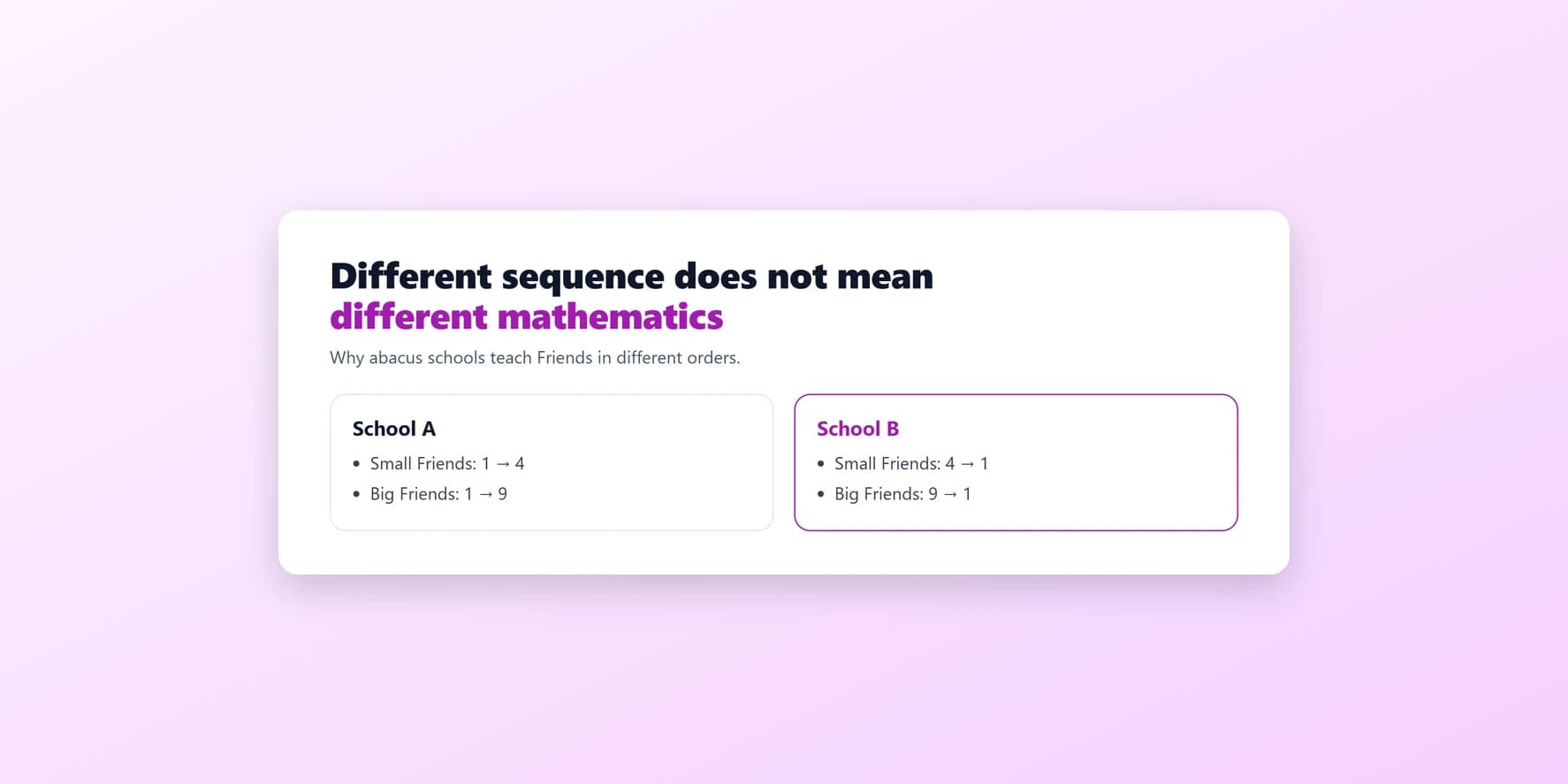
There is no single mandatory order for teaching Small Friends and Big Friends on the abacus. Some programmes teach Small Friends from 1 to 4, while others use 4 to 1. Big Friends may be taught from 1 to 9 or from 9 to 1. The most important factor is a consistent methodology across lessons, workbooks and practice.
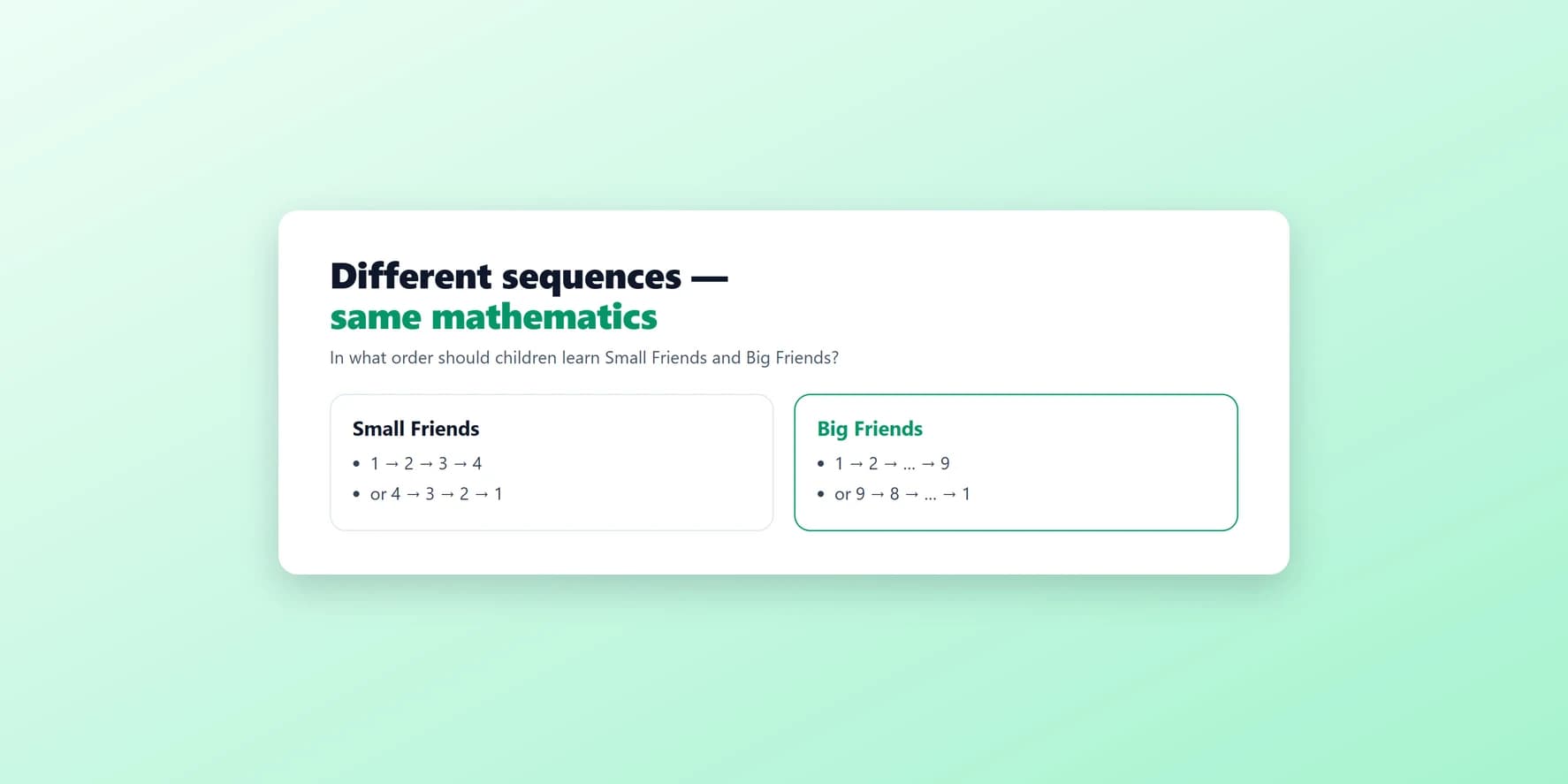
Small Friends
1 → 2 → 3 → 4
or
4 → 3 → 2 → 1
Big Friends
1 → 2 → … → 9
or
9 → 8 → … → 1
Different sequence. Same number relationships.
First, understand one important point
Small Friends and Big Friends are not simply lists of formulas. They are part of a teaching methodology. The order in which they are introduced often depends on how a particular school structures:
That means the sequence should not be judged in isolation from the rest of the curriculum.
A quick reminder: what the Friends are
Small Friends are complements to 5 — the pairs 1 and 4, 2 and 3. They are used when an operation cannot be completed directly with the available lower beads and the upper bead worth 5 needs to become part of the movement: +4 = +5 −1, or −3 = −5 +2.
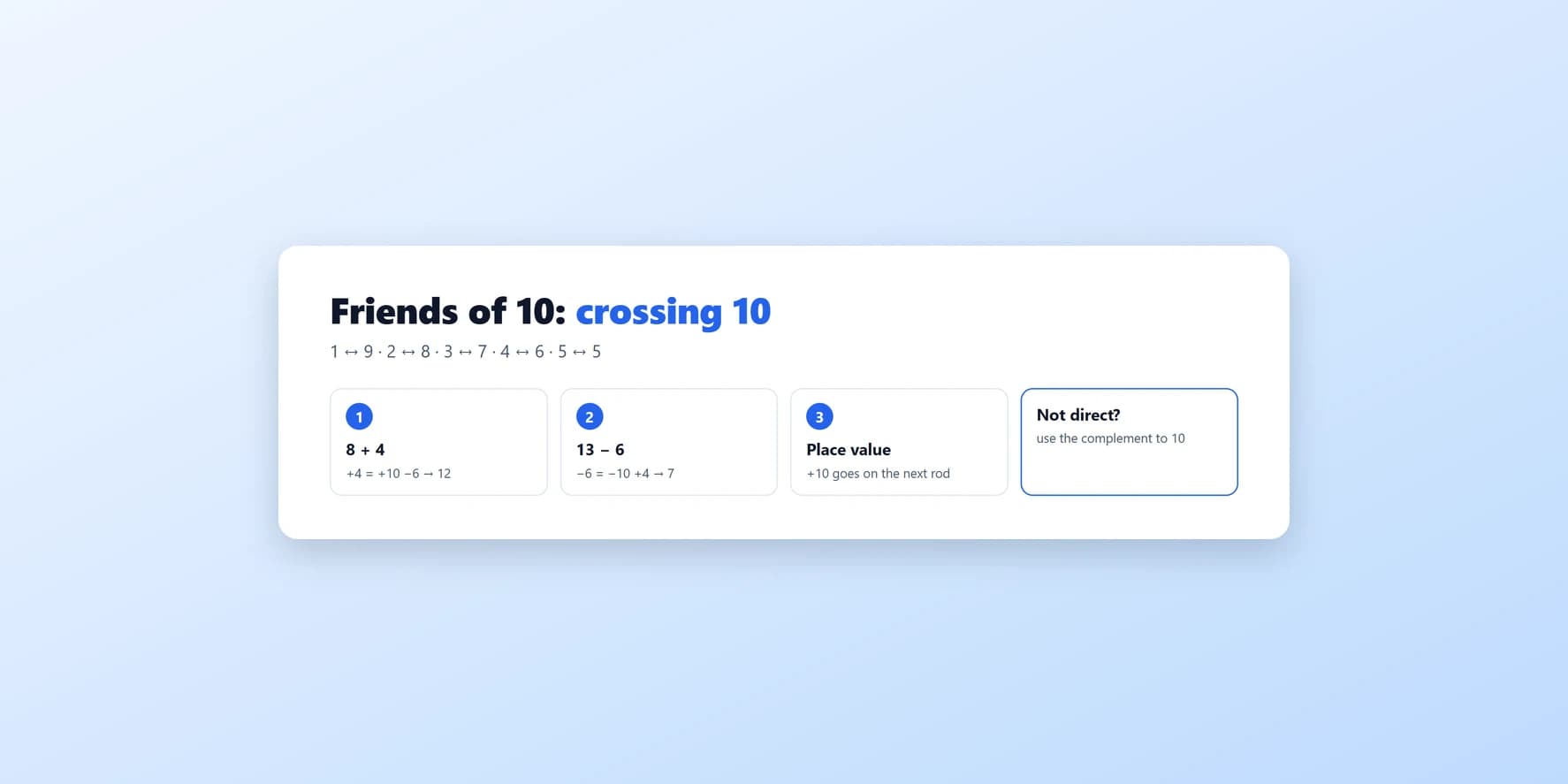
Big Friends are complements to 10 — 1 and 9, 2 and 8, 3 and 7, 4 and 6, 5 and 5. They are used when an operation crosses the current place value: +4 = +10 −6, or −6 = −10 +4.
This article is not about how each Friend works — for the mechanics, see Small Friends on the abacus, Big Friends on the abacus and the overview what Small Friends and Big Friends are. Here the question is how to structure the learning sequence.
A common learning sequence
One common approach is to move from the smaller number upward: Small Friends 1 → 2 → 3 → 4, Big Friends 1 → 2 → 3 → … → 9.
This sequence feels intuitive because the child moves progressively through the number line. But it is not the only valid option.
The reverse sequence is also used
Some schools teach in the opposite direction: Small Friends 4 → 3 → 2 → 1, Big Friends 9 → 8 → 7 → … → 1.
That approach can also have a clear methodological logic. It may be connected to a particular movement pattern, a workbook structure, the order of exercises, or the way the school builds later topics.
Does this mean one sequence is better?
I would be very careful about making that claim. I do not think it is useful to label one order as universally “correct” and another as “wrong” if both are part of a consistent methodology and children are learning successfully.
In practice, several things matter more than the exact direction:
- quality of explanation;
- correct movement;
- enough repetition;
- gradual increase in difficulty;
- avoiding chaotic switching between topics.
Why the sequence matters at all
Because children get used to a particular learning logic. Imagine a programme that teaches 4 → 3 → 2 → 1. The teacher explains topics in that order. The workbook reinforces them in that order. Homework follows the same order. The next topic builds on the previous one.
That creates one coherent system.
Where problems begin
Problems appear when different parts of the learning process follow different sequences. For example:
- the teacher teaches Small Friends from 4 to 1;
- the workbook moves from 1 to 4;
- the digital trainer only allows 1 → 2 → 3 → 4;
- the parent adds random videos that use yet another structure.
Now the child is receiving several different learning systems at the same time. That can create unnecessary confusion.
What creates confusion
- Teacher: 4 → 1
- Workbook: 1 → 4
- Digital practice: 1 → 4
- Random videos: mixed order
↓ Too many learning systems at once
What works
- Teacher
- Workbook
- Homework
- Digital practice
↓ One consistent curriculum
Consistency matters more than universality
I would rather have a child work inside one clear system than constantly search for the “one universally correct sequence.” If the school uses 1 → 4, the surrounding practice should support that structure. If the school uses 4 → 1, the practice should support that instead. The same applies to Big Friends.
Different abacus methodologies can teach the same rules in different sequences.
Why different schools developed different sequences
The reasons can be quite practical. Some programmes were built around their own workbooks. Some teachers began with combinations they considered easier to demonstrate. Some connected the order to finger movement. Others structured the course around the types of examples they wanted children to reach first.
Over time, these sequences became part of the school's methodology — we look at this more broadly in why different abacus schools teach Friends in different orders.
This is not unusual in education
There are often several ways to teach the same concept. Two strong teachers may explain the same topic differently. If both understand the methodology, teach the movement correctly, work consistently and achieve stable learning outcomes, there is no need to force them into identical programmes.
Flexibility does not mean randomness
This distinction matters. A child should not learn +4 today, randomly jump to +1 tomorrow, then return to +3 simply because there is no plan.
The teacher still needs a clear progression. That progression may differ from another academy, but it should remain structured within the programme itself.
What matters more than the order of Small Friends?
I would put several things above the sequence itself:
- The child understands when a Friend is actually needed.
- The movement is correct.
- The child can perform the rule without unnecessary extra movements.
- The skill becomes stable.
Only after that should speed become a priority. A child can follow the “correct” order perfectly and still build weak technique — the finger technique checklist helps catch that early.
What matters more than the order of Big Friends?
With Big Friends, place value becomes especially important. The child needs to understand where the ones are, where the tens are and what happens when crossing 10. If that foundation is weak, even a perfectly organised 1-to-9 sequence will not prevent mistakes.
Should Small Friends be fully learned before Big Friends?
In many structured programmes, Small Friends come before Big Friends. That progression makes sense: the child first learns to work around 5, then 10 becomes the next reference point.
But individual curricula may organise review and overlap slightly differently. The key is not to overload the child with too many new relationships at once.
When should topics be mixed?
Not immediately. First, the child should recognise an individual Friend confidently. Then several Friends. After that, mixed practice can be introduced — for example +4, −2, +3, −1. Later, Small Friends and Big Friends can appear in the same practice set, but only after the individual topics are reasonably stable.
Why mixed practice should not come too early
Because it changes the task. If the child receives ten examples using the same Friend, they are mostly practising one movement. When Friends are mixed, the child has to recognise the situation, choose the rule and perform the movement. That is a higher level of difficulty — see why mixed practice matters.
A good learning progression might look like this
- Explain one new Friend
- A few simple examples
- Focused practice on that one topic
- Short chains
- Mixed practice once the movement is stable
- A small increase in speed
- More mental practice
Do not change several things at once
Suppose a child has just started a new topic. I would not immediately increase speed, make the chain longer, add more digits and mix in three additional Friends. If performance drops, it becomes difficult to understand why.
Changing one variable at a time makes the learning process much easier to diagnose — and makes it clearer when a child is ready for the next topic.
Learning order and learning speed are different things
Even if the curriculum says 1 → 2 → 3 → 4, that does not mean every child should move through those topics at the same pace. One child may learn 1 and 2 quickly. Another may need more repetition on 1.
The sequence can be shared. The pace does not have to be.
Curriculum sequence
Shared by the whole group
Practice volume
Individual:
- Student A → more practice on +3
- Student B → more practice on +4
Same curriculum does not mean identical practice.
This matters especially in groups
A single group may include a stronger student, an average student and a child who needs more repetition. The teacher can keep one common methodology while giving different students different amounts of practice — the same principle as in teaching a mixed-ability abacus group.
This is where a digital platform becomes useful.
Why a rigid digital programme can create problems
Imagine an academy teaches Small Friends 4 → 3 → 2 → 1, but the software only allows 1 → 2 → 3 → 4. Now the child hears one sequence during the lesson and receives another at home.
That is not support. It creates unnecessary friction.
The platform should support the curriculum
This is why I do not think a digital platform should try to become the “main methodologist” for every school. Different teachers may have different working approaches. Technology should help them assign practice, track completion, adjust difficulty and review results. It should not force every teacher to use exactly the same curriculum.
How this works in Amavit
In Amavit, there is no fixed path through the Friends. When a teacher builds homework, each stage is a topic the teacher picks: Small Friends for a specific number (1, 2, 3 or 4) and Big Friends for a specific number, in whatever order the stages are added.
So Small Friends can be practised 1 → 2 → 3 → 4 or 4 → 3 → 2 → 1, and Big Friends 1 → 2 → … → 9 or 9 → 8 → … → 1. This allows an academy to keep the structure of its existing course — as described in using Amavit as a practice tool alongside your own curriculum.
Why this matters for established academies
A school that has been operating for several years usually already has lesson plans, workbooks, teacher training, homework systems and an established order of topics. Forcing that academy to rebuild its entire programme around one app is rarely a good idea.
It is usually much better for the technology to fit into the existing learning process.
What should parents do?
If a child is already studying with a teacher, I would not recommend changing the Friends sequence independently at home — even if a video online says: “No, this is the only correct order.”
First, understand the teacher's methodology. Do not create a second parallel curriculum for the child without a clear reason. How parents can help with mental arithmetic covers what support at home should look like.
What if online lessons explain it differently?
Do not panic. First ask: is the mathematics actually different — or only the sequence and terminology? Very often, the mathematics is the same. Only the teaching structure differs.
If there is still uncertainty, a much better question for the teacher is:
“What order do you use for Friends, and how does it fit into your programme?”
That is more useful than mixing two different systems.
When does it make sense to change the sequence?
I would change it only for a clear methodological reason. For example: the teacher sees a recurring problem; the academy redesigns its curriculum; a new version of the programme is being introduced; or the school has tested another approach and has a reason to adopt it.
Not simply because a random video used a different order.
How do you know the chosen sequence is working?
The child:
- understands new rules;
- does not constantly confuse Friends;
- moves the beads correctly;
- gradually increases speed;
- handles mixed practice;
- begins transferring the skill into mental calculation.
If these things are happening, the sequence is doing its job.
Should every child in one academy follow exactly the same path?
Usually the topic sequence is shared if the academy uses one curriculum. The practice volume does not have to be. One child may need more repetition of +3. Another may need more work with +4.
In other words: the sequence can stay the same while the practice becomes individual.
This is where individual practice helps
Individual practice does not need to mean that software takes control of the curriculum. It can work inside the teacher's chosen methodology. The teacher decides which topic is currently being taught. The practice around it can then be adjusted:
- a student who struggles with one Friend can get personal homework with extra stages on that topic;
- a topic that is already stable can get fewer repetitions;
- with auto difficulty on, the game itself makes speed and chain length harder after a run of correct answers and easier after a mistake.
That is a much more practical model.
What I would avoid
I would not:
- declare one sequence universally correct;
- change methodology halfway through a course without a reason;
- mix random schools and videos;
- introduce all Friends at once;
- confuse learning sequence with individual learning pace;
- force teachers to rebuild their curriculum around software.
The main idea
Small Friends and Big Friends can be taught in different sequences: Small Friends 1 → 4 or 4 → 1; Big Friends 1 → 9 or 9 → 1. The direction itself is not the most important part.
What matters is a clear methodology, consistency, correct technique, enough practice and gradual progression — and the mechanics of each step, from abacus addition to abacus subtraction.
Teachers should be able to choose the sequence that matches their curriculum. And technology should support that choice. Not replace it.
Your methodology. Your sequence. Amavit supports the practice. Running a school? See Amavit for academies.
Frequently asked questions
What order should Small Friends be taught in?
There is no single mandatory order. Many programmes teach Small Friends from 1 to 4, others from 4 to 1. The best order is the one your curriculum uses consistently across lessons, workbooks and homework.
Can Small Friends be taught from 4 to 1?
Yes. A 4 → 3 → 2 → 1 sequence is used by many schools and can have a clear methodological logic — for example, a particular movement pattern or workbook structure.
What order should Big Friends be taught in?
Big Friends are often taught from 1 to 9, but some programmes go from 9 down to 1. Both can work when the whole programme follows the same order.
Can Big Friends be taught from 9 to 1?
Yes. The direction changes the teaching sequence, not the mathematics: the pairs that make 10 stay exactly the same.
Is one sequence better than another?
Not universally. Quality of explanation, correct movement, enough repetition, gradual progression and avoiding chaotic topic switching matter more than the direction itself.
Should Small Friends be learned before Big Friends?
In most structured programmes, yes. The child first learns to work around 5, and then 10 becomes the next reference point. Individual curricula may organise review and overlap slightly differently.
When should mixed practice begin?
After the child recognises individual Friends confidently. First one Friend, then several, then mixed sets — and Small and Big Friends together only once each topic is reasonably stable.
Should every student follow the same pace?
No. The curriculum sequence can be shared while practice volume is individual: one child may need more repetition on +3, another on +4.
Your methodology. Your sequence. Amavit supports the practice.
Choose which Friend each homework stage practises and in what order — Amavit follows your curriculum instead of replacing it.
Explore Amavit for TeachersFree for teachers