How to Assess a New Abacus Student Before Placing Them in a Group
When a new student joins an abacus class, one of the teacher’s first questions is:
“Where should this child start?”
If the child has never studied mental arithmetic before, the answer is relatively simple. You begin with the foundation.
The more difficult situation is when parents say:
“They have already studied for two years.”
Or:
“They can already calculate mentally.”
Or:
“They know Small Friends and Big Friends.”
At first, it may seem logical to continue exactly where the previous school stopped. But in practice, that is not always the best decision. Because the same topic name does not always mean the same skill level.
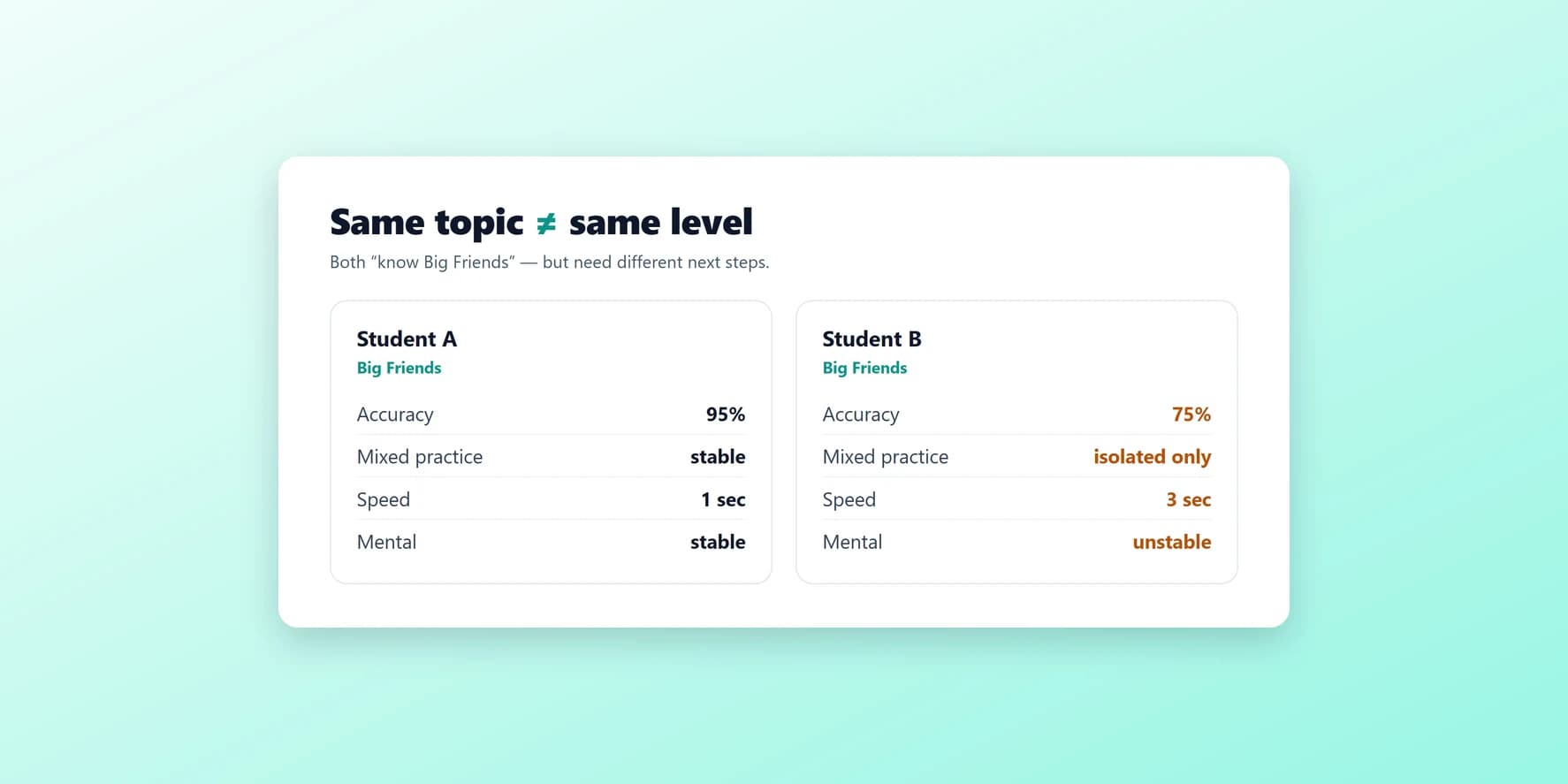
Two children may both say “I know Big Friends.” And still have very different technique, speed, accuracy, digit length, mental stability and readiness for the next stage.
That is why a new student needs more than a conversation. They need a short placement assessment.
A good abacus placement assessment should check more than the last topic a child studied. Teachers should evaluate physical technique, accuracy, speed, mixed-topic performance, digit length, chain length and the difference between physical and mental calculation before deciding where the student should start.
A placement assessment is not an exam
This should be clear to both the child and the parents. The goal is not to catch mistakes, give a grade or prove that the previous school taught badly.
The goal is much simpler: understand what the child can already do and where support is still needed.
If the child feels that they are being tested or judged, they may become nervous, rush and make more mistakes than usual. A better explanation is:
“We are just checking how you calculate so we can choose the right practice for you.”
Do not start with “What topic did you reach?”
This is a useful question. But it is not enough. A parent may say:
“They reached multiplication.”
That does not tell you:
- how stable addition and subtraction are;
- whether the technique is correct;
- how strong mental calculation is;
- what speed the child can maintain;
- what digit length they can handle;
- how they perform in mixed practice.
The name of the last topic is only a reference point. It is not the actual level.
The last topic studied is not the same as the current working level.
Start with the physical abacus
Even if the child says they already calculate mentally, it is often useful to begin with the physical abacus. Why? Because it shows the teacher:
- how the child moves the beads;
- which fingers they use;
- whether there are unnecessary movements;
- whether place value is understood;
- whether rules are applied correctly;
- whether the child uses compensating shortcuts.
The physical abacus can reveal the quality of the foundation very quickly — one of the reasons physical abacus work never fully disappears.
A correct answer is not enough
A child may solve the example correctly. But the teacher should also look at: how the answer was produced.
- Was the correct finger used?
- Did the child recognise the required rule immediately?
- Did they stop and recalculate?
- Were there unnecessary movements?
- Did they choose a longer, less efficient path?
If the teacher looks only at the final answer, the student’s level can easily be overestimated.
Start easy
There is no reason to begin with the most difficult task the child might possibly solve. Start with something the child is very likely to know.
This has two advantages. First: the child relaxes. Second: the teacher can observe basic technique without unnecessary stress. Then difficulty can increase gradually.
Check topics step by step
A practical sequence may be: Simple. Then Small Friends. Then Big Friends. Then mixed topics.
If stable mistakes appear at one stage, there may be no reason to continue immediately to the most advanced tasks. The main gap has already been identified.
Isolated practice is not enough
A child may perform very well when every example requires the same rule. For example: only +4 / −4. They already know what to expect.
But when you mix Simple, Small Friends and Big Friends, the task changes. Now the child has to do two things:
- recognise which rule is needed;
- then execute it correctly.
This is where the real level of automaticity often becomes visible — see also why mixed practice matters.
Check speed — but not maximum speed first
Do not start by pushing the child to the fastest possible tempo. Begin at a comfortable speed. If the child remains accurate, gradually increase it.
If accuracy suddenly falls, this tells the teacher something important: the child may understand the rule, but the skill is not yet automatic. That is useful diagnostic information.
Speed only has meaning in context
The statement:
“This child calculates at one second per number.”
does not tell you enough. You also need to know which topic, what digit length, what chain length, physical or mental, isolated or mixed practice.
A placement assessment should record the conditions, not only the speed — the same point we make about how speed develops.
Check digit length
A child may be excellent with one-digit numbers. But struggle with two-digit numbers. Or perform well with two digits and start losing place value with three digits.
This is a separate dimension of skill. A teacher can gradually check 1-digit, 2-digit and, if appropriate, 3-digit work. There is no reason to test advanced digit lengths if the earlier level is already unstable.
Check chain length
Some students are accurate with short chains: 3–5 operations. But begin to lose the mental image or skip numbers at 10–15 operations.
That does not necessarily mean the topic itself is weak. The limiting factor may be the ability to maintain the sequence. These are different problems and should be diagnosed differently.
Then move to mental calculation
If the child has previous mental arithmetic experience, assess:
- whether they can work without the physical abacus;
- which topics are stable mentally;
- what digit length they can maintain;
- what speed is comfortable;
- what chain length remains accurate.
And most importantly: compare physical vs mental performance.
Physical and mental levels may be different
For example: physical — Big Friends. Mental — Small Friends.
This is not automatically a problem. It may simply reflect the methodology used by the previous school. But the new teacher needs to know it.
Mental homework should not be assigned only because the child can perform the same topic physically.
| Simple | Small Friends | Big Friends | Mixed | |
|---|---|---|---|---|
| Physical level | ✓ | ✓ | ✓ current | — |
| Mental level | ✓ | ✓ current | — | — |
Different levels can be normal. Assess them separately.
Mental assessment should also progress gradually
Start with simple familiar topics. Then mixed practice. Then speed. Then longer chains.
Do not immediately give advanced Anzan and conclude:
“This child cannot calculate mentally.”
The purpose is to find the child’s real working level.
Find where the skill breaks down
Imagine: physical accuracy — 95%. Mental accuracy — 70%. What does that mean? Several possibilities exist. The mental image may be less stable. The speed may be too high. The chain may be too long. The child may have had very little mental practice before.
That is very different from: physical 70%; mental 65%. In the second case, the foundation itself may be unstable.
Check older topics too
If a child says:
“I learned this last year,”
that does not guarantee the skill is still stable. Test several earlier rules. Especially those that are required for the next topics.
A gap in older material often becomes the reason a child struggles later — see why children keep making the same mistakes.
Do not criticise the previous school
If a child comes from another academy and uses a different technique, avoid telling the parent:
“They were taught incorrectly.”
The previous school may simply use another methodology. A better approach is:
“We use a slightly different method here. I will show you how we work.”
This protects trust.
Different schools may use different algorithms
This is particularly common in finger technique, topic sequence, multiplication, division and the transition to mental calculation.
A difference is not automatically a mistake. The real question is:
Does this technique prevent the child from progressing in your program?
If not, there may be no need to rebuild a working habit simply for the sake of uniformity.
Fundamental technique problems should be corrected
Some issues do need attention. For example, if the child:
- uses inefficient finger technique;
- makes unnecessary movements;
- does not understand place value;
- constantly recounts;
- uses an unstable process,
those problems may later limit speed and mental calculation. In that case, correction is useful.
Do not place students by age alone
Two nine-year-old children can be at completely different levels. One may have no previous experience. The other: three years of training.
Age matters for communication, lesson format and attention span. But it should not be the main placement criterion.
Do not place students only by parent description
Parents naturally want their child to avoid repeating old material, not waste time and join a stronger group. Sometimes they say:
“They already know all of this.”
The assessment may show that the child knows the topic only at a slow speed, in isolated tasks, with support — but not yet in mixed practice.
That does not mean the parent was wrong. They were simply looking at the child from a different perspective.
Placement should be based on the working level
The working level is the level at which the child can:
- calculate with acceptable accuracy;
- use stable technique;
- understand the rules;
- work without constant prompting.
Not the hardest example they managed to solve once.
Student A · Big Friends
95% accuracy · mixed practice stable · 1 sec · mental stable
Student B · Big Friends
75% accuracy · isolated only · 3 sec · mental unstable
Both “know Big Friends” — but they should not receive the same next step.
Sometimes it is better to start slightly lower — but move quickly
If the child understands the topic but the foundation is unstable, it can be reasonable to begin half a step lower. But avoid making the child repeat easy material for months.
The objective is: close the gaps quickly; then move forward. Otherwise, a capable student may lose motivation.
Sometimes the child can stay in the stronger group
Placement does not always mean moving a student to a lower group. Suppose the child understands the current group topic, but has one older weakness. They may remain with the group and receive additional targeted practice at home.
In other words: placement is not only about choosing a class. It is also about designing the first period of individual practice — the approach we describe in managing several abacus groups.
Do not turn placement into a long examination
The assessment should be short enough to keep the child engaged. The child is not applying to university. You only need enough information to make the first good decision. Then continue observing during normal lessons.
A good placement assessment should answer these questions
After the assessment, the teacher should understand:
- How stable is the physical technique?
- Which topics are strong?
- Which topics are weak?
- What speed is comfortable?
- What digit length is stable?
- What chain length can the child maintain?
- How different are physical and mental performance?
- Can the child handle mixed practice?
- Which group is likely to be suitable?
- What should the first few weeks of practice focus on?
If those questions are answered, the assessment has done its job.
Do not search for the “perfect level”
Placement is a starting hypothesis. Even a strong assessment cannot show everything.
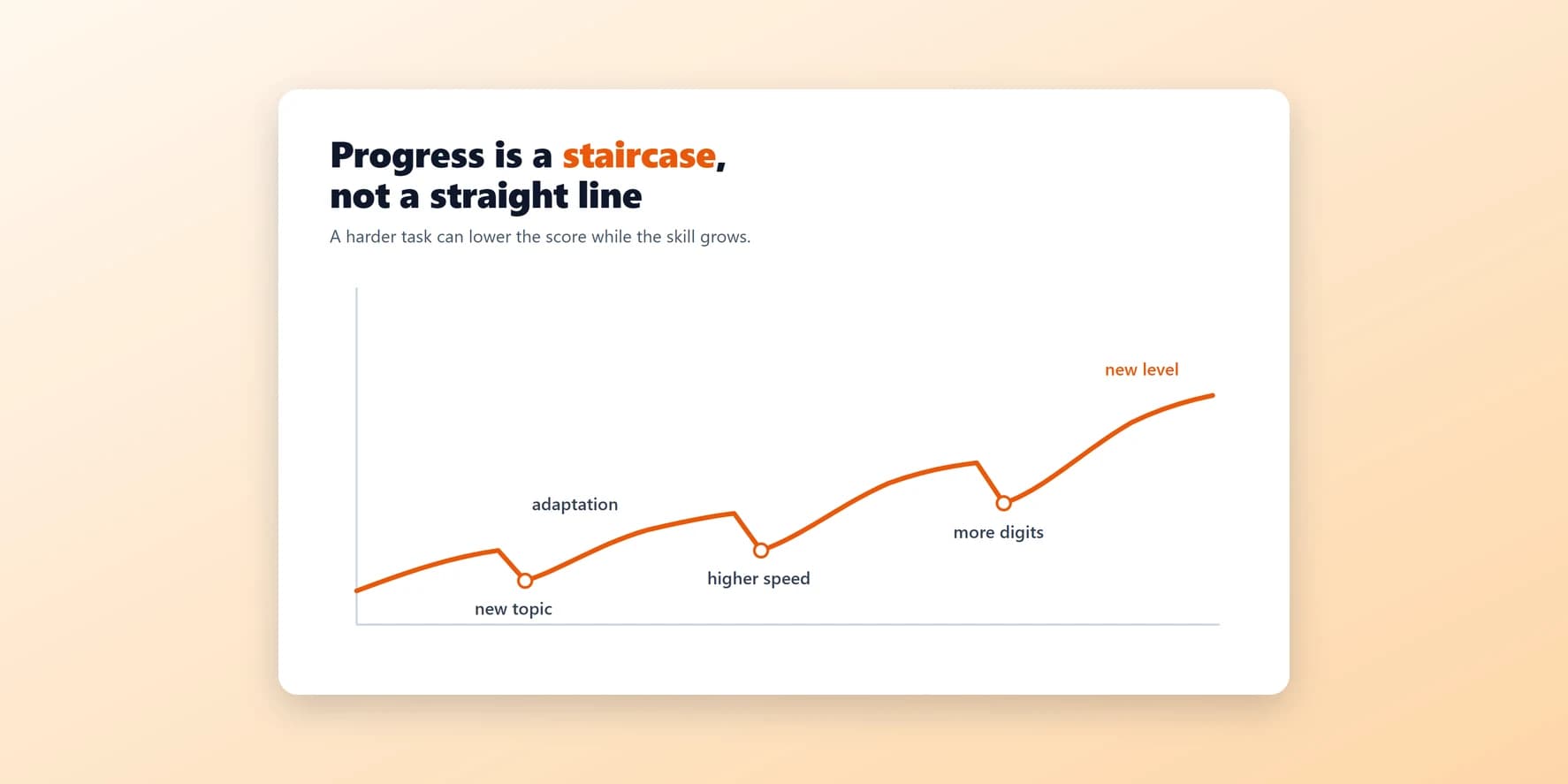
After two weeks, you may discover the child adapts faster than expected — or the gaps are deeper than they first appeared. Then the teacher adjusts the plan. That is normal.
The first 2–3 weeks are part of the assessment
A useful way to think about placement is: not one test; but a short process.
- Initial assessment first lesson
- First homework observe independent work
- 2–3 weeks of observation check stability
- Adjust if needed
Placement is a starting hypothesis, not a permanent label.
Then the placement decision becomes much more reliable.
Homework often reveals what a test does not
During the assessment, the child may be focused, motivated, supported by the teacher and trying to show their best result.
At home, the conditions are different. The child has to work more independently. This may reveal unstable topics, lower real speed, poor regularity or the need for additional support.
That is why the first homework assignments can also be part of the assessment — and why it helps to have a clear homework workflow from the start.
How Amavit can support placement assessment
A digital platform can help teachers test students under consistent conditions. For example: the same topic; the same speed; the same digit length; the same chain length. That can make results easier to interpret.
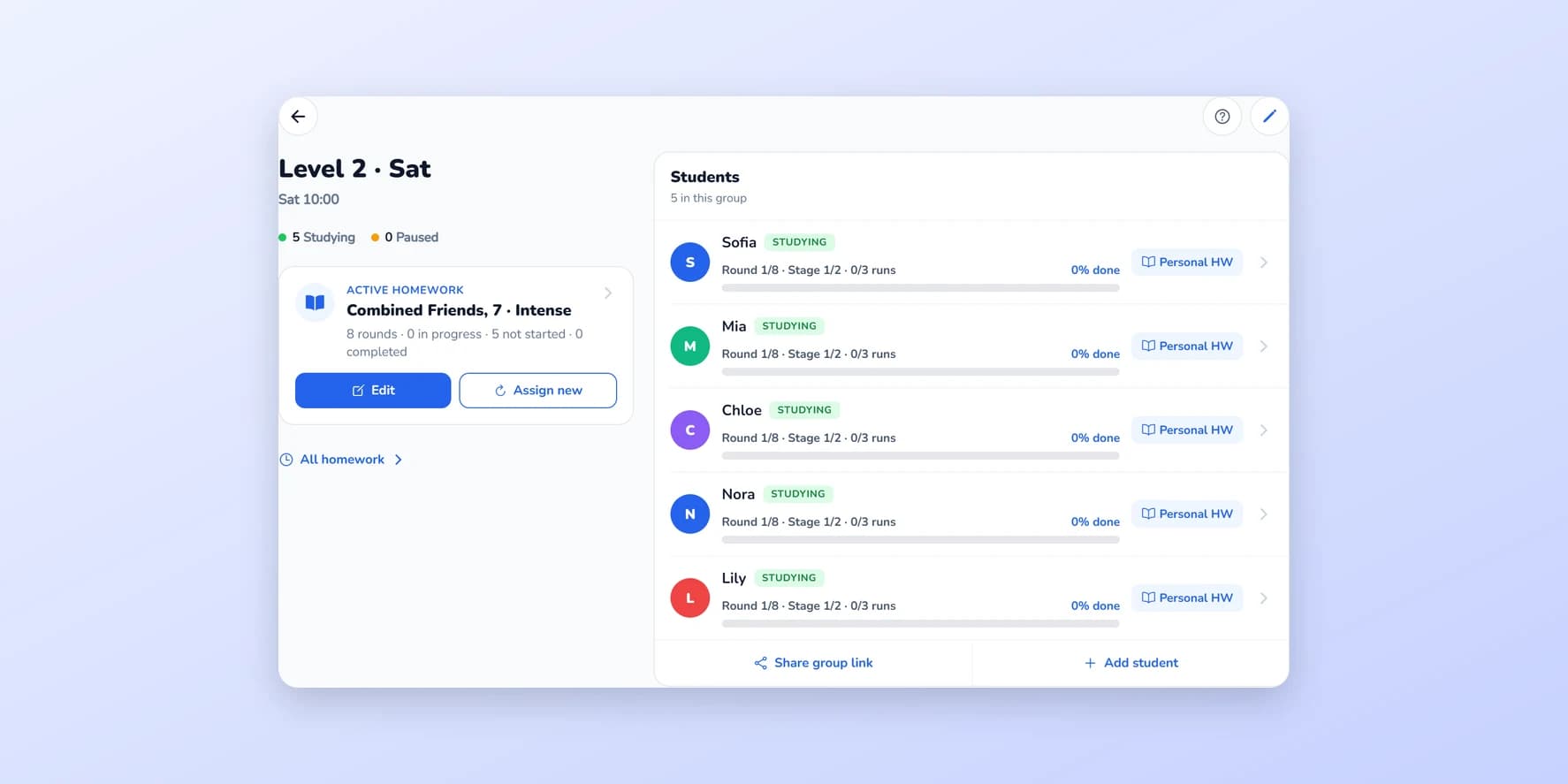
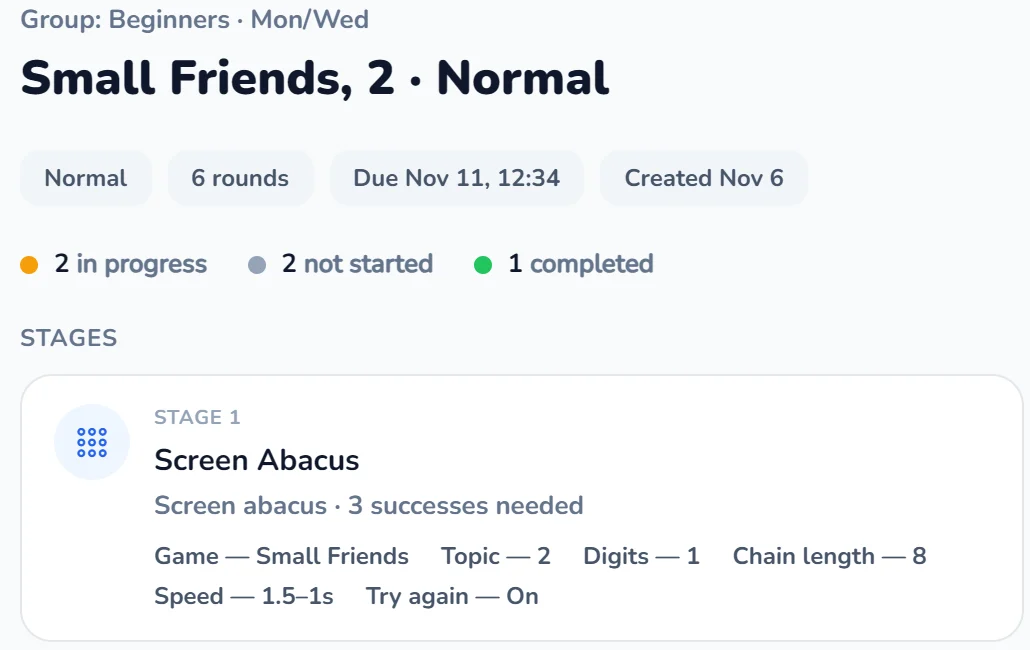
In Amavit, these conditions are part of the assignment itself: each stage records the game and topic, digits, chain length and speed, so a new student’s first homework can be given exactly the same settings as the group they may join.
But the purpose is not to create one universal ranking. The purpose is to give the teacher better information.
The platform should not make the final decision
A platform may show accuracy, speed, practice volume and topic results. But only the teacher can observe:
- finger technique;
- confidence;
- how the child responds to explanation;
- how the previous methodology was structured;
- whether a mistake is technical or conceptual.
Data supports the decision. The teacher makes the decision.
Data supports placement. The teacher makes the decision.
Create a simple diagnostic sequence
A practical assessment can include:
- Simple physical
- Small Friends physical
- Big Friends physical
- Mixed physical
- Mental comfortable speed
- Speed
- Digit length
- Chain length
Stop when stability clearly breaks down — there is no need to go through all eight steps.
But this should not become a rigid test for every student. If the foundation is already clearly unstable at stage two, there is little value in forcing the child through advanced tasks.
Move from easy to difficult
This is the core principle. Not:
“Show me the hardest thing you can do.”
But:
“Let us find the highest level where the skill is still stable.”
That is usually the best place from which to build the next stage of learning.
Do not look for the hardest task a child can solve. Find the highest level where the skill is still stable.
What to tell parents after the assessment
Avoid saying:
“Your child is Level 4.”
That gives very little useful information. A better explanation sounds like:
“The physical technique is good and Small Friends are stable. Mixed Big Friends still cause some mistakes. Mental calculation is confident on the previous topic. I suggest keeping the child in this group while using the first two weeks to strengthen Big Friends with additional targeted practice.”
Now the parent understands what the child can do, where the gap is and what the teacher plans to do.
Do not turn placement into a sales show
A trial lesson and a placement assessment have different purposes. During a trial lesson, it can be useful to show an interesting result, give the child a sense of success and introduce the abacus in an engaging way.
A placement assessment has another goal: find the correct starting point. The two can sometimes happen in the same session. But the teacher should understand the difference.
Trial lesson and placement assessment are not the same thing
A trial lesson may answer:
“Does this child enjoy the activity?”
A placement assessment should answer:
“What does this child already know, and what should they learn next?”
Both are useful. They solve different problems. Parents choosing a school can use this difference too: a good teacher first assesses the child rather than simply selling a standard program.
The main conclusion
A new student should not be placed in a mental arithmetic program only by age, years of previous study, the last topic they remember, parent description or one impressive result.
The teacher needs to understand the real working level. Look at:
- physical technique;
- accuracy;
- speed;
- topic stability;
- mixed practice;
- digit length;
- chain length;
- physical vs mental performance.
Start from the highest level where the skill is genuinely stable. Not so high that the child begins failing constantly. Not so low that the child becomes bored.
A good placement assessment does not label the child. It answers one practical question:
“What should this student do next?”
That is where real individualised teaching begins.
Frequently asked questions
What should an abacus placement assessment include?
It should typically check physical technique, accuracy, topic stability, mixed practice, speed, digit length, chain length and, when relevant, mental calculation.
Should a child be placed according to the last topic studied?
Not by that information alone. Two students may have studied the same topic but have very different stability, speed and technique.
Should teachers test physical abacus even if the child can calculate mentally?
Often yes. Physical work can reveal finger technique, place-value understanding and rule execution that may not be visible from the final mental answer.
How long should an abacus placement test take?
It should be long enough to identify the child’s stable working level but short enough to avoid turning the session into a stressful examination. The first 2–3 weeks can continue the assessment.
Should physical and mental levels be assessed separately?
Yes. A student may be more advanced physically than mentally, and that can be completely normal depending on the previous methodology.
Can a student stay in a stronger group while revising weak topics?
Yes. If the child understands the group curriculum, targeted individual homework may sometimes be better than moving the student to a lower group.
Can software automatically place a student?
Software can provide useful data, but technique, confidence and methodological compatibility still require teacher judgement.
Free for teachers